

Skip to content
07944 877 329 hello@alectrona.solar

Alectrona

Manufacturers we specify

Astronergy and the question of who answers in year fourteen

Astronergy supplies n-type TOPCon modules and was among the first makers to run that cell in volume. It reaches the UK through its own subsidiary, Astronergy Solar UK Ltd, rather than through distribution alone. The company itself is unlisted inside the CHINT group, so its accounts are not separately published, and we say that rather than pointing at the group’s listed arm.

  • Early n-type TOPCon maker
  • UK-registered subsidiary
  • Over 50 kWp, outside MCS
  • 2006 Founded as CHINT’s solar business
  • CHINT Group Parent core trade is electrical apparatus
  • China Where the modules are made with further South-East Asian capacity
  • ~18.5 GW Modules shipped in H1 2025 a top-six or top-seven global shipper

A top-tier TOPCon maker with a UK-registered company in the warranty chain, which changes who you write to when a module fails.

Astronergy is the solar business of CHINT, a Chinese industrial group whose core trade is low-voltage electrical apparatus: circuit breakers, switchgear, distribution equipment. Solar is one arm of that group rather than the whole company.

It was making n-type TOPCon cells before most of the market moved to them, and it is one of the few makers we specify with its own registered company in the United Kingdom. Both facts matter, and they matter for different reasons.

01 The range

One module line, specified to the roof rather than picked from a catalogue

Solar modules

n-type TOPCon modules for commercial rooftops

The mainstream commercial module in our line-up where the brief calls for TOPCon from one of the largest makers in the world, with a company registered in Britain standing behind the paperwork.

  • ASTRO N5 n-type TOPCon
  • ASTRO N7 n-type TOPCon

We publish no wattage, efficiency or warranty term for Astronergy, because we hold no datasheet for it in our registry; all three are read from the manufacturer sheet for the exact module and written into your specification.
Datasheet figures only. We publish no price, and the exact model is confirmed against the design and the current datasheet before order.

02 Bankability

What you can and cannot read from the CHINT listing

Astronergy is not listed. It sits inside CHINT Group as a subsidiary, and the listed company in that group is Chint Electrics on the Shanghai exchange under 601877, which is the electrical apparatus business rather than the solar one. A lender who pulls those accounts is reading a different company. We would rather state that than let a ticker do work it cannot do.

What can be tested is trading scale and continuity. Astronergy shipped around 18.5 GW of modules in the first half of 2025, which places it among the six or seven largest suppliers in the world, and it was building n-type TOPCon before the technology became the market default. For a twenty-year warranty, though, its UK subsidiary weighs more than either figure. A claim in year fourteen goes to a company registered in Britain rather than to whichever distributor happens still to be trading.

BloombergNEF Tier 1 lists Astronergy for Q1 2026. The maker also announces the listing itself, so we re-check it against the scheme rather than the brochure. We re-verify the listing for the exact module before contract.

  • ~18.5 GW Modules shipped in H1 2025 among the six or seven largest suppliers
  • 9th Kiwa PVEL Top Performer result independent stress testing on production modules
  • SSE 601877 The listed group company is the electrical arm Astronergy itself is unlisted
  • UK subsidiary Astronergy Solar UK Ltd a company registered here, in the supply chain
03 The parent

A solar arm inside an electrical-equipment group

CHINT does not primarily sell solar. Its long trade is low-voltage electrical apparatus, the circuit breakers, contactors and distribution gear that sit in switchrooms, and it has been at that far longer than it has been making modules. For a module buyer that cuts two ways, and both should be said.

On the helpful side, a solar division inside a diversified industrial is not wholly exposed to a module price war. When the whole sector was posting losses on module pricing, a group with a separate electrical business had somewhere else for its earnings to come from. On the other side, a division is funded at the group’s discretion. The commitment behind a thirty-year performance warranty is a capital allocation decision taken above the solar business, not by it.

We read the module maker’s standing at specification stage rather than assuming the group’s size covers it, and we say which entity a warranty is written by before you sign.

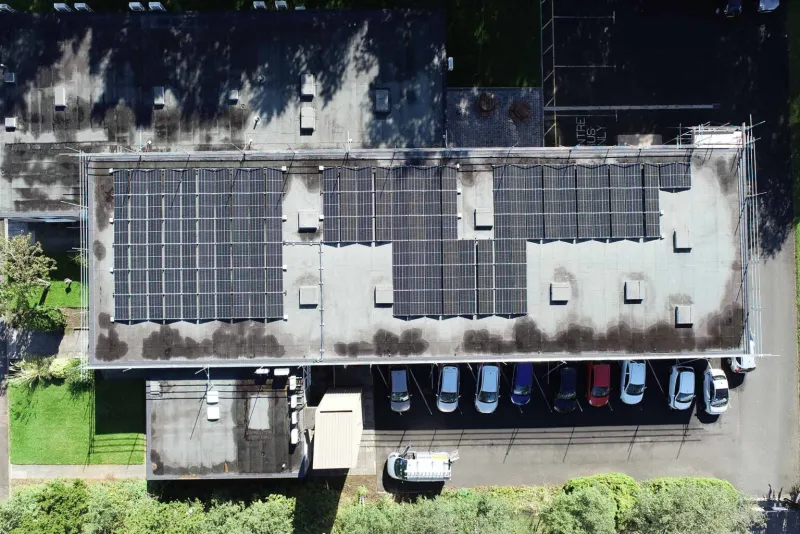
Modules running in long rows across a commercial roof

The module is one product of a group whose main trade is electrical apparatus.

04 Cell technology

Early to TOPCon, and where that shows up on a hot roof

Astronergy committed to n-type TOPCon while much of the market was still shipping p-type PERC. TOPCon places a thin passivating oxide layer behind the cell, which lifts efficiency over PERC and, more usefully for a commercial roof, flattens the temperature coefficient. A dark membrane roof in July runs far hotter than the 25°C the nameplate is measured at, and a flatter coefficient is simply less output given back at exactly the hours a factory or a chilled warehouse is drawing hardest.

Being early to a cell technology is not the same as being ahead on it now; TOPCon is the market default and the field has caught up. What the early start did leave is a longer run of production data on the same cell architecture, and that is what the independent test programme measures. Astronergy holds a Kiwa PVEL Top Performer result for the ninth time, which is a statement about repeatable production rather than about a single good sample.

Where the cell technology is the deciding question for your roof, our comparison of TOPCon, HJT and PERC sets out how each behaves in heat, in shade and over time.

05 Scale

Two figures we can stand behind, and one we can only attribute

The difference between an independently reported figure and a company headline is the whole point of this strip.

  • ~18.5 GW Modules shipped in H1 2025 independently reported
  • 9th Kiwa PVEL Top Performer result independent laboratory testing
  • 130 GW+ Cumulative shipments claimed company-sourced; we attribute it rather than assert it
06 Year fourteen

What a warranty claim on this module actually involves

  1. Record

    The evidence is captured at handover, not hunted for later

    Module serial numbers, the datasheet revision the array was specified against, the flash-test data and both warranty terms go into your operation and maintenance pack when we hand over. A claim fourteen years later is won or lost on whether that record exists.

    At handover

  2. Detect

    A string tells you before a module does

    Underperformance shows up as one string drifting from its neighbours in the monitoring, then as a specific module on an IV curve or a thermal scan. We measure the suspect module against its own commissioning record under IEC 62446-1 rather than against the nameplate.

    Whenever the data drifts

  3. Claim

    The claim goes to a company registered here

    This is what the UK subsidiary changes. The claim is lodged with Astronergy Solar UK Ltd with the serials, the test data and the site record attached, rather than depending on a distributor that may have moved on. We lodge it and manage the correspondence.

    On confirmation

  4. Replace

    A replacement of equal or greater rating, or a rebuilt string

    Where the series is still in production the replacement is like for like. Where it has ended, the substitute module has to suit the string electrically, so we redo the string calculation and, if needed, rearrange the affected strings rather than mixing incompatible modules.

    After acceptance

Astronergy is a middle-of-the-line-up specification for us: a credible TOPCon module from a very large maker, chosen when the brief values supply certainty and a domestic counterparty over the last percentage point of efficiency.

07 Honest placement

The briefs Astronergy answers well, and the ones it does not

Specify

Where it fits

  • Specifications that name TOPCon and a maker in the global top ten
  • Buyers who want a company registered in Britain inside the warranty chain
  • Programmes where module supply must not become the pacing item alongside the G99 application
  • Estates buying in phases, where the same series needs to stay available across several roofs
Specify something else

Where it does not

  • Tenders scored on a published bankability letter grade, which Astronergy does not currently hold
  • Constrained roofs where the output target only fits at back-contact efficiency
  • Any brief where a cumulative-shipment headline is being taken at face value
  • Specifications that demand a published warranty term before the survey has fixed a module
08 FAQ

Astronergy on a commercial roof: common questions

Astronergy is the solar business of CHINT Group, trading as Chint New Energy Technology Co., Ltd. It is a subsidiary rather than the group itself, and it is unlisted. The listed company in the group is Chint Electrics, on the Shanghai exchange under 601877, which is the electrical apparatus business. If a funder asks for the module maker’s published accounts, that is the honest answer to give them.

We do not hold an Astronergy datasheet in our registry, so we will not print a product or performance warranty term we cannot evidence. Both are read from the current manufacturer sheet for the exact module specified for your roof, confirmed in writing, and set out in your specification before you commit. That is deliberate: a term quoted from memory and a term written into a contract are not the same thing.

On its own, no. BloombergNEF is explicit that a maker announcing its own listing is not evidence of it. Astronergy does appear in the independent Q1 2026 reproduction of the list, which is what we rely on, and we re-verify the live quarter for your exact module before contract because the list is revised every quarter. Tier 1 measures financing track record rather than how a module performs on a roof.

In China, with further capacity in South-East Asia. We confirm the country of manufacture for your specific order from the delivery documentation rather than from the brand’s nationality, because that is the question a supply-chain or ESG questionnaire actually asks. The UK subsidiary is a sales and support entity, not a factory, and we do not present it as one.

The module is one line in a survey-led cost, so we publish no per-panel, per-watt or per-kWp figure. We build the number from the roof survey, the PV*SOL yield model and the balance-of-system design, then set it out as one fully costed system so you can see what this specification adds against the alternatives we priced. Our commercial solar cost guide explains how the figure is assembled.

Get a commercial quote

The equipment is chosen to fit the design, not the other way round.

Tell us about the roof and the load. We survey the site, model the array in PV*SOL against your half-hourly data, and specify what actually fits, with the manufacturer, the series and the warranty named. Astronergy goes on the roof where it is the right answer and not because it is on a list.

  • On-site 3D drone survey and half-hourly PV*SOL model
  • We confirm your DNO and handle the G99 connection
  • Over 50 kWp, outside MCS