Skip to content

Alectrona

Commercial solar by sector

Commercial solar for hospitality.

Hotels and conference venues run kitchens, hot water, HVAC and event spaces through the day and into the evening, which is exactly when a rooftop array is generating, so a high share of the output is used on site rather than exported.

  • Hotels and conference venues carry high, steady energy loads and large roofs. Harrogate has an unusually dense conference and hospitality estate.
  • Sized from your half-hourly load
  • Over 50 kWp, outside MCS
Reviews

The feedback we work to earn

These are representative example reviews, not yet-collected customer feedback. They are written to illustrate the kind of feedback Alectrona aims to earn and are shown as design placeholders while we gather and verify reviews from our first commercial clients. Alectrona is the commercial solar trading brand of RVTC LTD.

What set Alectrona apart was the documented design pack. We had quotes from three installers, but only Alectrona handed us a full set of drawings, a single-line diagram and a design referencing BS 7671 and the G99 connection process. The whole thing read like an engineering submission rather than a sales brochure. Our M&E consultant reviewed it and signed it off without a single query. That gave the board the confidence to release the capital.

Estates Manager, academy trust (Yorkshire)

Other firms priced our roof off a satellite image and a desktop guess. Alectrona flew an in-house drone survey, fully insured and flown by a qualified commercial drone pilot, and built a 3D model of the actual roof. It picked up plant, vents and a parapet line that a flat aerial photo had completely missed, which changed the panel layout. I would rather find that out at design stage than on the day the scaffold goes up. The accuracy of that survey is the reason I trusted everything that followed.

Facilities Manager, distribution centre (East Midlands)

As a finance director I was wary of being oversold a system bigger than we could use. Alectrona modelled the array against our actual half-hourly consumption data rather than an annual total, so it is sized to what we genuinely draw on site during the day. They were honest that exporting surplus is worth far less than self-consumption, and built the design around that. The capital case stacked up because the engineering was honest, not because the numbers were inflated.

Finance Director, logistics group (North West)

We were undecided between buying outright, leasing and a PPA. Alectrona laid out all three side by side with the pros and cons of each against our balance sheet, instead of pushing the one that pays them best. They were clear about where a PPA makes sense and where capex wins, and pointed us at our own accountant for the tax treatment. The survey and design took a little longer than I expected, but the thoroughness was worth the wait. Genuinely consultative.

Property Director, retail park (West Midlands)

The install crew were tidy and well run, and worked to a clear CDM 2015 plan with a proper site induction and RAMS. What impressed me most was the handover. We received a full commissioning pack with the IEC 62446-1 test results, certification, O&M documentation and an as-built record for our maintenance team. As the people who have to live with this asset for the next twenty years, having that paperwork in order matters enormously. Nothing was left loose.

Operations Director, food manufacturer (Lincolnshire)

I expected the usual hard sell and got the opposite. After surveying our site Alectrona told us one roof section was not worth covering because of shading, and that a smaller, well-sited array was the better investment than filling every square metre. There was no commission-driven upselling and no pressure. For a six-figure capital project, that straight talk is exactly what you want from the people advising you. We will be using them again on our second site.

Managing Director, engineering firm (Sheffield)

At a glance
  • Indicative size 50–250 kWp (hotels, conference venues)

Commercial solar suits hotels and conference venues because the load runs through the daylight hours. This page is for the operators of hotels, conference centres, event venues, restaurants and pubs with rooms: buildings that never really switch off. A hospitality site carries a base load it cannot avoid, from refrigeration and hot-water plant to lifts, lighting and air handling, and it layers a variable load on top whenever the kitchen is busy or a function room fills.

That combination is worth modelling for solar. The roof on a hotel block or a conference hall is often far larger than the footprint suggests, and the demand underneath it runs through the daylight hours when an array generates most. For a building over 50 kWp, where the system sits outside MCS and is assured by the engineering stack instead, the question is not whether the roof can hold panels. It is how much of the generation your operation actually consumes.

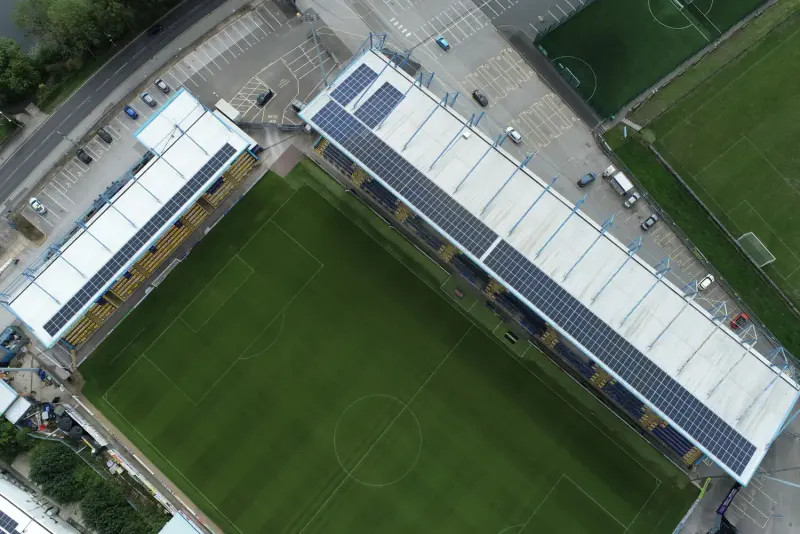
Commercial rooftop solar, the kind specified for hospitality

An on-site drone survey and a PV*SOL model before anything is specified.

01 Why it fits

What makes solar work for hospitality.

Solar pays best when the electricity is used on the spot. A unit consumed on site offsets an expensive import unit, while a unit exported to the grid is paid far less. So the return on a hospitality system tracks how closely generation lines up with demand through the day, not the panel count on the roof.

Hospitality tends to line up well. Commercial kitchens run extraction, refrigeration and cooking load across long service hours. Hot water and laundry draw steadily, and in a hotel the demand carries into the evening as guests arrive and rooms fill. HVAC and ventilation often climb through the afternoon, which overlaps the strongest part of the generation curve. The result is a load shape that self-consumes a useful share rather than spilling cheaply to export. The shape does vary by format. A function-led venue can sit quiet between events, and occupancy is rarely flat across the week, so we read the real half-hourly profile rather than assume a sector average. Where the daytime match is weaker, battery storage to shift generation into the evening peak, or a portfolio view across several sites, is worth looking at.

02 Typical system

What a typical system looks like.

A hospitality site typically lands in the 50 to 250 kWp range, spread across the large roofs of a hotel block, a conference hall or a leisure and spa wing. Many carry shallow-pitch or flat roof areas that take a clean, well-orientated array, though plant rooms, rooftop air-handling units and parapets all eat into the usable area and need designing around. That band is indicative only, a sense of scale for the sector and not a quote. The real figure comes from the survey and the PV*SOL model built for your exact roof and your actual load.

03 Sector detail

Reading the load shape behind a hotel or venue

Self-consumption is the whole game above 50 kWp. A unit generated and used on site displaces an expensive import unit; a unit exported to the grid is paid far less. So the return on a hospitality array tracks how closely generation lines up with demand through the day, far more than it tracks the panel count on the roof. Reading that match for your building means looking at your own half-hourly metering data rather than a sector average, because the load shape behind a 90-bedroom conference hotel and a function-led wedding barn could not be more different.

The format decides the profile, and the profile decides the design. A hotel carries a steady base load that never really switches off: refrigeration, hot-water plant, lifts, corridor lighting and ventilation run around the clock, much like the year-round continuous demand behind a leisure centre or pool. A conference or wedding venue sits quiet between bookings and then spikes hard when a function fills the kitchen, the bar and the air-handling plant at once. Sites with a spa or pool wing add a continuous plant load on top of either pattern. That mix of steady base and sharp event peaks is exactly what we model before sizing anything, because it sets how much of the roof's output you actually keep rather than spill cheaply to export.

Where the load lands through the day matters as much as how much there is. Commercial kitchens run extraction, refrigeration and cooking across long service hours, hot water and laundry draw steadily, and HVAC tends to climb through the afternoon, which overlaps the strongest part of the generation curve. In a hotel the demand carries into the evening as guests arrive and rooms fill, which is the part of the day an array no longer covers. That evening shoulder is where commercial battery storage can earn its place, shifting midday generation into the check-in and dinner peak rather than exporting it. We weigh that against simply sizing the array to the daytime load, and where the case for storage is marginal we say so.

The honest caveat is the quiet period. A function-led venue with gaps between events, or a seasonal hotel that winds down through the shoulder months, will export more of its generation when the building is empty. We do not paper over that. We model the real half-hourly and seasonal shape, size the array to the demand the operation actually carries across the year, and look at whether storage, a sensible export route for the genuinely quiet months, or an estate-wide view across several sites improves the match more than overbuilding a roof. Any kWh/kWp yield or self-consumption split we mention is a starting point we confirm in the PV*SOL model built for your roof and your load, not a guaranteed output.

04 Sector detail

Roof design, statutory duties and how the spend is funded

A hospitality roof is rarely a single clean plane. A hotel estate often mixes a flat membrane over the function rooms, a shallow-pitch metal deck over the bedroom block and a separate plant or leisure wing, each with its own age, orientation and structural headroom. Plant rooms, lift overruns, rooftop air-handling units, kitchen flues and parapets all eat into the usable area and cast shading that has to be designed around rather than averaged out. Our in-house drone survey captures that geometry directly and feeds an accurate 3D model, so the array is laid out around the real obstructions and the shading is modelled per string rather than estimated from a flat roof-area figure.

Above 50 kWp the assurance comes from the engineering stack rather than a domestic certificate. MCS is the residential scheme and does not apply at this scale, so the right evidence is the work itself: design and installation to BS 7671, system verification and commissioning to IEC 62446-1, a G99 connection agreement with the DNO, and an RC62 recommendation and insurance-backed guarantee on completion. CDM 2015 applies to every project, with the appropriate principal designer and principal contractor roles appointed, which matters on an occupied, trading hotel where the works share the site with guests and staff. We sequence the roof work around your fire strategy, escape routes and trading calendar so the install does not compromise either.

On scale, a hospitality system typically lands in the 50 to 250 kWp range. Smaller boutique hotels and pubs with rooms sit toward the 50 to 150 kWp band, while a larger conference hotel or a multi-building resort can reach the 200 to 300 kWp band once the function space and back-of-house roofs are counted in. That band is indicative only, a sense of scale and not a quote; the real figure comes from the survey and the PV*SOL model built for your exact roof and load.

How the spend is funded shapes the business case as much as the kit. The same model that sizes the array feeds the numbers, and capital outlay on a qualifying solar system can attract capital allowances against your tax bill. Whether you buy outright, lease or fund through a power purchase agreement is set out in the commercial finance options, where any payback or bill-reduction figure is modelled for your site and disclosed with its basis, never promised as a flat sector number. The first feasibility read is free, so you can see where your building sits before committing to anything.

FAQ

Commercial solar for hospitality: common questions

Because the load runs when the sun is up. Kitchens, hot water, refrigeration, HVAC and event spaces draw steadily through the day and into the evening, which overlaps the strongest part of the generation curve. That means a useful share of the output is used on site rather than exported cheaply, and self-consumption is where commercial solar earns. The exact split depends on your format and occupancy, so we model your real half-hourly load before sizing anything.
As a rough sense of scale, hospitality sites tend to fall in the 50 to 250 kWp range, depending on the roof area and the load. That is an indicative band for orientation only rather than a quote and with no price attached. Your real system size comes from the on-site drone survey and the PV*SOL model, sized to your actual half-hourly consumption.
Often, but it depends on the shape of the demand, which is exactly why we measure it. A function-led venue can sit quiet between events while a hotel carries a steadier base load. We take your half-hourly data and model the match against generation, and where the daytime fit is weaker we look at whether battery storage to shift output into the evening, or a portfolio view across sites, improves it. If the case is marginal we will tell you straight.
No. Systems over 50 kWp sit outside the scope of MCS, so MCS is not the right assurance for a building of this scale. Instead the install is assured by the engineering stack, with CDM 2015 applying to every project and the appropriate principal designer and principal contractor roles appointed. The trust signal here is the engineering and the survey, not a domestic certificate.
We do not quote a hotel from a price list, because the cost follows the roof, the array size and the connection work rather than the sector. Larger systems carry a lower cost per kWp than smaller ones, and the honest per-kWp bands and the main cost drivers are set out in our commercial solar cost guide. The feasibility assessment is free: we model the site before we quote, so you can see an indicative figure for your building, and how it might be funded through the commercial finance options, before committing to anything.
Most hospitality projects run a few months from the drone survey to energising, and the pacing item is usually the grid side. A system at this scale needs a G99 connection application to the DNO, Northern Powergrid across Yorkshire and the Lincolnshire areas we cover, which typically takes around 45 days to determine, and we run that in parallel with design and procurement rather than in sequence. We then work the install around your trading calendar so the roof work avoids your busiest function dates and stays clear of occupied wings.
Get a commercial quote

See what your roof and your load would actually do.

We model your half-hourly consumption against a system sized from an on-site drone survey, so the figure you get is yours, not a from-price. No obligation, no MCS gatekeeping on systems this size.

  • On-site 3D drone survey, fully insured in-house pilot
  • Half-hourly load modelled in PV*SOL before anything is specified
  • Engineer-led, assured to the non-MCS standard (CDM 2015)