Skip to content

Alectrona

BESS brand

Solis

Solis, the inverter and storage brand of Ginlong Technologies, is one of the larger global string-inverter makers. Its EverCore and PrimePower commercial range pairs S6 three-phase hybrid inverters with battery cabinets across a broad C&I capacity band.

  • Commercial scale, over 50 kWp
  • Brand-agnostic, the right fit
  • Sized to your real load
Reviews

The feedback we work to earn

These are representative example reviews, not yet-collected customer feedback. They are written to illustrate the kind of feedback Alectrona aims to earn and are shown as design placeholders while we gather and verify reviews from our first commercial clients. Alectrona is the commercial solar trading brand of RVTC LTD.

What set Alectrona apart was the documented design pack. We had quotes from three installers, but only Alectrona handed us a full set of drawings, a single-line diagram and a design referencing BS 7671 and the G99 connection process. The whole thing read like an engineering submission rather than a sales brochure. Our M&E consultant reviewed it and signed it off without a single query. That gave the board the confidence to release the capital.

Estates Manager, academy trust (Yorkshire)

Other firms priced our roof off a satellite image and a desktop guess. Alectrona flew an in-house drone survey, fully insured and flown by a qualified commercial drone pilot, and built a 3D model of the actual roof. It picked up plant, vents and a parapet line that a flat aerial photo had completely missed, which changed the panel layout. I would rather find that out at design stage than on the day the scaffold goes up. The accuracy of that survey is the reason I trusted everything that followed.

Facilities Manager, distribution centre (East Midlands)

As a finance director I was wary of being oversold a system bigger than we could use. Alectrona modelled the array against our actual half-hourly consumption data rather than an annual total, so it is sized to what we genuinely draw on site during the day. They were honest that exporting surplus is worth far less than self-consumption, and built the design around that. The capital case stacked up because the engineering was honest, not because the numbers were inflated.

Finance Director, logistics group (North West)

We were undecided between buying outright, leasing and a PPA. Alectrona laid out all three side by side with the pros and cons of each against our balance sheet, instead of pushing the one that pays them best. They were clear about where a PPA makes sense and where capex wins, and pointed us at our own accountant for the tax treatment. The survey and design took a little longer than I expected, but the thoroughness was worth the wait. Genuinely consultative.

Property Director, retail park (West Midlands)

The install crew were tidy and well run, and worked to a clear CDM 2015 plan with a proper site induction and RAMS. What impressed me most was the handover. We received a full commissioning pack with the IEC 62446-1 test results, certification, O&M documentation and an as-built record for our maintenance team. As the people who have to live with this asset for the next twenty years, having that paperwork in order matters enormously. Nothing was left loose.

Operations Director, food manufacturer (Lincolnshire)

I expected the usual hard sell and got the opposite. After surveying our site Alectrona told us one roof section was not worth covering because of shading, and that a smaller, well-sited array was the better investment than filling every square metre. There was no commission-driven upselling and no pressure. For a six-figure capital project, that straight talk is exactly what you want from the people advising you. We will be using them again on our second site.

Managing Director, engineering firm (Sheffield)

Key facts
  • Maker Solis, the brand of Ginlong Technologies, one of the larger global string-inverter makers
  • Commercial range S6 three-phase hybrid inverters with EverCore (all-in-one) and PrimePower (packaged) cabinets; EverCore in 50 kW/100 kWh, 60 kW/120 kWh and 125 kW/261 kWh
  • Cabinet capacity EverCore cabinets from 100 to 261 kWh, paralleled to a maximum system of around 1.25 MW / 15.66 MWh
  • Protection grades C5 and C5 PRO corrosion ratings for harsher installation environments
  • Versions Four per size: NV standard, NV-C5 (C5 corrosion grade), NV-PRO (lithium-ion detector, explosion relief board, two explosion-proof exhaust valves), NV-C5-PRO (both)
  • Bankability Established maker with a named product warranty; the fit and warranty confirmed per project before contract

Solis is the brand of Ginlong Technologies, a long-established manufacturer with a very large installed base of string inverters worldwide. For a commercial battery paired with solar over 50 kWp, the relevant Solis kit is its commercial storage range: S6 three-phase hybrid inverters working with EverCore and PrimePower battery cabinets, rather than the residential hybrids the name is better known for.

This page sets out where Solis genuinely fits, how the commercial range is built, and how we frame its bankability without overstating it. Alectrona is brand-agnostic; Solis is one option we specify where the survey says it is the right fit, and we confirm the exact product and its warranty before contract.

A commercial solar installation

Engineer-led, assured to the non-MCS standard (CDM 2015).

The commercial range: S6 hybrids with EverCore and PrimePower cabinets

The commercial Solis storage line is built around S6 three-phase hybrid inverters, in roughly the 30 to 125 kW band, paired with battery cabinets. The EverCore range is the all-in-one option: the power conversion, the inverter, the static transfer switch and the energy management are integrated into one cabinet alongside the battery, so there are fewer separate boxes and connection points to coordinate on site. PrimePower is the packaged alternative, pairing the S6 hybrid with high-voltage battery stacks.

The battery cabinets span a broad capacity range, roughly 100 to 261 kWh per cabinet, and are designed to be paralleled where a larger store is needed. They are offered in different protection grades, with C5 and C5 PRO corrosion ratings for harsher or more exposed installation environments. The system can be DC-coupled or AC-coupled to your solar, which is a design choice we make per site rather than a fixed rule.

EverCore currently comes in three configurations: a 50 kW hybrid with a 100 kWh cabinet, a 60 kW hybrid with 120 kWh, and a 125 kW hybrid with 261 kWh. Cabinets parallel to a maximum system of around 1.25 MW and 15.66 MWh, so the one product line covers a single cabinet beside a roof array through to a multi-cabinet industrial store. Each size is offered in four versions: NV as standard, NV-C5 adding a C5 corrosion grade for exposed or coastal sites, NV-PRO adding a lithium-ion detector, an explosion relief board and two explosion-proof exhaust valves, and NV-C5-PRO combining both. We specify the version from the installation environment and the fire-safety assessment, not as an upsell.

On the engineering detail, the cabinets use high-density 314 Ah LFP cells with an air-cooling design rather than liquid coolant, transfer between on-grid and off-grid operation in under 10 ms to hold critical loads, and deliver up to 1.6 times rated output for 200 ms off-grid for heavy-load start-up. The S6 hybrid supports up to twice PV oversizing with 21 A string input, and the system is VPP-ready, monitored and updated remotely through the SolisCloud platform.

Where Solis fits

The cabinet-based EverCore and PrimePower format sits across a broad commercial-and-industrial capacity band, so it covers a useful spread of behind-the-meter sites: from a single cabinet next to a roof-mounted array up to several paralleled cabinets on a larger industrial load. The integrated, fewer-boxes approach of EverCore in particular suits sites where a tidy, single-vendor stack and a simpler install matter.

It is one option among the makers we specify from, not a default. Whether Solis is right for your building depends on your half-hourly load profile, your existing inverters, the connection and where the kit needs to live. We size and specify from the project, decided from the survey and the model, not from a badge.

Bankability, framed honestly

Solis is an established manufacturer with a large global inverter base and a named product warranty on its storage range. It is a capable, value-strong maker whose commercial line is competitively positioned. That is a genuine strength, and it is also where we are careful with the language.

We will not dress a value brand in a utility-grade bankable tier. We do not claim a BNEF Tier 1 ranking or that lenders will finance the asset on the strength of the brand alone. What we will do is confirm the specific product, the warranted terms and the bankability that actually fits your project, in writing, before contract, rather than assume them from a reputation.

How Alectrona specifies it

The brand is chosen after the survey, not before it. An in-house insured drone survey of the roof and plant area establishes the constraints, and PV*SOL half-hourly modelling shows how the system would behave against your real consumption across the year. Stored solar offsets expensive import, where export is typically paid far less, so the model is built around lifting self-consumption rather than selling power back. The battery is then sized and specified from that picture.

  • Solis specified only where the data shows it is the right fit.
  • Exact model, ratings and warranty confirmed from the live datasheet, not assumed.
  • Sizing driven by your half-hourly load, not a default cabinet capacity.
  • Installed to BS 7671, commissioned to IEC 62446-1, connected under G99, delivered under CDM 2015 on a JCT or NEC contract.

What standards and safety certification do the Solis cabinets carry?

A commercial battery sits inside a stack of named standards, and on a Solis EverCore or PrimePower install we verify the specific certificates against the cabinet's own datasheet rather than taking them on trust. The cells and the battery system are tested to the IEC 62619 functional-safety standard for industrial lithium cells and to IEC 62933 for the electrical energy storage system as a whole, which is the framework that covers a behind-the-meter cabinet of this scale. The lithium-iron-phosphate chemistry Solis uses in its commercial cabinets is the more thermally stable cell type for a building-side battery, which is part of why the format works in an outdoor enclosure beside a working site. We set that chemistry choice out in plain terms on our LFP versus NMC explainer.

Fire safety is a design question we answer at survey rather than read off a brochure. The siting, separation, ventilation and detection follow the principles in NFPA 855 and the relevant BS EN guidance for stationary energy storage, and the HSE expects a commercial battery to be risk-assessed in its installed setting. The C5 and C5 PRO corrosion grades on the Solis cabinets matter here too, because an exposed yard or a coastal site changes both the enclosure rating and the fire-separation layout. Our commercial battery fire-safety page sets out how we approach this, and the exact protection arrangement is confirmed for your building before contract.

What can a Solis cabinet earn, and how do we frame the numbers?

The honest answer is that the economics of a Solis EverCore or PrimePower system come from your tariff and your dispatch rather than from the brand, so every figure here is modelled and confirmed in your own design rather than promised. The core return on a behind-the-meter battery paired with over 50 kWp of solar is lifting self-consumption: storing generation that would otherwise export at a low rate and using it to offset expensive import. We model that against your half-hourly data, and we set out the mechanism in full on our solar self-consumption page rather than quote a percentage here.

Beyond self-consumption, an S6-based system charged on a time-of-use tariff can shift load out of expensive periods, and a suitably sized cabinet can clip demand peaks. We explain how that works on our peak-shaving page. Where a site is large enough and the connection allows it, a commercial battery can also stack revenue from grid and flexibility services, which the National Energy System Operator (NESO) procures through the Balancing Mechanism and ancillary products such as Dynamic Containment, alongside the Capacity Market and within the charging rules Ofgem sets. We frame those routes by name and mechanism on our grid-services page; any income from them is modelled against your metering and market access, never a fixed number we attach to the Solis badge.

How long does a Solis commercial battery last, and what does the warranty actually cover?

Cycle life and warranty are where a value-strong brand has to be read carefully, so we confirm the warranted terms against the current Solis datasheet for the exact EverCore or PrimePower model specified, rather than assume them from the range. The commercial cabinets use large-format prismatic LFP cells, a chemistry rated for a high cycle count and a gentle degradation curve, which is what makes a daily-cycling self-consumption duty viable over the asset's life. The figure that matters for your model is the end-of-warranty retained capacity, the throughput or cycle limit, and whether the cover is parts-only or includes labour and the power electronics, and we put those terms in writing before contract.

Sizing follows from that duty. A battery specified for one deep cycle a day ages differently from one cycling several times for arbitrage, and we size the Solis cabinet to your real load and intended use in the PV*SOL model first, which our battery sizing page explains. We also confirm how the warranty treats paralleled cabinets, because an EverCore or PrimePower store built from several units has to be warranted and managed as one coordinated system across all the units.

How does a Solis system integrate, get commissioned and stay monitored?

The integration story is where the all-in-one EverCore format does real work, because the inverter, the static transfer switch and the energy management sit in the same cabinet as the battery, so there are fewer interfaces to align between vendors on site and one controller deciding when to charge, hold and discharge against your tariff and your load. On a DC-coupled design the solar feeds the S6 hybrid directly, which is the more efficient route when the array and the battery are built together; on a retrofit we AC-couple the cabinet so it ties into the building network without touching the existing solar inverters. Which way we go is a per-site design decision, decided from the survey and the model, and we explain the underlying logic on our how commercial battery storage works page.

Commissioning is engineered to the same standard whichever Solis product is specified. The electrical design follows BS 7671, the system is commissioned and verified to IEC 62446-1, the connection is made under G99 with your network operator, and the whole job runs under CDM 2015 on a JCT or NEC contract. After handover the Solis monitoring platform gives a remote view of state of charge, cabinet temperature and dispatch, so the battery's behaviour can be checked against the modelled duty rather than assumed, and any drift in performance is visible early. The export limit, the local network constraint and any half-hourly settlement arrangement are configured into the controller at commissioning so the cabinet operates inside the connection it was granted.

Solis at a glance

  • S6 three-phase hybrid: 50 kW, 60 kW or 125 kWInverter
  • EverCore all-in-one: 50 kW/100 kWh, 60 kW/120 kWh, 125 kW/261 kWh; paralleled to around 1.25 MW / 15.66 MWhConfigurations
  • 314 Ah EVE LFP prismaticCell
  • Air-cooled, no liquid coolantCooling
  • On-grid to off-grid in under 10 ms; up to 1.6x rated power for 200 ms off-gridBackup transfer
  • C4 / C5 anti-corrosion (battery), C5 (inverter); PRO versions add lithium-ion detector, explosion relief board and two explosion-proof exhaust valvesProtection
  • NV, NV-C5, NV-PRO, NV-C5-PROVersions
  • All-in-one cabinet: inverter, battery and EMS integratedType
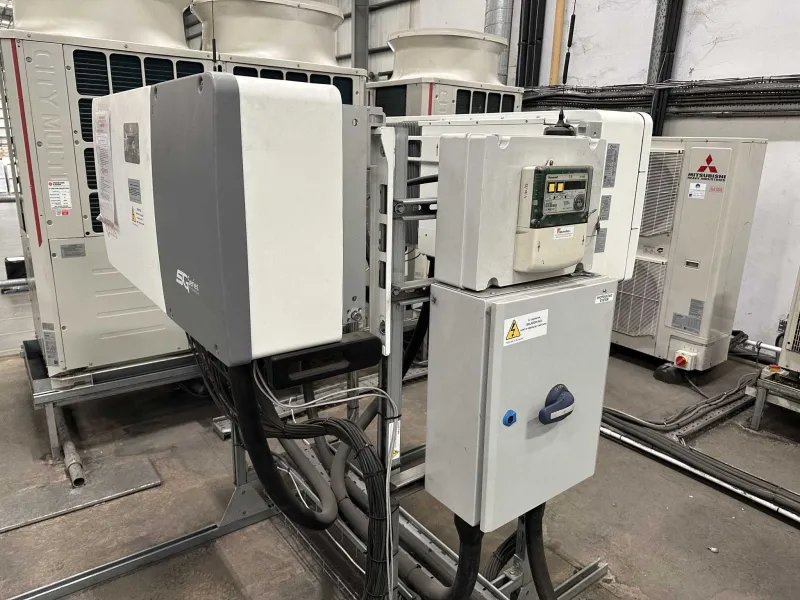
Solis EverCore all-in-one commercial energy storage system
FAQ

Solis: common questions

Solis is an established manufacturer with a large global inverter base and a named product warranty on its storage range, which is a real strength. We will not claim a BNEF Tier 1 ranking, a bankable tier or that lenders will finance it on the brand alone, because we do not dress a value brand as utility-grade. We confirm the specific product, its warranted terms and the bankability that fits your project in writing before contract.

Both are Solis commercial storage options built around its S6 three-phase hybrid inverters. EverCore is the all-in-one cabinet, with the power conversion, inverter, transfer switch and energy management integrated alongside the battery, so there are fewer separate boxes to coordinate. PrimePower is the packaged alternative pairing the S6 hybrid with high-voltage battery stacks. We choose between them on what fits your site.

We will not quote a fixed figure for your site here, because the honest one comes from your project design. The EverCore line comes in three set configurations, a 50 kW hybrid with 100 kWh, a 60 kW hybrid with 120 kWh and a 125 kW hybrid with 261 kWh, paralleled to a maximum of around 1.25 MW and 15.66 MWh, and PrimePower covers a similar band with high-voltage stacks. We size the system from your half-hourly consumption and confirm the exact model's ratings and warranty from the current datasheet before contract.

Often, yes. The S6 hybrid range supports both DC and AC coupling, and AC coupling is the natural route for adding storage to an existing array without changing the solar side. Which coupling suits your site is a design decision we make from the survey, alongside whether Solis or another maker is the better fit for your load and connection.

No. Alectrona is brand-agnostic. We specify the battery that fits the project, the scale and your risk appetite, with the current product and warranty confirmed before contract. Solis is one option we put forward where the survey and the model show it is the right fit, not a default we lead with on every job.

We do not publish a price for a Solis EverCore or PrimePower system, because an honest figure depends on the cabinet count, the coupling, the connection works and the install, all set at survey. The cost is driven by the kWh sized to your half-hourly load rather than by a per-cabinet sticker. See our commercial battery costs page and the commercial solar cost guide for what shapes the number, then we confirm a fixed scope and price in your quotation.

From a signed survey, a Solis cabinet install is usually a few weeks of on-site work once the design, the equipment and the grid position are settled, but the lead time is set by the G99 connection process with your network operator, which can run for months on a larger site. We start the G99 application early and sequence procurement and the install around it, and we confirm a programme in writing before contract.

Get a commercial quote

See what a battery would actually do on your site.

We model your half-hourly load and your solar against a battery sized from an on-site survey, so the figure you get is yours, not a from-price. Capex first, with the bankable brand that fits the project.

  • Sized from your half-hourly load, not a per-kWh rule of thumb
  • Brand-agnostic: the bankable battery that fits the project
  • Engineer-led, assured to the non-MCS standard (CDM 2015)