Skip to content

Alectrona

Commercial solar by sector

Commercial solar for food & drink processing.

In a food or drink processing plant, ovens, chillers and packing lines run hard through the working day, so most of what the roof generates is used on the factory floor rather than exported.

  • Energy-intensive production lines and refrigeration self-consume well. York and the Humber hold some of the UK largest food-manufacturing sites.
  • Sized from your half-hourly load
  • Over 50 kWp, outside MCS
Reviews

The feedback we work to earn

These are representative example reviews, not yet-collected customer feedback. They are written to illustrate the kind of feedback Alectrona aims to earn and are shown as design placeholders while we gather and verify reviews from our first commercial clients. Alectrona is the commercial solar trading brand of RVTC LTD.

What set Alectrona apart was the documented design pack. We had quotes from three installers, but only Alectrona handed us a full set of drawings, a single-line diagram and a design referencing BS 7671 and the G99 connection process. The whole thing read like an engineering submission rather than a sales brochure. Our M&E consultant reviewed it and signed it off without a single query. That gave the board the confidence to release the capital.

Estates Manager, academy trust (Yorkshire)

Other firms priced our roof off a satellite image and a desktop guess. Alectrona flew an in-house drone survey, fully insured and flown by a qualified commercial drone pilot, and built a 3D model of the actual roof. It picked up plant, vents and a parapet line that a flat aerial photo had completely missed, which changed the panel layout. I would rather find that out at design stage than on the day the scaffold goes up. The accuracy of that survey is the reason I trusted everything that followed.

Facilities Manager, distribution centre (East Midlands)

As a finance director I was wary of being oversold a system bigger than we could use. Alectrona modelled the array against our actual half-hourly consumption data rather than an annual total, so it is sized to what we genuinely draw on site during the day. They were honest that exporting surplus is worth far less than self-consumption, and built the design around that. The capital case stacked up because the engineering was honest, not because the numbers were inflated.

Finance Director, logistics group (North West)

We were undecided between buying outright, leasing and a PPA. Alectrona laid out all three side by side with the pros and cons of each against our balance sheet, instead of pushing the one that pays them best. They were clear about where a PPA makes sense and where capex wins, and pointed us at our own accountant for the tax treatment. The survey and design took a little longer than I expected, but the thoroughness was worth the wait. Genuinely consultative.

Property Director, retail park (West Midlands)

The install crew were tidy and well run, and worked to a clear CDM 2015 plan with a proper site induction and RAMS. What impressed me most was the handover. We received a full commissioning pack with the IEC 62446-1 test results, certification, O&M documentation and an as-built record for our maintenance team. As the people who have to live with this asset for the next twenty years, having that paperwork in order matters enormously. Nothing was left loose.

Operations Director, food manufacturer (Lincolnshire)

I expected the usual hard sell and got the opposite. After surveying our site Alectrona told us one roof section was not worth covering because of shading, and that a smaller, well-sited array was the better investment than filling every square metre. There was no commission-driven upselling and no pressure. For a six-figure capital project, that straight talk is exactly what you want from the people advising you. We will be using them again on our second site.

Managing Director, engineering firm (Sheffield)

At a glance
  • Indicative size 150 kWp – 1 MWp+ (large process facilities)

Food and drink processing covers the sites that turn raw ingredients into finished, packed product: bakeries and confectioners, dairies and creameries, meat and fish processing, ready-meal and prepared-food plants, breweries, distilleries and soft-drink bottlers. These are some of the most electricity-hungry buildings in the region, running mixing, cooking, chilling, filling and packing lines through long production shifts.

That demand profile is exactly what makes commercial solar worth modelling here. The return on a commercial array is governed by how much of the generation you use on site, and a processing plant pulls heavy, steady load straight through the daylight hours. York and the Humber hold some of the UK's largest food-manufacturing sites, so this is a sector we build for often.

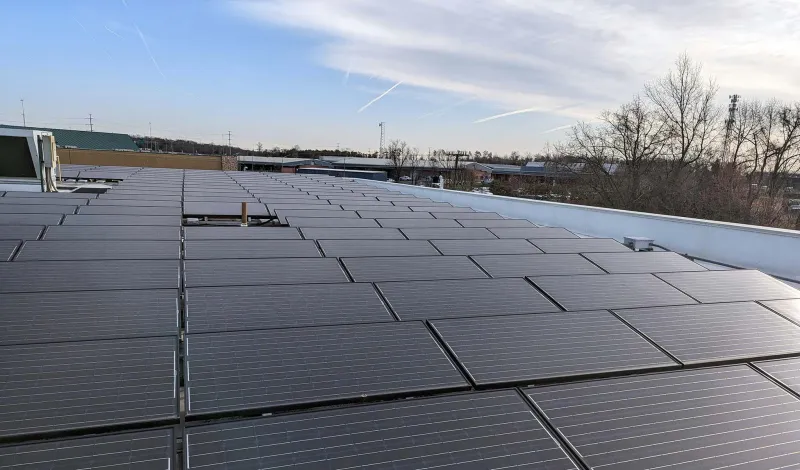
Commercial rooftop solar, the kind specified for food & drink processing

Engineer-led commercial solar, over 50 kWp and outside MCS.

01 Why it fits

What makes solar work for food & drink processing.

Solar earns most when generation is consumed on site. Every unit you use offsets an expensive import unit, while a unit exported to the grid is paid far less. So the value of a system tracks how well its output lines up with the building's demand, not how many panels the roof can hold. A processing plant lines up unusually well. Refrigeration and chilled storage run continuously, process heat and steam plant draw through every shift, and the mixing, filling and packing lines carry a high, sustained daytime base load. That combination tends to self-consume a high share of what the array makes.

The match is rarely flat across the year, and it is worth being honest about that. Production peaks, seasonal product runs and cleaning-down cycles all move the demand curve, and a chilled or frozen plant typically lifts its refrigeration load in summer, which lines up with the strongest generation. Where shift patterns leave gaps, or where a site runs lighter at weekends, we look at whether battery storage shifts generation into the evening run or the overnight chill load. A site built mainly around chilled and frozen stores reads more like our cold storage case, where refrigeration is the dominant continuous load. None of this is a rule of thumb. We size to the demand the building actually carries.

02 Typical system

What a typical system looks like.

Processing plants tend to occupy large single-occupier sheds, often a mix of high-bay production hall, chilled or frozen stores and ancillary blocks, which between them present a substantial run of flat or shallow-pitch roof. For orientation only, sites in this sector tend to fall in an indicative band of 150 kWp to 1 MWp and above, which spans our commercial system-size guidance from mid-scale roofs up to the largest single-occupier sheds. Treat that as a sense of scale rather than a quote. The real figure comes from the on-site survey and the half-hourly load model, and on a food site the roof needs particular care: heavy rooftop plant, condensers, flues and extract runs all reduce the usable array area and shade parts of it, so the survey works around them before anything is sized.

03 Sector detail

How a processing plant funds and taxes the system

The capital decision on a processing plant usually runs through a finance director who wants the route and the tax position settled before the array is sized. The right structure depends on how the business already funds plant and machinery. A capital purchase keeps the asset and the full generation benefit on your own balance sheet; a lease or operating agreement spreads the cost against the energy it saves and can be arranged to sit off balance sheet; and a power purchase agreement lets a third party fund and own the array while you simply buy the output, which suits operators who would rather not commit capital to a roof. Our finance comparison sets out how each one fits a manufacturing balance sheet, and the survey can be paired with whichever route your board prefers.

On a site of this size the tax treatment moves the numbers as much as the headline cost. A rooftop array is plant and machinery, so the capital-allowances position, including the Annual Investment Allowance and any first-year allowances in force, can pull a large share of the spend forward against taxable profit in the year you install. The qualifying treatment and the limits change between Budgets, so they have to be verified for the year the work lands rather than assumed, and a processing business with steady taxable profits is usually well placed to use them. We set the mechanism out in the capital-allowances guide, and where a figure is needed for a board paper we model it on the conservative end rather than the best case.

Cost itself is never published from a page, because no two processing plants present the same problem. A creamery running deep refrigeration around the clock, a bakery with a bank of ovens on a single day shift, and a bottling line drawing in bursts all carry a different load and a different roof, so a figure pulled from a sector average would mislead more than it helped. The per-kWp bands on our commercial finance pages let you sense-check a budget against system size, and the on-site survey and PV*SOL model settle the firm figure for your plant before any number is committed.

04 Sector detail

Payback, statutory duty and the load shape we model

We do not put a single payback figure against the sector, because a continuous-load chilled plant and a single-shift bakery return very differently, and an honest number has to come from your own half-hourly data. What we can state plainly is the mechanism: the more of the generation a plant self-consumes against its own import price, the faster the array pays back, and the heavy daytime refrigeration and process load typical of food and drink processing is one of the stronger self-consumption profiles we model. Any payback we present is built on the conservative end of the modelled self-consumption split rather than the optimistic one, so the case holds if a year runs lighter than planned, and it is always a model confirmed against your meter, not a promise. The generation we line against it is itself a modelling starting point we settle in PV*SOL for your exact roof, after shading from rooftop plant and the array losses are applied, never a headline yield carried over from another site. The payback-by-sector guide walks through how those figures are constructed before any survey.

A live food factory also brings statutory duties that shape how the work is delivered, beyond the question of whether it pays. A system over 50 kWp is delivered under CDM 2015 with a Principal Designer and Principal Contractor appointed, and on a food site that programme is built around your production schedule, your hygiene zones and the food-safety controls that govern roof and high-level access above an open line. The electrical work is wired to BS 7671 and commissioned to IEC 62446-1, the connection is agreed with Northern Powergrid under a G99 application, and where the model shows generation that would otherwise spill cheaply to export we look at G100 export limitation so the design fits what the local network will accept. None of that touches the MCS scheme, which stops at 50 kWp and is the domestic certification route rather than a trust signal for a plant of this scale; the assurance here is the engineering stack and the commissioning record, not a domestic certificate.

The load shape itself is what we test hardest, because it is what the whole case turns on. A plant that runs deep refrigeration and process heat through the night exports very little but may want battery storage to shift midday generation into the overnight chill load, whereas a day-shift operation closer to the cold storage profile self-consumes almost everything it makes while the line runs. Seasonal product runs, deep-clean shutdowns and the summer lift in refrigeration duty all move that curve through the year, and the summer peak in chilling load tends to fall where generation is strongest. We read which of these patterns your meter shows before sizing anything, so the array is matched to the demand the plant genuinely carries through its shifts rather than to the area on the roof.

FAQ

Commercial solar for food & drink processing: common questions

That is exactly what the survey is for. Food and drink sites carry a lot of rooftop kit, including condensers, chillers, flues and extract runs, all of which reduce and shade the usable roof area. Our in-house 3D drone survey maps every obstruction so the array is laid out around the real roof, not an idealised one. The system size then comes from what the roof can genuinely carry, modelled in PV*SOL.
It tends to help a great deal. Solar earns most when generation is used on site rather than exported, because an exported unit is paid far less than an imported one. A processing plant with continuous refrigeration, process heat and daytime production lines draws heavy, steady load right through the daylight hours, so a high share of generation is typically self-consumed. We confirm the actual split from your half-hourly data before sizing anything.
We model it rather than assume it. A chilled or frozen plant usually lifts its refrigeration load in summer, which lines up with peak generation. Where shifts leave gaps, or a site runs lighter at weekends, we look at whether battery storage shifts generation into the evening run or the overnight chill load. The aim is to match the system to the demand you actually carry, not to overbuild a roof that would export cheaply.
Yes. A commercial system over 50 kWp is delivered under CDM 2015 with a Principal Designer and Principal Contractor appointed, and the works are planned around your production schedule and food-safety requirements. The engineering is assured by the non-MCS stack, BS 7671 wiring and IEC 62446-1 commissioning, with a G99 application confirming permission to connect.
We do not publish a price, because a processing plant's size depends on its production lines, its refrigeration duty, the roof and the half-hourly load. The enquiry, the drone survey and the PV*SOL model are free, and you get an honest written cost only once the system is sized to the demand your plant genuinely carries through its shifts, never from a sector average on a page.
It depends on the roof, any battery storage and the grid connection. As a rough guide the survey and model come back within a few weeks, and on a large processing roof the works run over weeks rather than days, sequenced around a live, food-safe production environment, once a G99 connection is agreed with Northern Powergrid. We give you a programme specific to your plant before anything is committed.
Get a commercial quote

See what your roof and your load would actually do.

We model your half-hourly consumption against a system sized from an on-site drone survey, so the figure you get is yours, not a from-price. No obligation, no MCS gatekeeping on systems this size.

  • On-site 3D drone survey, fully insured in-house pilot
  • Half-hourly load modelled in PV*SOL before anything is specified
  • Engineer-led, assured to the non-MCS standard (CDM 2015)