Skip to content

Alectrona

Commercial guide

What are network charges, and how does solar change them?

A large share of a commercial electricity bill is not the energy itself but network and non-commodity charges. Self-consumed solar reduces the units you import, and with them the per-unit charges you carry.

  • Commercial scale, over 50 kWp
  • On-site 3D drone survey + PV*SOL
  • Engineer-led, outside MCS
Reviews

The feedback we work to earn

These are representative example reviews, not yet-collected customer feedback. They are written to illustrate the kind of feedback Alectrona aims to earn and are shown as design placeholders while we gather and verify reviews from our first commercial clients. Alectrona is the commercial solar trading brand of RVTC LTD.

What set Alectrona apart was the documented design pack. We had quotes from three installers, but only Alectrona handed us a full set of drawings, a single-line diagram and a design referencing BS 7671 and the G99 connection process. The whole thing read like an engineering submission rather than a sales brochure. Our M&E consultant reviewed it and signed it off without a single query. That gave the board the confidence to release the capital.

Estates Manager, academy trust (Yorkshire)

Other firms priced our roof off a satellite image and a desktop guess. Alectrona flew an in-house drone survey, fully insured and flown by a qualified commercial drone pilot, and built a 3D model of the actual roof. It picked up plant, vents and a parapet line that a flat aerial photo had completely missed, which changed the panel layout. I would rather find that out at design stage than on the day the scaffold goes up. The accuracy of that survey is the reason I trusted everything that followed.

Facilities Manager, distribution centre (East Midlands)

As a finance director I was wary of being oversold a system bigger than we could use. Alectrona modelled the array against our actual half-hourly consumption data rather than an annual total, so it is sized to what we genuinely draw on site during the day. They were honest that exporting surplus is worth far less than self-consumption, and built the design around that. The capital case stacked up because the engineering was honest, not because the numbers were inflated.

Finance Director, logistics group (North West)

We were undecided between buying outright, leasing and a PPA. Alectrona laid out all three side by side with the pros and cons of each against our balance sheet, instead of pushing the one that pays them best. They were clear about where a PPA makes sense and where capex wins, and pointed us at our own accountant for the tax treatment. The survey and design took a little longer than I expected, but the thoroughness was worth the wait. Genuinely consultative.

Property Director, retail park (West Midlands)

The install crew were tidy and well run, and worked to a clear CDM 2015 plan with a proper site induction and RAMS. What impressed me most was the handover. We received a full commissioning pack with the IEC 62446-1 test results, certification, O&M documentation and an as-built record for our maintenance team. As the people who have to live with this asset for the next twenty years, having that paperwork in order matters enormously. Nothing was left loose.

Operations Director, food manufacturer (Lincolnshire)

I expected the usual hard sell and got the opposite. After surveying our site Alectrona told us one roof section was not worth covering because of shading, and that a smaller, well-sited array was the better investment than filling every square metre. There was no commission-driven upselling and no pressure. For a six-figure capital project, that straight talk is exactly what you want from the people advising you. We will be using them again on our second site.

Managing Director, engineering firm (Sheffield)

  • What they are DUoS and TNUoS network charges, plus other non-commodity costs on the bill
  • Mostly charged on Each unit you import from the grid
  • What solar reduces Imported units, and with them the per-unit charges they carry
  • Where it grows material On larger, megawatt-scale systems where connection and capacity also weigh in
  • Rates Vary by region and year, so confirmed against your own bill
01 The short version

Network charges (DUoS, TNUoS)

OrientationThis is a plain-English orientation for a commercial buyer, not formal advice; network-charge rates vary by region and year, and we confirm the position against your own bill and connection for your project.

When a finance director looks at a commercial electricity bill, the unit rate is only part of the picture. Layered on top of the energy cost is a set of charges for using the wires that deliver it: the network charges. Two of the larger ones are Distribution Use of System (DUoS), for the local network, and Transmission Use of System (TNUoS), for the high-voltage national network. Alongside them sit other non-commodity costs that ride on the same bill, mostly billed per unit imported.

This matters for solar because much of that stack is charged on the units you draw from the grid. When the array supplies a unit on site, that unit is not imported, so you avoid both its energy cost and the network and non-commodity charges sitting on top of it. This guide explains what the main network charges are, why self-consumption is what reduces them, and why they become more material to the business case as a system grows. It is a plain-English orientation, not formal advice, and the rates themselves vary by region and year, so we frame the actual figures through your bill and route the economics to the payback guide rather than quoting numbers here.

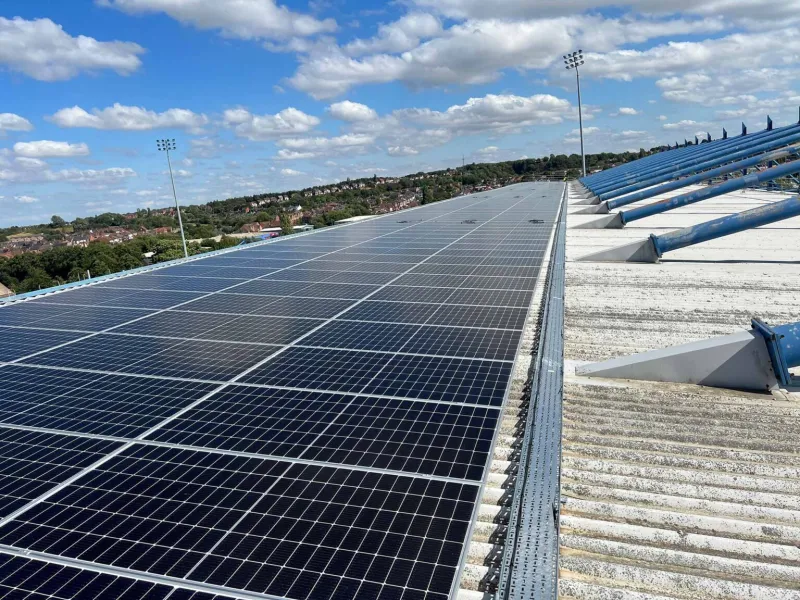
Commercial rooftop solar, the subject of this guide: Network charges (DUoS, TNUoS)
Engineer-led, from the survey to the G99 connection.
02

What network charges actually are

Network charges pay for building, running and maintaining the grid that moves electricity from where it is generated to your meter. Distribution Use of System (DUoS) covers the local distribution network, the regional cables and substations owned by your Distribution Network Operator. Transmission Use of System (TNUoS) covers the high-voltage transmission network that carries power across the country before it reaches the local grid. Both appear on a commercial bill, usually bundled into the rate by your supplier or itemised on a half-hourly account.

They are not the only non-commodity costs. A commercial bill also carries balancing and policy charges that fund the wider system, and most of these are levied on each unit you import. The rates are set through the regulated charging framework and vary by region, by voltage and by year, and some vary by time of day. The practical point is consistent even though the numbers move: a meaningful slice of every imported unit is network and non-commodity charge, not energy.

03

Why self-consumed solar reduces what you pay

The lever that solar pulls is import. Because the bulk of network and non-commodity charges are applied per unit imported, every unit the array supplies on site is a unit you do not buy and therefore a unit that carries none of those charges. The saving on a self-consumed unit is the energy cost plus the network and non-commodity charges layered on it, which is why on-site use is worth more than the headline unit rate alone suggests.

Exported units behave differently. When the array generates more than the site is using and the surplus goes back to the grid, that exported unit earns an export payment, and that payment is typically well below the value of a unit used on site. Export does not avoid your import charges, because you were not importing in that moment anyway. This is why a well-matched commercial system is sized around on-site demand rather than around export: the network-charge saving comes from displacing import, and a unit sent to the grid captures comparatively little of it.

  • Self-consumed unit: avoids energy cost plus the network and non-commodity charges on top, the larger saving.
  • Exported unit: earns an export payment only, typically worth much less than a unit used on site.
The surplus sent back

Exported unit

When the array generates more than the site is using, the surplus goes back to the grid and earns an export payment instead of displacing an import.

  • Earns an export payment only
  • Typically worth much less than a unit used on site
  • Does not avoid your import charges, since you were not importing then
  • Why a well-matched system is sized around on-site demand
04

Why scale changes the picture

For a mid-sized rooftop array the network-charge story is mainly about reducing import. As a system grows the picture broadens, because the charging arrangements and the grid connection both become more involved at larger scale. A larger generator interacts with the network in ways a small one does not, and the connection itself competes for limited capacity, so the route to connect can carry cost and lead time that feed straight into the business case.

At megawatt scale the grid-capacity queue is no longer a footnote. The Distribution Network Operator assesses a larger connection against the headroom physically available on that part of the network, and where capacity is tight the offer can depend on reinforcement work the operator needs to do first. That is a programme and cost question, not only a technical one, which is why larger projects weigh the connection route, the export position and the network-charge profile together rather than in isolation. The thresholds and rates that apply at this scale are set by the regulated framework and confirmed for your connection, so we establish the position for your site rather than assume a figure.

05

How Alectrona frames this for your site

We start from your actual bill and your half-hourly consumption data, because that is what makes the network-charge saving concrete rather than estimated. Modelling generation for your exact roof against that demand profile shows how much of the array’s output would be used on site, and it is that self-consumption figure, not the system size on its own, that determines how much network and non-commodity charge the system displaces.

From there we frame the rest honestly. Where a system is large enough for the connection and capacity position to matter, we treat that as a design input alongside the load modelling, and we confirm the connection terms with your network operator rather than assuming them. We do not put rates or payback figures on this page, because they vary by region and year and depend on your specific contract. The detailed economics, including how avoided network charges feed the return, sit in the payback guide and the finance section, and we confirm the figures against your own bill before anything is committed.

06

Why does the time of day a unit is imported change the network charge?

Distribution Use of System charges are not flat across the day on a half-hourly commercial supply. The framework that sets them, administered through the Distribution Connection and Use of System Agreement and overseen by the regulator Ofgem, divides the day into charging bands often described as red, amber and green. The red band sits over the late-afternoon and early-evening peak, when the local network is under most strain, and it carries the highest DUoS unit rate by a wide margin. Amber covers the shoulder periods and green covers overnight and weekends, where the per-unit charge is lowest.

This time-of-day shape changes how solar saving is read. A unit the array supplies during a daytime amber period avoids a moderate charge, while the highest-charged red units fall in the early evening when generation is fading. That is one reason a system is sized and modelled against the half-hourly demand profile rather than against annual totals: the value of each displaced unit depends on which band it falls in. It is also why pairing solar with storage is worth modelling, because a battery can shift self-consumption into the red band after the array has wound down. We set out how that interacts with metering in our guide on half-hourly metering, and the band boundaries themselves are published by your Distribution Network Operator, Northern Powergrid across Yorkshire and northern Lincolnshire, and confirmed against your own supply rather than assumed here.

07

What are TNUoS Triad charges, and can solar reduce them?

Transmission Use of System charges have historically been recovered from larger demand sites through a demand-related element linked to consumption at the system peak. The mechanism the industry has used for this is the Triad: the three half-hours of highest national demand across the winter, separated by at least ten clear days, identified after the event by the electricity system operator NESO. A site's transmission demand charge has been driven by its average import across those three half-hours, which fall in the cold dark early evenings when solar output is at or near zero.

This creates a known limit. Solar alone does little to cut a Triad charge, because the peak occurs after generation has stopped for the day, so a guide that promised TNUoS savings from panels would be misleading. Where a battery is part of the scheme it can be discharged to reduce import across the suspected Triad windows, which is a behavioural and dispatch question rather than a panel one. The charging methodology is set through industry codes under Ofgem, and the Targeted Charging Review has been reshaping how these demand-side charges are levied, so the precise mechanism that applies in a given year should be confirmed rather than taken as fixed. We weigh the transmission position alongside the connection and export picture set out in our guide on the grid connection queue and the role of your Distribution Network Operator.

08

Who sets these charges, and why do they keep changing?

None of these rates are set by your supplier in isolation. The charging framework is governed by industry codes, principally the Distribution Connection and Use of System Agreement for the local network and the Connection and Use of System Code for transmission, both regulated by Ofgem. NESO, the National Energy System Operator, calculates and publishes the transmission charges and identifies the demand peaks, while each Distribution Network Operator publishes its own DUoS rates and charging bands for its region. The Energy Networks Association coordinates much of the technical framework that sits underneath connections and metering.

The reason the numbers move year to year is that this framework is under active reform. Ofgem's Targeted Charging Review changed how the fixed, capacity-based residual element of network charges is recovered, moving more of it onto a banded fixed charge tied to a site's agreed capacity rather than its consumption. Further reform of the forward-looking signals continues. For a buyer this has two consequences worth holding in mind: a portion of the network charge is now a standing capacity charge that solar does not directly reduce, and the rates underpinning any economic model carry a regulatory horizon. We therefore model the saving against current published rates and your own bill, flag where a charge is capacity-based rather than consumption-based, and treat the figures as a position to confirm rather than a fixed forecast. The wider economics of how avoided charges feed the return sit in our payback guide and the finance section.

09

How do agreed capacity and authorised supply capacity affect the bill?

A half-hourly commercial connection carries an agreed level of import capacity, the authorised supply capacity measured in kVA, and the site pays a standing availability charge against that figure whether or not it is fully used. Drawing above the agreed level can trigger excess-capacity penalties, so the capacity a site holds is a recurring cost line that runs whether or not the connection is fully used. Following Ofgem's Targeted Charging Review, more of the fixed network recovery now attaches to this agreed-capacity banding, which means it is charged on the capacity reserved rather than on the units imported.

This matters for how solar is read against the bill. Self-consumed solar reduces the units imported and the consumption-based charges on them, but it does not on its own reduce the standing availability charge tied to agreed capacity, because the connection still has to be sized for the days the array contributes little. Where solar is paired with storage and load management, a site can sometimes review whether its agreed capacity is set higher than its real peak now requires, which is a separate conversation with the supplier and network operator. We surface the capacity position when we model a system from your half-hourly data, so the part of the bill solar genuinely reduces is not confused with the standing element it does not, and we confirm the agreed-capacity figures against your own supply documentation rather than estimating them.

10 How we quote

Past the guide, this is how your figure actually gets set.

  1. Survey

    On-site 3D drone survey

    Our own insured pilot flies your roof and captures the real geometry and shading, so the design starts from your building instead of a satellite guess.

    Booked to suit your operating hours

  2. Model

    PV*SOL design and proposal

    We model the array in bankable-grade software, size it around your daytime load, and set out generation, savings and payback across three funding routes.

    Modelled, not promised

  3. Install

    Engineered and installed

    Designed and installed to BS 7671, commissioned to IEC 62446-1, connected under G99 and run under CDM 2015. Alectrona is typically the Principal Contractor.

    Outside MCS, assured by the non-MCS stack

  4. Aftercare

    Operations and maintenance

    A 12-month defects period backed by an Insurance-Backed Guarantee, then ongoing operations and maintenance so the asset keeps earning for its full working life.

    Kept performing, year on year

11 FAQ

Network charges (DUoS, TNUoS): common questions

Both are network charges, but they pay for different parts of the grid. Distribution Use of System (DUoS) covers the local distribution network in your region, the cables and substations owned by your Distribution Network Operator. Transmission Use of System (TNUoS) covers the high-voltage national transmission network that carries power across the country before it reaches the local grid. Both appear on a commercial bill, often bundled into the rate, and both are part of the cost that self-consumed solar helps reduce.

The charges themselves are set by the regulated framework, but the amount you pay falls because most of them are applied per unit imported. Every unit the array supplies on site is a unit you do not draw from the grid, so it carries none of those network and non-commodity charges. The saving comes from reducing import, which is why a well-matched system is sized around on-site demand.

A unit used on site avoids the energy cost and the network and non-commodity charges layered on an imported unit, which is the larger saving. An exported unit earns an export payment that is typically well below that value, and it does not reduce your import charges because you were not importing at that moment. For most commercial sites the stronger value is in self-consumption, not export.

As a system grows towards megawatt scale, both the charging arrangements and the grid connection become more involved. A larger generator interacts with the network differently, and the connection competes for limited capacity, so the route to connect can carry cost and lead time. At that scale the network-charge profile, the connection queue and the export position are weighed together. The thresholds are set by the regulated framework and confirmed for your specific connection.

Not from a guide page, because the rates vary by region, by voltage and by year, and they depend on your specific supply contract. We model the saving against your own bill and half-hourly consumption data so the figure reflects your site rather than an average. The detailed economics sit in the payback guide and the finance section, and we confirm them with you before any commitment.

We do not put a price on this guide, because the network-charge saving depends on your region, your agreed capacity, your half-hourly consumption shape and your supply contract, all of which we read from your own bill rather than an average. The modelling work that quantifies the saving is part of a commercial feasibility assessment, scoped to your site. The wider cost picture for a system sits in our commercial solar cost guide, and we confirm every figure against your own data before anything is committed.

Reading the DUoS bands, TNUoS position and agreed-capacity charges from a recent half-hourly bill is usually a matter of days once we have the data and your authority to request it from the supplier. Where the system is large enough that the grid connection and capacity headroom come into play, the timeline is set by your Distribution Network Operator rather than by us, and that connection assessment can run to weeks or months. We set out those connection lead times in our grid connection queue guide.

Get a commercial quote

Get the numbers for your roof.

A guide can only take you so far. The figure you get is modelled from your own half-hourly load and a system sized from the on-site drone survey. No obligation, and systems this size sit outside the domestic MCS scheme, so the assurance is the engineering stack.

  • On-site 3D drone survey, fully insured in-house pilot
  • Half-hourly load modelled in PV*SOL before anything is specified
  • Engineer-led, assured to the non-MCS standard (CDM 2015)
  • Capex, lease-purchase or PPA, whichever suits you