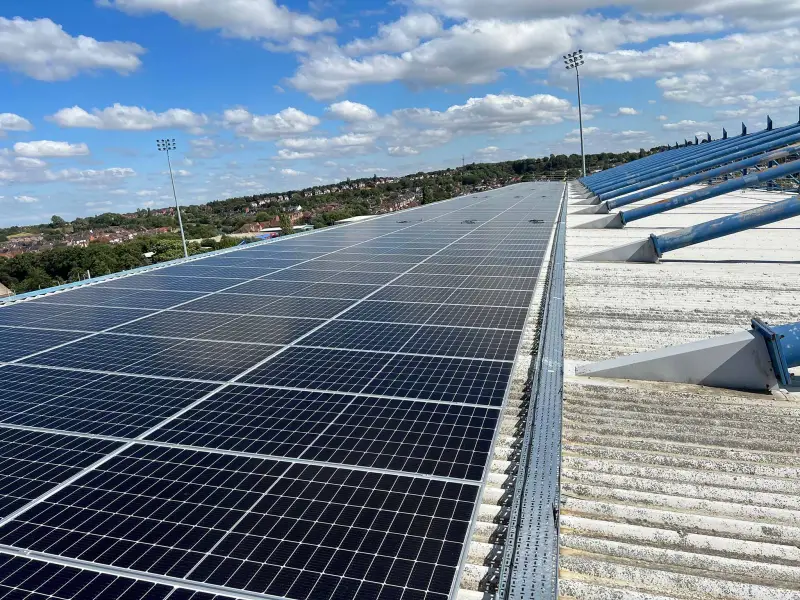
What set Alectrona apart was the documented design pack. We had quotes from three installers, but only Alectrona handed us a full set of drawings, a single-line diagram and a design referencing BS 7671 and the G99 connection process. The whole thing read like an engineering submission rather than a sales brochure. Our M&E consultant reviewed it and signed it off without a single query. That gave the board the confidence to release the capital.
Alectrona
Commercial processHow we quote
We do not give you a desktop guess. A drone survey of your roof and your half-hourly consumption feed a PV*SOL model of generation, self-consumption and export, which produces a designed system and a fixed price you can take to the board.
- Engineer-led, every step
- In-house insured drone survey
- Over 50 kWp, outside MCS
The feedback we work to earn
These are representative example reviews, not yet-collected customer feedback. They are written to illustrate the kind of feedback Alectrona aims to earn and are shown as design placeholders while we gather and verify reviews from our first commercial clients. Alectrona is the commercial solar trading brand of RVTC LTD.
Other firms priced our roof off a satellite image and a desktop guess. Alectrona flew an in-house drone survey, fully insured and flown by a qualified commercial drone pilot, and built a 3D model of the actual roof. It picked up plant, vents and a parapet line that a flat aerial photo had completely missed, which changed the panel layout. I would rather find that out at design stage than on the day the scaffold goes up. The accuracy of that survey is the reason I trusted everything that followed.
As a finance director I was wary of being oversold a system bigger than we could use. Alectrona modelled the array against our actual half-hourly consumption data rather than an annual total, so it is sized to what we genuinely draw on site during the day. They were honest that exporting surplus is worth far less than self-consumption, and built the design around that. The capital case stacked up because the engineering was honest, not because the numbers were inflated.
We were undecided between buying outright, leasing and a PPA. Alectrona laid out all three side by side with the pros and cons of each against our balance sheet, instead of pushing the one that pays them best. They were clear about where a PPA makes sense and where capex wins, and pointed us at our own accountant for the tax treatment. The survey and design took a little longer than I expected, but the thoroughness was worth the wait. Genuinely consultative.
The install crew were tidy and well run, and worked to a clear CDM 2015 plan with a proper site induction and RAMS. What impressed me most was the handover. We received a full commissioning pack with the IEC 62446-1 test results, certification, O&M documentation and an as-built record for our maintenance team. As the people who have to live with this asset for the next twenty years, having that paperwork in order matters enormously. Nothing was left loose.
I expected the usual hard sell and got the opposite. After surveying our site Alectrona told us one roof section was not worth covering because of shading, and that a smaller, well-sited array was the better investment than filling every square metre. There was no commission-driven upselling and no pressure. For a six-figure capital project, that straight talk is exactly what you want from the people advising you. We will be using them again on our second site.
Explore a drone-survey model.
- Starts with An in-house drone survey of your roof and shading, flown by our own insured pilot
- Modelled in PV*SOL, against your half-hourly load, for generation, self-consumption and export
- You receive A designed system and a fixed, site-specific price for a defined scope
- No from-price Commercial solar is site-specific, so there is no honest headline figure
- Funding Capex first, with leasing, hire purchase and PPA available
A commercial solar price is only as good as the survey behind it. Anyone can drop a satellite outline into a spreadsheet and put a round number against it. That number tends to move the moment a real engineer walks the roof, which is exactly the wrong time for a price to change.
We quote the other way round. We survey first, model the site against your actual load, design the system that fits, and only then put a price on it. The figure you receive is for the system we have designed for your roof, rather than a placeholder that gets revised on contact with reality.
Engineer-led from the first call to the final handover.
Survey first, not a desktop guess
Every quote starts with a site survey, because the roof decides what is buildable. Our own pilot flies an in-house drone survey of your roof and the surrounding shading, with imagery detailed enough to plan panel layout, fixings and cable routes against the real structure rather than a map.
That survey tells us the usable area, the orientation and pitch of each plane, the obstructions and the shading through the day. It is the difference between a number that survives the first site visit and one that does not. The drone work is flown by our own pilot, who holds the A2 Certificate of Competency and a General VLOS Certificate and is fully insured.
Your half-hourly load drives the model
A system sized to the roof alone is only half the picture. The other half is how your business actually uses electricity through the day and across the year. We take your half-hourly consumption data and run it against the surveyed roof in PV*SOL, the industry modelling tool used across the trade.
That model shows how much of the generation you would use on site, how much would export, and how a battery would change the shape of both. It is what turns a panel count into a designed system: one sized to your consumption profile rather than to a rule of thumb. Self-consumption is where commercial solar earns its return, so the load profile matters as much as the roof.
A designed system and a fixed price
The survey and the model produce two things together: a designed system and a fixed, site-specific price. The design specifies the array, the inverters, the mounting and the electrical work to the standards the install is delivered against, so the price covers what will actually be built.
There is no honest "from £X" headline for commercial solar, because the right system is specific to your roof and your load. A from-price would be a guess dressed up as a figure. What we give you instead is a fixed price for a defined scope, with the assumptions stated, so it is a number you can take to a board and stand behind.
Capex first, with finance routes if you need them
We lead with capex, because owning the system outright keeps the most of the return and qualifies for the first-year capital allowances that shorten payback. For a business with the cash and the appetite, it is usually the strongest position.
Where the cash flow needs it, the same designed system can be funded other ways, and the quote is structured so you can compare them on like-for-like terms:
- Capex, owned outright, the primary route on most projects.
- Leasing or hire purchase, spreading the cost while you still own the asset at the end.
- A power purchase agreement (PPA), where a third party funds and owns the system and you buy the generation.
We are not financial or tax advisers, so the funding decision is one to take with your accountant. Our job is to give you a designed system and a clear price that any of those routes can be built on.
What the price is built against
Over 50 kWp your system sits outside MCS, so the quote does not lean on a single certificate. It is priced against the named engineering standards the install is delivered to, and the scope you receive says so on the face of it. The figure covers electrical work designed to BS 7671, commissioning and inspection to IEC 62446-1, a G99 connection agreed with Northern Powergrid, your network operator across Yorkshire and northern Lincolnshire, and a project planned and built under CDM 2015. Each of those carries cost, and a quote that omits them is cheaper because it is buying less. We would rather show the standards inside the price than discover the gap at handover. How that engineering stack assures a build without MCS is set out on design and engineering.
How an indicative figure hardens into a fixed price
The price does not appear from nowhere. It hardens through defined stages, and each one replaces an assumption with a measured fact. The first rung is an indicative desktop model from imagery and your load, covered on remote survey. The next is the drone survey, where our own pilot, who holds the A2 Certificate of Competency and a General VLOS Certificate and is fully insured, flies the roof so the layout, fixings and cable routes are set against the real structure. Only once the surveyed roof and your half-hourly load are modelled in PV*SOL do we put a fixed figure against a designed scope. Reading from imagery to a measured survey is the difference between a number that moves on the first site visit and one that holds to contract.
How to read the quote we send
The quote is written to be read by a finance or facilities director with nothing to decode. It states the designed system, the scope of work against the standards above, the assumptions the price depends on, and the funding routes laid out on like-for-like terms so capex, leasing or hire purchase and a PPA can be compared directly. We do not print a headline rate, because a from-price for a site-specific asset is a guess in the shape of a figure. For the cost drivers behind any commercial system, the commercial solar cost guide explains what moves the number, and the finance pages set out the routes. Any payback or return is modelled against your own site and disclosed with its basis, never promised as a generic percentage, and capital allowances are described as the mechanism to confirm with your accountant.
How we quote: common questions
Because the right system is specific to your roof and your consumption. The usable area, the shading, the orientation and how much of the generation you would actually use all change the design, and the design changes the price. A from-price would be a guess presented as a figure, and it would move the moment we surveyed the site. We would rather survey first and give you a number that holds.
Two things, mainly. Access to fly the drone survey of your roof, and your half-hourly electricity consumption data so we can model how much of the generation you would use on site. With those, we can survey, model in PV*SOL and return a designed system and a fixed price for it.
Your real half-hourly load and the surveyed roof, rather than generic assumptions. PV*SOL is the industry modelling tool used across the trade, and feeding it your actual consumption is what separates a yield figure you can rely on from one pulled off a template. The result is a yield figure solid enough to base a capital decision on, with the inputs behind it set out.
The price is fixed for the scope we set out, because it is built on a real survey and a designed system rather than a desktop estimate. The assumptions behind it are stated, so you can see exactly what it covers. That is the point of surveying first: the figure you take to the board is the figure, not a placeholder.
We set out the routes and structure the quote so you can compare capex, leasing or hire purchase and a PPA on like-for-like terms. We lead with capex because it keeps the most of the return. The funding decision itself sits with your accountant, though, as we are not financial or tax advisers; we give you the designed system and the numbers to take to them.
The timeline turns on two things you control: access to fly the drone survey and your half-hourly consumption data. Once we have both, the work runs in sequence: the surveyed roof and your load are modelled in PV*SOL, the system is designed to the standards the install is delivered against, and a fixed price is put against that scope. A larger or multi-building site, a complex roof, or a G99 connection position that needs confirming with Northern Powergrid all add to the engineering, so we set the timescale against your specific asset when we have seen it rather than quoting a generic turnaround we cannot stand behind. The remote survey can give you an indicative model sooner, before the on-roof survey hardens it into the fixed figure.
Start where every good project starts: the survey.
We fly your roof, model your half-hourly load, and come back with a designed system and a price you can take to the board. Engineer-led from the first call to the final handover, and the years after it.
- On-site 3D drone survey, fully insured in-house pilot
- Half-hourly load modelled in PV*SOL before anything is specified
- Engineer-led, assured to the non-MCS standard (CDM 2015)