Skip to content

Alectrona

Use case

Grid services from a commercial battery

A battery that already pays its way on site can earn a second income from grid services, but that income is variable, not guaranteed, and it sits on top of your on-site savings rather than replacing them.

  • Commercial scale, over 50 kWp
  • Brand-agnostic, the right fit
  • Sized to your real load
Reviews

The feedback we work to earn

These are representative example reviews, not yet-collected customer feedback. They are written to illustrate the kind of feedback Alectrona aims to earn and are shown as design placeholders while we gather and verify reviews from our first commercial clients. Alectrona is the commercial solar trading brand of RVTC LTD.

What set Alectrona apart was the documented design pack. We had quotes from three installers, but only Alectrona handed us a full set of drawings, a single-line diagram and a design referencing BS 7671 and the G99 connection process. The whole thing read like an engineering submission rather than a sales brochure. Our M&E consultant reviewed it and signed it off without a single query. That gave the board the confidence to release the capital.

Estates Manager, academy trust (Yorkshire)

Other firms priced our roof off a satellite image and a desktop guess. Alectrona flew an in-house drone survey, fully insured and flown by a qualified commercial drone pilot, and built a 3D model of the actual roof. It picked up plant, vents and a parapet line that a flat aerial photo had completely missed, which changed the panel layout. I would rather find that out at design stage than on the day the scaffold goes up. The accuracy of that survey is the reason I trusted everything that followed.

Facilities Manager, distribution centre (East Midlands)

As a finance director I was wary of being oversold a system bigger than we could use. Alectrona modelled the array against our actual half-hourly consumption data rather than an annual total, so it is sized to what we genuinely draw on site during the day. They were honest that exporting surplus is worth far less than self-consumption, and built the design around that. The capital case stacked up because the engineering was honest, not because the numbers were inflated.

Finance Director, logistics group (North West)

We were undecided between buying outright, leasing and a PPA. Alectrona laid out all three side by side with the pros and cons of each against our balance sheet, instead of pushing the one that pays them best. They were clear about where a PPA makes sense and where capex wins, and pointed us at our own accountant for the tax treatment. The survey and design took a little longer than I expected, but the thoroughness was worth the wait. Genuinely consultative.

Property Director, retail park (West Midlands)

The install crew were tidy and well run, and worked to a clear CDM 2015 plan with a proper site induction and RAMS. What impressed me most was the handover. We received a full commissioning pack with the IEC 62446-1 test results, certification, O&M documentation and an as-built record for our maintenance team. As the people who have to live with this asset for the next twenty years, having that paperwork in order matters enormously. Nothing was left loose.

Operations Director, food manufacturer (Lincolnshire)

I expected the usual hard sell and got the opposite. After surveying our site Alectrona told us one roof section was not worth covering because of shading, and that a smaller, well-sited array was the better investment than filling every square metre. There was no commission-driven upselling and no pressure. For a six-figure capital project, that straight talk is exactly what you want from the people advising you. We will be using them again on our second site.

Managing Director, engineering firm (Sheffield)

Key facts
  • Income type Variable, not guaranteed; treated as upside on top of on-site savings
  • Main markets Frequency response and demand-side flexibility
  • How accessed Usually via an aggregator that qualifies, bids and settles on your behalf
  • Entry condition Subject to qualification: battery spec, metering, telemetry and grid connection
  • Where it sits A third layer after solar self-consumption and peak shaving, sized from your load

The system operator and the network operators pay for fast, controllable power to keep the grid balanced and at frequency. A battery is well suited to providing it, because it can charge and discharge in a fraction of a second. Access these markets and your battery can earn on top of the import cost it already avoids.

We treat grid-services income as upside, never as the reason to buy. The on-site case, lifting solar self-consumption and shaving expensive peaks, has to stand on its own first. If the flexibility revenue then adds to it, that is a bonus you can plan around, not a number we will dress up as fixed.

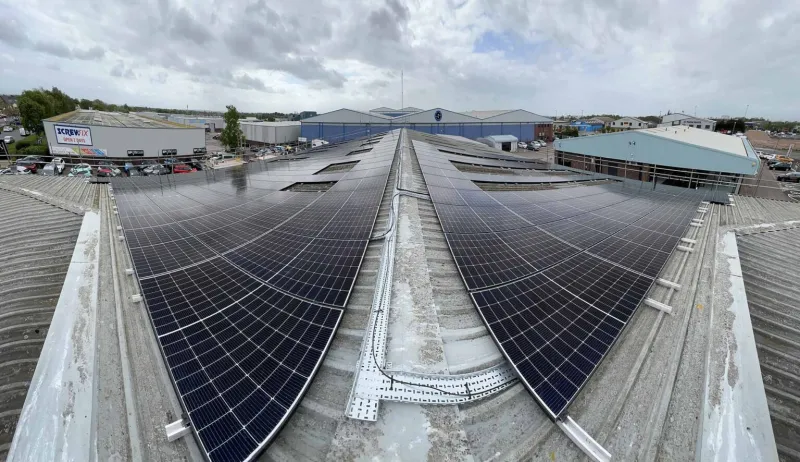
A commercial solar installation

Sized from your half-hourly load, not a per-kWh rule of thumb.

What grid services actually are

Grid services are the jobs a battery does for the wider network in return for payment. The two broad families are frequency response, where the battery automatically charges or discharges within seconds to hold the grid at its target frequency, and demand-side flexibility, where you agree to shift or reduce your import at set times when the system is tight.

Fast frequency response is the headline product here. It rewards a quick, accurate response, and a battery can deliver it without you lifting a finger, because the control happens automatically. Demand-side flexibility schemes ask for a planned change in your draw from the grid, which a battery makes painless because it can cover the load instead of you switching equipment off.

How you get paid: the aggregator route

Most commercial sites reach these markets through an aggregator. An aggregator pools many batteries and flexible sites into one fleet, qualifies them, bids them into the relevant market, and passes a share of the revenue back to you. It handles the metering, the telemetry and the market rules, which would be heavy to carry on a single site.

Qualification is a real gate, not a formality. Your battery, its metering and its grid connection all have to meet the market's technical requirements, and the terms differ by product and by aggregator. We design the system so it can qualify where that makes sense, and we are honest where a site's connection or profile makes a given market a poor fit.

  • The aggregator qualifies, bids and settles; you receive a share of what the battery earns.
  • Entry depends on your battery spec, metering, telemetry and grid connection passing the market rules.
  • Contract terms, the revenue split and notice periods vary by aggregator, so they are worth comparing.

Why the income is variable, and how it stacks

Flexibility and balancing markets are competitive and they move. What a battery earns depends on the product it qualifies for, how often it is called, the prices clearing at the time and the share your aggregator keeps. None of that is fixed, so we will not quote you a per-megawatt figure as if it were. Anyone who does is guessing.

What we can say plainly is how it stacks. The first and most reliable return is on-site: stored solar offsets expensive import, and export is paid far less, so self-consumption is where the steady money is. Peak shaving trims your worst demand charges. Grid services then sit on top, as a variable third layer. Build the case on the first two and treat the third as upside you would welcome but have not banked.

Which markets actually pay, and who runs them

It helps to name the markets rather than talk of grid services in the abstract, because each is run by a different body and each has its own door. The first family is frequency response, procured by the National Energy System Operator (NESO, the former National Grid ESO) through its suite of dynamic services. NESO defines three products that a fast battery is built for: Dynamic Containment, which arrests a sharp frequency deviation after a sudden loss of generation; Dynamic Moderation, which acts pre-fault to keep frequency inside a tighter band; and Dynamic Regulation, which corrects the slow, continuous drift around the 50 Hz target. A battery can pre-qualify for one or more of these and switch between them as their value changes through the day.

The second family is the Balancing Mechanism, the near-real-time tool NESO uses to match supply and demand minute by minute. Through it, a battery can submit bids and offers to turn up or down on instruction. Historically this was the preserve of large generators, but reforms under the Wider Access programme opened it to aggregated, smaller assets, which is how a single commercial battery can now reach it through a pool. Alongside both sits the Capacity Market, an availability payment secured at auction, and wholesale time-of-use arbitrage, which is a trading job rather than a grid service. A well-run battery is moved between these by its control system and aggregator to chase the most valuable opportunity at any moment, a practice the market calls revenue stacking. We name each mechanism so you can see what is on offer, but we will not attach a clearing price to any of them, because those prices are set in competitive auctions and live markets that move from one settlement period to the next.

What qualifies a battery to take part

Qualification is the gate that decides whether any of these markets is even open to your site, and it is governed by published rules rather than goodwill. NESO's dynamic services require the asset to meet defined technical and metering standards before it can pre-qualify, including a controllable response that tracks the frequency signal accurately and within the product's reaction and delivery times. The grid connection itself sits under the Distribution Code and Engineering Recommendation G99, which is the framework your network operator, Northern Powergrid across our region, uses to agree how a battery may import and export. Settlement of any market income depends on metering that meets the Balancing and Settlement Code, typically half-hourly metering that the market can read and trust.

The battery and its inverter have to carry the right certification and behave predictably under the relevant standards, the same IEC 62619 cell-level safety standard and IEC 62933 system-level standard we hold the equipment to for the rest of the build. Aggregators will not enrol an asset that cannot evidence its response, so the telemetry and metering are as much a part of qualification as the cells. We design the system from the start so it can clear these gates where it makes sense to, and we are straight with you where a site's import or export limit, its connection agreement or its load profile makes a given market a poor fit. None of this is a formality you can assume your way past, which is exactly why the income has to be modelled rather than promised. The practical route through pre-qualification, bidding and settlement is almost always an aggregator, which carries the registration and dispatch burden a single site could not justify alone.

How participation affects the asset, and how we protect it

Earning from the grid is not free of consequence for the battery, and an honest page has to say so. Frequency response and Balancing Mechanism activity add charge and discharge cycles beyond the predictable on-site work, and every cycle counts towards the gradual capacity fade that every lithium battery experiences over its life. That is one of the central reasons we treat grid-services income as upside rather than the core case: the steady on-site jobs are sized first, and market participation is layered on only where it fits inside the maker's warranted cycle and throughput limits.

Manufacturers warrant their commercial products against a stated number of full-equivalent cycles or a total energy throughput, and aggressive market cycling can move a battery towards those limits faster than a self-consumption-only duty would. We read the specific warranty and operating envelope for the chosen product from its current datasheet before committing it to any market, and we set the control rules so dispatch stays inside that envelope. Where a lucrative product would push the asset past its warranted duty or compromise the on-site savings, we leave it out, because a voided warranty is a far bigger number than a marginal frequency-response payment. This is also why we size the battery from your half-hourly load for the on-site case first; the model has to demonstrate the durability headroom for grid services before we count on it. The chemistry that makes this manageable, and the safety standards behind it, are covered on our peak shaving and fire-safety pages.

Is your site a good candidate for grid services?

Not every commercial site that benefits from a battery is a strong grid-services prospect, and it is worth knowing which side of that line you fall before the topic shapes your business case. Three things weigh most heavily. The first is your grid connection: the import and export capacity in your agreement with Northern Powergrid sets a hard ceiling on how much power the battery can offer to a market, and a constrained connection narrows what you can earn regardless of the battery's nameplate. The second is your metering: settlement-grade half-hourly metering under the Balancing and Settlement Code is a prerequisite for most market income, so a site still on a non-half-hourly supply has a step to take first. The third is duration and headroom: a battery sized tightly for solar self-consumption may have little spare capacity to dedicate to the grid without eating into the on-site jobs that pay most reliably.

This is why we work the question from the survey outwards rather than from a brochure inwards. An in-house insured drone survey and a half-hourly PV*SOL model show us your real load shape, your connection limits and the spare cycles a battery would have once the on-site work is covered. From that we can tell you honestly whether a grid-services layer is worth chasing for your site or whether the case stands perfectly well on solar self-consumption and peak shaving alone. How all of this folds into a single modelled return, with the markets fed in as variable layers rather than banked income, is set out on our ROI calculator page.

The capital-allowances treatment of standalone battery storage is not settled in public HMRC guidance; confirm the position with your tax adviser.

FAQ

Grid services: common questions

No, and we would not trust anyone who did. Flexibility and balancing markets are competitive and prices change, so the income is variable. It depends on which product your battery qualifies for, how often it is called, the prices clearing at the time and your aggregator's share. We build the business case on the on-site savings, which are far more predictable, and treat grid-services revenue as upside.

For most commercial sites, yes. An aggregator pools your battery with others, qualifies it, bids it into the market and handles the metering and telemetry, then pays you a share. Going direct is heavy for a single site. We design the system so it can qualify through an aggregator where that adds up, and tell you where a site's connection or profile makes a market a poor fit.

It can add cycles, which is one reason we treat the revenue as upside rather than the core case. We size the battery from your half-hourly load for the on-site jobs first, then look at whether grid-services participation fits within the maker's warranty and operating terms. Where it does, you get a second income; where it would compromise the warranty or the on-site savings, we leave it out.

That is a question for your tax adviser. The capital-allowances treatment of standalone battery storage is not settled in public HMRC guidance, and adding a grid-services income stream does not change that. We give you the engineering, sized from an in-house insured drone survey and half-hourly PV*SOL modelling; the tax and accounting treatment should be confirmed with a qualified accountant before you commit.

There is no list price for either, and we will not invent one. The cost is survey-led, because grid-services readiness mostly comes from metering, telemetry and a connection that already qualifies, and we model your figure from an in-house drone survey rather than a slider. See battery costs. The earnings are variable by definition: they depend on the products you qualify for, how often you are called, the prices clearing at the time and your aggregator's share, so any figure is modelled and market-dependent, not promised.

The on-site savings begin at commissioning. Grid-services income comes later, because it depends on pre-qualifying the asset with NESO and your aggregator, confirming settlement-grade half-hourly metering and clearing the G99 connection terms with Northern Powergrid. That sequence runs in parallel with the install but settles on the market's timetable, so we never promise a date for the first payment. We give you the engineering and a realistic plan from the survey; the market timeline is confirmed with your chosen aggregator.

Get a commercial quote

See what a battery would actually do on your site.

We model your half-hourly load and your solar against a battery sized from an on-site survey, so the figure you get is yours, not a from-price. Capex first, with the bankable brand that fits the project.

  • Sized from your half-hourly load, not a per-kWh rule of thumb
  • Brand-agnostic: the bankable battery that fits the project
  • Engineer-led, assured to the non-MCS standard (CDM 2015)