What set Alectrona apart was the documented design pack. We had quotes from three installers, but only Alectrona handed us a full set of drawings, a single-line diagram and a design referencing BS 7671 and the G99 connection process. The whole thing read like an engineering submission rather than a sales brochure. Our M&E consultant reviewed it and signed it off without a single query. That gave the board the confidence to release the capital.
Alectrona
Commercial battery storageStorage that earns its place, sized to your load.
A commercial battery is a capital asset, not a gadget. It earns by shaving your peak, shifting cheap power to expensive hours, and keeping more of your solar on site. We size it to your half-hourly load and specify the bankable brand that fits the project.
- Sized to your half-hourly load
- Brand-agnostic, bankable
- Over 50 kWp, outside MCS
The feedback we work to earn
These are representative example reviews, not yet-collected customer feedback. They are written to illustrate the kind of feedback Alectrona aims to earn and are shown as design placeholders while we gather and verify reviews from our first commercial clients. Alectrona is the commercial solar trading brand of RVTC LTD.
Other firms priced our roof off a satellite image and a desktop guess. Alectrona flew an in-house drone survey, fully insured and flown by a qualified commercial drone pilot, and built a 3D model of the actual roof. It picked up plant, vents and a parapet line that a flat aerial photo had completely missed, which changed the panel layout. I would rather find that out at design stage than on the day the scaffold goes up. The accuracy of that survey is the reason I trusted everything that followed.
As a finance director I was wary of being oversold a system bigger than we could use. Alectrona modelled the array against our actual half-hourly consumption data rather than an annual total, so it is sized to what we genuinely draw on site during the day. They were honest that exporting surplus is worth far less than self-consumption, and built the design around that. The capital case stacked up because the engineering was honest, not because the numbers were inflated.
We were undecided between buying outright, leasing and a PPA. Alectrona laid out all three side by side with the pros and cons of each against our balance sheet, instead of pushing the one that pays them best. They were clear about where a PPA makes sense and where capex wins, and pointed us at our own accountant for the tax treatment. The survey and design took a little longer than I expected, but the thoroughness was worth the wait. Genuinely consultative.
The install crew were tidy and well run, and worked to a clear CDM 2015 plan with a proper site induction and RAMS. What impressed me most was the handover. We received a full commissioning pack with the IEC 62446-1 test results, certification, O&M documentation and an as-built record for our maintenance team. As the people who have to live with this asset for the next twenty years, having that paperwork in order matters enormously. Nothing was left loose.
I expected the usual hard sell and got the opposite. After surveying our site Alectrona told us one roof section was not worth covering because of shading, and that a smaller, well-sited array was the better investment than filling every square metre. There was no commission-driven upselling and no pressure. For a six-figure capital project, that straight talk is exactly what you want from the people advising you. We will be using them again on our second site.
A battery is only worth it if the numbers are.
Commercial storage pays in more than one way, and the value stacks: a lower metered peak, cheaper energy shifted from off-peak, more of your own solar used on site, and sometimes income from grid services. Which of those matters most depends entirely on your load and your tariff, so the design starts with your half-hourly data, not a per-kWh rule of thumb.
These pages orient you before the survey: how a commercial battery works, how it is sized and costed, the bankable makers we specify from, and the jobs a battery can do. The tax treatment of standalone storage is not settled, so we are careful with the numbers and point you to your own adviser.
What is a commercial battery storage system, and where does its value come from?
A commercial battery energy storage system, or BESS, is a block of lithium cells, power-conversion electronics and control software that sits between your incoming supply, your solar array and your loads. It charges when power is cheap or your panels are generating more than the building can use, and it discharges when power is expensive or your demand spikes. On a site over 50 kWp the unit is rarely a single wall box. It is a rack, a cabinet or a row of cabinets, with its own protection, metering and an energy-management layer deciding moment by moment what to do.
The reason a commercial battery earns its keep is that its value stacks: no single one of those jobs usually justifies the capital on its own, but together, against the right load and tariff, they can. The starting point is always how the equipment behaves, which we set out plainly in how commercial battery storage works. Everything after that is a question of which parts of the value stack your specific site can actually reach.
AC-coupled or DC-coupled, and how the architecture is chosen?
The coupling decides where the battery sits relative to your inverters. A DC-coupled system shares an inverter with the solar array and stores energy on the DC side before it is ever converted to AC. That keeps round-trip losses down when the battery is mostly soaking up surplus solar, and it suits a new-build where panels and storage are designed together. An AC-coupled system has its own inverter and connects on the AC side, alongside the existing supply. It is the natural choice for retrofit, for storage that has to work independently of the solar, and for sites where the battery's main job is tariff arbitrage or peak shaving rather than catching PV surplus.
Most commercial projects end up as a considered mix. A large site may run DC-coupled storage on a new PV block and AC-coupled storage to handle the wider load, governed by one control system. We choose the topology from what the site has to do, how much solar is involved, whether it is retrofit or new, and how the connection is configured, rather than from whichever arrangement a brochure happens to show. The hardware that ties it together is covered in how it works, and the brain that coordinates it is the subject of EMS software.
How is a commercial battery sized, and why does the job set the number?
Sizing follows the job the battery has to do, and a per-kWh rule of thumb cannot capture that. A battery is described by two figures that are easy to confuse: power, measured in kW, which is how hard it can push or pull at any instant, and energy, measured in kWh, which is how long it can sustain that. The right ratio between them depends entirely on what you are asking the battery to do. Peak shaving is a power problem first: you need enough kW to flatten the spike and enough kWh to cover how long the spike lasts. Arbitrage and self-consumption are energy problems: you need the capacity to hold a meaningful block of cheap or solar-generated power and release it later. Backup is sized on the critical load you must keep alive and the hours you need to ride through.
That is why we will not put a figure on a battery from a phone call. We size from your half-hourly consumption data and your solar generation profile, read against the specific outcome you are buying. A unit sized for backup may be wrong for arbitrage, and a unit sized to shave a short sharp peak may be far smaller than one sized to shift energy across a whole evening. The method, and the data we ask for, is set out in full on battery sizing.
Which battery brands do we specify, and what does bankable actually mean here?
We are brand-agnostic, and bankable here is an engineering test rather than a marketing tier. Solar modules have a recognised tiering scheme. Batteries do not, so we never describe a BESS as Tier 1, because the phrase belongs to PV modules and means nothing for storage. For a battery, bankable comes down to four hard questions. Is the manufacturer large enough and established enough that the warranty will still be honoured in ten years? Does it have a real track record at the scale you are buying? Is the warranty written in terms you can actually rely on, with a stated cycle life and capacity retention? And is the product certified to the standards that matter, IEC 62619 for the cells and modules and IEC 62933 for the system?
Judged that way, we specify from the makers we supply through UK distribution, led by Sigenergy and including Sunsynk, Solis, SolaX, Fox ESS, SolarEdge and JA Solar. The one we choose follows the project, its scale and your appetite for risk, with the warranty terms confirmed before contract rather than assumed. Where each brand sits relative to its capital is part of the picture on battery costs.
What jobs does a commercial battery actually do day to day?
Four jobs cover most of the load-side value, and the right design usually combines them. Peak shaving targets the half-hours when your demand spikes and your capacity or demand charges are set, holding the metered peak down by discharging through it; we cover the mechanics on peak shaving. Time-of-use arbitrage charges the battery when energy is cheap and discharges it when it is dear, turning a tariff spread into avoided cost, which is the subject of time-of-use arbitrage.
Solar self-consumption is often the quiet workhorse on a site with panels: instead of exporting surplus generation for a low rate, the battery stores it and feeds it back into the building later, so more of your own clean power offsets an expensive import. We set that out on solar self-consumption. Backup power is the job that has nothing to do with saving money and everything to do with continuity, keeping a defined critical load running through an outage, which we cover on backup power. Which of these dominates is a property of your load and tariff, and it is exactly what the survey is there to find.
Can a battery earn revenue from the grid, and how honest should that case be?
It can, and this is the part of the value stack where we are most careful with language. Beyond cutting your own costs, a battery can be paid to support the network: providing fast frequency response and other balancing services, holding capacity available for the system operator, or being pooled with other assets and dispatched by a third party. We describe each route on grid services, the Capacity Market, and aggregators and VPPs.
The income from these routes is modelled and market-dependent, and we never present it as promised. The rates move with auctions and with a fast-changing market, eligibility carries technical and contractual conditions, and a route that pays well this year may not next. So we put no fabricated per-kW-year or per-MWh figure on a page. Where revenue stacking is part of a business case, we model it against current market conditions, flag it as a variable rather than a guarantee, and let your own financial adviser sign off the assumptions. Treated that way it can be a genuine part of the return, and we will not write it up as a fixed promise.
What chemistry, safety and standards sit behind a system we would specify?
For commercial storage we specify LFP chemistry as the default. Lithium iron phosphate trades a little energy density for a markedly better thermal and safety profile and a long cycle life, which is the right balance for a fixed asset that has to cycle daily for many years. NMC has its place where space is tight, but for most yard and plant-room installations LFP is the sensible choice, and we explain the trade in full on LFP vs NMC.
Safety is engineered in layers. The cells and modules should meet IEC 62619 and the system IEC 62933, with the battery management and energy-management software watching cell voltages and temperatures continuously and shutting down before a fault propagates; the control layer is covered on EMS software. Around the hardware sit fire detection, separation distances, ventilation and the early-warning monitoring we set out on fire safety. For larger or outdoor deployments a containerised BESS brings its own fire suppression, thermal management and enclosure rating as an engineered package, which simplifies siting on a constrained yard.
What does planning and the grid connection actually involve?
The connection is usually the longest pole in the tent, so we plan it at the start of the project. A storage system that can export to the network needs a G99 connection agreement with the distribution network operator, which across our region is Northern Powergrid. The application sets out how much the site can import and export and under what conditions, and the operator's response can shape the size and even the viability of the scheme. On a constrained part of the network the offer can carry a cost or a curtailment condition, and the timescale is measured in months, not weeks. We cover the realities of the queue in the guide on the grid connection queue.
Planning is the other gate. A wall-mounted or indoor battery often sits within permitted development, but a sizeable outdoor or containerised installation can need full planning permission, with fire-service consultation, environmental and acoustic considerations and siting constraints to satisfy. We set out what to expect on planning. Both processes run in parallel with the design, and we sequence them deliberately so the connection offer and any planning condition are known before you commit capital.
What does a commercial battery cost, and how is the return worked out?
We do not publish a from-price, because an honest battery figure cannot come from a brochure. The capital depends on the power and energy you actually need, the coupling and connection, the brand specified, the civils and the connection conditions, and those only become real after a survey. So the cost is survey-led, and the number you receive is yours rather than a headline designed to win a click. How the capital breaks down, and how brand and scale move it, is set out on battery costs.
The return is modelled the same way. We take your half-hourly load and your solar profile, apply the jobs the battery will do on your site, and produce a business case grounded in your own data. Any saving, payback or ROI we show is modelled and market-dependent rather than guaranteed, because tariffs and grid-service rates move. You can see how the levers interact on the ROI calculator. One further caveat we will not paper over: the capital-allowances treatment of standalone storage is not settled in public HMRC guidance, so we give you the engineering and the indicative figures and leave the tax position to your accountant.

Battery storage, by topic.
How it works and what it costs
What a commercial battery is, how it is sized to your load, what drives the cost, and how the return stacks up. Orientation before the survey.
-
How it works
An engineer's plain-English guide to commercial BESS: battery modules, the BMS, the power conversion system, the EMS, AC versus DC coupling. | Alectrona
Read more -
Sizing
How a commercial battery is sized: power for peak-shaving, energy for arbitrage and self-consumption, critical load for backup. Sized from your data.
Read more -
Costs
What actually drives the capital cost of a commercial battery: usable kWh, power rating, chemistry, power conversion, EMS, install, switchgear and grid works.
Read more -
ROI calculator
How commercial battery ROI is really built: stacked value from peak shaving, time-of-use arbitrage and solar self-consumption, net of losses. | Alectrona
Read more
Engineering and chemistry
What is inside the box and how it is run: the cell chemistry, the control software that stacks the value, and whether the system sits in a cabinet or a container.
-
LFP vs NMC
LFP versus NMC for commercial BESS: why lithium iron phosphate, with its higher thermal-runaway threshold and long cycle life, is now the stationary norm.
Read more -
EMS software
The EMS is the brains of a commercial battery: it decides when to charge and discharge, stacks the competing jobs and optimises the value.
Read more -
Containerised BESS
Containerised outdoor BESS versus an indoor cabinet or rack: how the form factor drives siting, foundations, fire separation, noise and the work on site.
Read more
Safety and planning
A battery is a managed risk, not a worry. The fire-safety standards and siting, and the planning a larger commercial system attracts.
-
Fire safety
How commercial battery thermal-runaway risk is managed: LFP vs NMC chemistry, the safety standards, fire testing, siting, detection and suppression.
Read more -
Planning
When a commercial battery needs planning permission: siting and fire separation, cooling noise, enclosure scale, flood risk and fire-authority consultation.
Read more
BESS brands
The makers we specify from, supplied through UK distribution and led by Sigenergy. We are brand-agnostic: the right battery is the one that fits your project, your scale and your risk appetite, with the warranty confirmed before contract.
-
Sigenergy
Sigenergy's SigenStor platform for small-to-mid commercial: a modular battery that grows in 12 kWh steps, plus a Gateway for grid-islanding backup.
Read more -
Sunsynk
Sunsynk three-phase hybrid inverters and high-voltage storage for commercial solar over 50 kWp, outside MCS. Where it fits, and how we specify it.
Read more -
Solis
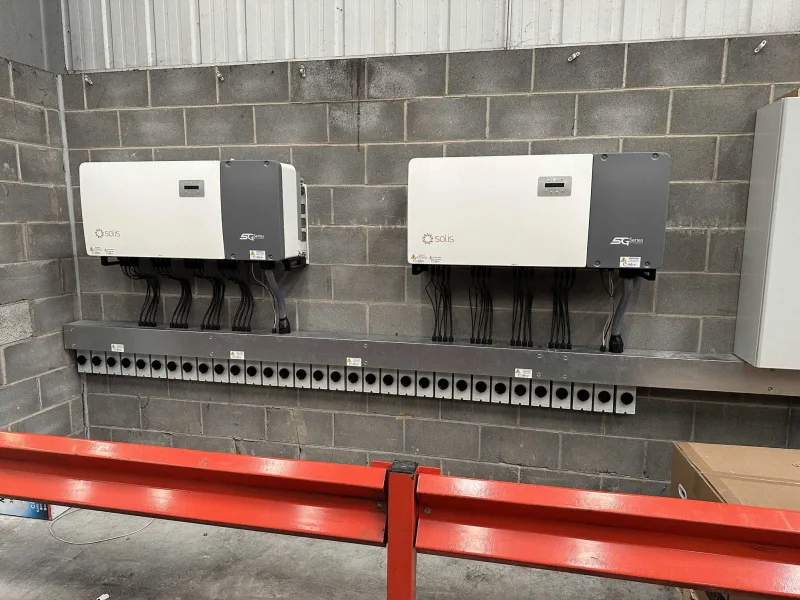
Solis EverCore and PrimePower commercial storage from Alectrona: S6 three-phase hybrid inverters with battery cabinets across a broad C&I range.
Read more -
SolaX
SolaX commercial storage for solar over 50 kWp, outside MCS: X3 three-phase hybrid inverters, Triple Power T58 batteries and the Trene C&I ESS cabinet.
Read more -
Fox ESS
Fox ESS for commercial solar storage over 50 kWp, outside MCS: H3 Plus and H3 Pro three-phase hybrids and the G-Max all-in-one cabinet, sized to your load.
Read more -
SolarEdge
SolarEdge Commercial Storage System and 50 kW battery inverter for UK commercial solar over 50 kWp. A listed name, warranty-confirmed per project. | Alectrona
Read more -
JA Solar
JA Solar BluePlanet liquid-cooled C&I storage, around 125 kW / 261 kWh, on commercial solar over 50 kWp. A large, well-capitalised maker. | Alectrona
Read more
What a battery is for
A commercial battery earns in more than one way. The jobs it does, from shaving the peak to lifting solar self-consumption, each sized to your load.
-
Peak shaving
How a commercial battery shaves peak demand: discharging at your highest-demand periods so the metered peak drops, cutting capacity and red-band DUoS charges.
Read more -
Time-of-use arbitrage
How time-of-use arbitrage works: charge off-peak when import is cheap, discharge at peak when it is dear, keep the spread. Where it pays. | Alectrona
Read more -
Solar self-consumption
How a commercial battery lifts solar self-consumption: store midday surplus for evening and morning use instead of exporting it cheaply. | Alectrona
Read more -
Backup power
How commercial battery backup works: a standard grid-tied BESS will not run you through an outage. Backup needs islanding and a critical-load circuit.
Read more -
Grid services
How a commercial battery can earn from flexibility and balancing markets, via an aggregator and subject to qualification. On top of on-site savings.
Read more -
Capacity Market
How the GB Capacity Market pays a commercial battery to be available, via T-4 and T-1 auctions and a de-rating factor set by duration. Upside, not guaranteed.
Read more -
Aggregators and VPPs
What a battery aggregator or VPP does: pools your battery to reach grid markets, stacks revenue, and pays a share. The contract model and what to look for.
Read more
Commercial battery storage: common questions
Not always. Solar alone is often the better first investment, because every unit you use as it is generated already offsets an expensive import. A battery earns when you have a clear job for it: a high metered peak to shave, a wide off-peak to on-peak tariff spread, a lot of solar being exported cheaply, or a need for backup. We will tell you honestly whether storage earns its place on your site.
We are brand-agnostic. We specify from the makers we supply through UK distribution, led by Sigenergy and including Sunsynk, Solis, SolaX, Fox ESS, SolarEdge and JA Solar, choosing the one that fits the project, the scale and your risk appetite, with the warranty confirmed before contract.
From the job it has to do. Peak shaving is sized on power and how long the peak lasts; arbitrage and self-consumption are sized on energy; backup is sized on the critical load and the duration you need to ride through. All of it comes from your half-hourly data and your solar profile, modelled before anything is bought.
The capital-allowances treatment of standalone battery storage is not settled in public HMRC guidance, so we do not make a blanket claim. Confirm the position for your business with a qualified accountant or tax adviser. We will give you the engineering and the indicative figures; the tax treatment is theirs to confirm.
There is no honest from-price, because the capital depends on the power and energy you need, AC or DC coupling, the brand specified, the connection conditions and the civils, and those are only known after a survey. So the cost is survey-led and the figure you receive is yours rather than a headline number. We set out how the capital breaks down on our battery costs page, and the return is modelled from your own half-hourly data on the ROI calculator. Any saving or payback we show is modelled and market-dependent, not promised.
Plan in months rather than weeks, and the grid connection is usually the longest part. A storage system that can export needs a G99 agreement with the distribution network operator, Northern Powergrid in our region, and that response can take some time and may carry conditions; we cover this on the grid connection queue guide. A sizeable outdoor or containerised system can also need full planning permission, set out on our planning page. We run the connection and planning in parallel with the design so the timeline is clear before you commit, and we give you a realistic programme once the survey defines the scheme.
It can, through grid services, the Capacity Market or being pooled by an aggregator, and on some sites that income stacks on top of the savings from peak shaving and self-consumption. We describe each route on grid services, the Capacity Market and aggregators and VPPs. The income is modelled and market-dependent rather than guaranteed, because the rates move with auctions and market conditions and eligibility carries conditions. Where it is part of your business case we model it against current conditions, flag it as a variable, and let your adviser sign off the assumptions.
For commercial storage we default to LFP, lithium iron phosphate, which has a better thermal and safety profile and a long cycle life that suits an asset cycling daily for years; we compare it with NMC on LFP vs NMC. Safety is engineered in layers: cells and systems certified to IEC 62619 and IEC 62933, continuous battery and energy management on the EMS, plus fire detection, separation and monitoring covered on fire safety. Larger outdoor systems often use a containerised BESS with suppression and thermal management built in.
Find out if storage earns its place on your site.
We model your half-hourly load and your solar against a battery sized from an on-site survey, so the figure you get is yours, not a from-price. No obligation, and an honest answer either way.
- Sized from your half-hourly load, not a per-kWh rule of thumb
- Brand-agnostic: the bankable battery that fits the project
- Engineer-led, assured to the non-MCS standard (CDM 2015)