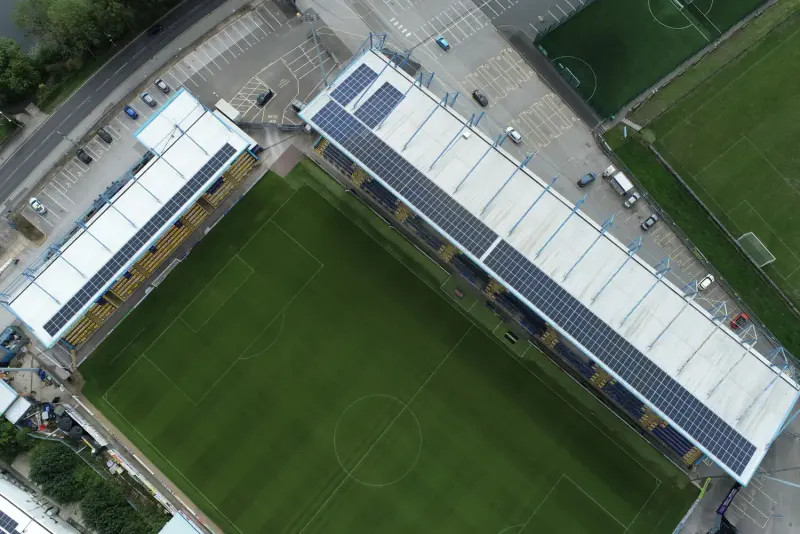
What set Alectrona apart was the documented design pack. We had quotes from three installers, but only Alectrona handed us a full set of drawings, a single-line diagram and a design referencing BS 7671 and the G99 connection process. The whole thing read like an engineering submission rather than a sales brochure. Our M&E consultant reviewed it and signed it off without a single query. That gave the board the confidence to release the capital.
Alectrona
Commercial guideMEES and EPC: how solar affects a commercial building's rating
On-site generation can improve a building's Energy Performance Certificate, which matters because the Minimum Energy Efficiency Standards (MEES) set a floor on the EPC rating a commercial property needs before it can be let.
- Commercial scale, over 50 kWp
- On-site 3D drone survey + PV*SOL
- Engineer-led, outside MCS
The feedback we work to earn
These are representative example reviews, not yet-collected customer feedback. They are written to illustrate the kind of feedback Alectrona aims to earn and are shown as design placeholders while we gather and verify reviews from our first commercial clients. Alectrona is the commercial solar trading brand of RVTC LTD.
Other firms priced our roof off a satellite image and a desktop guess. Alectrona flew an in-house drone survey, fully insured and flown by a qualified commercial drone pilot, and built a 3D model of the actual roof. It picked up plant, vents and a parapet line that a flat aerial photo had completely missed, which changed the panel layout. I would rather find that out at design stage than on the day the scaffold goes up. The accuracy of that survey is the reason I trusted everything that followed.
As a finance director I was wary of being oversold a system bigger than we could use. Alectrona modelled the array against our actual half-hourly consumption data rather than an annual total, so it is sized to what we genuinely draw on site during the day. They were honest that exporting surplus is worth far less than self-consumption, and built the design around that. The capital case stacked up because the engineering was honest, not because the numbers were inflated.
We were undecided between buying outright, leasing and a PPA. Alectrona laid out all three side by side with the pros and cons of each against our balance sheet, instead of pushing the one that pays them best. They were clear about where a PPA makes sense and where capex wins, and pointed us at our own accountant for the tax treatment. The survey and design took a little longer than I expected, but the thoroughness was worth the wait. Genuinely consultative.
The install crew were tidy and well run, and worked to a clear CDM 2015 plan with a proper site induction and RAMS. What impressed me most was the handover. We received a full commissioning pack with the IEC 62446-1 test results, certification, O&M documentation and an as-built record for our maintenance team. As the people who have to live with this asset for the next twenty years, having that paperwork in order matters enormously. Nothing was left loose.
I expected the usual hard sell and got the opposite. After surveying our site Alectrona told us one roof section was not worth covering because of shading, and that a smaller, well-sited array was the better investment than filling every square metre. There was no commission-driven upselling and no pressure. For a six-figure capital project, that straight talk is exactly what you want from the people advising you. We will be using them again on our second site.
- Applies to Let commercial property under MEES
- EPC scale A to G, from an accredited EPC assessor
- Minimum band Tightening over time; confirm the current band with your advisers
- Solar's effect Contributes to the rating; not guaranteed to move a band on its own
- Who confirms it EPC band by the assessor; we model generation
MEES / EPC for commercial solar
OrientationThis is a plain-English orientation for a commercial buyer, not formal legal or compliance advice; we confirm the specifics for your site and your advisers confirm the MEES and EPC position.
If you let commercial floorspace, the building's EPC rating is no longer a background compliance formality. Under MEES, an EPC below the minimum band can stop you granting or continuing a lease, which puts the rating on the same risk register as your other regulatory obligations.
Solar is one of the measures that moves an EPC rating. It is not the only one, and on its own it may not be enough, but for a finance or facilities director weighing a roof-mounted system, the effect on EPC and MEES compliance is a real part of the case alongside the energy bill saving.
What MEES and EPC actually are
An Energy Performance Certificate (EPC) rates a building's energy efficiency on an A to G scale, based on a modelled assessment of the fabric, services and on-site energy. It is produced by an accredited EPC assessor and is valid for a fixed period before it needs renewing.
The Minimum Energy Efficiency Standards (MEES) sit on top of that. MEES makes it unlawful, subject to exemptions, to let a commercial property whose EPC rating falls below a set minimum band. That minimum has been tightening over time, and further increases have been signalled for the future. The minimum band and the timing of any future change are policy that moves, so confirm the band that applies to your building, and what is coming, with your property advisers rather than relying on a fixed figure here.
How on-site solar can improve an EPC rating
An EPC is a model of the building rather than a meter reading. On-site renewable generation is one of the inputs the assessment recognises, so a roof-mounted PV array that supplies part of the building's demand can lift the modelled rating.
How much it moves the band depends on the building. A large array on an energy-intensive site with a poor starting rating can have a meaningful effect; a small system on an already-efficient building may move the number very little. The honest position is that solar contributes to the rating rather than guaranteeing a particular band, and the gain has to be assessed against your specific assessment inputs. The accredited EPC assessor confirms how a given array size translates to band movement for your building before you rely on it.
For that reason, solar is usually one part of a wider efficiency plan that may also cover lighting, controls, heating and building fabric. We can model the generation a roof can support; the EPC band outcome is confirmed by the accredited EPC assessor working from the building's full inputs.
Why landlords and asset owners care
For a landlord the EPC rating is a leasing constraint. A property that drops below the MEES minimum can become harder to let or to keep let, which affects rental income, void risk and asset value. Improving the rating protects the ability to transact.
- Lettability: a compliant EPC keeps the building available to let under MEES.
- Asset value: a stronger rating supports valuation and reduces the risk of a building becoming a stranded asset as the standard tightens.
- Enforcement: letting below the minimum without a valid exemption can expose the landlord to penalties, so the rating is a compliance item as well as a marketing one.
Solar that both lowers running costs and contributes to the EPC rating can therefore serve two parts of the business case at once. The size of each effect is specific to the building and the lease structure.
Where solar fits, and where it does not
Solar reduces the energy a building draws from the grid and feeds into the EPC model as on-site generation, so it helps on both the cost side and the rating side. It does not fix a building whose fabric or services are the real problem, and it cannot be assumed to move the band by a fixed amount.
Our role is the engineering: assessing the roof, the structural capacity and the connection, then specifying a system to recognised component and installation standards for systems above the MCS domestic scale. The EPC band itself is determined by an accredited EPC assessor, and MEES compliance is a legal question for your advisers. We size and build the array; we do not issue the certificate.
How does an EPC actually score on-site solar?
It helps to know what the assessment is doing under the bonnet, because that explains why the band movement is hard to promise in advance. A non-domestic EPC is produced using the government's Simplified Building Energy Model (SBEM) methodology, run through accredited software by a qualified non-domestic energy assessor. SBEM models the building's notional energy use for heating, cooling, ventilation, lighting and hot water, then expresses it as an asset rating on the A to G scale. On-site renewable generation is fed in as a deduction against that modelled energy demand, so a roof-mounted array reduces the net figure the rating is calculated from.
The mechanics matter because the array is credited against modelled demand rather than against your actual metered import. That is why a system sized closely to your real daytime load, the approach we set out in half-hourly metering, can read differently in the SBEM model than it does on your bill. The assessor enters the installed capacity and the system's expected contribution, and the software does the rest. Two buildings with the same array can land on different bands because their fabric, services and baseline demand differ. The single reliable way to know your number is to have the accredited assessor model the proposed system against the building's full SBEM inputs before you commit. The methodology and assessor accreditation rules sit with the Department for Energy Security and Net Zero and the approved accreditation schemes, so confirm the current SBEM version and conventions with your assessor rather than assuming a figure here.
What are the MEES exemptions, and how does solar interact with them?
MEES is not an absolute bar. The Energy Efficiency (Private Rented Property) (England and Wales) Regulations 2015, which underpin the commercial standard, allow a landlord to register an exemption on the government's PRS Exemptions Register in defined circumstances rather than carry out works. The detail and validity periods are policy that changes, so treat the following as orientation and confirm the live position with your property advisers and the register itself.
- All relevant improvements made: where the cost-effective measures available have been installed and the property still falls short, an exemption can apply.
- Seven-year payback test: a measure can be excluded from the required works if its expected payback exceeds a set threshold, assessed on the energy saving rather than on the wider commercial case.
- Third-party consent or devaluation: where a tenant, lender or planning authority withholds consent, or a measure would devalue the property beyond a set level, an exemption may be available.
Solar interacts with this in a practical way. Because an array contributes to the modelled rating, installing it can be part of demonstrating that relevant improvements have been made, or it can lift a building clear of the minimum so no exemption is needed. The payback test is assessed on the measure's own terms, which is a different question from your overall investment case. We keep these separate: we model the engineering and generation, your advisers handle the register entries and the legal tests. The broader return on the system is a finance question and stays gated to commercial finance, never asserted on a regulatory page like this one.
How does solar fit into a wider EPC improvement plan?
Solar rarely carries a band on its own, so it works best sequenced inside a fuller efficiency programme. The order usually matters: reducing demand first, through the building fabric and services, then sizing generation against the demand that remains, tends to give a cleaner SBEM result than bolting an array onto an inefficient building. A coordinated plan also avoids paying for a larger array than the load can justify.
- Lighting and controls: moving to LED with occupancy and daylight controls cuts a load the SBEM model weights heavily, often for a short payback.
- Heating and cooling: upgrading plant or moving away from electric resistance and older fossil systems changes the modelled energy mix the rating is built on.
- Fabric: insulation, glazing and air-tightness reduce the underlying demand before any generation is added.
- On-site generation: a PV array sized to the residual daytime load, confirmed against your roof through a structural roof survey and the usable area set out in how much roof space you need.
Where the daytime match is weak, storage can shift surplus generation into the demand rather than exporting it cheaply, though battery storage is treated separately in the SBEM model from the array itself. The same data that supports the EPC case also feeds your wider energy and carbon reporting, which we cover in social value and carbon reporting and in the ESOS and SECR context. Our part stays fixed: we assess the roof, structure and connection and specify the array to recognised component and installation standards above the MCS domestic scale, as set out in quality without MCS. The band itself is always the accredited assessor's determination.
Who does what, from survey to certificate?
An EPC-driven solar project pulls in several parties, and confusion over who owns which step is a common cause of delay. Setting the roles out plainly helps a finance or facilities director keep the project moving.
- Alectrona, a trading name of RVTC LTD: we carry out the roof, structural and connection assessment, model the generation against your demand, and specify and install the system. We provide the installed capacity and expected contribution figures the assessor needs.
- The non-domestic energy assessor: an independent accredited professional who runs the SBEM model, enters the array data and issues the EPC. They confirm the band, and we do not.
- Your property and legal advisers: they interpret MEES, advise on the minimum band that applies, and handle any PRS Exemptions Register entries.
- Your DNO, Northern Powergrid across Yorkshire and northern and north-east Lincolnshire: the network operator who governs the grid connection the array depends on, separate from the EPC question entirely.
Sequencing these well is what keeps the EPC outcome on track. A useful pattern is to involve the assessor early, so the proposed array can be modelled before installation rather than after, then book the formal EPC once the system is commissioned and its real configuration is fixed. We are happy to work alongside your assessor and advisers from the feasibility stage, sharing the system specification they need; the feasibility study guide explains how that early modelling fits into a project. None of this is legal or compliance advice, and the statutory thresholds, dates and methodology versions move, so confirm the current position with your own advisers before you rely on it.
Past the guide, this is how your figure actually gets set.
-
Survey On-site 3D drone survey
Our own insured pilot flies your roof and captures the real geometry and shading, so the design starts from your building instead of a satellite guess.
Booked to suit your operating hours
-
Model PV*SOL design and proposal
We model the array in bankable-grade software, size it around your daytime load, and set out generation, savings and payback across three funding routes.
Modelled, not promised
-
Install Engineered and installed
Designed and installed to BS 7671, commissioned to IEC 62446-1, connected under G99 and run under CDM 2015. Alectrona is typically the Principal Contractor.
Outside MCS, assured by the non-MCS stack
-
Aftercare Operations and maintenance
A 12-month defects period backed by an Insurance-Backed Guarantee, then ongoing operations and maintenance so the asset keeps earning for its full working life.
Kept performing, year on year
Last updated June 2026
MEES / EPC for commercial solar: common questions
Not automatically. On-site generation is one of the inputs an EPC assessment recognises, so solar can lift the modelled rating, but the amount depends on the building's starting point, its energy use and the size of the array. A large array on an energy-intensive site can have a meaningful effect, while a small system on an efficient building may move the number very little.
The reliable way to know is to have the accredited EPC assessor model the proposed system against the building's full inputs. We can tell you the generation a roof can support; the assessor confirms the band.
MEES sets a minimum EPC band below which a commercial property generally cannot be let, subject to exemptions, and that minimum has been tightening over time with further increases signalled. Because the exact band and the timing move as policy changes, we do not state a fixed figure here.
This is an orientation, not legal advice. Your property advisers can confirm the band that applies to your building today and what is coming.
Sometimes, but often it is one part of a wider plan. Solar contributes to the EPC rating and cuts grid demand, yet a building held back by its fabric, heating or lighting may need those addressed too. Treating solar as one measure within an efficiency programme is usually the safer assumption.
No. We design and build the solar array to recognised engineering and component standards for systems above the domestic MCS scale. The EPC itself is produced by an accredited EPC assessor, and MEES compliance is a legal matter for your own advisers.
We work alongside those parties by providing the system specification and expected generation they need to model the outcome.
There is no fixed figure, because the cost is driven by the array size your EPC and demand actually require, the roof and structure, and the grid connection, all of which differ by building. A system sized to lift a band sits within your wider efficiency spend rather than being a standalone EPC fee. The honest way to scope it is a survey-led proposal against your roof and load rather than a headline rate. Our commercial solar cost guide explains what shapes the figure, and any payback or return claim is kept to commercial finance.
Plan in months rather than weeks, and start well ahead of any MEES letting deadline. Feasibility and half-hourly data review take a few weeks, the structural and roof survey and a Northern Powergrid connection assessment add further lead time, and the install itself depends on system size and access. The formal EPC is issued by the accredited assessor after commissioning, so the certificate cannot be backdated to beat a deadline. Engaging the assessor early, alongside our feasibility study, is the surest way to leave room before the date you need to let.
Get the numbers for your roof.
A guide can only take you so far. The figure you get is modelled from your own half-hourly load and a system sized from the on-site drone survey. No obligation, and systems this size sit outside the domestic MCS scheme, so the assurance is the engineering stack.
- On-site 3D drone survey, fully insured in-house pilot
- Half-hourly load modelled in PV*SOL before anything is specified
- Engineer-led, assured to the non-MCS standard (CDM 2015)
- Capex, lease-purchase or PPA, whichever suits you