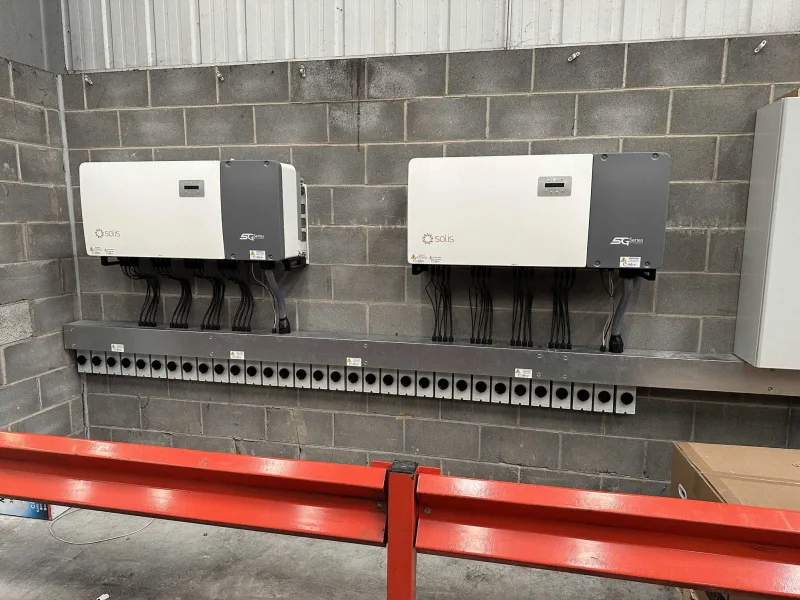
What set Alectrona apart was the documented design pack. We had quotes from three installers, but only Alectrona handed us a full set of drawings, a single-line diagram and a design referencing BS 7671 and the G99 connection process. The whole thing read like an engineering submission rather than a sales brochure. Our M&E consultant reviewed it and signed it off without a single query. That gave the board the confidence to release the capital.
Alectrona
ServiceEV charging, powered by your own solar and storage
We design and install the solar, storage and electrical infrastructure that powers commercial EV charging, and integrate the charge points into it. We are the energy side, sizing the supply, managing the load and handling the connection so charging earns its place on your site.
- Engineer-led, honest scope
- Sized from your half-hourly load
- Over 50 kWp, outside MCS
The feedback we work to earn
These are representative example reviews, not yet-collected customer feedback. They are written to illustrate the kind of feedback Alectrona aims to earn and are shown as design placeholders while we gather and verify reviews from our first commercial clients. Alectrona is the commercial solar trading brand of RVTC LTD.
Other firms priced our roof off a satellite image and a desktop guess. Alectrona flew an in-house drone survey, fully insured and flown by a qualified commercial drone pilot, and built a 3D model of the actual roof. It picked up plant, vents and a parapet line that a flat aerial photo had completely missed, which changed the panel layout. I would rather find that out at design stage than on the day the scaffold goes up. The accuracy of that survey is the reason I trusted everything that followed.
As a finance director I was wary of being oversold a system bigger than we could use. Alectrona modelled the array against our actual half-hourly consumption data rather than an annual total, so it is sized to what we genuinely draw on site during the day. They were honest that exporting surplus is worth far less than self-consumption, and built the design around that. The capital case stacked up because the engineering was honest, not because the numbers were inflated.
We were undecided between buying outright, leasing and a PPA. Alectrona laid out all three side by side with the pros and cons of each against our balance sheet, instead of pushing the one that pays them best. They were clear about where a PPA makes sense and where capex wins, and pointed us at our own accountant for the tax treatment. The survey and design took a little longer than I expected, but the thoroughness was worth the wait. Genuinely consultative.
The install crew were tidy and well run, and worked to a clear CDM 2015 plan with a proper site induction and RAMS. What impressed me most was the handover. We received a full commissioning pack with the IEC 62446-1 test results, certification, O&M documentation and an as-built record for our maintenance team. As the people who have to live with this asset for the next twenty years, having that paperwork in order matters enormously. Nothing was left loose.
I expected the usual hard sell and got the opposite. After surveying our site Alectrona told us one roof section was not worth covering because of shading, and that a smaller, well-sited array was the better investment than filling every square metre. There was no commission-driven upselling and no pressure. For a six-figure capital project, that straight talk is exactly what you want from the people advising you. We will be using them again on our second site.
Putting in EV charging is an electrical decision before it is a charging decision. Whether it is a fleet depot turning over vehicles overnight, staff charging through the working day, or customer charging on a forecourt, every point you add is a new load on a connection that may already be tight. Get the energy side right and charging becomes cheaper to run and simpler to expand. Get it wrong and you are paying for grid power at peak and waiting on a reinforcement.
Alectrona designs and installs the generation, storage and electrical infrastructure that sits behind your charging, and specifies and integrates the charge points into that design. We do not make charge points or run a charging network, and we do not bill your drivers. We make sure the supply is sized correctly, the load is managed, and the connection is handled so the hardware you choose has the power it needs.
Charging fits solar and storage, if it is designed that way
Commercial charging is one of the better loads to pair with on-site generation, because much of it is flexible and happens in daylight. Vehicles parked through the working day, depot fleets sitting on charge, and customer cars on a forecourt are all demand you can shape around when your own solar is producing. That is the self-consumption case: every unit a vehicle takes straight from your array offsets an expensive grid import instead of being bought at the meter.
A battery widens the window. It carries cheap midday solar into the morning and evening peaks when chargers are busy but the sun is low, and it smooths the spikes a bank of points creates so you draw less power at the most expensive times. Solar and the right tariff already compound; add storage and active load management and the charging can run for a large share of the day on power you generated rather than power you bought. How much depends on your charging pattern, your tariff and the array, so we model it for your site rather than quote a headline number.
This is why we look at generation, storage and charging as one design. A commercial battery sized to your half-hourly load, and where the geometry suits it a solar carport generating directly over the parking, change the economics of charging more than the choice of charge point does.
The capacity and connection reality
Adding EV charging adds load, and load is the part most charging quotes skate over. A run of fast chargers can ask for more power than the rest of your building combined, and on a constrained site the existing connection simply may not have the headroom. Finding that out after the points are ordered is the expensive way to find out.
So we treat charging the way we treat any large new load: with the same G99 and DNO connection thinking a solar and storage project needs. We assess your existing capacity, model the demand the chargers will create, and work out whether you can add them within your current connection, whether on-site solar, a battery and load management can keep you inside it, or whether a formal capacity application is the right move. Active load management, where the charging is curtailed or staggered against available power, often lets you add more points without reinforcing the supply. We set that case out on site, before anything is committed, so you are deciding on real numbers rather than a hopeful assumption.
What we do, and what we do not
Being clear about scope saves everyone time. Alectrona is the energy and electrical engineering side of your charging project. We design and install the solar array, the storage, the distribution, the protection and the connection works, and we specify and integrate the charge-point hardware into that design so the whole thing works as one system and is signed off to BS 7671. Because the sister operation Solar Tech Support works brand-agnostically, we are not tied to one charger manufacturer and can integrate the hardware that suits your vehicles, your software and your budget.
What we are not is a charge-point manufacturer or a charging-network operator. We do not build the points, run the back-office platform, or set and bill the price your drivers pay per session. Those decisions stay with you, often alongside a charging network partner, and we make sure the supply behind them is right. If you are electrifying a forecourt or a fleet, the natural starting point is often the building itself; our work for automotive dealerships shows how showroom-roof generation, storage and EV charging fit together on one site.
How a charging project runs with us
It starts with a site survey rather than a price. Our own qualified, insured pilot flies a 3D drone survey of the roof or canopy area, and we build the design in PV*SOL, the bankable-grade software lenders model against. From your half-hourly consumption and your intended charging pattern we size the solar, the storage and the supply together, assess the connection, and design the charging infrastructure around the load you actually have.
The result is a system designed to BS 7671, with the G99 connection arranged with the DNO and the work signed off by an AM2-trained Qualifying Supervisor. Because every figure comes from a model of your real site, the economics are yours rather than an average. We route the funding and the return through our commercial finance pages, where capex is the recommended route, and the ROI and payback guide. We do not publish a per-charge-point price, because the right answer depends on your site; the survey gives you the real one.
EV charging: common questions
We are the energy side. We design and install the solar, storage and electrical infrastructure that powers your charging, and we specify and integrate the charge-point hardware into that design so it works as one system. We are not a charge-point manufacturer or a charging-network operator, and we do not run or bill the charging sessions. The charge-point hardware, the back-office software and the tariff to drivers are yours to choose, often with a network partner, and we make sure the supply behind them is sized and built correctly.
It might, and that is exactly the question to answer before you commit. Chargers are a large new load, and on a constrained site the existing connection may not have the spare capacity. Adding capacity needs the same G99 and DNO connection thinking as a solar and storage project, which is why we look at generation, storage and charging together. On-site solar and a battery, plus active load management, can let you add charging within or close to your existing capacity and reduce or avoid a costly reinforcement. We assess the position on site rather than assuming it.
Vehicles parked through the working day are a flexible daytime load, which is the same window solar generates in. Charging directly from your own array means each unit offsets an expensive import rather than being bought from the grid, and a battery carries cheap midday solar into the morning and evening peaks. The exact saving depends on your charging pattern, your tariff and the array size, so we model it for your site rather than quoting a headline figure.
Yes. Through the sister operation Solar Tech Support we work brand-agnostically, so we can survey an existing solar or storage system, confirm what spare electrical capacity is available and design the charging infrastructure to integrate with it. If the system needs attention first, we will tell you that straight before adding load to it.
It is survey-led, so we do not publish a price or a per-charge-point figure. The cost depends on the number and rating of the points, the cable runs and groundworks, whether the connection needs reinforcing, and how much solar and storage sits behind it. We survey the site, model the design, and route the economics through our commercial finance pages and the ROI guide so you see real numbers for your building rather than an average.
The honest answer is that your grid connection sets the pace. A survey-led design takes a matter of weeks: the drone survey, the PV*SOL model of the solar, storage and supply, and the load assessment. The variable that decides the overall timeline is the connection. If the chargers sit inside your existing capacity, or solar, a battery and active load management keep you inside it, the work can move quickly to installation. If a formal G99 capacity application or a reinforcement is needed, the lead time is set by your Distribution Network Operator's process rather than by us, and that can run to months. We assess the connection early and on site, before anything is committed, so you know which case you are in from the start rather than discovering a reinforcement after the points are ordered. The charge-point hardware and any back-office software have their own lead times, which sit with the manufacturer and your network partner; we sequence the energy and electrical works around them so the supply is ready when the points arrive.
Tell us what the building needs to do.
Whether it is charging, a tariff question, a funding route or a failed inverter, we start from your site and your load, model it, and come back with an honest answer rather than a from-price.
- Engineer-led, sized from your half-hourly load
- Capex-first, with the honest read on every funding route
- Brand-agnostic, assured to the non-MCS standard (CDM 2015)