Skip to content
07944 877 329 hello@alectrona.solar

Alectrona

Commercial solar panels · over 50 kWp · outside MCS

The panels we specify, and exactly what makes them bankable.

A lender will not finance a system on a brand it cannot stand behind. So on every commercial roof we specify panels with a sourced financeability credential, and we name the scheme, the grade and the quarter rather than leaning on a legacy badge.

Here is how a module is chosen, the two we lead with, and a straight explanation of what "bankable" and "Tier 1" actually mean.

  • BloombergNEF Tier 1, scheme and quarter named
  • SMSL heritage shown in the past tense only
  • Re-verified for the exact module before contract
01 How we choose a panel

We specify panels a lender will finance. Bankability is led by BloombergNEF Tier 1, with the scheme and quarter named.

Our modules are sourced from globally significant, independently assessed manufacturers, and we are precise about what each credential means. Several of our supply partners are long-established, top-tier crystalline-silicon makers that PV-Tech historically classified as members of the Silicon Module Super League (SMSL), the analyst grouping of the world’s largest module manufacturers from 2015 to 2019. These include LONGi, JA Solar, JinkoSolar, Trina Solar, Canadian Solar and Hanwha Qcells. We also specify premium, high-efficiency brands that were never part of that grouping and we do not label them as such; Aiko (a BloombergNEF Tier 1 maker and pioneer of N-type ABC back-contact modules) and REC (a premium heterojunction manufacturer, owned by Reliance Industries, with a long record as a Kiwa PVEL Top Performer through 2024). The SMSL is a measure of scale and heritage, not a quality, safety or bankability certification; its own author was explicit that it was never a bankability measure. For current trust we therefore lead with live, independent frameworks: BloombergNEF Tier 1 for financeability, PV ModuleTech Bankability Ratings, and Kiwa PVEL and RETC scorecards for reliability. We name the specific scheme, grade and quarter for the exact module we propose, rather than relying on legacy badges.

For a financier or finance director, bankability is the confidence that a module maker is financially strong enough to honour 25 to 30 year warranties and that its panels are accepted in bank-financed projects. Lenders finance bankable, Tier 1 panels, so we specify them. The independent benchmark we cite is the BloombergNEF Tier 1 PV Module Maker List, a financeability indicator: a maker qualifies by supplying own-brand modules to at least six utility-scale projects (each over 10 MW under the current methodology), non-recourse financed by six different commercial banks, within roughly the prior two years. On the current Q1 2026 list this includes LONGi, JinkoSolar, Trina Solar, JA Solar, Canadian Solar and Aiko. We will confirm the exact quarter’s listing for the proposed module before contract. Two essential caveats: BNEF Tier 1 measures financing track record only, not module quality, efficiency or durability (reliability is assessed separately by Kiwa PVEL and RETC, and broader financial strength by PV ModuleTech AAA to B grades, where LONGi, Trina and JA Solar hold AAA); and JinkoSolar was removed from the BNEF Tier 1 list in Q2 2024 over a minor unresolved legal matter and subsequently reinstated, so we describe its current listing rather than an unbroken record. Where a brand is not a verifiable BNEF Tier 1 supplier (for example REC, a premium, Reliance-backed heterojunction maker), we position it on its genuine merits and do not claim Tier 1 status. Note also that the S&P Global Tier 1 Cleantech Company status held by Hanwha Qcells is a separate scheme from the BloombergNEF Tier 1 list and we keep the two distinct.

We specify modules from 10 independently assessed makers, so the right module is chosen for your roof rather than the one a salesperson is pushing. We name the specific scheme, grade and quarter for the exact module we propose, and re-verify it before contract.

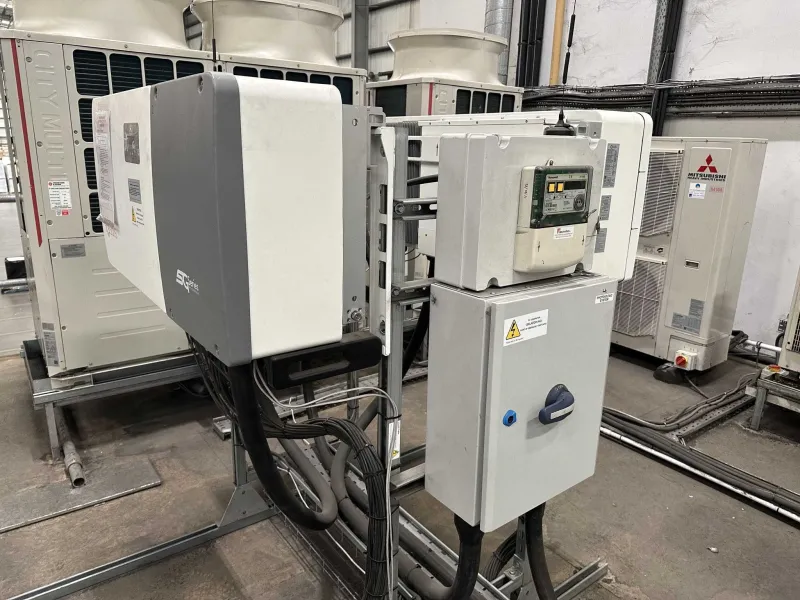
Operations and maintenance on a commercial solar system

The right module for the roof, not the one a salesperson is pushing.

02 The roster

Which module ends up on the roof is settled after the survey. Every maker we specify has one page, covering everything it supplies to us.

We specify modules from ten manufacturers, and the corporate history, the ownership, the manufacturing footprint, the warranty terms and the honest caveats for each are written once, on that maker’s own page, rather than summarised into a card here. A maker that also supplies inverters or storage has one page covering all of it, because it has one balance sheet and one warranty operation. The full roster sits at the manufacturer directory, which filters to modules, and the conversion and storage sides of the same design have their own pages.

Two rules hold wherever a scheme lands. Silicon Module Super League is shown as the historical scale grouping it was, from 2015 to 2019, and never as a live badge. And a BloombergNEF Tier 1 line always names the quarter, is re-verified for the exact module before contract, and is never attached to an inverter or a battery, because the scheme rates PV modules and nothing else. Where a maker is not on that list we say so and position it on its genuine merits instead. What each of those credentials is, and what it is not, is set out in the bankable and Tier 1 explained guide.

03 The two we lead with

A high-efficiency flagship, and a value workhorse.

Aiko is the premium back-contact module we size the array around when roof space or yield is the constraint. JA Solar is the bankable value module that earns its place on larger, simpler roofs. We choose between them on your geometry, not on a margin.

  • Flagship module Aiko Solar

    Aiko 665W Stellar 3N+ N-type ABC Dual-Glass (72-cell)

    N-type ABC (All Back Contact), dual-glass

    • 24.6%Efficiency
    • 665 WPower
    • 15 yrProduct warranty
    • 30 yrPerformance warranty
    • N-type ABC back-contact: among the highest-efficiency commercial silicon (this SKU 24.6%, the series to 25.5%)
    • Cell-level partial-shade optimisation, so a shaded cell costs less yield than on a conventional module
    • A 15-year product warranty against the usual 12, and a -0.26%/°C temperature coefficient for warm-roof performance
  • JA Solar

    JA Solar 610W N-type TOPCon Bifacial Double-Glass (72-cell)

    N-type TOPCon (MBB, double-glass bifacial)

    • 23.1%Efficiency
    • 610 WPower
    • 12 yrProduct warranty
    • 30 yrPerformance warranty
    • N-type TOPCon cells: lower light-induced degradation and a stronger temperature coefficient than PERC
    • Double-glass bifacial, with rear-side gain on reflective commercial roofs and a 30-year linear-output warranty
    • A strong-value choice for larger, simpler arrays
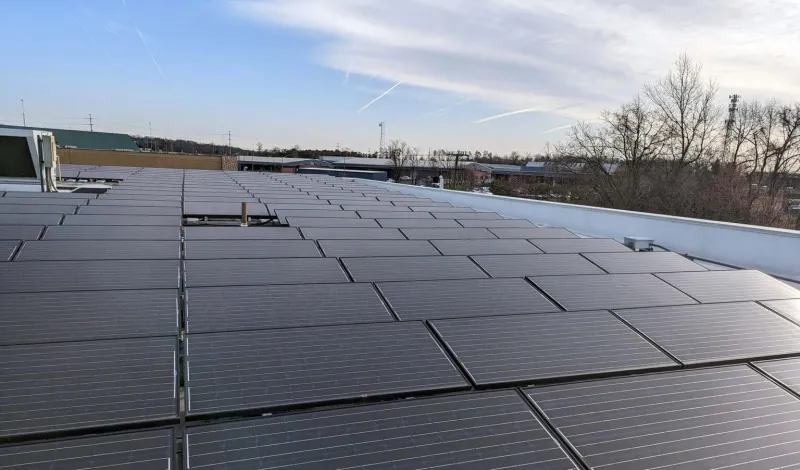
A large solar array across a flat commercial membrane roof in winter light

Bankable by design, reliable by test.

04 The honest version

What "bankable" and "Tier 1" actually mean. What a lender is actually checking before it finances a module.

On a commercial roof the panel brand is a financeability question before a performance one. The trust signal is bankability, led by BloombergNEF Tier 1 with the scheme and the quarter named, and re-verified for the exact module before contract. Tier 1 is a financeability heuristic, not a guarantee of quality, so we cite independent reliability testing separately and show Silicon Module Super League heritage in the past tense.

Read the full guide on what bankable and Tier 1 mean

BloombergNEF, "Tier 1 Solar Module Methodology", 18 March 2026. Public methodology PDF at assets.bnef.com/public/tiering/solarmodules.pdf. Paraphrased and attributed; never reproduced.

FAQ

Common questions about commercial solar panels

We specify ten commercial panel brands and stay agnostic between them: JA Solar, LONGi, JinkoSolar, Canadian Solar, Trina Solar, Aiko Solar, Q Cells, REC, Astronergy and DMEGC Solar. Each carries its own honest status, from BloombergNEF Tier 1 with the quarter named to premium specialists, and we match the module to your roof rather than to a single supplier.
No. We are brand-agnostic and earn nothing extra from one maker over another. The module is chosen from the survey and the PV*SOL model to suit your roof geometry, shading and load, then named with its scheme, grade and quarter and re-verified before contract. The decision follows the roof, not a supplier deal.
We lead with two high-output modules: the Aiko 665W back-contact module for constrained roofs where yield per square metre matters, and the JA Solar 610W bifacial module as the bankable value choice on larger, simpler roofs. Both carry full datasheet specifications on their brand pages, with no price. Your figure comes from the survey and the model.
Yes. If your preferred module clears the same bankability and reliability bar we hold every brand to, we will specify it and confirm its current status before contract. Where a requested brand does not meet that bar for a system over 50 kWp, we will tell you plainly and set out the alternatives rather than fit it quietly.
It depends on the roof. Bifacial modules pick up reflected light from the surface behind the array, so they earn their place on a high-reflectance flat roof or a ground-mount with a light surface, and add little on a dark, tightly packed pitched roof. We model the gain for your specific roof in PV*SOL rather than assume it, and specify bifacial only where it pays.
We confirm live availability and the current bankability quarter for the exact module before contract, not at quote stage, because distributor stock and tier status both move. If the specified module cannot be sourced as bankable stock when you build, we name an equivalent from the same line-up and confirm its status in writing rather than substituting quietly.
The panel itself is a small part of the figure, so we do not quote from a price list. The number comes from the on-site survey and a PV*SOL model run against your half-hourly load, taking in your roof, mounting, inverters, the DNO connection and any storage. You receive a costed proposal with the bankable module named, and we can set out the finance routes alongside it.
Get a commercial quote

Get the right panel specified for your roof.

Tell us about your building and your electricity use. We will survey the roof, model it in PV*SOL, and specify a bankable module with the scheme, grade and quarter named.

  • A bankable module, scheme and quarter named
  • Re-verified for the exact module before contract
  • Independent reliability scorecards cited alongside Tier 1
  • On-site 3D drone survey and PV*SOL modelling on every quote