Skip to content

Alectrona

Commercial guide

Why does the grid connection queue hold up commercial solar?

A commercial array has to agree how it connects to the network, and on a constrained part of the grid that offer can take time. A well-judged export design often keeps the project moving without waiting on reinforcement.

  • Commercial scale, over 50 kWp
  • On-site 3D drone survey + PV*SOL
  • Engineer-led, outside MCS
Reviews

The feedback we work to earn

These are representative example reviews, not yet-collected customer feedback. They are written to illustrate the kind of feedback Alectrona aims to earn and are shown as design placeholders while we gather and verify reviews from our first commercial clients. Alectrona is the commercial solar trading brand of RVTC LTD.

What set Alectrona apart was the documented design pack. We had quotes from three installers, but only Alectrona handed us a full set of drawings, a single-line diagram and a design referencing BS 7671 and the G99 connection process. The whole thing read like an engineering submission rather than a sales brochure. Our M&E consultant reviewed it and signed it off without a single query. That gave the board the confidence to release the capital.

Estates Manager, academy trust (Yorkshire)

Other firms priced our roof off a satellite image and a desktop guess. Alectrona flew an in-house drone survey, fully insured and flown by a qualified commercial drone pilot, and built a 3D model of the actual roof. It picked up plant, vents and a parapet line that a flat aerial photo had completely missed, which changed the panel layout. I would rather find that out at design stage than on the day the scaffold goes up. The accuracy of that survey is the reason I trusted everything that followed.

Facilities Manager, distribution centre (East Midlands)

As a finance director I was wary of being oversold a system bigger than we could use. Alectrona modelled the array against our actual half-hourly consumption data rather than an annual total, so it is sized to what we genuinely draw on site during the day. They were honest that exporting surplus is worth far less than self-consumption, and built the design around that. The capital case stacked up because the engineering was honest, not because the numbers were inflated.

Finance Director, logistics group (North West)

We were undecided between buying outright, leasing and a PPA. Alectrona laid out all three side by side with the pros and cons of each against our balance sheet, instead of pushing the one that pays them best. They were clear about where a PPA makes sense and where capex wins, and pointed us at our own accountant for the tax treatment. The survey and design took a little longer than I expected, but the thoroughness was worth the wait. Genuinely consultative.

Property Director, retail park (West Midlands)

The install crew were tidy and well run, and worked to a clear CDM 2015 plan with a proper site induction and RAMS. What impressed me most was the handover. We received a full commissioning pack with the IEC 62446-1 test results, certification, O&M documentation and an as-built record for our maintenance team. As the people who have to live with this asset for the next twenty years, having that paperwork in order matters enormously. Nothing was left loose.

Operations Director, food manufacturer (Lincolnshire)

I expected the usual hard sell and got the opposite. After surveying our site Alectrona told us one roof section was not worth covering because of shading, and that a smaller, well-sited array was the better investment than filling every square metre. There was no commission-driven upselling and no pressure. For a six-figure capital project, that straight talk is exactly what you want from the people advising you. We will be using them again on our second site.

Managing Director, engineering firm (Sheffield)

  • Applies to Commercial solar over 50 kWp connecting to the local network
  • Who decides timescale The Distribution Network Operator and local network capacity, not the installer
  • Main design fork Full export versus export-limited or zero-export
  • Why export limiting helps It can avoid network reinforcement and shorten the connection path
  • Our input Half-hourly load modelling sizes the system and frames the export route
01 The short version

Grid-connection queue

OrientationThis is a plain-English orientation for a commercial buyer, not formal advice; we confirm the connection specifics with your network operator for your site.

Before a commercial solar system can run, the network operator that owns the local cables and substation has to agree how it connects. For most rooftop arrays over 50 kWp that means a formal application to the Distribution Network Operator (DNO), and the answer comes back as a connection offer. On a healthy part of the network the offer is straightforward. On a constrained part it can take longer, and the terms can carry a cost or a delay you need to know about before you commit capital.

This guide explains why connection offers take time, what the queue and network capacity constraints actually are, and the design choice that most often gets a project moving: a full export connection versus an export-limited design that avoids triggering network reinforcement. The aim is to let a finance or facilities director read a connection position with open eyes, so the grid question is answered before it becomes a programme risk. It is a plain-English orientation, not formal advice; we confirm the specifics with your network operator for your site.

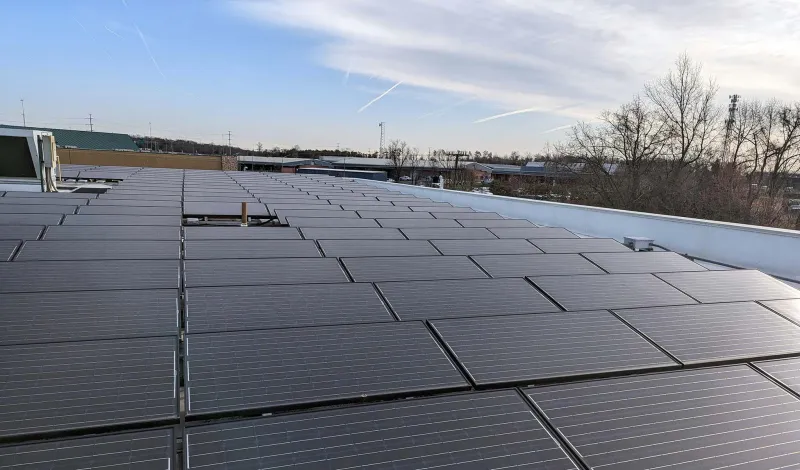
Commercial rooftop solar, the subject of this guide: Grid-connection queue
Engineer-led commercial solar over 50 kWp, sized to your load.
02

Why a connection offer can take time

The local distribution network was built to deliver power to buildings, not to receive it back from many generators. When a solar system exports, it pushes power the other way, and the DNO has to confirm the local cables, transformers and protection can handle that without pushing voltage or fault levels outside safe limits. That assessment takes engineering time, and it has to consider other generation already connected or already accepted in the area.

Where there is plenty of spare network capacity, the DNO can usually offer a connection quickly. Where the local network is already carrying a lot of generation, the assessment is more involved, and the offer may depend on work the DNO needs to do first. The timescale is set by the network operator and the state of the local network, not by the installer, so the honest answer to “how long” is that it depends on where you are connecting and what is already connected near you.

03

The queue and network capacity constraints

Connection applications are assessed broadly in the order they are made, against the capacity that is physically available on that part of the network. If earlier applications have already taken the headroom, a later project can find that the cheap, fast connection is gone and a larger piece of network work would be needed to accommodate full export. That is what people mean by the connection queue: you are waiting your turn for capacity, and your position depends on what sits ahead of you.

When the available capacity is used up, the DNO may quote network reinforcement, meaning an upgrade to cables, a transformer or a substation so the network can carry the extra generation. Reinforcement can carry a real cost and a real lead time, both of which the DNO sets. The key point for a buyer is that a constrained connection is not a dead end. It is a fork in the design, and the route you take is a commercial decision as much as a technical one.

04

Full export versus export-limited design

A full export connection lets the system send any surplus generation back to the grid without a cap. It is the right answer where the network has the headroom and where exported units add enough value to justify any wait or reinforcement cost. The trade-off is that it is the design most exposed to the queue, because it asks the most of the network.

An export-limited design caps how much the system can send back, often to a set figure or to zero, using an export limitation device that throttles the inverters so the agreed limit is never breached. Because it asks little or nothing of the network on the export side, it can sidestep the capacity assessment that drives reinforcement and shorten the path to a connection. For many commercial sites this fits the economics anyway, because a well-matched system is sized to be used on site rather than exported, and self-consumed power is usually worth more than an exported unit. Where exported units would only ever be a small, low-value tail, capping export to protect the programme is often the stronger commercial call.

  • Full export: no cap, best where network capacity exists and exported value is worth the offer.
  • Export-limited or zero-export: a capped or no-export design that can avoid reinforcement, suited to sites that self-consume most of their generation.
The design fork
Full export

No cap on what goes back

The system sends any surplus generation back to the grid without a cap. The right answer where the network has the headroom and exported units add enough value to justify any wait or reinforcement cost.

  • Best where network capacity exists and exported value is worth the offer
  • Asks the most of the network, so it is the design most exposed to the queue
  • Can carry a reinforcement cost and lead time where capacity is used up
Export-limited or zero-export

A capped or no-export design

An export limitation device throttles the inverters so the agreed limit is never breached. Because it asks little or nothing of the network on the export side, it can sidestep the capacity assessment that drives reinforcement.

  • Suited to sites that self-consume most of their generation
  • Can avoid reinforcement and shorten the path to a connection
  • Protects only a small, low-value export tail on a well-matched system
05

How Alectrona designs around the queue

We treat the grid connection as a design input that shapes the system from the start. The starting point is your half-hourly consumption data modelled against generation for your exact roof, which tells us how much of the array’s output would be used on site and how much would ever look for an export route. That self-consumption figure is what makes the export decision concrete rather than guessed.

From there we frame the connection route honestly. Where the network has headroom and full export earns its keep, we design for it. Where the queue or a reinforcement quote would stall the project, we look at an export-limited or zero-export design that holds the same on-site benefit while keeping the connection straightforward. The application itself follows the relevant connection process for the system size, with the protection and export limitation specified to the DNO’s requirements. We tell you the trade-off in plain terms before anything is committed, and we confirm the actual connection position with your network operator for your specific site rather than assuming it.

06

How is the national connections queue being reformed, and what does it mean for my project?

The connection queue is not only a local question of who applied first on your street. Across Great Britain the transmission and distribution queues had grown to a backlog measured in hundreds of gigawatts of accepted-but-not-yet-built projects, far more than the network can carry, and the rules for managing that backlog have been overhauled. The National Energy System Operator (NESO), working with the energy regulator Ofgem, has moved the process away from a pure date-order queue toward a model that prioritises projects that are ready to proceed and that align with strategic network need. The reform package commonly referenced as the connections queue reform, and the associated grid code modification taken through Ofgem, reorders the basis on which capacity is allocated.

The practical shift for a buyer is the move from first come, first served toward first ready, first connected. Under the older model a position in the queue could be held by a project that had stalled, blocking capacity for schemes that were genuinely ready to build. The reformed approach asks projects to demonstrate readiness, for example evidence of land rights and planning progress, before they keep their place. For a commercial rooftop array this is usually a help rather than a hindrance, because a real building with a real load and a funded scheme is, by definition, a ready project. It also means a connection position cannot be treated as a permanent reservation, so the timing of your application against your wider programme matters more than it used to. Because the detail of these reforms continues to move, we confirm the current position with your network operator rather than stating a reform milestone as settled, in keeping with the orientation purpose of this guide.

07

What does a DNO connection application and offer actually involve?

For a site in the Yorkshire, north and north-east Lincolnshire region the distribution network operator is Northern Powergrid, and a commercial array above the light-touch notification threshold connects under ENA Engineering Recommendation G99, the framework published by the Energy Networks Association that governs how generation connects to and exports onto the network. The application is not a single form. It is a technical submission describing the generation you intend to connect, the inverters and their protection settings, the proposed point of connection and the export arrangement, assessed by the operator against the state of the local network. The depth of that assessment scales with the size and connection voltage of the scheme, a point we set out in our G99 application guide.

What comes back is a connection offer: a document that states the capacity the operator will permit, any conditions attached to it, any network reinforcement it considers necessary, and the associated cost and indicative timescale. The offer carries a fixed acceptance window and a price that holds only for that window, so it has to be acted on rather than left open while other decisions catch up. Before signing, the figures worth checking are the permitted export capacity against your modelled surplus, whether any reinforcement is attributed to your project, the protection and metering obligations, and any commissioning conditions that gate switch-on. Who the operator is, and why their permission sits ahead of your supplier arrangements, is explained in our DNO explained guide, and the metering that underpins the export side is covered in half-hourly metering. We read the offer with you and translate its conditions into plain commercial terms before any capital is committed.

08

Can battery storage or a behind-the-meter design get a project past a constrained connection?

Where the network has no export headroom, the lever that most often frees a stalled scheme is to change what the site asks of the grid rather than to wait for the grid to change. An export-limited or zero-export design caps what leaves the boundary, and the device that enforces that cap is governed by ENA Engineering Recommendation G100, the standard for export limitation schemes. Because a G100 scheme demonstrates to the operator that the agreed limit cannot be breached, it can let a larger array connect on a constrained network than a full-export application would allow. The detail of how that limitation is engineered and witnessed is set out in our export limitation and G100 guide.

Battery storage strengthens the same argument. A battery lets the site absorb generation that would otherwise have to be exported, shifting solar produced at midday into the late-afternoon and evening load, which raises self-consumption and shrinks the surplus the connection ever has to carry. On a capacity-constrained part of the network that can be the difference between a quick connection and a reinforcement quote, and it does so while keeping the energy on site, where a self-consumed unit is generally worth more than an exported one. The way storage reshapes the load profile is covered across our commercial battery storage pages. None of this is a blanket recommendation, because a battery has its own capital cost and its own payback case; whether it earns its place on a given site is a question we settle from your half-hourly data, not from a rule of thumb, and the wider numbers are framed under commercial finance.

09 How we quote

Past the guide, this is how your figure actually gets set.

  1. Survey

    On-site 3D drone survey

    Our own insured pilot flies your roof and captures the real geometry and shading, so the design starts from your building instead of a satellite guess.

    Booked to suit your operating hours

  2. Model

    PV*SOL design and proposal

    We model the array in bankable-grade software, size it around your daytime load, and set out generation, savings and payback across three funding routes.

    Modelled, not promised

  3. Install

    Engineered and installed

    Designed and installed to BS 7671, commissioned to IEC 62446-1, connected under G99 and run under CDM 2015. Alectrona is typically the Principal Contractor.

    Outside MCS, assured by the non-MCS stack

  4. Aftercare

    Operations and maintenance

    A 12-month defects period backed by an Insurance-Backed Guarantee, then ongoing operations and maintenance so the asset keeps earning for its full working life.

    Kept performing, year on year

10 FAQ

Grid-connection queue: common questions

It depends on where you are connecting and how much generation is already on that part of the network. On a network with spare capacity an offer can come back quickly. On a constrained network the assessment is more involved and the offer may depend on work the operator needs to do first. The timescale is set by the network operator, so we confirm the real position for your site rather than quoting a figure that may not apply.

Reinforcement is an upgrade to the local cables, a transformer or a substation so the network can carry extra generation when the existing capacity is used up. The Distribution Network Operator quotes the cost and the lead time, and both can be significant. The point of an export-limited design is to ask little or nothing of the network on the export side, which can avoid triggering reinforcement altogether.

Usually very little, because the savings on a well-matched commercial system come mainly from using the power on site to offset imported units, not from exporting. An exported unit is typically paid less than the unit you would otherwise buy. Where a system self-consumes most of its generation, capping or removing export protects only a small, low-value tail. We model your half-hourly load first so the export decision is made on your real numbers.

It can, which is why we treat it as a design input from the start rather than discovering it late. By modelling self-consumption early, we can often choose a connection route, including an export-limited design, that keeps the programme moving without waiting on reinforcement. We frame the trade-off in plain terms and confirm the connection position with your network operator before capital is committed.

Get a commercial quote

Get the numbers for your roof.

A guide can only take you so far. The figure you get is modelled from your own half-hourly load and a system sized from the on-site drone survey. No obligation, and systems this size sit outside the domestic MCS scheme, so the assurance is the engineering stack.

  • On-site 3D drone survey, fully insured in-house pilot
  • Half-hourly load modelled in PV*SOL before anything is specified
  • Engineer-led, assured to the non-MCS standard (CDM 2015)
  • Capex, lease-purchase or PPA, whichever suits you