What set Alectrona apart was the documented design pack. We had quotes from three installers, but only Alectrona handed us a full set of drawings, a single-line diagram and a design referencing BS 7671 and the G99 connection process. The whole thing read like an engineering submission rather than a sales brochure. Our M&E consultant reviewed it and signed it off without a single query. That gave the board the confidence to release the capital.
Alectrona
Commercial solar guidesThe commercial solar questions, answered plainly.
Orientation for a finance or facilities director looking at solar over 50 kWp: the grid process, the compliance that replaces MCS at this scale, and how the cost and returns actually work. Guides, not a sales pitch.
- Plain English, not jargon
- Over 50 kWp, outside MCS
- Orientation, not advice
The feedback we work to earn
These are representative example reviews, not yet-collected customer feedback. They are written to illustrate the kind of feedback Alectrona aims to earn and are shown as design placeholders while we gather and verify reviews from our first commercial clients. Alectrona is the commercial solar trading brand of RVTC LTD.
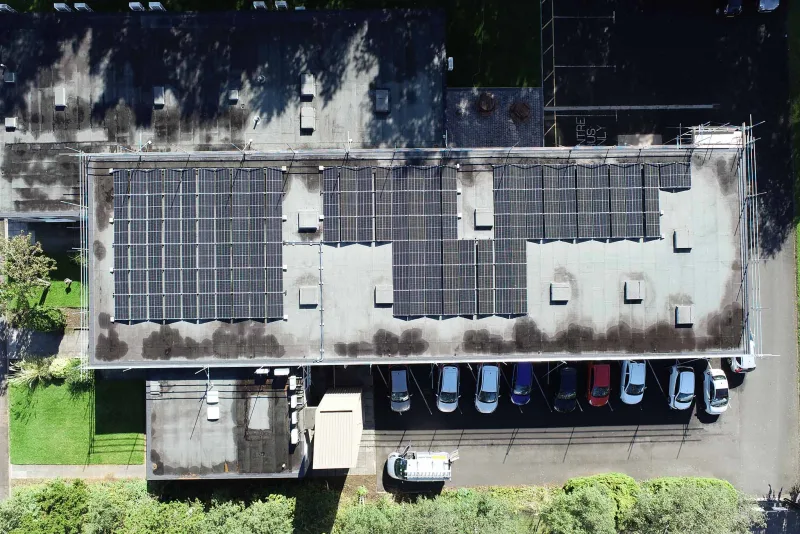
Other firms priced our roof off a satellite image and a desktop guess. Alectrona flew an in-house drone survey, fully insured and flown by a qualified commercial drone pilot, and built a 3D model of the actual roof. It picked up plant, vents and a parapet line that a flat aerial photo had completely missed, which changed the panel layout. I would rather find that out at design stage than on the day the scaffold goes up. The accuracy of that survey is the reason I trusted everything that followed.
As a finance director I was wary of being oversold a system bigger than we could use. Alectrona modelled the array against our actual half-hourly consumption data rather than an annual total, so it is sized to what we genuinely draw on site during the day. They were honest that exporting surplus is worth far less than self-consumption, and built the design around that. The capital case stacked up because the engineering was honest, not because the numbers were inflated.
We were undecided between buying outright, leasing and a PPA. Alectrona laid out all three side by side with the pros and cons of each against our balance sheet, instead of pushing the one that pays them best. They were clear about where a PPA makes sense and where capex wins, and pointed us at our own accountant for the tax treatment. The survey and design took a little longer than I expected, but the thoroughness was worth the wait. Genuinely consultative.
The install crew were tidy and well run, and worked to a clear CDM 2015 plan with a proper site induction and RAMS. What impressed me most was the handover. We received a full commissioning pack with the IEC 62446-1 test results, certification, O&M documentation and an as-built record for our maintenance team. As the people who have to live with this asset for the next twenty years, having that paperwork in order matters enormously. Nothing was left loose.
I expected the usual hard sell and got the opposite. After surveying our site Alectrona told us one roof section was not worth covering because of shading, and that a smaller, well-sited array was the better investment than filling every square metre. There was no commission-driven upselling and no pressure. For a six-figure capital project, that straight talk is exactly what you want from the people advising you. We will be using them again on our second site.
What these guides are, and what they are not.
A commercial solar project runs on engineering and process, not a brochure. These guides explain the parts that decide whether a system gets built, gets connected and earns its place: the grid application, the assurance stack that stands in for MCS above 50 kWp, and the honest version of cost and payback.
They are orientation, written to get a commercial buyer up to speed before the survey, not formal advice for a specific site. Every figure that matters to your building, the system size, the cost and the return, comes from an on-site drone survey and a half-hourly model, not from a guide. Where a guide touches tax or finance, confirm the position with your own adviser.
Guides by topic.
Connecting to the grid
A system over 50 kWp connects through your Distribution Network Operator, not a domestic notification. These guides orient you on the process before the application goes in.
-
G99 application
What G99 means for a commercial solar export connection: how the DNO assesses your system, why a larger array needs a full application, and where G100 fits.
Read the guide -
Grid-connection queue
Why a DNO connection offer can take time, what network capacity limits commercial solar, and how an export-limited design can avoid the queue.
Read the guide -
DNO explained
What a Distribution Network Operator is, how the regional DNO model works, and why every commercial solar project needs DNO sign-off before it can connect.
Read the guide -
G100 export limitation
What G100 export limitation means for commercial solar: how an agreed or zero export limit lets a constrained network grant a connection, distinct from G99.
Read the guide -
Network charges (DUoS, TNUoS)
What DUoS and TNUoS network charges are, why self-consumed solar reduces the units you import, and why they grow material on larger commercial systems.
Read the guide -
How long installation takes
A realistic end-to-end timeline for a commercial solar install over 50 kWp: survey, design, the G99 DNO application, procurement, install and commissioning.
Read the guide
Compliance and assurance
MCS is a domestic-scale scheme; commercial systems are assured by a different stack. Planning, fire safety, construction duties and how a system is signed off without MCS.
-
Planning permission
When commercial rooftop and ground-mount solar needs planning permission versus permitted development, plus listed-building and conservation-area exceptions.
Read the guide -
Quality without MCS
MCS caps at 50 kWp, so it cannot assure commercial solar. Here is the engineering stack that takes its place, and why a finance director can rely on it.
Read the guide -
RC62 fire safety
What RC62, the insurer fire-safety guidance for rooftop solar, asks of a commercial array, why your insurer cares, and how good engineering answers it.
Read the guide -
CDM 2015
How the CDM 2015 regulations apply to a commercial solar install: your client duties, the principal designer and principal contractor roles, and why it matters.
Read the guide -
MEES / EPC for commercial solar
How on-site solar can lift a commercial building's EPC rating, what MEES means for letting, and why landlords plan around it. A plain-English orientation.
Read the guide -
BS 7671 for solar
What BS 7671, the UK wiring regulations, requires of a commercial solar system, why Section 712 covers PV, and how it fits the non-MCS assurance stack.
Read the guide -
Working at height safety
How the Work at Height Regulations 2005 and CDM 2015 govern a commercial solar install: fall prevention, edge protection, safe access and fragile-roof risk.
Read the guide -
Asbestos on older roofs
Why an older roof needs an asbestos survey before solar, what the Control of Asbestos Regulations 2012 require, and why mounting stays non-penetrative.
Read the guide -
Ground-mount planning
Why ground-mount commercial solar generally needs full planning permission, what the application considers, and how its lead time differs from rooftop work.
Read the guide -
Choosing a commercial installer
How to choose a commercial solar installer above 50 kWp: the checks that matter, the documents to ask for, and the red flags that should end a conversation.
Read the guide -
Commercial solar insurance
A finance director's orientation to insuring commercial solar: the contractor's liability cover, the post-50 kWp protection gap and insurer disclosure.
Read the guide -
Commercial solar maintenance
What ongoing O&M a commercial solar system needs: monitoring, inverter replacement, cleaning and inherited-system audits. It needs low but real ongoing care.
Read the guide -
Cleaning and bird-proofing
Condition-led commercial solar panel cleaning and perimeter bird-proofing for arrays over 50 kWp. Why shallow-pitch and coastal roofs soil. Book a survey.
Read the guide -
EPC B by 2030
The non-domestic MEES trajectory toward EPC B, why the date and scope moved in 2026, and how rooftop solar feeds the SBEM model. A plain-English orientation.
Read the guide -
Is your solar underperforming?
How to tell whether a commercial array is genuinely underperforming: specific yield and performance ratio against your own model, plus the common causes.
Read the guide -
PAS 2038
What PAS 2038, the non-domestic retrofit specification, is, how commercial solar sits inside it, and why it suits a project over 50 kWp outside MCS.
Read the guide -
Structural roof survey
What a structural roof survey checks before a commercial solar array: load cases, purlin and fixing capacity, remaining roof life, and engineer sign-off.
Read the guide
Sizing and metering
The right system size comes from your actual load, not your roof area. How half-hourly data and a roof survey set the figure.
-
Half-hourly metering
What half-hourly settlement metering is, why most larger commercial sites are on it, and how that 30-minute data is the best single input for sizing solar.
Read the guide -
How much roof space?
A rule-of-thumb guide to roof area per kWp for commercial rooftop solar, what kWp common roof sizes carry, and why the firm figure needs a survey.
Read the guide -
How many solar panels?
How the panel count for a commercial array is worked out: target kWp divided by module wattage, set by your load and survey rather than by filling the roof.
Read the guide -
What size solar system
How to size a commercial solar system over 50 kWp to your daytime base load, why self-consumption drives the value, and why the figure comes from your meter.
Read the guide
Cost and returns
What drives the capital cost, how payback is actually calculated, and an honest read on when commercial solar is worth it. Indicative only, never a from-price.
-
Commercial solar cost
What drives the capital cost of a commercial solar system over 50 kWp, why there is no honest 'from £X' headline, and how we reach a fixed price from a survey.
Read the guide -
ROI and payback
How commercial solar payback and ROI are worked out: capex, annual saving, self-consumption and first-year tax relief, and the mechanics behind any figure.
Read the guide -
Is commercial solar worth it?
An honest decision guide for finance and facilities directors: when commercial solar over 50 kWp is worth it, when it is marginal, and what actually decides it.
Read the guide -
Feasibility study
What a commercial solar feasibility study contains and how it replaces a from-price with a real, site-specific number: drone survey, half-hourly load, PV*SOL.
Read the guide -
Payback by sector
Why commercial solar payback varies by sector: it tracks how well your daytime load matches the generation curve, modelled from your own half-hourly data.
Read the guide
Reporting and ESG
How commercial solar shows up in mandatory energy and carbon reporting, and how the carbon saving is actually calculated. Methodology, not headline numbers.
-
ESOS and SECR
How ESOS energy audits and SECR carbon reporting apply to large UK businesses, and how on-site solar reduces reported energy use and Scope 2 emissions.
Read the guide -
Carbon savings methodology
How carbon savings from commercial solar are calculated: generation in kWh times the grid carbon factor, why the figure falls each year, and how it reports.
Read the guide -
Social value and carbon reporting
How metered on-site solar evidences a Scope 2 reduction for SECR and ESG, and how it scores in public-sector social-value and Carbon Reduction Plan bids.
Read the guide
Panels and cell technology
The module on the roof: how we choose the cell technology, the format and bifacial gain, and what bankable and Tier 1 actually mean.
-
Bankable Tier 1 panels
What bankable and BloombergNEF Tier 1 mean for commercial solar panels: a financeability heuristic, not a quality guarantee. We name the scheme and quarter.
Read the guide -
TOPCon vs HJT vs PERC
How TOPCon, HJT and PERC cells differ on a commercial roof, what actually changes kWh/kWp, and why the right choice is modelled for your roof. Survey-led.
Read the guide -
Bifacial on flat roofs
Where bifacial panels earn real rear-gain on a commercial flat roof: albedo, row spacing and elevation, modelled in PV*SOL for your roof rather than assumed.
Read the guide -
Why commercial-size panels
The engineering case for large-format 72-cell modules above 50 kWp: fewer panels, fewer connectors and fewer failure points per kWp, modelled for your roof.
Read the guide -
Best commercial solar panels
There is no single best commercial solar panel. Five weighed criteria decide it: bankability, efficiency, warranty, temperature coefficient and roof fit.
Read the guide -
String vs central inverters
How string and central inverters differ on a commercial project: MPPTs, redundancy, serviceability and phasing, chosen for your roof rather than a spec sheet.
Read the guide -
Why we do not specify Huawei
Why Alectrona does not specify Huawei on a commercial system: the LUNA battery line is being withdrawn from the UK, plus long-term support and policy risk.
Read the guide
Commercial solar guides: common questions
No. They are plain-English orientation to get you up to speed before a survey. The specifics that apply to your building, the system size, the grid terms, the cost and the return, are confirmed for your site once we have surveyed the roof and modelled your half-hourly load. Where a guide touches tax or finance, confirm the position with a qualified adviser.
MCS is a certification scheme built around domestic-scale installations. Systems over 50 kWp sit above it, so MCS is not the assurance for a commercial project. The assurance comes from a different stack: design and wiring to BS 7671, commissioning to IEC 62446-1, a compliant G99 grid connection, CDM 2015 construction duties and a JCT or NEC contract. The guides on compliance and assurance walk through it.
The G99 application, the DNO correspondence and the CDM 2015 duties are part of delivering the system, not a separate exercise you are left to manage. The design, the protection settings and the export strategy all feed the grid application, and the network operator response feeds back into the design.
The cost and returns guides explain how the numbers are built and what drives them, which is the honest thing a guide can do. The actual figure for your site is not a from-price: it comes from a system sized to your roof and modelled against your real consumption. That is the number worth having.
A dated programme arrives with the proposal, once the survey and model are done. The site survey reaches you quickly from our Yorkshire base, so getting to your roof is rarely the slow part. From there the pace is set by the G99 connection to your DNO, Northern Powergrid across Yorkshire and northern Lincolnshire, whose timescales drive the date more than travel or panel supply ever do. The installation timeline guide walks through each stage.
Read the guide, then get the numbers for your roof.
We model your half-hourly load against a system sized from an on-site drone survey, so the figure you get is yours, not a from-price. No obligation, and no MCS gatekeeping on systems this size.
- On-site 3D drone survey, fully insured in-house pilot
- Half-hourly load modelled in PV*SOL before anything is specified
- Engineer-led, assured to the non-MCS standard (CDM 2015)