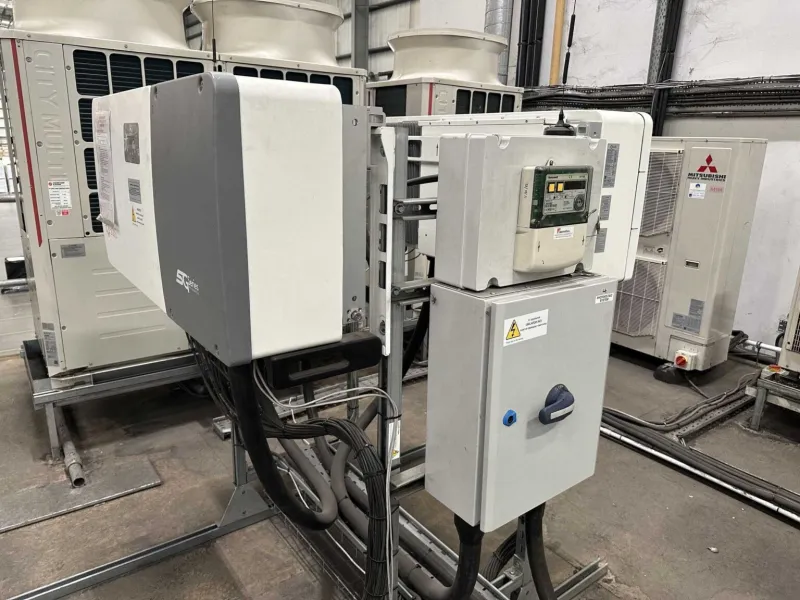
What set Alectrona apart was the documented design pack. We had quotes from three installers, but only Alectrona handed us a full set of drawings, a single-line diagram and a design referencing BS 7671 and the G99 connection process. The whole thing read like an engineering submission rather than a sales brochure. Our M&E consultant reviewed it and signed it off without a single query. That gave the board the confidence to release the capital.
Alectrona
Commercial guideWhat insurance does a commercial solar project actually need?
There are two sides to check, held by two different parties: the contractor's own liability cover and your own building, asset and interruption cover. Above 50 kWp the structured protection a homeowner gets by default is not there, so you secure it by contract instead.
- Commercial scale, over 50 kWp
- On-site 3D drone survey + PV*SOL
- Engineer-led, outside MCS
The feedback we work to earn
These are representative example reviews, not yet-collected customer feedback. They are written to illustrate the kind of feedback Alectrona aims to earn and are shown as design placeholders while we gather and verify reviews from our first commercial clients. Alectrona is the commercial solar trading brand of RVTC LTD.
Other firms priced our roof off a satellite image and a desktop guess. Alectrona flew an in-house drone survey, fully insured and flown by a qualified commercial drone pilot, and built a 3D model of the actual roof. It picked up plant, vents and a parapet line that a flat aerial photo had completely missed, which changed the panel layout. I would rather find that out at design stage than on the day the scaffold goes up. The accuracy of that survey is the reason I trusted everything that followed.
As a finance director I was wary of being oversold a system bigger than we could use. Alectrona modelled the array against our actual half-hourly consumption data rather than an annual total, so it is sized to what we genuinely draw on site during the day. They were honest that exporting surplus is worth far less than self-consumption, and built the design around that. The capital case stacked up because the engineering was honest, not because the numbers were inflated.
We were undecided between buying outright, leasing and a PPA. Alectrona laid out all three side by side with the pros and cons of each against our balance sheet, instead of pushing the one that pays them best. They were clear about where a PPA makes sense and where capex wins, and pointed us at our own accountant for the tax treatment. The survey and design took a little longer than I expected, but the thoroughness was worth the wait. Genuinely consultative.
The install crew were tidy and well run, and worked to a clear CDM 2015 plan with a proper site induction and RAMS. What impressed me most was the handover. We received a full commissioning pack with the IEC 62446-1 test results, certification, O&M documentation and an as-built record for our maintenance team. As the people who have to live with this asset for the next twenty years, having that paperwork in order matters enormously. Nothing was left loose.
I expected the usual hard sell and got the opposite. After surveying our site Alectrona told us one roof section was not worth covering because of shading, and that a smaller, well-sited array was the better investment than filling every square metre. There was no commission-driven upselling and no pressure. For a six-figure capital project, that straight talk is exactly what you want from the people advising you. We will be using them again on our second site.
- Two sides to check The contractor's liability cover and your own asset cover
- Contractor covers Public liability, professional indemnity, employers' liability
- The gap Above 50 kWp, MCS and consumer-code protection do not apply
- Insurer disclosure A legal duty under the Insurance Act 2015, before work starts
- Your own cover Add the array to the buildings sum insured; consider interruption cover
Commercial solar insurance
OrientationThis is an engineering and commercial orientation, not formal insurance, legal or tax advice. Insurance limits, scheme minimums and the duties under the Insurance Act 2015 and CDM 2015 change over time; confirm the current position with your broker, insurer or a qualified adviser before you contract.
Insuring a commercial solar array raises two separate questions. First, does the contractor carry the liability cover to work on your roof. Second, does your own insurance reflect the asset once it is fixed in place. These are separate policies held by separate parties, and a finance director needs to verify both.
This guide is a plain-English orientation for a finance or facilities director, not formal insurance advice. It sets out the contractor cover to ask for, the protection gap that opens above 50 kWp where MCS and the consumer codes stop, the legal duty to tell your building insurer, and how the array sits in your asset and business-interruption cover. The figures here are framed as reference points; confirm the limits that suit your project with a broker. Status is as at June 2026.
The contractor's own cover, and what to ask for
Before anyone goes near your roof, ask the contractor for in-date certificates for three covers. Each does a different job, and a missing one shifts risk back to you.
- Public liability (PL) protects third parties and their property against injury or damage caused during the works. The MCS scheme minimum is at least £2m, and many contractors carry £5m or more on larger jobs. That £2m figure is a domestic-scheme floor, set for work the scheme covers, which by definition is 50 kWp or under. For a larger commercial project the appropriate limit is a judgement about the value and exposure of your site rather than a scheme minimum, so confirm the limit suits the project rather than accepting a floor.
- Professional indemnity (PI) covers financial loss from a design or specification error, as opposed to a physical accident. It is the cover that responds when the system is built exactly as designed but the design itself was wrong, for example an array that under-performs or a structural or electrical design fault. A scheme minimum commonly cited is £500,000; for a large or structurally complex array a finance director should expect more.
- Employers' liability (EL) is compulsory under UK law for any firm with employees, with a statutory minimum of £5m. It matters here because solar work involves roof access and working at height. Confirm the contractor holds it, and that any sub-contractors do too.
This links to your duties under CDM 2015. As the client you must appoint competent contractors, and checking their insurance is part of demonstrating that diligence.
The protection gap above 50 kWp
This is the point most worth understanding. MCS, and the consumer codes that sit behind it such as RECC and HIES, cover domestic and small-scale installs only. The MCS solar PV standard applies up to a maximum of 50 kWp DC, and RECC's remit is selling or leasing to domestic consumers. A commercial array sits above both.
So for a system over 50 kWp, MCS certification, the RECC or HIES consumer-protection backstop, and the deposit and workmanship protection a homeowner gets by default do not automatically apply. The structured cover is simply absent. A commercial buyer has to secure the equivalent itself, through the contract: clear workmanship warranty terms, retentions held back against defects, an operations and maintenance contract, and, where it can be arranged, a performance warranty or an Insurance-Backed Guarantee.
An Insurance-Backed Guarantee (IBG) is a separate insurance policy that stands behind the installer's own written workmanship guarantee. If the installer ceases trading, the workmanship warranty is still honoured, by an FCA-regulated insurer, on the same terms as the original. It is not product cover, since panels and inverters are covered by their manufacturer warranties, and it is not your property cover. It specifically protects against installer insolvency. IBG terms commonly run for periods such as 2 to 10 years, and the IBG term can differ from the installer's written-guarantee term. Whether an off-the-shelf commercial IBG exists for an array of your size is worth confirming with a broker rather than assuming; treat equivalent protection as a contractual task.
Telling your building insurer is a legal duty
Adding a PV array is a material change in risk. It increases the reinstatement value of the building and alters the fire and roof-load profile. Under the Insurance Act 2015 a commercial policyholder owes a duty of fair presentation, which is to disclose every material circumstance it knows or ought to know before the policy is taken out or varied.
The consequences of getting this wrong are not trivial. Where there has been non-disclosure an insurer can adjust the terms, reduce a claim in proportion, or, if the non-disclosure was deliberate or reckless, void the policy, refuse all claims and keep the premium. The safe course is to notify the insurer before work starts and share the design documentation, rather than treat it as a courtesy after the fact.
Expect scrutiny when you do. Insurers increasingly examine rooftop PV for DC arc and fire risk, roof penetration, and, where a battery is added, lithium thermal-runaway and fire separation. That can raise premiums, require policy endorsements, or attach maintenance and inspection conditions. A property insurer asking for the design pack and evidence of ongoing maintenance at renewal is now normal.
Asset cover and business interruption
Once panels are physically fixed they are usually treated as part of the building, so the array's replacement cost must be added to the buildings sum insured. Leave it out and the property is under-insured, at which point a claim can be averaged down. Some policies need a specific endorsement for the PV plant, and for breakdown or electrical-surge damage to inverters and monitoring equipment. For a ground-mounted or otherwise accessible array, confirm theft and vandalism cover as well.
Then there is the revenue side. A damage event that takes the system offline causes lost generation savings and, where you export, lost export income. Business interruption or production-loss cover compensates for that downtime. The wider market has tightened here: as equipment lead-times have lengthened, insurers have increased the waiting and indemnity periods on this cover. The practical check for a finance director is that the deductible period and the indemnity-period length are long enough to match a realistic repair timescale rather than a best-case one.
How does adding a battery change what the insurer asks for?
A battery turns a property insurer's review from a roof question into a stored-energy question, and it is the single addition most likely to attach conditions to your policy. The fire concern with lithium-ion storage is thermal runaway, a self-sustaining heating reaction in a cell that can propagate through a pack and is hard to extinguish, so the underwriter's attention moves to where the battery sits, how far it is from people, escape routes and the boundary, and what detection and suppression are around it. This is a different risk class from the array itself, and on a commercial site the endorsement is usually driven by the battery rather than the panels.
The evidence an insurer wants here is design-led. Expect questions about siting and fire separation, whether the unit is indoors, in a dedicated room or in an outdoor containerised enclosure, the manufacturer's safety certification, the battery management system, and the fire-detection and ventilation provision. The recognised reference points are the fire-safety thinking the insurance market itself publishes, the same RISCAuthority stream that produced RC62 for rooftop PV, alongside the IET Code of Practice for electrical energy storage systems and the building's own fire strategy. Confirm the current standard rather than assuming, because storage guidance has moved quickly. We design the separation, siting and detection to suit the building so the disclosure to your insurer is a documented case rather than an open question, and the wider thinking is set out in our battery fire-safety guide and the RC62 fire-safety guide.
What insurance evidence does an inherited or second-hand solar system need?
Buying a building with an array already on the roof, or taking on a system from an installer who has since gone, leaves a specific insurance problem: you cannot disclose what you cannot evidence. The duty of fair presentation under the Insurance Act 2015 still applies to a system you inherited, but the commissioning pack, the as-built drawings, the connection paperwork and the installer's workmanship guarantee may all be missing, and an Insurance-Backed Guarantee normally dies with the installer unless the policy was written to survive a change of ownership. So the asset that came free with the building can be the one your insurer knows least about.
The practical fix is to rebuild the evidence before renewal rather than after a claim. An as-built audit and condition survey re-establishes what was installed and its age, whether monitoring exists and can be accessed, the inverter's position against its replacement horizon, and the grid-connection record, including the Northern Powergrid connection and the G99 or G98 registration. A thermographic survey gives the insurer current evidence that the DC connections are sound, which is exactly the assurance a property underwriter prices on. Those findings let you make an honest, documented disclosure and decide whether remediation is needed before the system is brought into cover on fair terms. The audit route is covered in our maintenance guide and run as a performance audit.
Who actually pays when something fails?
Buyers routinely conflate three different promises, and the distinction decides who pays in each failure mode. A manufacturer product warranty covers a defective panel, inverter or battery, replacing the hardware on the maker's terms, and a panel performance warranty separately underwrites that the modules will still produce a stated share of their rated output at year 25. The installer's workmanship guarantee covers faults in how the system was fitted, the wiring, mounting and labour, and it is that guarantee, not the manufacturer's, that an Insurance-Backed Guarantee stands behind if the installer ceases trading. None of these is your property insurance, which responds to external damage such as fire, storm, theft or accidental damage to the asset itself.
The gaps open where these promises meet. A manufacturer warranty is only as good as the manufacturer's solvency over a 25-year term, which is why bankability and the financial standing of the panel and inverter brands matter as much as the headline warranty length, a point we make in our quality without MCS guide. Warranties also commonly exclude consequential loss, so the lost generation while you wait for a replacement is a business-interruption question for your own policy rather than the manufacturer's. Mapping each failure mode to the promise that answers it, and pricing the residual gap into your own cover, is the work a finance director should do before signing, and the contractual side of it sits inside the capex and ownership decision.
How does an export or PPA arrangement affect the cover you need?
How you monetise the generation changes the revenue that insurance has to protect. If you self-consume and export the surplus under the Smart Export Guarantee, an outage costs you both the on-site bill savings and the export income, and the business-interruption or production-loss cover has to be sized to replace both. The longer equipment lead-times that have pushed insurers to lengthen waiting and indemnity periods bite hardest here, because the indemnity period must cover a realistic inverter or transformer replacement, parts lead-time included, rather than a best-case repair.
A power purchase agreement, where a third party owns the array on your roof and sells you the output, redraws the lines entirely. The asset belongs to the PPA provider, so the property insurance, plant cover and performance risk usually sit with them, while your exposure shifts to the contract: who insures what, who carries the business-interruption risk if the system is down, and what the roof-licence and access terms require of each side. The one duty that does not move is disclosure, because a third-party array fixed to your building still alters your building's risk and must be presented fairly to your own insurer under the Insurance Act 2015. Read the insurance and indemnity clauses of any PPA against your existing policy before signing, a point developed in our PPA and SEG export guides.
Past the guide, this is how your figure actually gets set.
-
Survey On-site 3D drone survey
Our own insured pilot flies your roof and captures the real geometry and shading, so the design starts from your building instead of a satellite guess.
Booked to suit your operating hours
-
Model PV*SOL design and proposal
We model the array in bankable-grade software, size it around your daytime load, and set out generation, savings and payback across three funding routes.
Modelled, not promised
-
Install Engineered and installed
Designed and installed to BS 7671, commissioned to IEC 62446-1, connected under G99 and run under CDM 2015. Alectrona is typically the Principal Contractor.
Outside MCS, assured by the non-MCS stack
-
Aftercare Operations and maintenance
A 12-month defects period backed by an Insurance-Backed Guarantee, then ongoing operations and maintenance so the asset keeps earning for its full working life.
Kept performing, year on year
Last updated June 2026
Commercial solar insurance: common questions
Ask for in-date certificates for three covers. Public liability, which protects third parties and their property during the works, with a limit that suits your project rather than a domestic-scheme floor. Professional indemnity, which responds to a design or specification error as opposed to a physical accident. And employers' liability, which is compulsory for any firm with employees and carries a statutory minimum of £5m. Confirm any sub-contractors carry their own cover too. Checking this is also part of your duty under CDM 2015 to appoint competent contractors.
No, they are different things. An Insurance-Backed Guarantee is a separate policy that stands behind the installer's own written workmanship guarantee, so that if the installer ceases trading the warranty is still honoured by an FCA-regulated insurer, on the same terms. It is not product cover, since panels and inverters are covered by their manufacturer warranties, and it is not your property cover. It specifically protects against installer insolvency. Your building insurance is your own policy covering the asset and the premises.
Yes, and it is a legal duty rather than a courtesy. Adding an array is a material change in risk, because it raises the reinstatement value and alters the fire and roof-load profile. Under the Insurance Act 2015 a commercial policyholder owes a duty of fair presentation, to disclose material circumstances before the policy is taken out or varied. Failing to do so can let the insurer adjust terms, reduce a claim, or, if the non-disclosure was deliberate or reckless, void the policy. Notify the insurer before work starts and share the design documentation.
Because MCS and the consumer codes behind it, such as RECC and HIES, are domestic and small-scale schemes. The MCS solar PV standard applies up to 50 kWp DC, and RECC covers selling or leasing to domestic consumers. A commercial array is larger, so it sits outside both. The deposit and workmanship protection a homeowner receives by default is not automatically there. A commercial buyer secures the equivalent through the contract instead: warranty terms, retentions, an operations and maintenance contract, and where available a performance warranty or an Insurance-Backed Guarantee.
It compensates for lost revenue when a damage event takes the system offline. That includes the generation savings you stop making and, where you export, the export income you stop receiving. The market has tightened as equipment lead-times have lengthened, with insurers increasing the waiting and indemnity periods on this cover. The check that matters is whether the deductible period and the indemnity-period length are long enough to match a realistic repair timescale, including parts lead-time, rather than a best case.
There is no flat figure, because the change to your premium depends on the array size, the building, whether a battery is added, and how your existing policy is structured, so it is priced by your broker rather than quoted sight-unseen. Adding PV raises the buildings sum insured and can attract an endorsement or a maintenance condition, and a lithium battery tends to have the larger effect because of the fire-separation requirements. Good design documentation and a live maintenance regime are what keep the loading reasonable, since they let the insurer price a managed risk. For the cost of the system itself rather than the cover, see our commercial solar cost guide.
At the design stage, before any work starts. Disclosing the array to your building insurer is a duty of fair presentation under the Insurance Act 2015 that has to be discharged before the policy is taken out or varied, so notify your insurer and share the design pack early rather than at handover. Check the contractor's public liability, professional indemnity and employers' liability certificates are in date before anyone goes on the roof. Then fold the asset into your buildings and business-interruption cover at commissioning, when the system goes live, so there is no window where a fixed, generating array sits outside your policy.
Get the numbers for your roof.
A guide can only take you so far. The figure you get is modelled from your own half-hourly load and a system sized from the on-site drone survey. No obligation, and systems this size sit outside the domestic MCS scheme, so the assurance is the engineering stack.
- On-site 3D drone survey, fully insured in-house pilot
- Half-hourly load modelled in PV*SOL before anything is specified
- Engineer-led, assured to the non-MCS standard (CDM 2015)
- Capex, lease-purchase or PPA, whichever suits you