Skip to content

Alectrona

Commercial guide

What maintenance does a commercial solar system actually need?

A commercial array is low maintenance, though the care it needs is real and ongoing. Over a 25 to 35 year life the costs that matter are monitoring, at least one inverter replacement and keeping yield clean of soiling, and they are managed, not left to chance.

  • Commercial scale, over 50 kWp
  • On-site 3D drone survey + PV*SOL
  • Engineer-led, outside MCS
Reviews

The feedback we work to earn

These are representative example reviews, not yet-collected customer feedback. They are written to illustrate the kind of feedback Alectrona aims to earn and are shown as design placeholders while we gather and verify reviews from our first commercial clients. Alectrona is the commercial solar trading brand of RVTC LTD.

What set Alectrona apart was the documented design pack. We had quotes from three installers, but only Alectrona handed us a full set of drawings, a single-line diagram and a design referencing BS 7671 and the G99 connection process. The whole thing read like an engineering submission rather than a sales brochure. Our M&E consultant reviewed it and signed it off without a single query. That gave the board the confidence to release the capital.

Estates Manager, academy trust (Yorkshire)

Other firms priced our roof off a satellite image and a desktop guess. Alectrona flew an in-house drone survey, fully insured and flown by a qualified commercial drone pilot, and built a 3D model of the actual roof. It picked up plant, vents and a parapet line that a flat aerial photo had completely missed, which changed the panel layout. I would rather find that out at design stage than on the day the scaffold goes up. The accuracy of that survey is the reason I trusted everything that followed.

Facilities Manager, distribution centre (East Midlands)

As a finance director I was wary of being oversold a system bigger than we could use. Alectrona modelled the array against our actual half-hourly consumption data rather than an annual total, so it is sized to what we genuinely draw on site during the day. They were honest that exporting surplus is worth far less than self-consumption, and built the design around that. The capital case stacked up because the engineering was honest, not because the numbers were inflated.

Finance Director, logistics group (North West)

We were undecided between buying outright, leasing and a PPA. Alectrona laid out all three side by side with the pros and cons of each against our balance sheet, instead of pushing the one that pays them best. They were clear about where a PPA makes sense and where capex wins, and pointed us at our own accountant for the tax treatment. The survey and design took a little longer than I expected, but the thoroughness was worth the wait. Genuinely consultative.

Property Director, retail park (West Midlands)

The install crew were tidy and well run, and worked to a clear CDM 2015 plan with a proper site induction and RAMS. What impressed me most was the handover. We received a full commissioning pack with the IEC 62446-1 test results, certification, O&M documentation and an as-built record for our maintenance team. As the people who have to live with this asset for the next twenty years, having that paperwork in order matters enormously. Nothing was left loose.

Operations Director, food manufacturer (Lincolnshire)

I expected the usual hard sell and got the opposite. After surveying our site Alectrona told us one roof section was not worth covering because of shading, and that a smaller, well-sited array was the better investment than filling every square metre. There was no commission-driven upselling and no pressure. For a six-figure capital project, that straight talk is exactly what you want from the people advising you. We will be using them again on our second site.

Managing Director, engineering firm (Sheffield)

  • Applies to Commercial solar over 50 kWp, outside MCS
  • Maintenance level Low, but not zero, across a 25 to 35 year life
  • Dominant costs Inverter replacement, soiling-driven yield loss, undetected faults
  • Inverter life Typically around 10 to 15 years; budget at least one replacement
  • The backbone Continuous monitoring, which turns repairs from reactive to preventive
01 The short version

Commercial solar maintenance

A solar array has no moving parts on the roof, so its ongoing maintenance is low relative to the output it produces. It is not zero, though, and treating it as fit-and-forget is how a system quietly loses yield and a finance model drifts from its assumptions. Over a 25 to 35 year asset life three things dominate: keeping the array monitored so faults are caught early, replacing the inverter at least once mid-life, and keeping the panels clean enough that soiling does not erode generation.

This guide is a plain-English orientation for a finance or facilities director on what operations and maintenance, usually shortened to O&M, actually involves for a system over 50 kWp. It covers what a contract typically includes, what an inverter replacement means for the model, how monitoring turns reactive repairs into preventive ones, and what to do with an inherited or orphaned system from a contractor who has moved on. It is a guide, not formal advice; we confirm the specifics for your site.

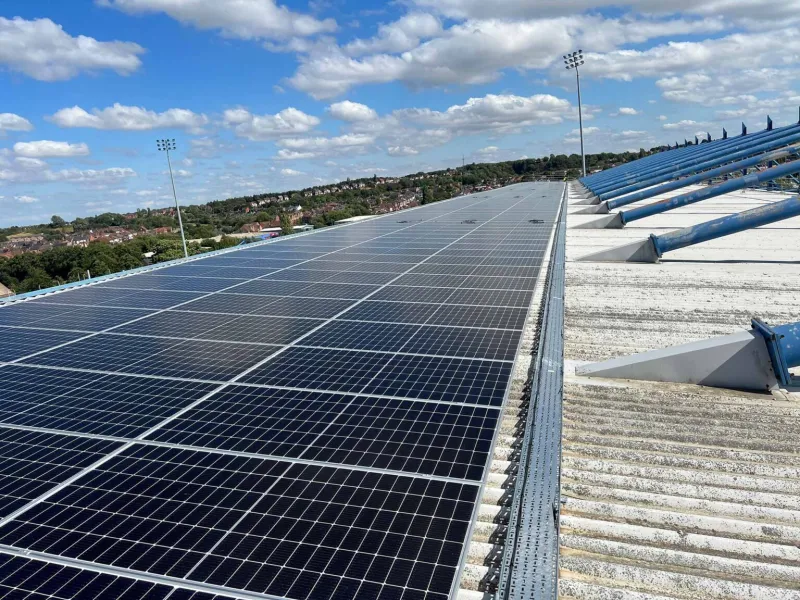
Commercial rooftop solar, the subject of this guide: Commercial solar maintenance
An on-site drone survey and a PV*SOL model behind every quote.
02

What an O&M contract typically covers

O&M scope is set by contract, not by a regulated standard, so it varies between providers and you have to read what is in and what is out. That said, a commercial O&M arrangement typically includes a recognisable set of activities:

  • Remote performance monitoring and alerting. Continuous tracking of generation against the expected yield, with alerts when a string drops out, an inverter faults or output sags.
  • Scheduled preventive inspections. Periodic visual checks, thermographic or infrared scanning of modules and connections to find hot spots, and electrical testing.
  • Inverter servicing and fault rectification. Firmware, fans and filters where applicable, and putting right faults the monitoring flags.
  • Panel cleaning. Scheduled or as-needed, set by how the site soils rather than a fixed calendar.
  • Vegetation and structural checks. Keeping growth off ground-mount rows and confirming the mounting and fixings remain sound.
  • Reactive call-outs with a defined response time, and reporting.

Where contracts differ most is on the expensive items: whether spare parts, a full inverter replacement and a performance or availability guarantee are inside the fee or charged on top. Check exactly which of those are in scope before comparing one quote with another, because a cheaper headline fee can simply mean the big-ticket items sit outside it.

03

The inverter is the part that needs planning for

The panels and the mounting structure are commonly rated for 25 to 30 years or more. The inverter is not. String and central inverters are the shortest-lived major component, typically rated for around 10 to 15 years, with standard product warranties commonly running 10 to 12 years and extendable, at a cost, to roughly 20 to 25 years. Financial models for a solar asset routinely budget for at least one full inverter replacement over the project life, commonly modelled somewhere around year 10 to 15.

The honest framing for a finance director is that this is the single largest planned mid-life capital cost on the system, and it should be sinking-funded rather than treated as a surprise. The exact timing and cost depend on the specific inverter, how hard it is run and how the contract handles replacement, so we do not put a fixed year or figure on a live page. The principle is fixed: budget for the replacement from the start so it is a planned event, not a shock to the model. The structural survey and the design set which inverter goes in; the O&M plan sets how its end of life is funded.

  • 25 to 30 years Panels and mounting structure Commonly rated for this life or more
  • 10 to 15 years String and central inverter The shortest-lived major component
  • At least one Full inverter replacement Routinely budgeted over the project life
04

Monitoring is what makes the maintenance preventive

Continuous monitoring is the backbone of commercial O&M, because it is what turns maintenance from reactive break-fix into early intervention. Inverter-level monitoring is the minimum; string-level or module and optimiser-level monitoring localises a problem faster. The standard metrics are the performance ratio and expected-versus-actual yield, and they flag the failure modes that otherwise go unseen: a string that has silently dropped out, an inverter fault, a soiling-driven slide in output, or degradation running faster than it should.

That last point matters because not all yield loss is a fault. Panels degrade slowly and predictably. Analysis of large fleets of installed systems by the US National Renewable Energy Laboratory puts the median module degradation at around 0.5% per year, with premium n-type cells often lower, so a panel degrading at that median rate is still producing around 88% of its original output at year 25. That is the gentle, expected decline that 25-year performance warranties are written around. The job of monitoring is to separate that slow, normal fade from the sudden or abnormal underperformance that signals a real problem, and to surface it while it is cheap to fix. If you suspect your existing system is underperforming, our guide on spotting an underperforming system covers how that is diagnosed.

05

Cleaning, and taking on an inherited or orphaned system

Soiling is the other slow erosion of yield. International PV-reliability research from the IEA-PVPS programme puts global soiling losses at roughly 3 to 5% of annual energy production, and UK-specific work from Loughborough University has found it can cut output by more than 5% here. UK rain provides a degree of natural cleaning, so the right cleaning frequency is site-specific: bird fouling, agricultural or industrial dust, pollen, and low-tilt arrays that do not self-clean all justify cleaning more often. The point is to set the schedule from how the site actually soils, not from a generic calendar.

A common situation for commercial buyers is inheriting a system, either with a building or from an installer who has since disappeared. Before pricing an ongoing O&M contract on an orphaned system, the practical first step is an as-built audit and condition survey: establish what was installed and its age, confirm whether monitoring exists and whether you can get credentialled access to it, run a performance baseline against expected yield, infrared-scan for hot spots and failed bypass diodes, check the inverter age against its replacement horizon, and verify the grid-connection paperwork, including the DNO and G98 or G99 records and any export registration. Older systems often turn up lost monitoring access, an out-of-warranty inverter near end of life, and degraded or mismatched strings. Those findings define the remediation scope, which is settled before an ongoing maintenance arrangement is priced. A commercial system over 50 kWp sits outside the domestic MCS scheme, so this audit, not a certificate, is what tells you the real condition of the asset.

06

What an O&M visit actually finds on the roof

Monitoring, the inverter and cleaning are the line items a finance director budgets for. The condition of the array itself is what an engineer finds when they get on a roof that nobody has walked across since the last visit, and it is worth knowing what that is, because it is the part that separates a real maintenance plan from a monitoring contract with a cleaning add-on. A few faults turn up on commercial roofs again and again.

Soiling that the roof will not self-clean. A shallow-pitch array does not shed dirt the way a steeper roof does, because the rain does not sheet across it hard enough to carry the soiling off. Output then drifts down slowly without ever registering as a fault. Coastal sites are worse again: salt and more airborne soiling dirty the glass faster and the rain clears less of it, so on those roofs cleaning is a larger part of the plan than a buyer tends to expect. The honest framing is that there is no universal schedule. The cleaning interval is set by how your site actually soils, read off the monitoring trend, not from a calendar. The mechanics of commercial cleaning are covered in the commercial solar cleaning guide.

Bird fouling and broken modules. Droppings and dead birds soil the glass and shade the cells beneath them, and a shaded cell in a working string runs hot, which over time damages the panel. Modules also crack and shatter, from impact, hail, thermal cycling and the microcracks that spread from it, and a damaged panel can keep generating while it underperforms and admits water. A visit clears the fouling, inspects for the hot-spot damage it leaves, and identifies the cracked modules for replacement. Because a single failed panel rarely announces itself, a periodic performance audit is what traces the lost yield back to the module behind it.

07

Birds nesting under the panels, and why perimeter bird-proofing is a real line in the plan

The fault that most surprises commercial buyers is one they cannot see from the ground. Pigeons and gulls nest in the gap between the modules and the roof, and when they do they pull the DC cabling out of its clips. That is a genuine fault, an unsupported live DC cable left to chafe or sit in water, and it is a fire and DC-arc risk under the thinking behind RC62, because the DC side of an array stays live in daylight and cannot simply be switched dead. Nesting material and fouling collecting under the panels compound it.

Re-clipping the cable at each visit treats the symptom. The durable fix is perimeter bird-proofing: a pigeon or critter mesh clipped around the edge of the array that closes the under-panel gap so birds cannot get in to nest. It is a fitted commercial measure that removes the cause rather than repeating the repair, and where a maintenance plan keeps finding pulled cabling on a bird-pressured roof it is usually the right answer. Whether a given roof needs it is a survey-led call based on how exposed the array is and how much bird pressure the site sees, which is the kind of condition-led judgement an O&M plan is built to make rather than a fixed inclusion.

08 How we quote

Past the guide, this is how your figure actually gets set.

  1. Survey

    On-site 3D drone survey

    Our own insured pilot flies your roof and captures the real geometry and shading, so the design starts from your building instead of a satellite guess.

    Booked to suit your operating hours

  2. Model

    PV*SOL design and proposal

    We model the array in bankable-grade software, size it around your daytime load, and set out generation, savings and payback across three funding routes.

    Modelled, not promised

  3. Install

    Engineered and installed

    Designed and installed to BS 7671, commissioned to IEC 62446-1, connected under G99 and run under CDM 2015. Alectrona is typically the Principal Contractor.

    Outside MCS, assured by the non-MCS stack

  4. Aftercare

    Operations and maintenance

    A 12-month defects period backed by an Insurance-Backed Guarantee, then ongoing operations and maintenance so the asset keeps earning for its full working life.

    Kept performing, year on year

09 FAQ

Commercial solar maintenance: common questions

Yes, though it is low relative to the output it produces. There are no moving parts on the roof, but the array still needs monitoring so faults are caught early, the inverter needs replacing at least once over the life of the system, and the panels need cleaning often enough that soiling does not erode generation. The risk is treating it as fit-and-forget, which is how a system quietly loses yield. A formal O&M arrangement plus a capital reserve for the inverter is the standard way a commercial buyer protects the model.

String and central inverters are the shortest-lived major component, typically rated for around 10 to 15 years, against 25 to 30 years or more for the panels and structure. Standard product warranties commonly run 10 to 12 years and can be extended, at a cost, to roughly 20 to 25 years. Financial models routinely budget for at least one full inverter replacement, commonly modelled around year 10 to 15. The exact timing depends on the inverter and how hard it is run, so we plan it as the largest mid-life capital cost rather than putting a fixed year on it.

It is site-specific. UK rain provides a degree of natural cleaning, so there is no universal schedule. Soiling typically costs a few per cent of annual output, and UK research has found it can be more than 5% in some cases, with more frequent cleaning justified where there is bird fouling, agricultural or industrial dust, pollen, or a low-tilt array that does not self-clean. We set the cleaning frequency from how your site actually soils, informed by the monitoring, rather than from a fixed calendar.

Yes, and the first step is an as-built audit and condition survey rather than an immediate O&M contract. We establish what was installed and its age, confirm whether monitoring exists and can be accessed, baseline the performance against expected yield, infrared-scan for hot spots, check the inverter against its replacement horizon, and verify the grid-connection paperwork. Inherited systems often have lost monitoring access, an out-of-warranty inverter near end of life, or degraded strings. Those findings set the remediation scope, which is settled before an ongoing maintenance arrangement is priced.

O&M scope is contractual, not a regulated list, so it varies by provider. A typical contract includes remote monitoring and alerting, scheduled preventive inspections with infrared scanning, inverter servicing and fault rectification, panel cleaning, vegetation and structural checks, reactive call-outs with a defined response time, and reporting. Contracts differ most on the expensive items: whether spare parts, a full inverter replacement and a performance or availability guarantee are inside the fee or charged on top. Check exactly which of those are in scope before comparing quotes, because a cheaper fee often means the big-ticket items sit outside it.

We price an O&M arrangement from a survey rather than a headline figure, because the cost is driven by the array size, the site's soiling behaviour, the inverter's age and replacement horizon, and which expensive items sit inside the fee. A cheap annual headline often excludes spare parts, the mid-life inverter replacement or a performance guarantee, so what determines value is the scope of the agreement, well beyond the headline rate. For an inherited system, an as-built audit comes first and its findings set the remediation cost before any ongoing fee is fixed. The capital side of an installation is covered in our commercial solar cost guide.

The starting point is a survey, and we can usually book one within a short window of an enquiry. Remote monitoring and alerting can be stood up quickly once we have credentialled access to the inverter platform, so early-warning cover begins almost straight away. A full as-built audit of an orphaned system, with an infrared scan and a performance baseline against expected yield, is a planned site visit rather than a same-day job, and any remediation it uncovers is scoped before the ongoing arrangement starts. Contact us to arrange the survey.

Get a commercial quote

Get the numbers for your roof.

A guide can only take you so far. The figure you get is modelled from your own half-hourly load and a system sized from the on-site drone survey. No obligation, and systems this size sit outside the domestic MCS scheme, so the assurance is the engineering stack.

  • On-site 3D drone survey, fully insured in-house pilot
  • Half-hourly load modelled in PV*SOL before anything is specified
  • Engineer-led, assured to the non-MCS standard (CDM 2015)
  • Capex, lease-purchase or PPA, whichever suits you