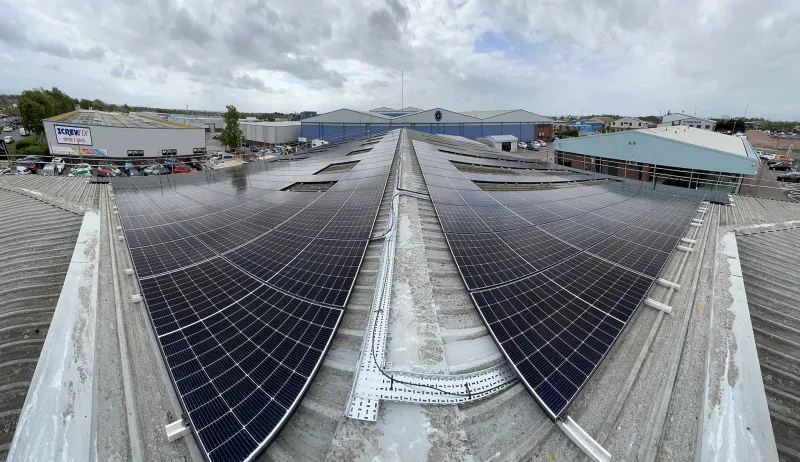
What set Alectrona apart was the documented design pack. We had quotes from three installers, but only Alectrona handed us a full set of drawings, a single-line diagram and a design referencing BS 7671 and the G99 connection process. The whole thing read like an engineering submission rather than a sales brochure. Our M&E consultant reviewed it and signed it off without a single query. That gave the board the confidence to release the capital.
Alectrona
Battery chemistryLFP vs NMC for commercial battery storage
Two lithium chemistries compete for a commercial battery, and they trade off differently. For stationary storage on a commercial site, lithium iron phosphate (LFP) has become the prevailing choice, chosen for its thermal stability and long working life, while nickel manganese cobalt (NMC) earns its place where space is tight.
- Commercial scale, over 50 kWp
- Brand-agnostic, the right fit
- Sized to your real load
The feedback we work to earn
These are representative example reviews, not yet-collected customer feedback. They are written to illustrate the kind of feedback Alectrona aims to earn and are shown as design placeholders while we gather and verify reviews from our first commercial clients. Alectrona is the commercial solar trading brand of RVTC LTD.
Other firms priced our roof off a satellite image and a desktop guess. Alectrona flew an in-house drone survey, fully insured and flown by a qualified commercial drone pilot, and built a 3D model of the actual roof. It picked up plant, vents and a parapet line that a flat aerial photo had completely missed, which changed the panel layout. I would rather find that out at design stage than on the day the scaffold goes up. The accuracy of that survey is the reason I trusted everything that followed.
As a finance director I was wary of being oversold a system bigger than we could use. Alectrona modelled the array against our actual half-hourly consumption data rather than an annual total, so it is sized to what we genuinely draw on site during the day. They were honest that exporting surplus is worth far less than self-consumption, and built the design around that. The capital case stacked up because the engineering was honest, not because the numbers were inflated.
We were undecided between buying outright, leasing and a PPA. Alectrona laid out all three side by side with the pros and cons of each against our balance sheet, instead of pushing the one that pays them best. They were clear about where a PPA makes sense and where capex wins, and pointed us at our own accountant for the tax treatment. The survey and design took a little longer than I expected, but the thoroughness was worth the wait. Genuinely consultative.
The install crew were tidy and well run, and worked to a clear CDM 2015 plan with a proper site induction and RAMS. What impressed me most was the handover. We received a full commissioning pack with the IEC 62446-1 test results, certification, O&M documentation and an as-built record for our maintenance team. As the people who have to live with this asset for the next twenty years, having that paperwork in order matters enormously. Nothing was left loose.
I expected the usual hard sell and got the opposite. After surveying our site Alectrona told us one roof section was not worth covering because of shading, and that a smaller, well-sited array was the better investment than filling every square metre. There was no commission-driven upselling and no pressure. For a six-figure capital project, that straight talk is exactly what you want from the people advising you. We will be using them again on our second site.
- The core trade-off LFP is safer and longer-lived; NMC is denser, so smaller and lighter for the same energy
- Thermal stability LFP has a higher thermal-runaway threshold, the central reason it suits stationary storage
- Cycle life LFP typically endures more cycles over its life, a longer working asset on a site cycled daily
- Energy density NMC packs more energy per kilogram and litre, which is why it dominates electric vehicles
- Materials LFP uses no cobalt; NMC depends on cobalt and nickel, with supply-chain and ESG concerns
When a finance or facilities director asks which battery they are buying, the chemistry behind the cells is one of the first things that matters. The two lithium chemistries in commercial use are lithium iron phosphate, written LFP, and nickel manganese cobalt, written NMC. They store energy the same way in broad terms, but they behave differently on safety, on how long they last, on how much space they take, and on where the raw materials come from. Those differences decide which one belongs on a stationary site behind your meter.
This page sets out the trade-off plainly for a commercial buyer. The short version is that LFP has become the prevailing choice for commercial and grid-scale stationary storage, while NMC remains common where energy density rules, such as in electric vehicles. We explain why, without dressing either chemistry as something it is not. Alectrona is brand-agnostic, and the right cell is the one that fits your project.
Sized from your half-hourly load, not a per-kWh rule of thumb.
The two chemistries, and what actually differs
LFP and NMC are both lithium-ion chemistries, so the basic mechanism is shared: lithium ions move between two electrodes to store and release charge. The difference sits in the cathode material, and that one difference cascades into the properties a commercial buyer cares about.
- Thermal stability. This is the headline. The iron-phosphate cathode in an LFP cell stays stable to a higher temperature before it breaks down, so it has a higher thermal-runaway threshold than NMC. In plain terms, an LFP cell tolerates more abuse and heat before it is at risk of running away, which is the central reason it is favoured for stationary storage.
- Cycle life. LFP cells typically endure more charge and discharge cycles across their life than NMC before their usable capacity fades to the end-of-life point. For a battery that is cycled hard every day on a commercial site, a longer cycle life is a longer working asset.
- Energy density. This is where NMC wins. An NMC cell packs more energy into the same weight and volume, so for a given amount of stored energy it is smaller and lighter. That is why it dominates in electric vehicles, where space and weight are at a premium.
- Materials. LFP uses no cobalt. NMC depends on cobalt and nickel, which carry both supply-chain and ESG concerns, since cobalt mining in particular raises well-documented ethical and sourcing questions.
None of this makes one chemistry simply better. It makes them suited to different jobs, and a stationary commercial battery is a different job from a car.
LFP and NMC, side by side
LFP
The prevailing choice for stationary storage on a commercial site, chosen for thermal stability and long working life. It needs more space for the same stored energy, a trade most commercial sites make willingly.
- Higher thermal-runaway threshold, the central reason it suits a battery shared with people and assets
- Typically endures more charge and discharge cycles, a longer working asset on a site cycled daily
- Uses no cobalt, avoiding the supply-chain and ESG concerns nickel and cobalt carry
- Gives up energy density: more floor space and weight for the same energy
NMC
A capable chemistry optimised for a different constraint. It packs more energy into less weight and volume, which is why it dominates electric vehicles, and it earns its place where space is genuinely tight.
- Higher energy density, so smaller and lighter for the same stored energy
- The mainstream automotive chemistry, where every kilogram competes with range and payload
- Fits the rare stationary case where the footprint cannot be expanded
- Lower thermal-runaway threshold, and depends on cobalt and nickel
Why LFP has become the stationary norm
For a battery that sits in a fixed location and earns its keep by cycling day after day, the things LFP is good at are the things that matter, and the thing it gives up barely costs you.
Start with safety. A stationary battery shares a building, a yard or a plant room with people and assets, so a higher thermal-runaway threshold is a direct reduction in the consequence of a fault. That feeds straight into the fire case, the insurance conversation and the planning conversation, which is why we treat chemistry as the foundation of the safety story rather than a footnote. The detail of how that is engineered, tested and certified is set out on our fire safety page.
Then the working life. A commercial battery is bought to be cycled, and LFP's longer cycle life means more useful years out of the same asset before its capacity fades to the point of replacement. Over the life of a project that is real value, and it is value that a car-oriented chemistry does not need to prioritise in the same way.
The one thing LFP gives up is energy density: it needs more physical space and a little more weight for the same stored energy. On most commercial sites that is a manageable trade. A plant room, a yard or a roof plant area has the floor space, and the structure carries the load, so taking up more room for a safer, longer-lived battery is a trade most commercial buyers make willingly. That balance is why LFP now leads commercial and grid-scale stationary storage.
Where NMC still earns its place
NMC is not a worse chemistry. It is optimised for a different constraint, and where that constraint dominates it is the right answer.
The constraint is space and weight per unit of energy. In an electric vehicle, every kilogram and every litre of battery competes with range and payload, so the higher energy density of NMC is decisive, and it is the mainstream automotive chemistry for that reason. The same logic applies in the rare stationary case where the footprint is genuinely tight and the available area cannot be expanded, where fitting more energy into a constrained space outweighs the other factors.
For most behind-the-meter commercial storage, that constraint does not bind. The site has the room, and the higher thermal-runaway threshold and longer cycle life of LFP outweigh the density advantage NMC would bring. So NMC remains common and capable, mostly outside the stationary commercial-and-industrial band where LFP has taken the lead. We name the chemistry that fits your constraints rather than defaulting to one.
What this means when we specify your battery
For most commercial sites paired with solar over 50 kWp, the bankable systems we specify are LFP, because the safety and cycle-life case is the one that fits stationary storage. The makers we lead with build their commercial products on LFP cells, and that is no accident. It is the chemistry the stationary market has converged on.
The choice is still made against your project rather than assumed. We confirm the cell chemistry, the cycle life and the warranted capacity from the current datasheet for the specific product, and we size the system from your half-hourly load in PV*SOL after an in-house insured drone survey, so the battery fits the job rather than the job being stretched to fit a battery. The install is then assured by the engineering stack at this scale, designed to BS 7671, commissioned and verified to IEC 62446-1, connected under G99 with your network operator, and delivered under CDM 2015 on a JCT or NEC contract. Alectrona is brand-agnostic, so the chemistry and the brand both follow the survey and the model. The safety standards the chosen cells are built and tested to, such as IEC 62619 and the large-scale fire-test work behind UL 9540A, are confirmed for the actual product before contract.
What standards confirm an LFP cell is actually safe?
Naming a chemistry as LFP only opens the safety case; the rest of it lives in the evidence. The properties that make lithium iron phosphate the stationary default only hold if the specific product has been built and tested to recognised standards, so for a commercial buyer the question shifts from "which chemistry" to "what evidence travels with this cell". Two standards frames matter and they are worth asking the supplier for by name.
The first is cell and system safety. IEC 62619 is the international standard for the safety requirements of secondary lithium cells and batteries used in industrial and stationary applications, and it is published in Britain as BS EN IEC 62619. It governs the cell, the battery management system and the protective functions meant to interrupt a fault before it becomes a fire, and it applies to both LFP and NMC, so it is not an LFP badge. The second frame is the wider system. IEC 62933 covers electrical energy storage systems as a whole, including the safety of the assembled installation rather than the bare cell. Where a larger or containerised system is specified, the large-scale fire-propagation test method UL 9540A deliberately forces a cell into thermal runaway and measures how heat and gas spread, and an LFP unit typically behaves more benignly in that test than an NMC equivalent, which is part of why the chemistry choice has fire-engineering consequences. In Britain those test results feed the fire strategy the HSE expects to see for a large installation, drawing on the US reference standard for stationary energy storage, NFPA 855, which is widely cited in UK fire strategies.
We confirm these certificates for the actual product before contract rather than taking a datasheet claim on trust, and the way the fire strategy is then engineered around the tested behaviour is set out on our fire safety page. The siting, separation and detection that follow from the chosen cells sit there too, alongside the how it works overview of the wider system.
How does the chemistry choice show up in cycle life and warranty?
The reason LFP suits a battery cycled every working day is its cycle life, but "more cycles" only means something against a defined test. A datasheet cycle figure is quoted to an end-of-life capacity point, usually the moment usable capacity has faded to a stated percentage of the original, and it is measured at a defined depth of discharge, temperature and charge rate. Two cells can both claim a long life on paper and mean different things if one is measured to a gentler end point or a shallower discharge. We read the cycle life, the depth of discharge it is quoted at and the warranted end-of-life capacity from the current datasheet for the specific product, so the comparison is like for like rather than headline against headline.
That feeds the warranty conversation, which for a commercial battery is usually written as a throughput guarantee: a number of full cycles or megawatt-hours of energy across a set term, with a guaranteed capacity retention at the end. LFP's longer cycle life is what lets a maker stand behind that throughput on a daily-cycling asset, and it is the warranty we hold the supplier to rather than the brochure. How hard the battery is actually cycled comes out of the sizing exercise, and the way the controller dispatches it day to day is covered on the EMS software page.
LFP vs NMC: common questions
Both are lithium-ion chemistries, but the cathode material differs and that changes how they behave. Lithium iron phosphate (LFP) has a higher thermal-runaway threshold, so it is more thermally stable, and it typically lasts more charge-discharge cycles, but it is less energy-dense. Nickel manganese cobalt (NMC) packs more energy into less space and weight, but has a lower thermal-runaway threshold and depends on cobalt and nickel. For stationary commercial storage the LFP balance is usually the better fit.
Because a stationary battery cares most about safety and working life, and those are LFP's strengths. Its higher thermal-runaway threshold reduces the consequence of a fault on a site shared with people and assets, and its longer cycle life gives more useful years out of a battery that is cycled every day. The one thing it gives up, energy density, costs little on most commercial sites, which have the floor space to take a slightly larger battery. That is why LFP now leads commercial and grid-scale stationary storage.
It can be, where space and weight are genuinely the binding constraint and the footprint cannot be expanded, because NMC fits more energy into less room. That is the situation in electric vehicles, where it is the mainstream chemistry. For most behind-the-meter commercial storage the site has the room, so the safety and cycle-life advantages of LFP outweigh NMC's density. We specify the chemistry that fits your constraints rather than defaulting to one.
Yes, and it is the foundation of the safety case. LFP's higher thermal-runaway threshold means the cells tolerate more heat and abuse before they are at risk of running away, which is a direct reduction in the consequence of a fault. That chemistry choice feeds into the fire engineering, the insurance position and planning. How it is then designed, tested and certified is covered on our fire safety page, which this comparison links to.
For most commercial sites it will be LFP, because the bankable stationary systems we specify are built on it and the safety and cycle-life case fits stationary storage. The choice is still confirmed against your project: we verify the cell chemistry, cycle life and warranted capacity from the current datasheet for the specific product, and size the system from your half-hourly load. Alectrona is brand-agnostic, so the chemistry and the brand follow the survey and the model rather than a default.
Chemistry is only one input to the price, so we will not put a figure on it here. The cost of a commercial system is driven by the energy and power you need, the enclosure and siting, the inverter, the grid connection and the install, not by the cathode material alone. LFP has become the stationary norm partly because its cost and life balance suits a daily-cycling asset. The price for your project is survey-led: see battery costs or our commercial solar cost guide.
Not in any meaningful way on its own. LFP is now the mainstream cell for stationary commercial storage, so the bankable systems we specify are built on it and are routinely available rather than special-order. What actually sets the timeline is the survey, the design, the half-hourly sizing model, the G99 connection with your network operator, and any planning and fire-authority consultation for a larger unit. We confirm the cell availability against the datasheet before contract so the chemistry never becomes the bottleneck.
See what a battery would actually do on your site.
We model your half-hourly load and your solar against a battery sized from an on-site survey, so the figure you get is yours, not a from-price. Capex first, with the bankable brand that fits the project.
- Sized from your half-hourly load, not a per-kWh rule of thumb
- Brand-agnostic: the bankable battery that fits the project
- Engineer-led, assured to the non-MCS standard (CDM 2015)