Skip to content

Alectrona

Commercial solar by sector

Commercial solar for agriculture.

On a farm the return depends on what the building does. A grain store, a milking parlour and a bare arable shed share the same simple roof but pull electricity at completely different times, so the load shape, not the roof, decides how much of the generation is used on site.

  • Large, simple farm-building roofs and rising on-farm electricity costs. The Vale of York, Selby and East Riding hold productive arable land with extensive roof stock.
  • Sized from your half-hourly load
  • Over 50 kWp, outside MCS
Reviews

The feedback we work to earn

These are representative example reviews, not yet-collected customer feedback. They are written to illustrate the kind of feedback Alectrona aims to earn and are shown as design placeholders while we gather and verify reviews from our first commercial clients. Alectrona is the commercial solar trading brand of RVTC LTD.

What set Alectrona apart was the documented design pack. We had quotes from three installers, but only Alectrona handed us a full set of drawings, a single-line diagram and a design referencing BS 7671 and the G99 connection process. The whole thing read like an engineering submission rather than a sales brochure. Our M&E consultant reviewed it and signed it off without a single query. That gave the board the confidence to release the capital.

Estates Manager, academy trust (Yorkshire)

Other firms priced our roof off a satellite image and a desktop guess. Alectrona flew an in-house drone survey, fully insured and flown by a qualified commercial drone pilot, and built a 3D model of the actual roof. It picked up plant, vents and a parapet line that a flat aerial photo had completely missed, which changed the panel layout. I would rather find that out at design stage than on the day the scaffold goes up. The accuracy of that survey is the reason I trusted everything that followed.

Facilities Manager, distribution centre (East Midlands)

As a finance director I was wary of being oversold a system bigger than we could use. Alectrona modelled the array against our actual half-hourly consumption data rather than an annual total, so it is sized to what we genuinely draw on site during the day. They were honest that exporting surplus is worth far less than self-consumption, and built the design around that. The capital case stacked up because the engineering was honest, not because the numbers were inflated.

Finance Director, logistics group (North West)

We were undecided between buying outright, leasing and a PPA. Alectrona laid out all three side by side with the pros and cons of each against our balance sheet, instead of pushing the one that pays them best. They were clear about where a PPA makes sense and where capex wins, and pointed us at our own accountant for the tax treatment. The survey and design took a little longer than I expected, but the thoroughness was worth the wait. Genuinely consultative.

Property Director, retail park (West Midlands)

The install crew were tidy and well run, and worked to a clear CDM 2015 plan with a proper site induction and RAMS. What impressed me most was the handover. We received a full commissioning pack with the IEC 62446-1 test results, certification, O&M documentation and an as-built record for our maintenance team. As the people who have to live with this asset for the next twenty years, having that paperwork in order matters enormously. Nothing was left loose.

Operations Director, food manufacturer (Lincolnshire)

I expected the usual hard sell and got the opposite. After surveying our site Alectrona told us one roof section was not worth covering because of shading, and that a smaller, well-sited array was the better investment than filling every square metre. There was no commission-driven upselling and no pressure. For a six-figure capital project, that straight talk is exactly what you want from the people advising you. We will be using them again on our second site.

Managing Director, engineering firm (Sheffield)

At a glance
  • Indicative size 50–500 kWp (barns, grain stores, poultry sheds)

This page is for working farms and estates: arable holdings, dairy and livestock units, poultry producers, grain merchants and the contractors who run the buildings between them. The land is productive, the roofs are large and simple, and on-farm electricity has become one of the costs that moves the margin.

Agriculture is worth modelling carefully because the answer is rarely uniform across a holding. Some buildings carry heavy, steady daytime load and self-consume almost everything they generate. Others sit idle for months and export more. The same farm can hold both, which is exactly why we size to the demand under each roof rather than to the area on top of it.

Commercial rooftop solar, the kind specified for agriculture

Sized from your half-hourly load, not a sector average.

01 Why it fits

What makes solar work for agriculture.

The value in commercial solar sits in self-consumption. A unit used on site offsets an expensive import unit, while a unit exported is paid far less, so the return tracks how well generation lines up with on-farm demand through the day. On a farm that match varies by enterprise, and that is the honest starting point.

Grain drying tends to run hard through late summer and autumn, often in daylight, when generation is at its strongest, so it self-consumes well in the months it operates. A milking parlour draws steady load around the milking routine and refrigeration, which reads much like the continuous demand on a cold storage site, and poultry sheds run ventilation, heating and lighting more or less continuously, both of which pull a useful share through the day. The same logic applies on the neighbouring horticulture holdings we work with. Arable buildings that are busy only at harvest, or stores that sit cold for half the year, tend to export more, so the export side of the meter and the option of battery storage matter more for them. Because a single holding often mixes these, we read the half-hourly profile of the buildings that actually carry the load before sizing anything.

02 Typical system

What a typical system looks like.

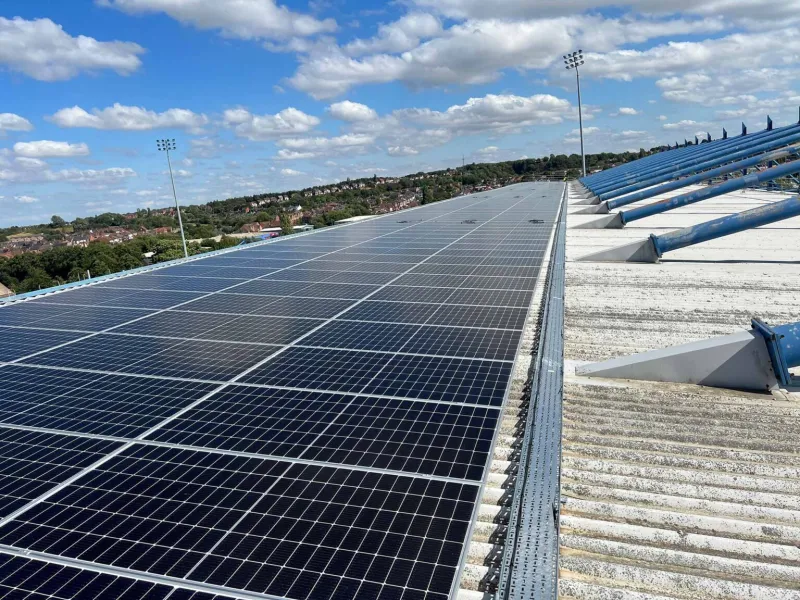
Farm buildings tend to give some of the most workable roofs on the register: large, simple steel-portal spans on barns, grain stores and poultry sheds, usually unshaded and on agricultural land with room to work safely. For orientation only, agricultural systems on the registry sit in an indicative band of roughly 50 to 500 kWp, which reflects how much that range can vary between a single livestock building and a run of large stores across a holding. Treat that as a sense of scale rather than a quote. The real figure comes from the on-site survey and the PV*SOL model, and older agricultural roofs in particular need the structural check before any array is sized, since loading and sheet condition vary widely across farm stock.

03 Sector detail

How the farm load shape lines up with generation

The strongest months on a farm tend to land when the roof is working hardest. Grain drying is the clearest example: continuous-flow and batch driers pull a heavy electrical load through late summer and into autumn, the same weeks a Yorkshire roof is still generating well and the daytime is long. For modelling we take a Yorkshire yield of roughly 900 to 950 kWh per kWp a year at a performance ratio of about 0.80 to 0.85 as the starting point we then confirm in PV*SOL against your exact roof, pitch and shading. That is a modelling anchor we resolve into a real figure at survey, not a guaranteed output. Where the drying load coincides with that generation, the self-consumed share through the drying season is high, which is the part of the year the array earns most. Dairy and poultry buildings read differently again: a milking parlour and its refrigeration, or a poultry shed running ventilation, heating and lighting, hold a steadier load across the whole year, so they self-consume a useful share every month rather than in a seasonal burst. A bare arable store sits at the other end, idle for long spells and exporting more, which is why we read the half-hourly profile of each building before we size anything and look honestly at whether battery storage shifts the balance on the buildings that export most.

04 Sector detail

Structure, asbestos, CDM and the grid on a working farm

Farm roofs carry duties that a clean industrial shed does not, and we deal with them before any array is sized. Older steel-portal frames and the fibre-cement or profiled-metal sheeting common on barns and grain stores vary widely in load capacity and condition, so the structural roof survey decides what the building can actually carry rather than assuming the area on top of it can take panels. Roofs put up before 2000 may contain asbestos in cement sheeting, which has to be identified and managed under the Control of Asbestos Regulations before anyone works on or near it; where that risk is present we flag it early and plan around it rather than disturb it. Because a working farm keeps running through the build, with livestock, machinery movement and grain traffic on site, the works fall under CDM 2015 with a Principal Designer and Principal Contractor appointed, and the programme is sequenced around that activity. The grid side matters too: a system over a certain size needs a G99 connection agreed with the Distribution Network Operator, which across Yorkshire and northern Lincolnshire is Northern Powergrid, and on a rural network the connection terms are the part of the timeline least within anyone's control. None of this is MCS territory; MCS is the domestic scheme that stops at 50 kWp, so the assurance here is the commercial engineering stack instead.

The way a farm is taxed and financed shapes the case as much as the roof does. Capital allowances can apply to qualifying plant, and an array may fall within the Annual Investment Allowance or first-year allowances depending on the structure of the business and the rules in force, which move from year to year, so this is something to confirm with your accountant and verify against the current position before you contract rather than treat as settled. We do not put a payback figure on this page. Any return is modelled against your own load and disclosed on that basis, not promised, and the economics are set out in full on our commercial finance page and in the payback by sector guide. The honest sequence is the same one we follow everywhere: model the site first, then quote, with the first feasibility read free.

FAQ

Commercial solar for agriculture: common questions

It can be, but it depends on the buildings. A bare arable store that sits cold for much of the year will export more of what it generates, since the daytime load is light outside harvest and grain drying. Where that is the picture we say so, and we look at whether grain drying, battery storage or the export tariff change the case. The honest read comes from modelling your half-hourly data, not from a sector average.
Buildings that carry steady, continuous load tend to self-consume best. Poultry sheds running ventilation, heating and lighting, and dairy units with milking and refrigeration, pull a useful share through the day. Grain drying self-consumes well in the late-summer and autumn months it runs, when generation is strong. We model the specific buildings that carry your load before sizing anything.
The registry shows an indicative band of roughly 50 to 500 kWp for agricultural sites, which is there for orientation only and is not a quote. The range is wide because a single livestock building and a run of large grain stores are very different. Your real system size comes from the on-site drone survey and the PV*SOL model, sized to the half-hourly load your buildings actually carry.
Yes. Agricultural buildings vary enormously in age, span and sheet condition, so the structural check is part of the survey before any array is sized. Our drone builds a 3D model of each roof without anyone walking uncertain sheeting, and the design follows what the structure and the load model support, not what the roof area alone might suggest.
We do not publish a price, because an agricultural holding can mix a poultry shed, a grain store and a near-dormant barn under very different load shapes, and a figure pulled from a page would mislead. The initial enquiry, the drone survey and the half-hourly load model are free, and you get an honest written cost only once we have sized the system to the buildings that actually carry the load.
It varies with the number of buildings, the structural picture and the grid connection. As a rough guide the survey and PV*SOL model come back within a few weeks of your enquiry, and the on-site works on a typical farm roof run over days rather than weeks once a G99 connection is agreed with Northern Powergrid. We give you a programme specific to your holding before anything is committed.
Get a commercial quote

See what your roof and your load would actually do.

We model your half-hourly consumption against a system sized from an on-site drone survey, so the figure you get is yours, not a from-price. No obligation, no MCS gatekeeping on systems this size.

  • On-site 3D drone survey, fully insured in-house pilot
  • Half-hourly load modelled in PV*SOL before anything is specified
  • Engineer-led, assured to the non-MCS standard (CDM 2015)