What set Alectrona apart was the documented design pack. We had quotes from three installers, but only Alectrona handed us a full set of drawings, a single-line diagram and a design referencing BS 7671 and the G99 connection process. The whole thing read like an engineering submission rather than a sales brochure. Our M&E consultant reviewed it and signed it off without a single query. That gave the board the confidence to release the capital.
Alectrona
Commercial solar by sectorCommercial solar for horticulture.
A glasshouse grower runs supplementary lighting, climate control and packhouse refrigeration as a heavy, year-round electrical load, so the demand under the roof is far steadier than a typical farm building, which is what makes horticulture one of the stronger self-consumption cases we model.
- Controlled-environment growers and packhouses run energy-intensive lighting and climate load, a stronger and steadier case than broadacre farm buildings.
- Sized from your half-hourly load
- Over 50 kWp, outside MCS
The feedback we work to earn
These are representative example reviews, not yet-collected customer feedback. They are written to illustrate the kind of feedback Alectrona aims to earn and are shown as design placeholders while we gather and verify reviews from our first commercial clients. Alectrona is the commercial solar trading brand of RVTC LTD.
Other firms priced our roof off a satellite image and a desktop guess. Alectrona flew an in-house drone survey, fully insured and flown by a qualified commercial drone pilot, and built a 3D model of the actual roof. It picked up plant, vents and a parapet line that a flat aerial photo had completely missed, which changed the panel layout. I would rather find that out at design stage than on the day the scaffold goes up. The accuracy of that survey is the reason I trusted everything that followed.
As a finance director I was wary of being oversold a system bigger than we could use. Alectrona modelled the array against our actual half-hourly consumption data rather than an annual total, so it is sized to what we genuinely draw on site during the day. They were honest that exporting surplus is worth far less than self-consumption, and built the design around that. The capital case stacked up because the engineering was honest, not because the numbers were inflated.
We were undecided between buying outright, leasing and a PPA. Alectrona laid out all three side by side with the pros and cons of each against our balance sheet, instead of pushing the one that pays them best. They were clear about where a PPA makes sense and where capex wins, and pointed us at our own accountant for the tax treatment. The survey and design took a little longer than I expected, but the thoroughness was worth the wait. Genuinely consultative.
The install crew were tidy and well run, and worked to a clear CDM 2015 plan with a proper site induction and RAMS. What impressed me most was the handover. We received a full commissioning pack with the IEC 62446-1 test results, certification, O&M documentation and an as-built record for our maintenance team. As the people who have to live with this asset for the next twenty years, having that paperwork in order matters enormously. Nothing was left loose.
I expected the usual hard sell and got the opposite. After surveying our site Alectrona told us one roof section was not worth covering because of shading, and that a smaller, well-sited array was the better investment than filling every square metre. There was no commission-driven upselling and no pressure. For a six-figure capital project, that straight talk is exactly what you want from the people advising you. We will be using them again on our second site.
- Indicative size indicative 100–500 kWp (glasshouse and packhouse roofs)
This page is for commercial horticulture: glasshouse and controlled-environment growers, propagation and nursery operations, and the packhouses that grade, chill and pack the crop. These are production sites that happen to grow plants, and the electricity bill reads like one. Supplementary grow-lighting, climate control through heating, ventilation and CO2 dosing, irrigation and pumping, and packhouse refrigeration together draw a high, sustained load that runs across the year rather than in short seasonal bursts.
That is what separates horticulture from the wider agriculture sector next door. A barn, grain store or arable shed can sit cold and idle for months and export much of what it generates, so on a farm the sizing follows whichever building actually carries the load. A controlled-environment grower does the reverse: the plant runs to keep an environment stable around the clock, so the demand is heavy and continuous, and far more of the generation tends to be used on site. That is exactly the profile a commercial array is worth modelling carefully against.
Engineer-led commercial solar, over 50 kWp and outside MCS.
What makes solar work for horticulture.
Solar pays best when the electricity is used on site rather than exported, because a unit consumed behind the meter offsets an expensive import unit, while an exported unit is paid far less. The return therefore tracks how well generation lines up with demand through the day, and a controlled-environment grower lines up unusually well. Climate-control heating and ventilation, circulation and irrigation pumps, CO2 and dosing plant and packhouse refrigeration all draw steadily through the daylight hours, so a high share of what the array makes is swallowed straight into the site rather than spilled to the grid.
The honest qualifier is supplementary lighting, and it cuts the other way from the rest of the load. Growers light hardest in the darker months and often into the evening and overnight, which is precisely when the array is generating least, so that part of the demand is met from import rather than from the roof. It strengthens the year-round case for using power on site, but it does not align with solar generation hour for hour. Where a grower wants to push more of the daytime surplus into an evening or overnight lighting run, battery storage is worth looking at, and we model the real half-hourly profile, lighting schedule and seasonal swing before sizing anything rather than quoting a sector average. The same modelling drives the return and payback case, and where capital structure matters we set out the finance options for a system this size.
What a typical system looks like.
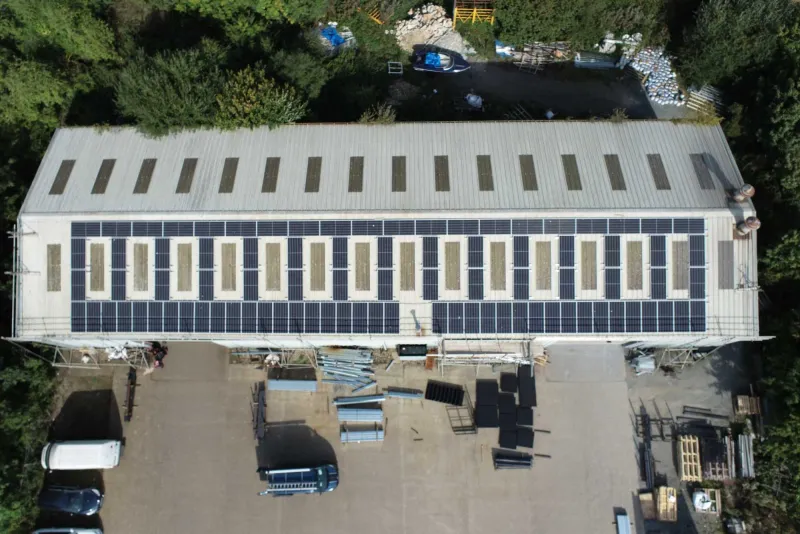
Horticulture sites tend to present a different roof to a farm. The packhouse, propagation block and ancillary buildings usually carry conventional flat or shallow-pitch steel-portal roofs that array cleanly, while a working glasshouse is a glazed structure that is rarely a candidate for panels itself, so the usable array area is typically the solid-roofed buildings and any suitable adjacent ground rather than the growing houses. Where the packhouse runs a heavy chilled or cold chain, the load and self-consumption picture is close to what we model for food and drink processing and cold storage sites. As an indicative orientation only, sites in this sector tend to fall in a medium-to-large band, reflecting the spread between a single packhouse and a large multi-house grower with substantial ancillary roof. Treat that as a sense of scale and nothing more. It is not a quote, and the real figure comes from the on-site survey and the PV*SOL model, sized to the load the site actually carries rather than to the area on top of it.
How the economics read on a horticulture site
Self-consumption drives the return here, and it tends to read more strongly than on a typical farm. Because the return on a horticulture array is driven almost entirely by how much generation is consumed behind the meter, a holding that runs heavy year-round demand keeps far more value on site than a farm building that sits cold for half the year and exports its surplus at a fraction of the import price it would otherwise offset. The steady climate-control, pumping and refrigeration baseload means a larger share of every generated unit lands against an expensive import unit rather than a low export rate, and that self-consumption ratio is the single biggest lever on the case. We model payback on the conservative self-consumption figure for your actual half-hourly profile rather than a sector average, and we show the import offset and any export value separately so the assumptions behind the number are visible and yours to challenge. None of that is a promise. The figures are modelled, not guaranteed, and they move with your tariff, your generation year and how the lighting schedule sits against the array across the seasons. The payback and return guide explains the method we use, and the payback-by-sector guide sets honest expectations by load type before any figure is attached to your specific site.
There is a seasonal twist worth pricing into the case. A grower lights least in the long summer days, exactly when the array generates most, so the months of strongest generation are also the months of lowest lighting demand, and that is when a daytime surplus is most likely to spill to export. The summer cooling and ventilation load takes back some of that surplus, but where the model shows meaningful export in the bright months, an export-limitation scheme under G100 or a battery to carry midday output into the evening lighting run both come into the sizing conversation. We model that seasonal swing explicitly rather than averaging it away, because a horticulture profile that looks self-consuming on an annual average can still export hard for a run of summer weeks.
How the spend is structured moves the net cost as much as the headline price. A solar array on a commercial building generally qualifies for capital allowances, and the way the investment is financed against the energy saving changes the cash position in the early years, so two sites carrying the same array can land on very different net figures depending on how each is structured. We set those options out under commercial finance rather than fold them into a single number, because the right structure depends on your accounts and your appetite for capital outlay, not on a default we apply to everyone. The generation figure itself is a modelling output rather than a rule of thumb: we confirm the expected yield in PV*SOL against your exact roof pitch, orientation and the shading thrown by glasshouse runs and water tanks, and we treat that model as a starting point we test rather than a guaranteed annual output. The drone survey fixes those physical variables before the model runs, which is why we will not put a figure to a horticulture site until it has been measured.
Installing over a live, climate-sensitive operation
The works sit over a growing operation that cannot simply stop. A glasshouse holds its environment around the clock and a packhouse runs a cold chain, so the installation programme is built around your growing and packing calendar rather than imposed on it, and the CDM 2015 duties under which the project runs are what keep a roof installation safe over occupied, plant-heavy buildings where ventilation, dosing and refrigeration plant stay live. On the network side, a system above 50 kWp needs a G99 connection agreement with Northern Powergrid, the distribution operator across our Yorkshire and northern Lincolnshire area, and that agreement is usually the pacing item rather than the roof works. We lodge it early and run the design alongside it so the connection position is known before we commit dates to your site.
Commercial solar for horticulture: common questions
The load shape is the difference. A barn, grain store or arable shed can sit idle for months and export much of what it generates, so on a farm the case turns on which building carries the load. A controlled-environment grower runs lighting, climate control and packhouse refrigeration as a heavy, year-round load, so the demand is steadier and a higher share of generation tends to be used on site. That continuous profile is what makes horticulture one of the stronger self-consumption cases we model.
Usually not on the glazing. A working glasshouse is built to let light through to the crop, so it is rarely a candidate for panels. The usable array area on a horticulture site is normally the packhouse, propagation block and ancillary buildings, which carry conventional solid roofs, plus any suitable adjacent ground. The drone survey maps what is genuinely available, and the array is laid out against those roofs rather than the growing houses.
It helps, but it is worth being honest about the fit. Lighting runs hardest in the darker months and often into the evening and overnight, which is when the array generates least, so that part of the load is met from import rather than from the roof. The daytime climate-control, pumping and refrigeration load lines up well with generation and self-consumes strongly. Where you want to push daytime surplus into an evening or overnight lighting run, we look at whether battery storage earns its place, modelled against your real half-hourly profile before anything is specified.
As an indicative orientation only, growers and packhouses in this sector tend to fall in a medium-to-large band, reflecting the spread between a single packhouse and a large multi-house operation with substantial ancillary roof. That figure is for scale only. It is not a quote and carries no price. Your real system size comes from the on-site drone survey and the PV*SOL model, sized to the half-hourly load your lighting, climate-control and refrigeration plant actually carries.
There is no honest per-site figure until the roof and the load are measured, because the cost follows the array size and the array follows your real demand rather than the floor area of the packhouse. What we can be open about is how the number is built: the drone survey fixes the usable roof and any adjacent ground, PV*SOL models the generation against your half-hourly profile, and the design is costed against that. Published commercial solar cost bands give a sense of the per-kWp range by system size, and the figure you receive from us is your own, modelled before we quote, never a from-price. The first feasibility read is free.
From signed design to energised, most commercial installations of this size run a few months rather than weeks, and the pacing item is usually the G99 connection agreement with Northern Powergrid rather than the roof works. The survey and PV*SOL model come first, then the design and the connection application run in parallel, then installation is programmed around your growing and packing calendar so the works sit over a live, climate-sensitive operation without disrupting the crop. We give you realistic dates for your site once the connection position is known.
See what your roof and your load would actually do.
We model your half-hourly consumption against a system sized from an on-site drone survey, so the figure you get is yours, not a from-price. No obligation, no MCS gatekeeping on systems this size.
- On-site 3D drone survey, fully insured in-house pilot
- Half-hourly load modelled in PV*SOL before anything is specified
- Engineer-led, assured to the non-MCS standard (CDM 2015)