What set Alectrona apart was the documented design pack. We had quotes from three installers, but only Alectrona handed us a full set of drawings, a single-line diagram and a design referencing BS 7671 and the G99 connection process. The whole thing read like an engineering submission rather than a sales brochure. Our M&E consultant reviewed it and signed it off without a single query. That gave the board the confidence to release the capital.
Alectrona
Battery sizingSizing a commercial battery
A commercial battery is sized to the job it does on your site, so the question is never "how big" in the abstract. It is power for some jobs, energy for others, and both are read off your half-hourly data before anything is specified.
- Commercial scale, over 50 kWp
- Brand-agnostic, the right fit
- Sized to your real load
The feedback we work to earn
These are representative example reviews, not yet-collected customer feedback. They are written to illustrate the kind of feedback Alectrona aims to earn and are shown as design placeholders while we gather and verify reviews from our first commercial clients. Alectrona is the commercial solar trading brand of RVTC LTD.
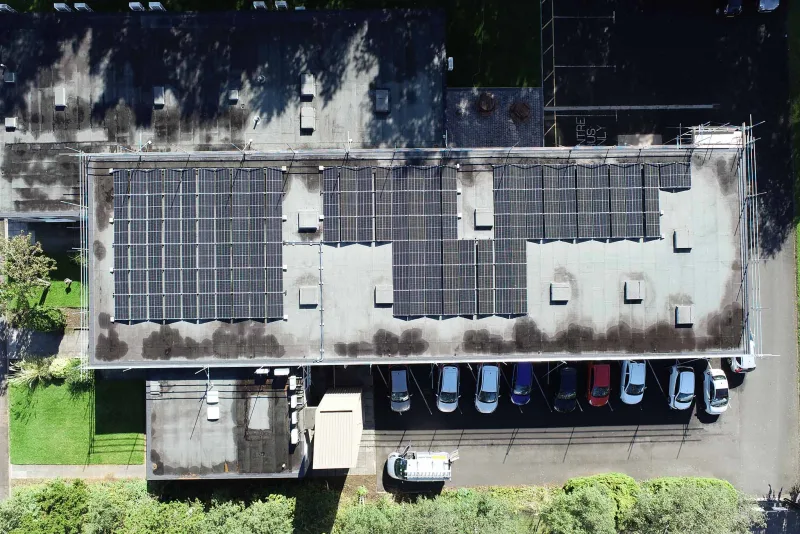
Other firms priced our roof off a satellite image and a desktop guess. Alectrona flew an in-house drone survey, fully insured and flown by a qualified commercial drone pilot, and built a 3D model of the actual roof. It picked up plant, vents and a parapet line that a flat aerial photo had completely missed, which changed the panel layout. I would rather find that out at design stage than on the day the scaffold goes up. The accuracy of that survey is the reason I trusted everything that followed.
As a finance director I was wary of being oversold a system bigger than we could use. Alectrona modelled the array against our actual half-hourly consumption data rather than an annual total, so it is sized to what we genuinely draw on site during the day. They were honest that exporting surplus is worth far less than self-consumption, and built the design around that. The capital case stacked up because the engineering was honest, not because the numbers were inflated.
We were undecided between buying outright, leasing and a PPA. Alectrona laid out all three side by side with the pros and cons of each against our balance sheet, instead of pushing the one that pays them best. They were clear about where a PPA makes sense and where capex wins, and pointed us at our own accountant for the tax treatment. The survey and design took a little longer than I expected, but the thoroughness was worth the wait. Genuinely consultative.
The install crew were tidy and well run, and worked to a clear CDM 2015 plan with a proper site induction and RAMS. What impressed me most was the handover. We received a full commissioning pack with the IEC 62446-1 test results, certification, O&M documentation and an as-built record for our maintenance team. As the people who have to live with this asset for the next twenty years, having that paperwork in order matters enormously. Nothing was left loose.
I expected the usual hard sell and got the opposite. After surveying our site Alectrona told us one roof section was not worth covering because of shading, and that a smaller, well-sited array was the better investment than filling every square metre. There was no commission-driven upselling and no pressure. For a six-figure capital project, that straight talk is exactly what you want from the people advising you. We will be using them again on our second site.
- Sizing starts from the job, not a catalogue size
- Peak-shaving and backup sized on power (kW/kVA) and duration
- Arbitrage and self-consumption sized on energy (kWh) you need to shift
- Backup rating set by the critical load and the run-time you need
- Modelled before purchase half-hourly load plus solar profile in PV*SOL
There is no standard size for a commercial battery. The right specification falls out of what you are asking it to do. A battery that shaves a half-hour demand peak is sized on power and how long that peak lasts. A battery that shifts cheap overnight units into the expensive day, or stores your own solar, is sized on energy. A battery that keeps a critical process alive through a grid failure is sized on the load it must carry and the hours it must carry it for.
Get the use case wrong and the sizing is wrong, however precise the maths. So the order is fixed: establish the job, read the load, model it, then specify the battery. We do not start from a product and work backwards.
Sized from your half-hourly load, not a per-kWh rule of thumb.
Power jobs and energy jobs are sized differently
The first split is between sizing on power and sizing on energy, because a battery is rated for both and they are not interchangeable.
Peak-shaving and standby for short demand spikes are power problems. What matters is the kW or kVA the battery can deliver at the moment your site peaks, and for how long that peak holds. A tall, brief spike needs power, not a large store. Arbitrage, time-of-use shifting and solar self-consumption are energy problems. What matters is the kWh you can move from one part of the day to another, so the battery has to hold enough to cover the window you are trying to shift.
Most commercial sites want more than one of these at once. The battery is then sized so the power rating clears the demand job and the usable energy clears the shifting job, with the binding constraint setting the specification.
Power jobs and energy jobs are sized differently
Sized on kW or kVA
Peak-shaving and standby for short demand spikes are power problems. What matters is the kW or kVA the battery can deliver at the moment your site peaks, and for how long that peak holds.
- A tall, brief spike is met by power rating rather than a large store
- Peak-shaving and backup, sized on power and duration
- Backup rating set by the critical load and the run-time you need
- The current that trips your main breaker is an instantaneous figure a half-hourly average hides
Sized on kWh
Arbitrage, time-of-use shifting and solar self-consumption are energy problems. What matters is the kWh you can move from one part of the day to another, so the battery has to hold enough to cover the window you are trying to shift.
- The store has to cover the shifting window you are trying to move
- Arbitrage and self-consumption, sized on energy you need to shift
- We size on usable energy after the derations, never the nameplate kWh
- Modelled from your half-hourly load plus the solar profile in PV*SOL
Backup is sized on the critical load, not the whole site
Backup is its own calculation, and it is rarely the whole building. The right question is which loads must stay live through an outage and for how long.
That critical load sets the power rating: the battery and its inverter have to carry the simultaneous demand of everything on the protected circuits, including the surge when motors and compressors restart. The duration you need sets the energy. A few minutes to ride through a dip and hand over to a generator is a very different store from running a cold room or a server room for hours.
Sizing backup honestly means mapping the critical circuits first, then the run-time, then the rating. Protecting the whole site for a long duration is possible, but it is a much larger battery, so the engineering and the cost track the scope you actually need.
The numbers come from your data, not a rule of thumb
Sizing is a modelling exercise, and the inputs are specific to your site. Three things drive it:
- Your half-hourly load data, which shows when you draw power, how high the peaks run, and how long they last across a real year.
- The solar generation profile for the array, modelled against the roof from the in-house insured drone survey, so the surplus the battery would store is a real shape rather than an assumption.
- The use case you are optimising for, which decides whether power or energy is the binding constraint.
We model all three together in PV*SOL before any battery is specified. That is what tells us the power rating, the usable energy and the round-trip behaviour the site needs. It also catches the cases where a smaller, better-matched battery does the job a larger one was assumed to require.
Right-sizing is part of the engineering, not an upsell
An oversized battery is wasted capital that rarely fills. An undersized one clips the very peaks it was bought to shave, or runs flat before the expensive window closes. Both are sizing failures, and both are avoidable by modelling first.
The whole installation is then engineered around the figure the model produces: the inverter and protection to BS 7671, commissioning and verification to IEC 62446-1, the G99 application to your DNO, and the works run under CDM 2015 on a JCT or NEC contract. The battery is specified to fit the job, not the job stretched to fit a battery.
Why we size on usable energy, not the nameplate kWh
A battery is not specified by its nameplate kWh. It is specified by the energy it will actually deliver over a warranted life, and that is a smaller number. Two derations sit between the headline figure and the figure the model uses.
The first is depth of discharge. The bankable lithium iron phosphate systems we lead with keep headroom at the top and bottom of the pack to protect cycle life, so the usable energy is a fraction of the nameplate. The second is round-trip efficiency: the energy that comes back out is less than the energy that went in, because the cells, the power-conversion system and the auxiliaries all take a share. We size on usable energy after both, never on the brochure capacity, so the store still clears the shifting window in year ten and not only on the day it is commissioned. The cells, conversion electronics and energy management are tested to the IEC 62619 safety standard for industrial lithium cells and the IEC 62933 series for the system as a whole, and the warranted throughput is read from the datasheet rather than assumed. How chemistry sets that usable depth is covered on how a commercial battery works, and the capital it drives on battery costs.
Why half-hourly averages are not enough for the power rating
For a peak-shaving or grid-services battery, the half-hourly meter is the wrong resolution to size the power rating from. Network charges and the metered maximum demand are settled on half-hourly averages, but the current that trips your main breaker or loads your transformer is an instantaneous figure, and a thirty-minute average hides the spikes inside it.
So we read the demand at two resolutions. The half-hourly data, the same data behind your half-hourly metering, sets the energy and the shape of the day. Where the job is to clip a maximum-demand charge or hold a network limit, we look harder at the instantaneous and short-interval peaks, because the power rating has to carry the real spike and its duration, not the averaged one. The same logic decides an export-limitation scheme under G100, where the battery and its controller hold the site inside an agreed limit in real time rather than on average. Getting this resolution right is the difference between a battery that actually shaves the peak and one that is averaged into missing it. The peak job itself is set out on peak-shaving.
How a stacked duty cycle changes the specification
When a battery earns from the markets as well as serving the site, the dispatch pattern feeds back into the sizing, because the two jobs compete for the same energy and the same cycles. A pack held full to be ready for a frequency-response call is not free to soak up midday solar, and a pack cycled hard for wholesale arbitrage ages faster than one cycled gently.
We model the stacked use case before specifying, so the rating carries the combined duty rather than one job at a time. The market frameworks are named and modelled by mechanism, never by a promised return: the Capacity Market run by the National Energy System Operator, the Balancing Mechanism, and the ancillary frequency-response services such as Dynamic Containment. Any revenue, payback or arbitrage spread is modelled against your tariff and dispatch and disclosed with its basis; it is never a fixed figure quoted on a page. How those markets pay, and how the duty cycle shapes the specification, is covered on grid services, the Capacity Market and the ROI model.
How the grid connection and siting can move the size
The model produces a number, but the site decides whether the number can be installed. Two constraints commonly move the specification after the load is read.
The first is the grid connection. A battery that charges and discharges at the rating the model wants may exceed what your existing connection allows to import or export, which turns the project into a G99 application to your DNO, Northern Powergrid across Yorkshire and northern Lincolnshire, and can introduce an export or import limit the controller then has to hold. The second is siting and fire safety. A larger pack needs separation distances, ventilation and a fire strategy consistent with BS EN 62933-5-2 and the guidance the HSE and the fire service work to, alongside NFPA 855 as a reference for spacing where it is cited, all of which is set out on battery fire safety. Those requirements can favour a smaller indoor cabinet or push a bigger system to an outdoor enclosure, the choice covered on containerised or indoor housing. We resolve the connection envelope and the siting envelope alongside the load model, so the specified battery is one that can actually be energised on your site, not only one that balances on a spreadsheet.
Sizing: common questions
Both, and which one binds depends on the job. Power (kW or kVA) is what the battery delivers at any instant, and it governs peak-shaving and backup. Energy (kWh) is how much it holds, and it governs arbitrage and solar self-consumption.
A site doing more than one job is sized so the power rating clears the demand work and the usable energy clears the shifting work, with the tighter of the two setting the specification.
From your data. We take your half-hourly load to see when and how hard you draw power, model the solar generation profile against your roof from the in-house insured drone survey, and run both against the use case in PV*SOL.
That model produces the power rating and usable energy the site actually needs, before any battery brand or product is specified. No size is quoted from a rule of thumb.
Around the critical load, not the whole building. We map which circuits must stay live through an outage, which sets the power rating the battery and inverter have to carry, including restart surges. The hours you need them to stay live set the usable energy.
Riding through a short dip is a small store; running a cold room or server room for hours is a much larger one, so we size to the scope you actually need rather than the maximum possible.
Yes, and it is a real cost. An oversized battery holds capacity that rarely fills, which is capital that does not work for you. An undersized one clips the peaks it was meant to shave or runs flat before the expensive window ends.
Modelling the half-hourly load against the solar profile is what avoids both, so the battery is matched to the job rather than rounded up or down.
No. We establish the job, read the load and model it first, then specify the bankable battery that fits the resulting power and energy figures. Alectrona is brand-agnostic across the makers we lead with, so the specification follows the engineering rather than a product we are tied to.
We do not put a price or a per-kWh rate on a sizing page, because the sizing decides the cost. The usable energy, the power rating, the duty cycle and any grid works all move the capital, and they settle only once your half-hourly load is modelled. We model first, then specify, then price the system that fits, so the figure is yours. See battery costs and commercial solar cost.
Sizing is quick once we hold the data. The lead time sits around it. A representative year of half-hourly data is ideal, and a request to your supplier or meter operator can take a few weeks to return; the model and specification then follow promptly. Where the rating triggers a G99 application to Northern Powergrid, the connection assessment is usually the critical-path item, so we run sizing and the grid conversation in parallel.
See what a battery would actually do on your site.
We model your half-hourly load and your solar against a battery sized from an on-site survey, so the figure you get is yours, not a from-price. Capex first, with the bankable brand that fits the project.
- Sized from your half-hourly load, not a per-kWh rule of thumb
- Brand-agnostic: the bankable battery that fits the project
- Engineer-led, assured to the non-MCS standard (CDM 2015)