Skip to content

Alectrona

Commercial solar panels · over 50 kWp · outside MCS

Q Cells for commercial solar, with an honest status.

Q Cells commercial solar panels come from a South Korea-headquartered module maker with Silicon Module Super League heritage (2015 to 2019), bankable on a sourced financeability credential that we name as the separate S&P Global Tier 1 Cleantech scheme, kept distinct from the BloombergNEF list.

  • Silicon Module Super League heritage (2015–19)
  • S&P Global Tier 1 Cleantech (separate scheme)
  • On-site 3D drone survey + PV*SOL
Reviews

The feedback we work to earn

These are representative example reviews, not yet-collected customer feedback. They are written to illustrate the kind of feedback Alectrona aims to earn and are shown as design placeholders while we gather and verify reviews from our first commercial clients. Alectrona is the commercial solar trading brand of RVTC LTD.

What set Alectrona apart was the documented design pack. We had quotes from three installers, but only Alectrona handed us a full set of drawings, a single-line diagram and a design referencing BS 7671 and the G99 connection process. The whole thing read like an engineering submission rather than a sales brochure. Our M&E consultant reviewed it and signed it off without a single query. That gave the board the confidence to release the capital.

Estates Manager, academy trust (Yorkshire)

Other firms priced our roof off a satellite image and a desktop guess. Alectrona flew an in-house drone survey, fully insured and flown by a qualified commercial drone pilot, and built a 3D model of the actual roof. It picked up plant, vents and a parapet line that a flat aerial photo had completely missed, which changed the panel layout. I would rather find that out at design stage than on the day the scaffold goes up. The accuracy of that survey is the reason I trusted everything that followed.

Facilities Manager, distribution centre (East Midlands)

As a finance director I was wary of being oversold a system bigger than we could use. Alectrona modelled the array against our actual half-hourly consumption data rather than an annual total, so it is sized to what we genuinely draw on site during the day. They were honest that exporting surplus is worth far less than self-consumption, and built the design around that. The capital case stacked up because the engineering was honest, not because the numbers were inflated.

Finance Director, logistics group (North West)

We were undecided between buying outright, leasing and a PPA. Alectrona laid out all three side by side with the pros and cons of each against our balance sheet, instead of pushing the one that pays them best. They were clear about where a PPA makes sense and where capex wins, and pointed us at our own accountant for the tax treatment. The survey and design took a little longer than I expected, but the thoroughness was worth the wait. Genuinely consultative.

Property Director, retail park (West Midlands)

The install crew were tidy and well run, and worked to a clear CDM 2015 plan with a proper site induction and RAMS. What impressed me most was the handover. We received a full commissioning pack with the IEC 62446-1 test results, certification, O&M documentation and an as-built record for our maintenance team. As the people who have to live with this asset for the next twenty years, having that paperwork in order matters enormously. Nothing was left loose.

Operations Director, food manufacturer (Lincolnshire)

I expected the usual hard sell and got the opposite. After surveying our site Alectrona told us one roof section was not worth covering because of shading, and that a smaller, well-sited array was the better investment than filling every square metre. There was no commission-driven upselling and no pressure. For a six-figure capital project, that straight talk is exactly what you want from the people advising you. We will be using them again on our second site.

Managing Director, engineering firm (Sheffield)

01 Corporate profile

Who Q Cells are. The sourced corporate facts a finance director will want, dated where they move. We re-verify before contract.

  • Legal name and headquarters Hanwha Qcells (Qcells division of Hanwha Solutions, part of Hanwha Group). Seoul (executive HQ); Thalheim, Germany (technology HQ), South Korea
  • Founded 1999
  • Ownership Public; KRX-listed parent Hanwha Solutions (009830). Q-Cells originated in Germany (1999); Hanwha acquired the business in 2012.
  • Recent shipments Largest US module footprint of any maker (Dalton plus fully integrated Cartersville, Georgia); No.1 US residential and commercial brand by Wood Mackenzie
  • Manufacturing United States (Georgia), South Korea, Malaysia
  • UK presence Exports to the UK via distributors and EPCs; an established premium brand in the UK market
02 Trust status

What each credential is, and what it is not. Silicon Module Super League is shown in the past tense; every BloombergNEF Tier 1 line names the quarter and is re-verified for the exact module before contract.

  • Silicon Module Super League heritage (2015–19)
  • S&P Global Tier 1 Cleantech (separate scheme)

A Western-headquartered maker (Hanwha Solutions, South Korea) with US, Korea and Malaysia manufacturing, and a historical Silicon Module Super League member (PV-Tech, founding member 2015 as Hanwha Q-CELLS). Its strongest, precisely-named credentials are a 9-year Kiwa PVEL Top Performer record, S&P Global 2025 Tier 1 Cleantech status, and the No.1 US residential and commercial brand ranking by Wood Mackenzie. We keep the S&P Global Tier 1 Cleantech scheme distinct from the BloombergNEF Tier 1 module list and do not conflate the two.

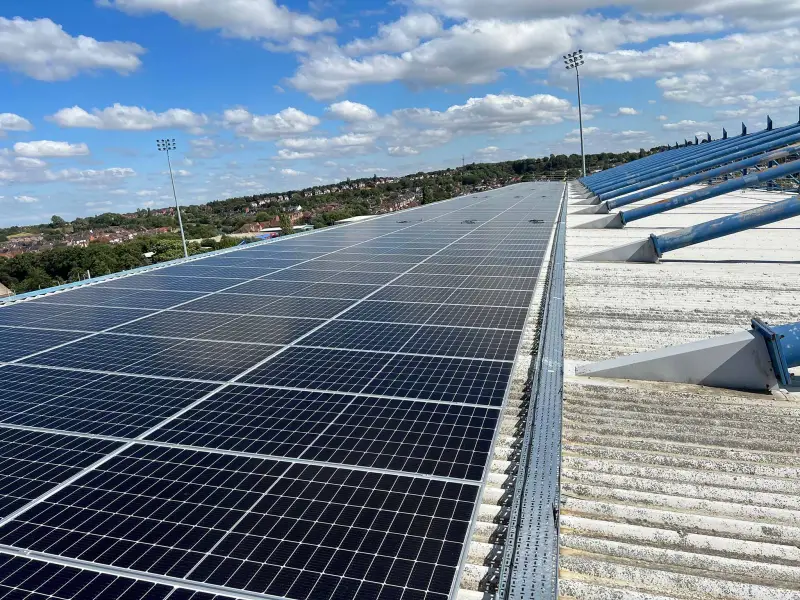
A commercial rooftop solar installation of the scale Q Cells modules are specified for
Engineer-led from the survey to the G99 connection, whatever the brand.
03 The engineering view

The engineer's read on Q Cells. Where the brand fits a commercial roof, the modules and the cell technology, and how we stand behind it without MCS.

Why we specify Q Cells

Q Cells earns a place on a commercial roof where a buyer wants a Western-headquartered maker with a long manufacturing record and reliability evidence that has been measured rather than asserted. Hanwha Qcells is the solar division of Hanwha Solutions, the KRX-listed South Korean group (009830), with a technology base that traces back to Germany and manufacturing across the United States, South Korea and Malaysia. That spread of footprint, and the corporate scale behind it, is part of why the brand sits in the premium part of our bankable line-up rather than the value end.

We frame its bankability precisely. Q Cells is an established, bankable brand, and its verifiable Tier 1 standing comes from the S&P Global 2025 Tier 1 Cleantech scheme. That is a separate scheme from the BloombergNEF Tier 1 module list, and we keep the two distinct and never conflate them. Where a funder asks specifically for BloombergNEF Tier 1, we tell them plainly that Q Cells is not what we would put forward for that test, and we offer a genuinely listed brand to compare against.

Which module lands on your roof follows the survey and the PV*SOL yield model, weighed against your structure, your roof geometry and your own electricity use. A badge does not decide it. You can read how we assess bankable and Tier 1 panels before any specification is fixed.

The modules and the cell technology

Q Cells supplies crystalline-silicon modules in the formats commercial rooftops are built around, and the brand reaches the UK through distributors and EPCs as an established premium name. We do not publish a named flagship SKU, an efficiency percentage or a nameplate watt figure on this page, because we do not hold a Q Cells datasheet in our product registry and will not quote a spec we cannot stand behind. The exact module, its cell technology and its measured efficiency are confirmed against the current manufacturer datasheet for the SKU we propose, after the survey.

What we can stand behind without a datasheet is the way module selection is driven. A module's efficiency sets how much power fits into a fixed roof area, and its temperature behaviour governs how output holds up on a warm summer roof, so both feed straight into the PV*SOL model and the array layout. On a constrained roof, a higher-efficiency module reduces the panel count and the mounting needed; on a larger, simpler roof, a lower cost per watt may earn its place instead. We size the array, the inverter and the structure together against your load profile, then read the confirmed module figures back to you in writing. If you want the difference between the modern cell technologies set out plainly, see our guide to TOPCon, HJT and PERC.

Warranty, reliability and assurance without MCS

Warranty is confirmed from the datasheet for the exact module before contract, and we hold to those datasheet figures rather than to a headline number. The product and performance warranty terms depend on the specific Q Cells module we propose, and they vary by series and production year, so we read both figures back to you in writing at survey alongside the bankability and reliability evidence. That way the cover you rely on matches the panel actually installed across what is a twenty-five-year-plus asset.

The reliability evidence we cite is independent and named. Q Cells holds a Kiwa PVEL Top Performer record across nine consecutive years, including 2026, and it is ranked the No.1 US residential and commercial brand by Wood Mackenzie. We set that measured reliability beside its bankability, the S&P Global 2025 Tier 1 Cleantech standing, rather than treating either as a stand-in for the other, and we re-verify the proposed module before contract. The corporate backing behind the warranty is Hanwha Solutions, the KRX-listed parent, which matters because a long warranty is only as good as the company standing behind it.

A commercial array over 50 kWp sits outside the domestic MCS scheme, so the assurance is engineered to standard rather than carried by a badge. We design and certify to BS 7671 and verify to IEC 62446-1, secure the grid connection under G99, discharge the CDM 2015 duties, and confirm the roof on a structural survey before any panel is fixed. The route is set out in our guide to quality without MCS.

04 The engineering

Over 50 kWp, the engineering is the trust signal.

MCS does not cover systems this size, so the rigour is what you rely on instead. These are the component-level standards we hold on every install, at commercial scale.

Sealed connectors on every site-made joint

MC4 plug-and-socket connectors are one of the most common failure points in the UK installed base, and the field-made ones are where the risk lives. Every connector we crimp on site gets a sealed ArcBox enclosure: weatherproof, UV-stable, and proof against the arcing-on-corroded-pins failure behind many rooftop PV fires. Diagnosed in real time through our sister company, Solar Tech Support.

Earthing and surge protection as standard

A commercial array is a large metal structure on an exposed roof, wired straight into your distribution board. We earth and bond every array to BS 7671 and fit the surge protection that stands between a lightning transient or a grid spike and your inverters and switchgear. It protects the asset and the building it feeds, and it is built into the base design on every install.

Signed off by a qualifying supervisor

Our Qualifying Supervisor, a fully AM2-trained electrician, personally reviews the install report on every job before commissioning sign-off: photos, test certificates, torque-check log and commissioning data, all filed and checked. We are an engineering company first, so the installer never signs themselves off.

05 FAQ

Q Cells panels: common questions

We do not present Q Cells as BloombergNEF Tier 1, because that specific listing is not what its sourced credential names. Q Cells is an established, bankable brand whose verifiable Tier 1 standing comes from the separate S&P Global 2025 Tier 1 Cleantech scheme, which we keep distinct from the BloombergNEF module list and never conflate with it.
The exact product and performance warranty depends on the specific module we propose, so we confirm both figures from that module's current datasheet at survey rather than quoting a headline number here. For a commercial roof over 50 kWp we read the warranty terms back to you in writing, alongside the bankability and reliability evidence, before anything is specified.
Q Cells is made by Hanwha Qcells, the solar division of Hanwha Solutions, a South Korean group whose technology base traces back to Germany. Manufacturing runs across the United States (Georgia), South Korea and Malaysia, and the brand reaches the UK through distributors and EPCs as an established premium name.
Q Cells was a founding member of the Silicon Module Super League from 2015 to 2019, as Hanwha Q-CELLS, an analyst grouping of the era's largest crystalline-module makers. That was a historical measure of scale and heritage, not a quality or bankability certification, so we describe it only in the past tense and never as a current credential.
On a building over 50 kWp, which sits outside MCS, we lead on independently sourced evidence rather than a badge. Q Cells holds a nine consecutive year Kiwa PVEL Top Performer record and is ranked the No.1 US residential and commercial brand by Wood Mackenzie. We cite that reliability evidence beside its bankability and re-verify the proposed module before contract.
We do not publish a per-panel or per-watt price for Q Cells, because the module is a small part of a survey-led commercial cost. Q Cells is an established premium name, so it tends to sit above a pure value brand on cost per watt, but the figure that matters is the installed system cost. Yours is built from the roof survey, the PV*SOL yield model and the balance-of-system design, then set out as one fully costed system in your written proposal. The honest cost-per-kWp bands are explained in our commercial solar cost guide.
Module supply is rarely the constraint, because Q Cells is widely stocked across UK distributors and EPCs. The programme is set by the survey, the design sign-off and the G99 grid connection. For a system above 50 kWp the Northern Powergrid assessment usually sets the critical path rather than the panels, so we start the application early and run procurement around it. We confirm the live Q Cells stock position for your exact module at proposal stage, and give a dated programme with the proposal rather than a guaranteed number of days.
Get a commercial quote

Get the right panel specified for your roof.

Tell us about your building and your electricity use. We will survey the roof, model it in PV*SOL, and specify a bankable module with the scheme, grade and quarter named.

  • A bankable module, scheme and quarter named
  • Re-verified for the exact module before contract
  • Independent reliability scorecards cited alongside Tier 1
  • On-site 3D drone survey and PV*SOL modelling on every quote