Skip to content
07944 877 329 hello@alectrona.solar

Alectrona

Commercial solar & storage · over 50 kWp

Bankable commercial solar, engineered to stand up to your finance director.

Commercial solar over 50 kWp sits outside MCS, so the trust signal is the engineering, not a domestic badge. We design to the standards that govern this work, specify panels lenders will finance, and prove the numbers with a survey, not a satellite photo.

Ahead of that, the free remote survey gives you a first read at no charge. Our engineer models your roof from aerial imagery against your own half-hourly consumption data and sends back a branded report with an indicative system size, before anyone visits your site.

An on-site 3D drone survey and a bankable-grade PV*SOL model on every quote. The most accurate commercial quotations in the market.

  • BloombergNEF Tier 1 panels (Q1 2026)
  • On-site 3D drone survey + PV*SOL
  • Capex-led, owned from day one
  • 50+ kWp Outside MCS Assured by the non-MCS engineering stack
  • 3D drone On-site survey Our own A2 CofC + GVC pilot, fully insured
  • Tier 1 Bankable panels BloombergNEF Tier 1, scheme and quarter named
  • Capex-first Or lease / PPA Capex gives the best return where you can

Flownbydrone.

ModelledinPV*SOL,bankablebydesign.

Designedbeforewesellit.

Beforeyousignanything.

Themostaccuratequotesintheindustry.

01 What a well-matched site can do

The economics, framed conservatively.

These are indicative ranges for a well-matched commercial roof, framed at the conservative end. Your figure comes from the survey and the PV*SOL model, never from a rule of thumb.

  • Payback

    payback can be as little as ~3 years (including the year-one AIA saving); typically ~3.5–5 years, depending on consumption profile, tariff and roof

  • Return on investment

    around 15–25% IRR over its life / ~25% annual return net of maintenance, after first-year capital allowances

  • Bill reduction

    up to ~60% on a well-matched site, more typically ~40–50%, depending on consumption profile and roof space

Representative example, not a quote. Figures assume a well-matched commercial site sized for self-consumption, a typical commercial import tariff, generation modelled in PV*SOL for the specific roof, and the year-one Annual Investment Allowance applied where the route is capex. Actual results depend on your consumption profile, roof space and tariff. Your own figures come from the on-site survey and model.

Indicative, not financial or tax advice. Confirm the position with a qualified accountant or tax adviser. Your figure comes from a survey-led PV*SOL model.

See your own figures from the free remote survey
02 How a commercial project runs

From the drone survey to switch-on, engineered and assured to the standards that govern >50 kWp.

  1. Survey

    On-site 3D drone survey

    Our own insured pilot flies your roof and captures the real geometry and shading, so the design starts from your building instead of a satellite guess.

    Booked to suit your operating hours

  2. Model

    PV*SOL design and proposal

    We model the array in bankable-grade software, size it around your daytime load, and set out generation, savings and payback across three funding routes.

    Modelled, not promised

  3. Install

    Engineered and installed

    Designed and installed to BS 7671, commissioned to IEC 62446-1, connected under G99 and run under CDM 2015. Alectrona is typically the Principal Contractor.

    Outside MCS, assured by the non-MCS stack

  4. Aftercare

    Operations and maintenance

    A 12-month defects period backed by an Insurance-Backed Guarantee, then ongoing operations and maintenance so the asset keeps earning for its full working life.

    Kept performing, year on year

03 The most accurate quote in the market

We fly your roof, then model it in PV*SOL.

We do not quote from a desktop. Our own qualified, insured pilot (A2 CofC and GVC) flies a 3D drone survey of your roof, and we build the design in PV*SOL, the bankable-grade software lenders model against.

That gives full shading analysis from the actual building, not a guess off an aerial image. The generation, the savings and the payback are calculated from real geometry, and we do it on every quote. See how we quote, or read what goes into the design and engineering behind it.

A quote is only as good as the survey behind it. Ours starts on your roof, which is how we give the most accurate commercial quotations in the market.

That accuracy cuts both ways, and sometimes the answer it produces is no. A roof that will not carry the array without strengthening that costs more than the solar saves. A connection with no headroom, where the export limit the network operator sets takes the top off the generation. A load that sits outside daylight hours, so too little of what the roof makes gets used on site. Those are the three findings that end a commercial project, and the free remote survey is where they surface, before you have spent anything with us.

Book a site survey
Indicative layout · scaled 3D model, not a satellite estimate.
04 What your proposal contains

A proposal your finance director can interrogate, on its own private page.

Your proposal is a private web page built from your survey and your own half-hourly consumption data. Every figure on it can be challenged, with the working shown, before it goes to the board.

Your building in 3D

The scaled model from the drone survey with the array placed on it, and object-level shading from the real plant, parapets and neighbouring structures.

Modelled on your half-hourly data

A PV*SOL premium simulation run hour by hour against your metered consumption and years of local climate data, so self-consumption is calculated rather than assumed.

The full financial case

Generation, savings, export and the 25-year cash position on stated assumptions, with the funding route that suits you modelled in the same document.

The programme and the paperwork

The connection route and programme from G99 application to energisation, and the CDM 2015 and certification stack set out before you commit.

Ask us to build one for your site
05 How it is funded

Buy it outright. It is the strongest case, and the one we model first.

Capex keeps every saving and every pound of tax relief on your own balance sheet, which is why it leads every proposal we write. Where capital is better deployed elsewhere, lease-purchase and PPA routes exist, and we will tell you straight which one fits your balance sheet.

  • Recommended Buy it outright

    Capex (buy outright)

    Businesses with the capital to invest. The best return: you own a 25-year asset from day one and keep every saving and every pound of tax relief.

    Capex explained
  • Spread the cost

    Leasing / hire purchase

    Spreading the cost while you still own the asset and hold its tax position. It costs more over the life of the system than buying outright, because the finance charge is a cost capex does not carry.

    Leasing & hire purchase
  • No capital outlay

    Power purchase agreement (PPA)

    No capital outlay at all: a funder owns the system and you buy the power it generates, usually below grid price. The funder takes most of the long-term return in exchange, so this is the route for a business that cannot go capex rather than one that would rather not.

    How a PPA works
Have the capex case modelled for your own numbers
06 The bankable panel line-up

We specify panels a lender will finance. Bankability is led by BloombergNEF Tier 1, with the scheme and quarter named.

We lead on financeability, then prove reliability. Here is what each credential we cite actually means, in plain terms. The full, sourced explainer sits on the panels page.

  • Financeability

    BloombergNEF Tier 1

    A lender's benchmark: the maker has put its own modules into enough bank-financed projects to clear non-recourse finance. It measures bankability, not module quality, so we name the scheme and the quarter and re-verify the exact module before contract.

  • Bankability grade

    PV ModuleTech Ratings

    A quarterly financial-grade assessment of a maker's capacity, balance sheet and shipment record, graded AAA down through the bands. A grade, not a pass-or-fail list.

  • Reliability

    Kiwa PVEL Scorecard

    An independent US laboratory that stress-tests production samples for how a module degrades and survives in the field, and names the best Top Performers. The part Tier 1 does not measure.

  • Heritage

    SMSL · 2015–19

    The Silicon Module Super League was an analyst grouping of the era's largest makers. Historical scale only, never a quality or bankability badge, so we always show it in the past tense.

The two modules we lead with

  • Flagship module Aiko Solar

    Aiko 665W Stellar 3N+ N-type ABC Dual-Glass (72-cell)

    N-type ABC (All Back Contact), dual-glass

    • 24.6%Efficiency
    • 665 WPower
    • 15 yrProduct warranty
    • 30 yrPerformance warranty
    • N-type ABC back-contact: among the highest-efficiency commercial silicon (this SKU 24.6%, the series to 25.5%)
    • Cell-level partial-shade optimisation, so a shaded cell costs less yield than on a conventional module
    • A 15-year product warranty against the usual 12, and a -0.26%/°C temperature coefficient for warm-roof performance
  • JA Solar

    JA Solar 610W N-type TOPCon Bifacial Double-Glass (72-cell)

    N-type TOPCon (MBB, double-glass bifacial)

    • 23.1%Efficiency
    • 610 WPower
    • 12 yrProduct warranty
    • 30 yrPerformance warranty
    • N-type TOPCon cells: lower light-induced degradation and a stronger temperature coefficient than PERC
    • Double-glass bifacial, with rear-side gain on reflective commercial roofs and a 30-year linear-output warranty
    • A strong-value choice for larger, simpler arrays

Behind the two we lead with sits a 10-brand line-up of independently assessed makers, so the right module is chosen for your roof rather than the one a salesperson is pushing. We name the specific scheme, grade and quarter for the exact module we propose, and re-verify it before contract.

Read the full bankability explainer
07 Who it is for

Wherever the daytime load is, that is where commercial solar earns.

Warehousing and logistics give the biggest, simplest roofs in the region; manufacturing and cold storage self-consume the most. We will tell you honestly whether your site stacks up.
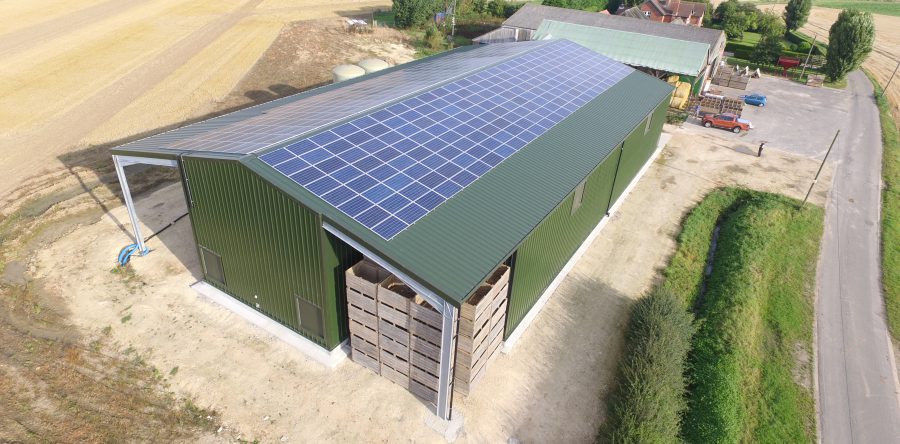
A roof-mounted solar array on an agricultural building
The building stock this work is built for: big roofs over daytime loads.
  • Warehousing & logistics The biggest, simplest commercial roofs in the region. M62, M1 and M18 distribution sheds give the most usable, unshaded array area per site.
  • Industrial units Yorkshire has dense multi-let industrial estates and converted mill stock. Many units suit a right-sized array once a structural survey confirms the roof.
  • Manufacturing High, continuous electricity demand makes manufacturing one of the strongest cases for commercial solar. Yorkshire is a major manufacturing region.
  • Cold storage Round-the-clock refrigeration load means the highest self-consumption of any sector, and the summer demand peak lines up with peak solar generation.
  • Food & drink processing Energy-intensive production lines and refrigeration self-consume well. York and the Humber hold some of the UK largest food-manufacturing sites.
  • Agriculture Large, simple farm-building roofs and rising on-farm electricity costs. The Vale of York, Selby and East Riding hold productive arable land with extensive roof stock.
  • Schools & academies Weekday daytime occupancy, large flat roofs and a sustainability mandate. Multi-academy trusts can roll a single approach across an estate.
  • Healthcare & care homes Round-the-clock occupancy means generation is used on site, not exported, and resilience matters where vulnerable residents depend on power.
See every sector we build for
08 The engineering

Over 50 kWp, the engineering is the trust signal.

MCS does not cover systems this size, so the rigour is what you rely on instead. These are the component-level standards we hold on every install, at commercial scale.

Sealed connectors on every site-made joint

MC4 plug-and-socket connectors are one of the most common failure points in the UK installed base, and the field-made ones are where the risk lives. Every connector we crimp on site gets a sealed ArcBox enclosure: weatherproof, UV-stable, and proof against the arcing-on-corroded-pins failure behind many rooftop PV fires. Diagnosed in real time through our sister company, Solar Tech Support.

Earthing and surge protection as standard

A commercial array is a large metal structure on an exposed roof, wired straight into your distribution board. We earth and bond every array to BS 7671 and fit the surge protection that stands between a lightning transient or a grid spike and your inverters and switchgear. It protects the asset and the building it feeds, and it is built into the base design on every install.

Signed off by a qualifying supervisor

Our Qualifying Supervisor, a fully AM2-trained electrician, personally reviews the install report on every job before commissioning sign-off: photos, test certificates, torque-check log and commissioning data, all filed and checked. We are an engineering company first, so the installer never signs themselves off.

09 The work

Engineering, on real roofs.

  • Warehousing & logistics

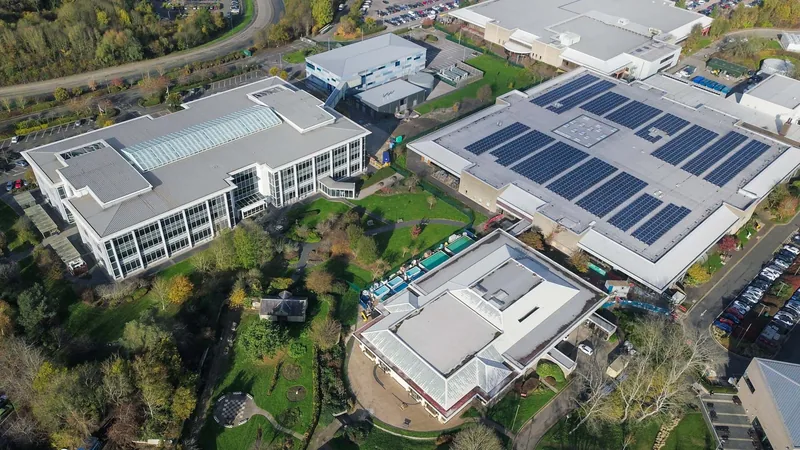
    Flat-roof logistics array

    How a large flat-roof distribution-centre array is sized to a daytime logistics load, using half-hourly modelling, an in-house drone survey and an export-limited design.

    Read the worked example
  • Sports venues

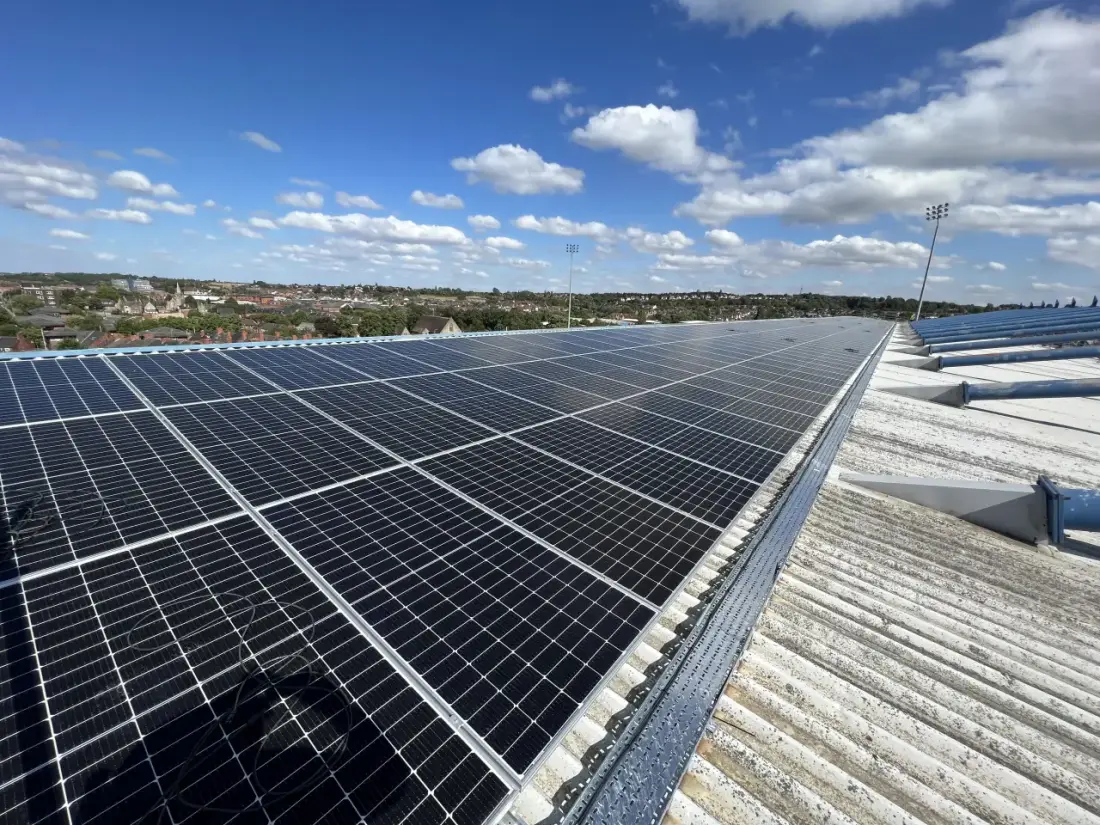
    Stadium stand roof

    How a stadium stand roof is matched to an event-driven load, where the heaviest demand falls in the evening and the load model decides whether storage earns its place.

    Read the worked example

How we work, from survey to handover

10 FAQ

Commercial solar: common questions

There is no honest rate per kWp we could publish, and a number quoted that way tends to mislead. At this scale the capital turns on the roof and its structural condition, the module and inverter specification, access and scaffold, the DC and AC works, and above all your G99 connection terms, and those vary far more between two similar-sized buildings than the panel count does. The direction of travel is real: the fixed elements of a project spread across more capacity as the system grows, so a larger array generally lands lower than a small one. We model your own figure from an on-site drone survey and a PV*SOL yield study, then quote a fixed scope against that documented design, with the capex case set out first. If you want an indicative figure before committing to any of that, the free remote survey models your roof against your half-hourly data and sends the numbers back in a report.
The survey reaches you quickly from our Yorkshire base, and your proposal arrives with a dated programme worked back from there. What sets the pace is the G99 connection to your distribution network operator rather than travel or panel lead times. We map that approval into the plan up front, so you see the real timeline on day one. See our installation timeline guide.
Commercial systems over 50 kWp, from a single roof to multi-site portfolios. The right capacity is set by your half-hourly consumption and the usable roof area the drone survey records, not by a catalogue tier, so the PV*SOL model sizes each site individually. Above 50 kWp the work sits outside MCS, and we assure it through the non-MCS engineering stack instead.
MCS caps at 50 kWp, so it does not apply to commercial systems and is not the trust signal here. We design and install to BS 7671, commission to IEC 62446-1, connect under G99, and run the job under CDM 2015 with a JCT or NEC contract and a 12-month defects period backed by an Insurance-Backed Guarantee.
We specify panels a lender will finance and name the scheme and quarter rather than relying on legacy badges. Several of our supply partners are on the BloombergNEF Tier 1 list as of Q1 2026; we re-verify the live quarter for the exact module before contract. Tier 1 measures financing track record, not module quality, so we cite the separate reliability scorecards too.
We survey on site with our own drone and model in bankable-grade PV*SOL software, so the figures are calculated from the real roof rather than estimated from a satellite image. The drone flight records parapets, plant, rooflights and shading that a flat aerial photo misses, and the model runs against your half-hourly consumption. The quote is then fixed against that documented design, so the price you sign is the price the engineering supports.
Yes, and the first step costs you nothing so that you hear it early. Three findings end a commercial project: a roof that needs strengthening costing more than the solar saves, a grid connection with no headroom for the export the array would produce, and a load sitting outside daylight hours, so too little of the generation is used on site. The free remote survey tests all three against your address and your half-hourly data.
Capex leads. Buying outright keeps every saving and every pound of tax relief, and it is the route your proposal models. Where capital is better deployed elsewhere, lease-purchase and power purchase agreements exist, and we will model the route that suits you in the same document. Our finance pages set out how each is structured, and the numbers are indicative rather than financial advice.
Commercial solar is a special-rate asset, and the Annual Investment Allowance gives a 100% first-year deduction within the annual limit, which materially improves the year-one position on a capex purchase. The right treatment depends on how the system is funded and how your accounts are structured. This is indicative, not tax advice; confirm the position with your accountant before a number goes in a board paper.
Yes. After the 12-month defects period we provide ongoing operations and maintenance: monitoring, inverter and string diagnostics, cleaning where soiling justifies it, and periodic electrical inspection. We also take over systems we did not install, through our sister operation Solar Tech Support, with the scope agreed against the site once we have seen it.
Get a commercial quote

Get a real quote for your site.

Tell us about your building and your electricity use. We will arrange a survey and come back with bankable numbers and three funding routes. If you would rather see figures before anyone visits, choose the free remote survey as your project type and we will model your roof from your own data first.
  • On-site 3D drone survey on every quote
  • PV*SOL bankable-grade modelling
  • BloombergNEF Tier 1 panels, scheme and quarter named
  • A capex-led financial case, with finance routes where they fit