Skip to content

Alectrona

Commercial guide

How long does a commercial solar installation actually take?

The physical install is the quickest part. The honest answer is that the grid connection sets the programme, so a straightforward system over 50 kWp typically runs a few months from contract to commissioning, longer where planning or network reinforcement is involved.

  • Commercial scale, over 50 kWp
  • On-site 3D drone survey + PV*SOL
  • Engineer-led, outside MCS
Reviews

The feedback we work to earn

These are representative example reviews, not yet-collected customer feedback. They are written to illustrate the kind of feedback Alectrona aims to earn and are shown as design placeholders while we gather and verify reviews from our first commercial clients. Alectrona is the commercial solar trading brand of RVTC LTD.

What set Alectrona apart was the documented design pack. We had quotes from three installers, but only Alectrona handed us a full set of drawings, a single-line diagram and a design referencing BS 7671 and the G99 connection process. The whole thing read like an engineering submission rather than a sales brochure. Our M&E consultant reviewed it and signed it off without a single query. That gave the board the confidence to release the capital.

Estates Manager, academy trust (Yorkshire)

Other firms priced our roof off a satellite image and a desktop guess. Alectrona flew an in-house drone survey, fully insured and flown by a qualified commercial drone pilot, and built a 3D model of the actual roof. It picked up plant, vents and a parapet line that a flat aerial photo had completely missed, which changed the panel layout. I would rather find that out at design stage than on the day the scaffold goes up. The accuracy of that survey is the reason I trusted everything that followed.

Facilities Manager, distribution centre (East Midlands)

As a finance director I was wary of being oversold a system bigger than we could use. Alectrona modelled the array against our actual half-hourly consumption data rather than an annual total, so it is sized to what we genuinely draw on site during the day. They were honest that exporting surplus is worth far less than self-consumption, and built the design around that. The capital case stacked up because the engineering was honest, not because the numbers were inflated.

Finance Director, logistics group (North West)

We were undecided between buying outright, leasing and a PPA. Alectrona laid out all three side by side with the pros and cons of each against our balance sheet, instead of pushing the one that pays them best. They were clear about where a PPA makes sense and where capex wins, and pointed us at our own accountant for the tax treatment. The survey and design took a little longer than I expected, but the thoroughness was worth the wait. Genuinely consultative.

Property Director, retail park (West Midlands)

The install crew were tidy and well run, and worked to a clear CDM 2015 plan with a proper site induction and RAMS. What impressed me most was the handover. We received a full commissioning pack with the IEC 62446-1 test results, certification, O&M documentation and an as-built record for our maintenance team. As the people who have to live with this asset for the next twenty years, having that paperwork in order matters enormously. Nothing was left loose.

Operations Director, food manufacturer (Lincolnshire)

I expected the usual hard sell and got the opposite. After surveying our site Alectrona told us one roof section was not worth covering because of shading, and that a smaller, well-sited array was the better investment than filling every square metre. There was no commission-driven upselling and no pressure. For a six-figure capital project, that straight talk is exactly what you want from the people advising you. We will be using them again on our second site.

Managing Director, engineering firm (Sheffield)

  • Quickest part The on-roof install, commonly one to three weeks, up to around four on larger systems
  • The long pole The G99 DNO connection, which the installer cannot compress
  • Straightforward project Commonly two to four months from contract to commissioning
  • Add time for Planning, network reinforcement or ground-mount, pushing toward six to twelve months
  • Run in parallel Survey, design and procurement alongside the connection application, not after it
01 The short version

How long installation takes

OrientationThis guide is orientation, not advice. Connection timescales, statutory assessment windows and the standards cited move with regulation and with each network operator's own published figures. Confirm the current position for your site with the relevant DNO and a qualified adviser before relying on it.

When a finance or facilities director asks how long a commercial solar project takes, the answer they expect is the few weeks the panels are on the roof. That is the quickest phase, not the timeline. The work that sets the programme happens before and around the install: the survey, the design, and above all the grid-connection application to your Distribution Network Operator.

For a straightforward system over 50 kWp, contract to commissioning is commonly a few months, often quoted as two to four. Once planning, network reinforcement or a ground-mount enters the picture, broader guidance stretches to six to twelve months. The variance lives almost entirely in the connection step. This guide walks the phases in order, indicative durations and all, and is honest about which parts an installer can compress and which it cannot. The figures are typical, not guaranteed, and we confirm the programme for your specific site.

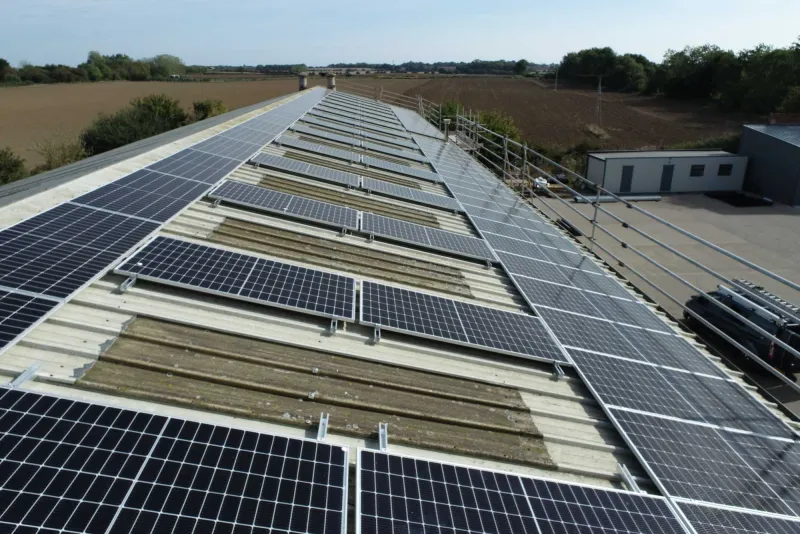
Commercial rooftop solar, the subject of this guide: How long installation takes
Engineer-led, from the survey to the G99 connection.
02

The phases, in order

A commercial project runs through a recognisable sequence. The durations below are typical and indicative, drawn from how these jobs tend to run rather than a guaranteed schedule, and several of the steps overlap rather than queueing one behind the next.

  • Site survey. Usually schedulable within a few weeks of engaging an installer. Our process opens with an in-house drone survey that builds a measured 3D model of the roof.
  • Detailed design. Around two to four weeks. The surveyed roof is run against your half-hourly consumption in PV*SOL, alongside the structural, electrical and shading work that fixes the layout.
  • G99 DNO application. The connection application to the network operator. This is the step that dominates the variance, covered in its own section below.
  • Procurement and lead times. Commonly four to eight weeks for modules, inverters and mounting, and it runs in parallel with the connection rather than after it.
  • Scaffold and install. Typically under a week to around three weeks on a mid-size roof, up to roughly four weeks on larger systems in the 100 to 300 kW range.
  • Commissioning and handover. In the order of a week, with the system tested, documented and energised once the connection is in place.

The point worth holding onto is that survey, design and procurement can be run alongside the connection application, not after it. A well-run programme starts the long-lead items early so the install is ready to go the moment the network gives the green light.

  • One to three weeks On-roof install Up to around four weeks on larger systems in the 100 to 300 kW range
  • Four to eight weeks Procurement lead times Modules, inverters and mounting, run in parallel with the connection
  • Two to four months Contract to commissioning For a straightforward system over 50 kWp; longer with planning or reinforcement
03

Why the G99 connection sets the programme

Any commercial generation above 50 kW falls under the full G99 route to the DNO, rather than the simpler G98 process used below that level. G98 covers up to 16 A per phase, around 3.68 kW on a single phase; above that, and specifically above 50 kW, the G99 application is required. That application is the single part of the programme that an installer cannot compress, because the assessment window and any required network reinforcement sit with the network operator, not with us.

Once a complete application is in, the DNO assesses it and issues a formal Connection Offer setting out the cost, the connection date and any works required. The assessment target often cited is in the region of 45 working days from a complete application, though in practice a sub-1 MW commercial project commonly runs nearer eight to sixteen weeks, and longer where the network is constrained or reinforcement is needed; larger or more complex connections can run to several months. Confirm the current windows against your own DNO's published timescales, because connections reform is changing queue dynamics through 2025 and 2026 and the figures move.

Two practical points follow. First, a complete first submission matters: if the DNO asks for further information on an incomplete application, the clock effectively restarts. Second, the offer itself carries a limited acceptance window, commonly a matter of weeks to a few months depending on the DNO, so the decision to accept needs to be ready when the offer lands rather than started from cold. Treat the connection step as the binding constraint and apply early.

04

What can run in parallel, and what cannot

The honest division is between the steps an installer controls and the steps it does not. The survey, the design, the procurement and the install are all within our control. They can be sequenced tightly, started early and accelerated where a deadline demands it. The DNO assessment window and any network reinforcement cannot be shortened by the installer at all; they run to the network operator's process.

Planning is the other parallel-track item. Rooftop commercial PV is usually permitted development, but where planning permission does apply, in a conservation area, on a listed building, on some flat roofs or on a ground-mount, it can add roughly four to eight weeks and occasionally gates the programme. Like the connection, it is best identified and lodged at the start rather than discovered late. A feasibility study front-loads exactly these questions, so the connection route, the export position and any planning trigger are known before the build programme is set rather than after.

05

Commissioning, handover and sign-off

The closing phase is commissioning. The recognised standard for a grid-connected PV system is IEC 62446-1, which sets out the documentation handed to the customer along with the commissioning tests and inspection: visual inspection, the DC and AC electrical testing, insulation resistance, polarity, earth and bonding continuity, and verification that the system performs as designed. The output is a documented, tested system rather than an array that has simply been switched on.

Because a system over 50 kWp sits outside MCS, and MCS is the domestic scheme that does not apply at this scale, the assurance comes from the commercial engineering stack instead: design and wiring to BS 7671, commissioning and documentation to IEC 62446-1, the G99 connection itself, and the construction managed under CDM 2015. One caveat to confirm for your own project: the core scope of IEC 62446-1 is written for grid-connected systems without batteries, so where a commercial install is battery-coupled, the commissioning regime for the storage side is confirmed separately rather than assumed to fall under the same part.

06

What actually delays a commercial solar programme?

The headline figure assumes a clean run, and most slippage comes from a short list of avoidable causes rather than from the build itself. The most common is an incomplete connection submission: where the Distribution Network Operator, Northern Powergrid across Yorkshire and northern and north-east Lincolnshire, comes back for further information, the assessment effectively restarts rather than pausing, so a missing single-line diagram or an unconfirmed inverter datasheet can cost weeks. The second is leaving the connection decision until late, because the Connection Offer carries a limited acceptance window and a board that has not pre-agreed the spend can let an offer lapse.

The structural picture is the next common stall. Where the in-house drone survey or the engineer's assessment finds the roof cannot carry the intended dead load, the design has to be re-cut, the layout reduced or the fixing method changed, and that loops back through design before procurement can be locked. Identifying it at the structural roof survey stage rather than after modules are ordered is the difference between a design iteration and a programme reset. Planning is the fourth: rooftop PV is usually permitted development, but a conservation area, a listed building or a ground-mount can trigger a determination, and a discovered-late planning condition gates everything behind it, as the planning permission and ground-mount planning guides set out. Procurement is the fifth, and the most controllable: a specific module grade or a particular inverter on extended lead time can hold the install even when everything else is ready, which is why long-lead items are ordered against the connection rather than after it. The pattern is that the build is rarely the bottleneck; the approvals and the decisions around it are.

07

How is connections reform changing the timeline through 2025 and 2026?

The connection step is the part of the programme moving most, because the way the connection queue is managed is being reformed. Ofgem and the National Energy System Operator, NESO, have been reordering the historic first-come-first-served queue towards a readiness-and-need basis, so that projects which are genuinely ready to build are not held behind speculative ones that may never connect. For a straightforward commercial rooftop this can help, because a shovel-ready sub-1 MW project is exactly the kind of connection the reforms intend to move forward, but the queue dynamics and the published timescales are genuinely in flux while the changes bed in.

The practical consequence is that any duration in this guide is a snapshot rather than a fixed rule, and the right figure is the one your own DNO publishes at the time you apply. The Energy Networks Association, ENA, coordinates the G99 framework that all the operators work to, and the individual operators publish their own current assessment and offer timescales; those are the numbers to plan against. For a project of any size it is worth confirming whether the connection sits inside the reformed process or under transitional arrangements, because that affects both the queue position and the acceptance terms. The honest position is that the connection has always set the critical path and still does, but the length of that path is being actively reshaped, so the grid connection queue and the detail of the G99 application are the two places to check the live position before committing dates to a board.

08

Does the time of year change how long the install takes?

Season affects the build phase more than the approvals phase, and the effect runs in two directions. Roof work is weather-dependent: high winds stop lifting and working at height under CDM 2015 and the working-at-height duties the Health and Safety Executive sets out, so a winter programme on an exposed roof can lose scattered days to weather that a summer programme would not. That rarely moves a project by months, but it widens the range on the install window itself, which is why the on-roof estimate is given as a span rather than a fixed number.

The connection and procurement phases are largely season-agnostic, with one caveat: lead times on modules and inverters can lengthen around periods of high industry demand, and installer availability tightens towards the end of a tax or financial year when buyers bring projects forward. Because the connection application runs in parallel and is the binding constraint, starting the G99 route early matters far more than the calendar month of the build. The most reliable way to keep the season working for rather than against a programme is to front-load the survey, design and connection over winter so the physical install lands in a settled weather window, and a feasibility study is where that sequencing decision is made. The build itself is fast in any season; the value of timing is in where you place the install rather than in trying to shorten it.

09

How does the timeline relate to cost and to when the system starts saving?

Timeline and cost are linked, but not in the way a domestic buyer might expect, because the longest part of the programme is the connection rather than the labour. A longer timeline driven by a network reinforcement requirement usually shows up as a connection cost in the DNO's offer rather than as more installer days, so the items that stretch the programme and the items that drive the price are often different things. There is no fixed figure for either: commercial pricing over 50 kWp is survey-led, set by the roof, the structure, the connection terms and the specified equipment, and the commercial solar cost guide explains why a credible number waits on the survey rather than a rate card.

The point in the timeline that matters commercially is when the system starts offsetting import, which happens at commissioning rather than at contract. Every week the connection sits in assessment is a week before the array generates, so a programme that front-loads the G99 route is also front-loading the first saved unit. Any payback or return figure depends on that energisation date, on your half-hourly load and on the prevailing tariff and finance terms, so it is modelled for your specific site rather than promised, and the basis sits with our finance material and the way we set out how we quote. Treat the timeline as part of the business case rather than separate from it: the schedule decides when the modelled saving begins, and the connection step decides the schedule.

10 How we quote

Past the guide, this is how your figure actually gets set.

  1. Survey

    On-site 3D drone survey

    Our own insured pilot flies your roof and captures the real geometry and shading, so the design starts from your building instead of a satellite guess.

    Booked to suit your operating hours

  2. Model

    PV*SOL design and proposal

    We model the array in bankable-grade software, size it around your daytime load, and set out generation, savings and payback across three funding routes.

    Modelled, not promised

  3. Install

    Engineered and installed

    Designed and installed to BS 7671, commissioned to IEC 62446-1, connected under G99 and run under CDM 2015. Alectrona is typically the Principal Contractor.

    Outside MCS, assured by the non-MCS stack

  4. Aftercare

    Operations and maintenance

    A 12-month defects period backed by an Insurance-Backed Guarantee, then ongoing operations and maintenance so the asset keeps earning for its full working life.

    Kept performing, year on year

11 FAQ

How long installation takes: common questions

The on-roof work is the quickest phase. On a mid-size commercial roof it is commonly a week or two once scaffold is up, and up to around four weeks on a larger system in the 100 to 300 kW range. The longer parts of any commercial timeline sit before the install, in the design and above all the grid-connection application, not in the days the panels go on.

Because it connects under a different, fuller process. Generation above 50 kW uses the G99 route to your Distribution Network Operator rather than the domestic-scale G98 notification, and the network operator assesses the application and issues a formal Connection Offer before the system can energise. That assessment, and any network works it identifies, set the programme. The physical install is no slower; the connection is what adds the time.

The DNO connection is the longest part and the one we genuinely cannot compress, because the assessment window and any reinforcement sit with the network operator. What we can do is start it early, submit a complete application so the clock does not restart for missing information, and run the survey, design and procurement in parallel so the install is ready the moment the connection is granted.

As early as the design allows, because it is the binding constraint on the whole programme. The DNO's assessment target is often cited near 45 working days from a complete application, but in practice a sub-1 MW commercial connection commonly runs nearer eight to sixteen weeks and longer where the network is constrained. The Connection Offer also carries a limited acceptance window once it arrives, so it pays to have the decision ready rather than starting it late.

Yes. A grid-connected commercial system is commissioned to IEC 62446-1, which covers the electrical testing, the inspection and the documentation you are handed: insulation resistance, polarity, earth and bonding continuity and a check that the system performs as designed. Because the system sits outside MCS at this scale, this commissioning and documentation is part of how the work is assured, alongside BS 7671 and the G99 connection.

A longer timeline does not automatically mean a higher price, because the part that usually stretches a commercial programme is the grid connection rather than the installer's labour. Where a network reinforcement is needed it tends to appear as a connection cost in the DNO's offer rather than as extra build days. There is no fixed figure either way: pricing over 50 kWp is survey-led and set by the roof, the structure, the connection terms and the equipment specified, so a credible number follows the survey. Our commercial solar cost guide explains how that is worked out.

Get a commercial quote

Get the numbers for your roof.

A guide can only take you so far. The figure you get is modelled from your own half-hourly load and a system sized from the on-site drone survey. No obligation, and systems this size sit outside the domestic MCS scheme, so the assurance is the engineering stack.

  • On-site 3D drone survey, fully insured in-house pilot
  • Half-hourly load modelled in PV*SOL before anything is specified
  • Engineer-led, assured to the non-MCS standard (CDM 2015)
  • Capex, lease-purchase or PPA, whichever suits you