What set Alectrona apart was the documented design pack. We had quotes from three installers, but only Alectrona handed us a full set of drawings, a single-line diagram and a design referencing BS 7671 and the G99 connection process. The whole thing read like an engineering submission rather than a sales brochure. Our M&E consultant reviewed it and signed it off without a single query. That gave the board the confidence to release the capital.
Alectrona
O&M serviceOperations and maintenance
A commercial array is a long-life asset wired into a working building, and it has to earn for every year of that life. Operations and maintenance is the work that keeps it performing across every year of the asset's life, rather than a line you remember after the first underwhelming bill.
- Engineer-led, every step
- In-house insured drone survey
- Over 50 kWp, outside MCS
The feedback we work to earn
These are representative example reviews, not yet-collected customer feedback. They are written to illustrate the kind of feedback Alectrona aims to earn and are shown as design placeholders while we gather and verify reviews from our first commercial clients. Alectrona is the commercial solar trading brand of RVTC LTD.
Other firms priced our roof off a satellite image and a desktop guess. Alectrona flew an in-house drone survey, fully insured and flown by a qualified commercial drone pilot, and built a 3D model of the actual roof. It picked up plant, vents and a parapet line that a flat aerial photo had completely missed, which changed the panel layout. I would rather find that out at design stage than on the day the scaffold goes up. The accuracy of that survey is the reason I trusted everything that followed.
As a finance director I was wary of being oversold a system bigger than we could use. Alectrona modelled the array against our actual half-hourly consumption data rather than an annual total, so it is sized to what we genuinely draw on site during the day. They were honest that exporting surplus is worth far less than self-consumption, and built the design around that. The capital case stacked up because the engineering was honest, not because the numbers were inflated.
We were undecided between buying outright, leasing and a PPA. Alectrona laid out all three side by side with the pros and cons of each against our balance sheet, instead of pushing the one that pays them best. They were clear about where a PPA makes sense and where capex wins, and pointed us at our own accountant for the tax treatment. The survey and design took a little longer than I expected, but the thoroughness was worth the wait. Genuinely consultative.
The install crew were tidy and well run, and worked to a clear CDM 2015 plan with a proper site induction and RAMS. What impressed me most was the handover. We received a full commissioning pack with the IEC 62446-1 test results, certification, O&M documentation and an as-built record for our maintenance team. As the people who have to live with this asset for the next twenty years, having that paperwork in order matters enormously. Nothing was left loose.
I expected the usual hard sell and got the opposite. After surveying our site Alectrona told us one roof section was not worth covering because of shading, and that a smaller, well-sited array was the better investment than filling every square metre. There was no commission-driven upselling and no pressure. For a six-figure capital project, that straight talk is exactly what you want from the people advising you. We will be using them again on our second site.
- Planned inspection On a schedule, covering the physical failure points monitoring cannot see
- Independent monitoring Sentinel, a free independent app, watches performance so faults surface early
- Found before the bill An underperforming or offline system is flagged early, rather than at the next quarterly bill
- One accountable group Alectrona installs, Sentinel monitors, Solar Tech Support diagnoses and repairs
- Handover assurance 12-month defects-rectification period plus an Insurance-Backed Guarantee
Buying the system right is half the job. Keeping it right is the other half. Panels soil, connectors loosen, an inverter throws a fault, a string drops offline, and on a roof nobody walks across, all of that can sit unnoticed for months while the asset quietly underperforms. The point of an O&M service is to catch the slow drift and the sudden fault early, so a long-life asset behaves like one across its full design life.
Our O&M is built on three things working together: planned maintenance and inspection on a schedule, continuous performance monitoring so a problem surfaces early rather than at the next quarterly bill, and a handover that hands you a twelve-month defects-rectification period and an Insurance-Backed Guarantee behind it. This is about resilience and sustained performance, rather than a saving we can promise you in advance.
Half-hourly load modelled in PV*SOL before anything is specified.
Planned maintenance and inspection
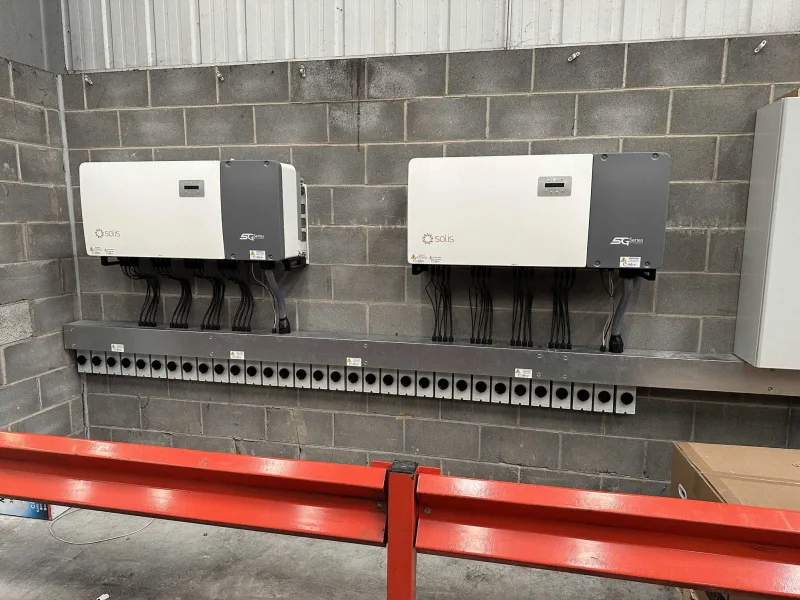
Monitoring tells you the system is generating. It does not tell you that a DC connector is starting to arc, that a cable clip has failed, or that a string is being shaded by something that has grown since commissioning. Those are physical faults found by physical inspection, and on a commercial roof they carry a fire and a revenue risk, so they belong on a schedule rather than a hope.
A planned visit covers the parts of the system that monitoring cannot see. Field-made DC connectors are a recognised weak point in rooftop PV, so the joints, the glands and the enclosures get checked for heat and water ingress. Earthing, bonding and surge protection are verified to the standard we installed them to. And the settings audit catches the quiet revenue thief: an export limit drifted from the G99 agreement, or a CT clamp reading the wrong way, both of which cost generation without ever flagging as a fault.
- Physical inspection of panels, cabling, isolators, inverters and any battery units for condition, heat and degradation
- Connector, gland and enclosure checks at the known PV failure points
- Earthing, bonding and surge-protection verification to BS 7671
- A settings and configuration audit against the G99 connection agreement
- A written report with photographs and a prioritised list of actions
What actually goes wrong on a commercial roof
Monitoring and a settings audit catch the electrical drift. The other half of an O&M visit is the physical condition of an array that nobody walks across between visits, and on a real commercial roof a recognisable set of problems turns up again and again. The visit exists to find them while they are cheap, before they show up as lost generation on a bill or, worse, as a fire risk.
Soiling, and why a shallow-pitch or coastal roof needs more cleaning than a buyer expects. Cleaning is a larger part of a commercial O&M plan than most buyers assume, and it is the parts of the plan a low-tilt or coastal site adds that get underestimated. A shallow-pitch array does not let rain sheet the dirt off the way a steeper domestic roof does, so soiling settles and stays, and output drifts gently down without ever flagging as a fault. A coastal site compounds it: salt in the air plus more airborne soiling means the glass dirties faster and rain clears less of it. We do not put a fixed cleaning frequency on a page, because the right interval is set by how your roof actually soils, read off the monitoring trend and confirmed at the visit, rather than off a generic calendar. Where soiling is the dominant loss on a site, the detail of how and how often we clean is covered in the commercial solar cleaning guide.
Bird fouling, dead birds and the shaded cells they leave behind. Droppings and dead birds sitting on the modules are a routine find on a commercial roof, and they are not only an aesthetic problem. A fouled patch of glass soils like any other soiling, but a concentrated droppings deposit, or a carcass, shades the cells beneath it, and a shaded cell in an otherwise generating string runs as a hot spot that, left long enough, can damage the module. The visit clears the fouling and inspects the cells underneath for the heat damage it may already have caused.
Shattered and cracked modules. Modules break. Impact from debris or a dropped tool, hail, thermal cycling over the seasons and the microcracks that propagate from it all leave a panel cracked or shattered, and a damaged module can keep generating while it quietly underperforms and lets water in at the failure. Identifying the affected panels and replacing them is part of putting the array back to its design output. This is also where independent monitoring and a periodic performance audit earn their place: a single failed or cracked module rarely announces itself, and the audit is how the underperformance gets traced back to the panel that caused it.
Birds under the panels: the cabling-pull fault and the fire risk
The problem we see most often that buyers least expect sits in the gap underneath the array. Pigeons and gulls nest in the space between the modules and the roof, and in doing so they pull the DC cabling out of its clips. That is a genuine electrical fault in its own right, an unsupported DC cable chafing on a roof or sitting in standing water, and under the thinking behind RC62 it is exactly the kind of DC-side condition that becomes an arc and ignition risk on a live array that cannot be switched dead in daylight. Nests, debris and fouling building up under the panels add to it.
An O&M visit checks the under-panel cabling for clips that have been pulled or displaced, re-secures the runs and clears the nesting material that drives the problem. Where birds are a persistent issue on a site, the durable answer is perimeter bird-proofing: a pigeon or critter mesh clipped around the edge of the array to close off the gap so birds cannot get under the panels to nest in the first place. It is a fitted commercial measure that removes the cause of the cabling-pull fault rather than re-clipping the same cables visit after visit. Whether a roof warrants it is a survey-led judgement about how exposed the array is and how much bird pressure the site sees.
Independent performance monitoring with Sentinel
Sentinel is our sister platform: a free, independent monitoring app from the same group of companies that watches the system's performance and tells you when it drops. The job it does is simple and it matters more than it sounds. Without it, the first sign of a fault is usually the bill, by which point you have already paid for the generation you did not get. With it, an underperforming string, an inverter error or a system that has dropped offline surfaces while it is still a small problem.
It is independent by design. It is not tied to one manufacturer's portal and it does not depend on us selling you anything to keep watching. That matters because a finance director should be able to see the truth about an asset without it being filtered through the people who installed it. When Sentinel flags something the maintenance schedule has not yet reached, the fault gets attention early rather than waiting for the next planned visit.
Diagnostics and repair when something genuinely breaks
Monitoring finds the fault and inspection prevents most of them, but equipment does occasionally fail, and when it does you want the diagnosis right the first time. That work sits with Solar Tech Support, the group's independent, brand-agnostic diagnostics and repair arm. It is the team that fixes orphaned systems whose original installer walked away, which means it is built to work on equipment it did not install rather than only the kit we put up.
For you that is one accountable group across the whole life of the asset: Alectrona designs and installs it, Sentinel watches it, and Solar Tech Support repairs it. No finger-pointing between a monitoring contract, an installer and a separate maintenance firm, and no system left orphaned because the company that built it has gone quiet.
The handover, the defects period and the guarantee
Every install is delivered under a JCT or NEC contract, and the handover is a formal part of it, rather than a set of keys and a goodbye. You receive the commissioning data, the test certificates to IEC 62446-1, the as-built records and the operating information, so the asset is documented from day one and the people running the building know what they have.
The contract carries a twelve-month defects-rectification period: if a defect in the work appears within that period, we come back and put it right at our cost. Behind that sits an Insurance-Backed Guarantee, so the cover does not rest solely on us still being here to honour it. That is the assurance that matters above 50 kWp, where MCS does not apply: the named engineering stack and a real contract you can hold us to, rather than a domestic badge.
Operations and maintenance: common questions
Three things working together: planned maintenance and inspection on a schedule, continuous independent performance monitoring through Sentinel, and the diagnostics and repair capability of Solar Tech Support when equipment genuinely fails. The inspection covers the physical faults monitoring cannot see, the monitoring catches performance drift early, and the repair arm handles the rare breakage.
The handover sits underneath all of it: a documented commissioning package, a twelve-month defects-rectification period and an Insurance-Backed Guarantee behind it.
Sentinel is our sister platform, a free and independent monitoring app from the same group of companies. It watches the system's performance and alerts when generation drops, an inverter reports an error, or the system goes offline. The reason it matters is timing: without monitoring, the first sign of a fault is usually the bill, by which point the lost generation is already paid for. Sentinel surfaces the problem while it is still small.
It is independent by design, so it is not tied to one manufacturer's portal and does not depend on us selling you anything to keep watching the asset.
A manufacturer's portal shows you that brand's equipment through that brand's lens, and it stops being useful the moment the company changes the portal, withdraws a product, or you mix kit from more than one maker. Sentinel is independent of any one manufacturer, so it gives you a single honest view of the whole asset rather than a marketing dashboard.
And monitoring of any kind only tells you the system is generating. It cannot see a loose connector or a corroded gland, which is why the planned physical inspection is part of the service rather than an optional extra.
The work is delivered under a JCT or NEC contract with a twelve-month defects-rectification period: if a defect in the installation appears within that period, we return and put it right at our cost. Behind that period sits an Insurance-Backed Guarantee, so the cover does not depend solely on us still trading.
Above 50 kWp the assurance is the named engineering stack and the contract, not MCS, which is the domestic scheme and does not apply at this scale.
It goes to Solar Tech Support, the group's independent, brand-agnostic diagnostics and repair arm. Because it routinely fixes orphaned systems other installers have abandoned, it is set up to work on equipment it did not install, not only the kit we put up. That means one accountable group across the asset's life, with no finger-pointing between a monitor, an installer and a separate maintenance firm when a fault needs resolving.
It is priced from the survey rather than from a published figure, because the work that keeps an asset performing is set by the asset. The cost of an O&M programme is driven by the system size in kWp, the roof type and access, how the site soils (a shallow-pitch or coastal array needs more cleaning), the number of inverters and strings to inspect, whether there are battery units to check, and the bird pressure that decides whether perimeter proofing is warranted. We scope all of that at a site visit and then quote the schedule to your asset rather than dropping a template price on a page.
Where the spend has to stack up against the generation it protects, that modelling sits on the commercial finance pages and the commercial solar cost guide, against your own site. Any payback or return on an O&M outlay is modelled, not promised, and any capital-allowances treatment of the cost is a mechanism to confirm with your accountant.
We do not fix a generic visit frequency on a page, because the right inspection interval is set by your asset. A shallow-pitch or coastal array that soils heavily, or a site under real bird pressure, warrants more frequent attention than a clean, steep, low-exposure roof. The cadence is set from how the system actually behaves, read off the Sentinel monitoring trend and confirmed at each visit, then written into the contract so it is a term you can hold us to rather than a hope.
Response time is where independent monitoring changes the picture. Sentinel watches the system continuously and flags an underperforming string, an inverter error or an offline system early, so a fault gets attention while it is still small rather than waiting for the next planned visit or the next quarterly bill. When something genuinely breaks, the repair goes to Solar Tech Support, the group's brand-agnostic diagnostics and repair arm, so one accountable group handles it without finger-pointing between a monitor, an installer and a separate maintenance firm.
Start where every good project starts: the survey.
We fly your roof, model your half-hourly load, and come back with a designed system and a price you can take to the board. Engineer-led from the first call to the final handover, and the years after it.
- On-site 3D drone survey, fully insured in-house pilot
- Half-hourly load modelled in PV*SOL before anything is specified
- Engineer-led, assured to the non-MCS standard (CDM 2015)