Skip to content

Alectrona

The controller

EMS and battery control software

The battery is the asset, but the Energy Management System is the brains. It decides, half-hour by half-hour, when to charge and when to discharge, so the jobs that pay are actually delivered and the value stacked across them.

  • Commercial scale, over 50 kWp
  • Brand-agnostic, the right fit
  • Sized to your real load
Reviews

The feedback we work to earn

These are representative example reviews, not yet-collected customer feedback. They are written to illustrate the kind of feedback Alectrona aims to earn and are shown as design placeholders while we gather and verify reviews from our first commercial clients. Alectrona is the commercial solar trading brand of RVTC LTD.

What set Alectrona apart was the documented design pack. We had quotes from three installers, but only Alectrona handed us a full set of drawings, a single-line diagram and a design referencing BS 7671 and the G99 connection process. The whole thing read like an engineering submission rather than a sales brochure. Our M&E consultant reviewed it and signed it off without a single query. That gave the board the confidence to release the capital.

Estates Manager, academy trust (Yorkshire)

Other firms priced our roof off a satellite image and a desktop guess. Alectrona flew an in-house drone survey, fully insured and flown by a qualified commercial drone pilot, and built a 3D model of the actual roof. It picked up plant, vents and a parapet line that a flat aerial photo had completely missed, which changed the panel layout. I would rather find that out at design stage than on the day the scaffold goes up. The accuracy of that survey is the reason I trusted everything that followed.

Facilities Manager, distribution centre (East Midlands)

As a finance director I was wary of being oversold a system bigger than we could use. Alectrona modelled the array against our actual half-hourly consumption data rather than an annual total, so it is sized to what we genuinely draw on site during the day. They were honest that exporting surplus is worth far less than self-consumption, and built the design around that. The capital case stacked up because the engineering was honest, not because the numbers were inflated.

Finance Director, logistics group (North West)

We were undecided between buying outright, leasing and a PPA. Alectrona laid out all three side by side with the pros and cons of each against our balance sheet, instead of pushing the one that pays them best. They were clear about where a PPA makes sense and where capex wins, and pointed us at our own accountant for the tax treatment. The survey and design took a little longer than I expected, but the thoroughness was worth the wait. Genuinely consultative.

Property Director, retail park (West Midlands)

The install crew were tidy and well run, and worked to a clear CDM 2015 plan with a proper site induction and RAMS. What impressed me most was the handover. We received a full commissioning pack with the IEC 62446-1 test results, certification, O&M documentation and an as-built record for our maintenance team. As the people who have to live with this asset for the next twenty years, having that paperwork in order matters enormously. Nothing was left loose.

Operations Director, food manufacturer (Lincolnshire)

I expected the usual hard sell and got the opposite. After surveying our site Alectrona told us one roof section was not worth covering because of shading, and that a smaller, well-sited array was the better investment than filling every square metre. There was no commission-driven upselling and no pressure. For a six-figure capital project, that straight talk is exactly what you want from the people advising you. We will be using them again on our second site.

Managing Director, engineering firm (Sheffield)

Key facts
  • What it is The Energy Management System: the control software that runs the battery and decides charge and discharge
  • What it does Monitors, forecasts, decides and controls in real time, then optimises the value across the jobs
  • Why it matters It stacks peak shaving, arbitrage and self-consumption half-hour by half-hour, rather than fixing the battery to one job
  • Grid markets Provides the fast automatic response and telemetry that grid-services participation needs, where the site qualifies
  • For your team Remote visibility, performance data, health and alarms, so the asset can be reported on and tuned

A commercial battery on its own is a box of stored energy. What turns it into a paying asset is the software that runs it. The Energy Management System, or EMS, is the control layer that watches your site, reads your tariff and your solar, and dispatches the battery to the right job at the right moment. The hardware sets what is possible; the EMS decides what actually happens.

The how it works page introduces the EMS as one of the four building blocks of a system. This page goes deeper into that controller itself. The use-case pages cover the work itself: peak shaving, time-of-use arbitrage, solar self-consumption and grid services. The EMS is what delivers them, decides which one earns most at any given moment, and gives your finance and facilities team the data to see it happening.

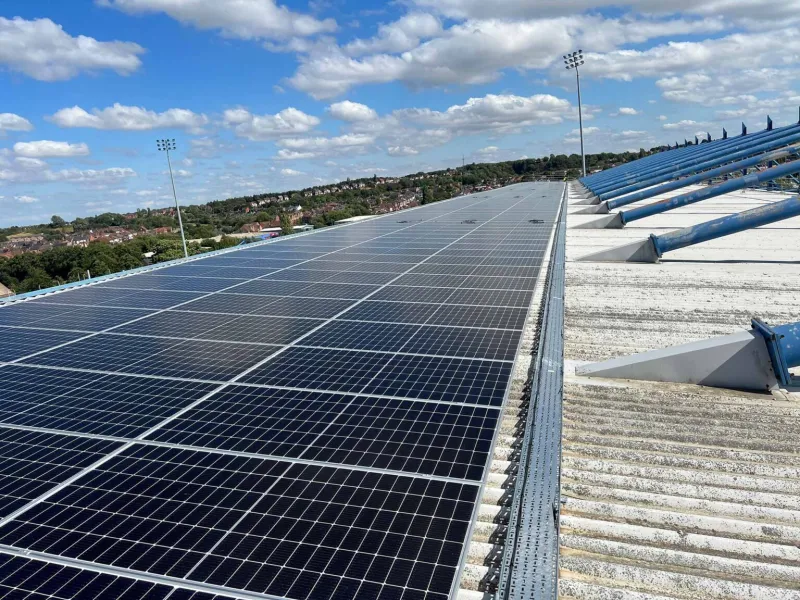
A commercial solar installation

Sized from your half-hourly load, not a per-kWh rule of thumb.

What a good EMS actually does

An EMS is doing four things at once, continuously. It monitors, reading your site load, your solar output, the battery's state of charge and the live tariff position in real time. It forecasts, anticipating the day's solar and the shape of your demand so it can plan ahead rather than only react. It decides, applying control logic to choose whether the next unit is better stored, used, sold or held in reserve. And it controls, sending the charge and discharge commands to the inverter so the plan becomes action.

The difference between a basic controller and a good EMS is in the decision-making. A simple timer can charge overnight and discharge in the evening. A real EMS weighs the competing jobs against each other in the moment, holds enough in reserve for the peak it can see coming, and does not spend the battery early on a thin opportunity when a more valuable one is an hour away. That judgement is where most of the return is won or lost.

Where the return is won or lost

A fixed timer or a real EMS

Basic controller

A simple timer

Charges overnight and discharges in the evening to a fixed schedule. It does one job adequately and the rest by accident.

  • Runs to a fixed schedule
  • Fixes the battery to one job
  • Spends the store early on a thin opportunity
  • Cannot weigh the competing jobs against each other

Stacking the value, half-hour by half-hour

The reason an EMS matters so much on a commercial site is that the jobs a battery does are not independent. Peak shaving, arbitrage and solar self-consumption all want the same stored energy at overlapping times, and they pay differently. Left to a fixed schedule, the battery does one job adequately and the rest by accident. The EMS resolves that contest deliberately.

It looks at each half-hour and asks which use of the battery is worth the most right now: covering a demand spike to protect your capacity charge, holding solar surplus for the evening so it offsets expensive import rather than being exported cheaply, or buying cheap and using dear where the tariff spread clears the losses. Then it dispatches to the winner and keeps a reserve for what it expects next. That is what stacking value means in practice, and the EMS is what does it.

  • It sequences the competing jobs rather than fixing the battery to one.
  • It holds reserve for a forecast peak instead of spending the store early.
  • It runs arbitrage only when the spread genuinely clears round-trip losses and wear.

The controller that reaches the grid markets

Where a site qualifies for grid services, the EMS is the technical gateway to them. Frequency response needs a fast, accurate, automatic reaction that no human could deliver by hand, and the controller is what provides it, charging or discharging within a fraction of a second to the grid signal. It is also what exposes the telemetry and accepts the dispatch instructions that an aggregator's platform and the market rules require. Without that control layer, the hardware simply could not take part.

The EMS folds any flexibility income in around the on-site jobs rather than ahead of them. It keeps the steady on-site savings as the priority and schedules market participation only where it fits the maker's warranty and does not compromise the core work. How those markets actually pay, the aggregator route, and why the income is variable are covered on the grid services page. Here it is enough to say the EMS is what makes participation possible and keeps it honest against the on-site case.

The data your team needs to see

For a finance director or a facilities manager, the EMS is also the window onto the asset. Remote visibility, through a portal or dashboard, shows what the battery did, what it earned or saved against each job, its state of health and any alarms, from a desk rather than a plant room. That record matters when you are reporting on the investment, reconciling it against the bill, or proving the savings to the board.

It also underpins the engineering. Live monitoring lets faults be caught early, performance be checked against the model the system was sold on, and the dispatch be tuned as your load or tariff changes over the years. The savings and revenue an EMS optimises depend entirely on your tariff, your load shape and the markets you qualify for, so we will not put a generic percentage on them. The figure for your site comes from modelling your half-hourly data. The capital-allowances treatment of standalone battery storage is not settled in public HMRC guidance, so confirm the tax position with your adviser; the disclaimer below sets that out.

What protocols does an EMS use to talk to the inverter, the meters and the grid?

An EMS reaches the rest of the site and the outside world through defined communication protocols, and it is worth knowing the names because they decide whether your battery, your meters and an aggregator's platform can actually talk to each other. Inside the installation the controller speaks to the inverter and the battery management system over an industrial bus, commonly Modbus TCP or CAN, and to site metering the same way. Where the system reaches the grid and the markets, the relevant frameworks are IEC 61850, the international standard for utility and substation communications, and the cyber-security provisions in the IEC 62443 series for industrial automation and control systems. The smart-grid interface standard IEEE 2030.5 is also used for demand-response signalling in some platforms.

This matters for two practical reasons. The first is openness. A controller locked to a single maker's cloud can leave you unable to switch aggregator or integrate a second-phase battery later, so we favour systems with documented, open interfaces. The second is security. An internet-connected controller that can charge and discharge a megawatt-hour of storage is an asset worth protecting, so authentication, encryption and segregation from the rest of your network belong in the specification from the outset. The hardware those protocols run on, the inverter and the battery management system, is introduced on the how it works page, and the brand-level differences sit on the individual inverter pages.

What data does the EMS need, and why half-hourly resolution?

The forecasting and dispatch logic is only as good as the data it is fed, and on a commercial site that data has a specific shape. The settlement signal that the EMS optimises against is the half-hourly meter read, the same granularity that the GB electricity market settles on, so the controller plans around the same time blocks your supplier bills you in. Under the market-wide rollout overseen by Ofgem and Elexon, half-hourly settlement is the basis on which non-domestic supply is reconciled, which is why a good EMS works to that resolution and a coarser daily picture falls short.

For the on-site jobs, the EMS reads your live demand and your solar generation and compares them against your tariff calendar, including the capacity and demand charges that drive peak shaving. For the market jobs, it ingests the dispatch and frequency signals that the National Energy System Operator (NESO) and an aggregator pass to it. Forecasting quality is what separates a controller that holds reserve for the right peak from one that empties early and misses it, and it improves as the system learns your building's pattern across the seasons. None of that turns into a promised figure here. The savings and any market income are modelled from your actual half-hourly data, and the basis is set out on the return on investment page; the price route is on the battery costs page.

How does the EMS balance earning from the battery against protecting it?

The EMS is also where two genuinely competing priorities are reconciled: earning from the battery and protecting it. Every cycle the controller dispatches adds wear, and the battery management system enforces hard limits on depth of discharge, charge and discharge rate, cell temperature and balancing that the EMS must respect. A well-tuned controller treats the warranty terms as a constraint, so it will hold off a thin arbitrage spread or an aggressive market call where doing so would breach a cycling limit or push the cells outside their safe window. The safety standards behind those limits, IEC 62619 for the industrial cells and battery, and the wider stationary-storage framework IEC 62933, sit underneath the control logic as binding requirements.

This is why the dispatch strategy is set per site and a maker's default is the starting point only. On a building where avoided import and peak shaving are the steady base, we configure the controller to lead with those and treat any flexibility income as the upside layer that sits on top of them. Where a site genuinely qualifies for the markets, the EMS and an aggregator share the dispatch, with the on-site jobs holding priority. The result is a control configuration matched to your load, your tariff and your warranty, and it is reviewed as those change over the asset's life rather than fixed at handover.

FAQ

EMS software: common questions

No. The battery is the hardware that stores energy; the EMS, or Energy Management System, is the software that runs it. The EMS reads your site load, solar and tariff, decides when to charge and discharge, and sends those commands to the inverter. The battery sets what is physically possible, but the EMS decides what actually happens, which is where most of the return is made.

Both matter, but the EMS is what turns a capable battery into a paying one. The same hardware can earn well or sit half-used depending on how intelligently it is dispatched. A good EMS weighs the competing jobs against each other in real time, holds reserve for a forecast peak, and runs arbitrage only when it genuinely pays. A fixed timer cannot do that, so the control layer is central to the business case.

It looks at each half-hour and dispatches the battery to whichever use is worth the most at that moment: shaving a demand spike, storing solar surplus for the evening, or buying cheap to use dear where the tariff spread clears the losses. It also forecasts the rest of the day so it can keep a reserve for a peak it can see coming, rather than spending the store early. That sequencing is what stacking value means in practice.

Through the EMS portal or dashboard, your team gets remote visibility of what the battery did, what it saved or earned against each job, its state of health and any alarms, from a desk rather than the plant room. That supports reporting the investment to the board and reconciling it against the bill. It also lets faults be caught early and the dispatch be tuned as your load and tariff change over time.

There is no separate price for the EMS, because it is specified inside the engineered system alongside the inverter and battery management system, and the whole system is survey-led. The controller's cost sits within the design rather than appearing as a standalone line. What it does is shape the return, stacking the jobs so the battery earns more from the same hardware. The price route is on the battery costs page, with the wider commercial solar cost guide alongside it.

The EMS is configured and commissioned as part of installing the battery, so it adds no separate lead time of its own; the dispatch logic is set up and verified during commissioning, before handover. The longer waits on a commercial battery are the grid connection and any planning, and the controller sits well inside those. The configuration is then tuned in the weeks after go-live as it learns your load. We give a realistic programme for the whole project at survey.

Get a commercial quote

See what a battery would actually do on your site.

We model your half-hourly load and your solar against a battery sized from an on-site survey, so the figure you get is yours, not a from-price. Capex first, with the bankable brand that fits the project.

  • Sized from your half-hourly load, not a per-kWh rule of thumb
  • Brand-agnostic: the bankable battery that fits the project
  • Engineer-led, assured to the non-MCS standard (CDM 2015)