Skip to content

Alectrona

Commercial solar by system size

Commercial solar at 50 to 150 kWp.

From around 50 kWp upward a rooftop array stops being a simple notification to the grid and becomes a full G99 connection application, which is the step that paces the whole project and the reason this SME band is sized and timed differently from a smaller scheme.

  • G99 grid connection
  • Sized from your half-hourly load
  • Over 50 kWp, outside MCS
Reviews

The feedback we work to earn

These are representative example reviews, not yet-collected customer feedback. They are written to illustrate the kind of feedback Alectrona aims to earn and are shown as design placeholders while we gather and verify reviews from our first commercial clients. Alectrona is the commercial solar trading brand of RVTC LTD.

What set Alectrona apart was the documented design pack. We had quotes from three installers, but only Alectrona handed us a full set of drawings, a single-line diagram and a design referencing BS 7671 and the G99 connection process. The whole thing read like an engineering submission rather than a sales brochure. Our M&E consultant reviewed it and signed it off without a single query. That gave the board the confidence to release the capital.

Estates Manager, academy trust (Yorkshire)

Other firms priced our roof off a satellite image and a desktop guess. Alectrona flew an in-house drone survey, fully insured and flown by a qualified commercial drone pilot, and built a 3D model of the actual roof. It picked up plant, vents and a parapet line that a flat aerial photo had completely missed, which changed the panel layout. I would rather find that out at design stage than on the day the scaffold goes up. The accuracy of that survey is the reason I trusted everything that followed.

Facilities Manager, distribution centre (East Midlands)

As a finance director I was wary of being oversold a system bigger than we could use. Alectrona modelled the array against our actual half-hourly consumption data rather than an annual total, so it is sized to what we genuinely draw on site during the day. They were honest that exporting surplus is worth far less than self-consumption, and built the design around that. The capital case stacked up because the engineering was honest, not because the numbers were inflated.

Finance Director, logistics group (North West)

We were undecided between buying outright, leasing and a PPA. Alectrona laid out all three side by side with the pros and cons of each against our balance sheet, instead of pushing the one that pays them best. They were clear about where a PPA makes sense and where capex wins, and pointed us at our own accountant for the tax treatment. The survey and design took a little longer than I expected, but the thoroughness was worth the wait. Genuinely consultative.

Property Director, retail park (West Midlands)

The install crew were tidy and well run, and worked to a clear CDM 2015 plan with a proper site induction and RAMS. What impressed me most was the handover. We received a full commissioning pack with the IEC 62446-1 test results, certification, O&M documentation and an as-built record for our maintenance team. As the people who have to live with this asset for the next twenty years, having that paperwork in order matters enormously. Nothing was left loose.

Operations Director, food manufacturer (Lincolnshire)

I expected the usual hard sell and got the opposite. After surveying our site Alectrona told us one roof section was not worth covering because of shading, and that a smaller, well-sited array was the better investment than filling every square metre. There was no commission-driven upselling and no pressure. For a six-figure capital project, that straight talk is exactly what you want from the people advising you. We will be using them again on our second site.

Managing Director, engineering firm (Sheffield)

This band covers the workhorse commercial systems, roughly 50 kWp to 150 kWp, that suit an SME factory, a retail-park unit, a smaller warehouse or a run of multi-let industrial units. It is the size most growing businesses reach first: enough roof and enough daytime load to be worth doing properly, without yet crossing into the heavier grid and engineering regimes that govern the larger bands.

It is also the band where the most-searched question, "what does a 100 kW solar system cost", actually gets asked. There is no honest single answer to that, and any installer quoting a flat "from" figure for a 100 kWp system is guessing at your roof. What we can do here is set out plainly what drives the cost at this scale, which engineering and regulatory steps switch on between 50 and 150 kWp, and roughly how big a system this is in panels, roof area and annual output, so you can size the opportunity before a survey turns it into a real number.

OrientationThese are indicative engineering rules of thumb. Your real figures come from an on-site survey and a PV*SOL model of your roof, shading and consumption.

What changes at 50 to 150 kWp: G99 grid connection

The fact that defines this band is the grid connection. A small generator connecting at up to 16 A per phase, broadly 3.68 kW on a single-phase supply and around 11 kW on a three-phase supply, can connect under the lighter G98 notification, where you tell the Distribution Network Operator after the event. Every system in this band sits well above that ceiling, so it needs a full G99 connection application made to the DNO before the work goes ahead, and approval is the gating step that paces the whole project.

In practice that means the DNO assesses what the local network can absorb and issues a connection offer, which may grant the full export you asked for, set an export limit, or in a constrained area call for reinforcement. None of that is a reason to hesitate. It is simply the process at this size, but it does change how a project is run. The application goes in early, the design is shaped around the offer that comes back, and an export limitation scheme or G100 limiter is often the neat way to keep generation flowing to your own load while staying inside what the network will accept. Because the array is over 50 kWp it is outside MCS scope entirely, so the assurance is the commercial engineering stack rather than a domestic certificate: the G99 agreement, design to BS 7671, commissioning to IEC 62446-1, and CDM 2015 managing the works. Getting the G99 application moving early is the single biggest thing that keeps a system in this band on programme.

At a glance
  • 50–150 kWp System size
  • 85–280 Modules
  • 250–1,050 m² Roof area
  • 42,000–145,000 kWh Annual output Yorkshire, indicative

What drives the cost at this scale

At this scale the cost is built from the parts and the work, not read off a price list. The main drivers are the panel count and the modules you choose, the inverters (several string inverters, or a central inverter, sized to the array), the mounting system and how it fixes to your particular roof, the DC and AC cabling and the switchgear back to your distribution board, and the access and scaffolding the building demands. On top of the kit sits the G99 connection itself: the DNO application, and any network charges or reinforcement the connection offer brings with it, which vary by site and are the one cost no installer can name before the offer is back.

The useful thing to understand at this size is how scale works in your favour. The fixed costs of a project, the survey, the design, the connection application, the scaffold mobilisation and the commissioning, are spread across more kilowatts-peak as the system grows, so the cost per kWp tends to fall as you move from the bottom of this band toward the top. A larger system is rarely proportionally dearer than a smaller one. That is why sizing to your actual load, rather than trimming the array to a smaller headline number, usually gives the better result.

To put the band in proportion, using engineering rules of thumb rather than prices: at modern commercial modules of roughly 540 to 600 W, a system in this band runs to roughly 85 to 90 panels at 50 kWp, around 170 to 185 at 100 kWp, and roughly 255 to 280 at 150 kWp (about 1.7 to 1.85 modules per kWp). On a flat roof, allowing for row spacing, that needs roughly 250 to 1,050 m² of roof (around 5 to 7 m² per kWp). And a Yorkshire yield of roughly 850 to 950 kWh per kWp a year puts indicative annual generation at roughly 42,000 to 145,000 kWh across the band. Treat all of those as indicative orientation, modelled properly for your roof at survey, never a fixed promise. We do not publish a price per kWp or a "from" figure, because the real number is survey-led: it comes out of the PV*SOL model built against your roof and your half-hourly load. For how the spend turns into a return, see the commercial finance options and the ROI and payback guide, which carry the economics in full; we keep no payback figures on this page.

Which businesses this band suits

This is the SME band, and it fits the businesses that carry a decent roof and a solid weekday load without operating at industrial-park scale. Typically that means a smaller manufacturer or SME factory, a unit on a retail park, a smaller warehouse or distribution shed, or a landlord or operator behind a run of multi-let industrial units where one design can be rolled across several comparable roofs.

What ties them together is the self-consumption logic, which is where a commercial array earns its keep at this size. A unit of generation you use on site offsets an expensive imported unit, while a unit you export is paid far less. So the value of a system in this band tracks how well its output lines up with your demand, not how many panels the roof can hold. The businesses above suit it because their load is heavy, steady and mostly daytime: machinery, refrigeration, lighting, charging and HVAC running straight through the hours the roof is generating. We confirm that match against your own half-hourly meter data before sizing anything, and where the daytime fit leaves a surplus we look at whether battery storage or an export-limited design is the better answer, modelled on your real numbers rather than a sector average.

How is the inverter and string side built at 50 to 150 kWp, and what gets metered?

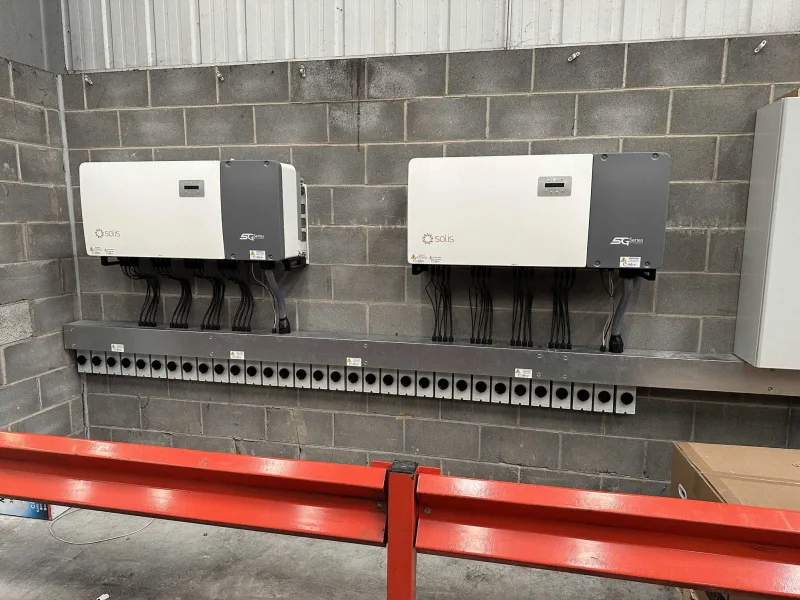
At this band the array is broken into several string inverters rather than run off one box, and the building moves onto half-hourly settlement metering. An SME system between 50 and 150 kWp is normally split across a handful of three-phase string inverters, each carrying its own group of strings, instead of a single central unit. That split is deliberate. It keeps the maximum power point tracking close to roofs that face different ways or shade at different times, it means a fault on one inverter takes down only its share of the output rather than the whole array, and it makes the AC side easier to land on your existing three-phase distribution board. The string layout, the DC stringing and the choice of inverter platform are set at design so the array reaches the export point cleanly and sits inside the G99 offer; the commercial inverter options set out the platforms we specify.

The metering change is the part most SMEs do not expect. A site carrying a 50 to 150 kWp generator usually sits on, or moves to, half-hourly settlement metering, so both the import the array offsets and any surplus it exports are measured and settled in half-hour blocks rather than estimated against a profile. That granularity is useful rather than a nuisance: it makes self-consumption auditable, it shows exactly how generation reshapes your demand across the trading day, and it is what an export route such as the Smart Export Guarantee needs in order to pay you for surplus at all. We model your supply against your own half-hourly readings before sizing, and the detail sits on the half-hourly metering guide.

Does the roof need a structural check, and can a multi-let estate be done in phases?

Yes to both. A system in this band carries real weight and wind load, so the roof is checked before a layout is fixed, and a run of multi-let units is usually rolled out roof by roof rather than all at once. Even at the lower end of the band the array is a meaningful imposed load on the roof structure, and on a flat roof a ballasted frame adds more again. The mounting design has to sit inside the building's structural capacity and the local wind zone, because uplift on a large roof is what governs how a ballasted or fixed frame is engineered. So a structural appraisal of the purlins, the deck and the spans comes before the panel count is signed off, and on an older building it runs alongside checks on the roof covering and any fixings. The structural roof survey and the commercial mounting pages cover how that appraisal and the frame design fit together; outside MCS the assurance here is the engineering stack, design to BS 7671 and the works managed under CDM 2015, rather than a domestic certificate.

The multi-let case is where this band earns its flexibility. A landlord or operator behind several comparable industrial units rarely needs every roof done in one programme. One design can be templated across similar roofs and the rollout phased unit by unit, which spreads the works, lets each tenancy or metering arrangement be handled in turn, and keeps a single G99 strategy across the estate rather than a scatter of separate applications. We confirm the demand on each unit against its own half-hourly profile first, because the sizing question on a multi-let site is set by what each tenant actually draws in daylight, not by how much roof the block carries. The sector pages and the commercial process walk through how a phased estate programme is sequenced.

A commercial solar installation in the 50 to 150 kWp range
FAQ

Commercial solar at 50 to 150 kWp: common questions

There is no honest flat figure, and we do not publish a price per kWp or a "from" price, because the cost is built from your specific roof and connection. At this scale the drivers are the panel count and module choice, the inverters, the mounting and how it fixes to your roof, the DC and AC cabling and switchgear, the access and scaffolding, and the G99 connection with any network charges the DNO offer brings. The real number is survey-led, out of the PV*SOL model built against your roof and your half-hourly load. As a sense of scale only, a 100 kWp system is roughly 170 to 185 commercial modules at 540 to 600 W, on roughly 500 to 700 m² of flat roof, generating an indicative 85,000 to 95,000 kWh a year on a Yorkshire yield.

Because of the size. A small generator connecting at up to 16 A per phase, broadly 3.68 kW on a single-phase supply and around 11 kW on a three-phase supply, can connect under the lighter G98 notification, where the DNO is told after the event. A system from roughly 50 kWp upward sits well above that ceiling, so it needs a full G99 connection application made to the DNO before the work proceeds. The DNO assesses what the local network can take and issues a connection offer, which may grant your full export, set an export limit, or call for reinforcement. That approval is the gating step for the project, which is why the application goes in early and the design is shaped around the offer that comes back.

As an engineering rule of thumb, allow roughly 5 to 7 m² of flat roof per kWp once row spacing is included, so the band runs to roughly 250 m² at 50 kWp and up toward 1,050 m² at 150 kWp. That is indicative orientation and never a fixed promise. The real figure comes from the on-site drone survey, which builds a 3D model of your roof and accounts for pitch, rooflights, plant, parapets and any structural span limits before a layout is fixed. A roof crowded with services will hold fewer panels than a clear one of the same footprint.

Solar earns most from the power you use on site, because a self-consumed unit offsets an expensive import while an exported unit is paid far less, so we size to your own daytime load first. On the export question, yes, the G99 connection offer can grant your full request, set an export limit, or in a constrained area call for network reinforcement. Where an export limit applies, an export limitation scheme or G100 limiter keeps generation flowing to your load while staying inside what the network will accept. For how export and self-consumption feed the return, see the commercial finance options and the ROI and payback guide; we keep no payback figures on this page.

The on-roof work for a system this size is usually a matter of weeks once a crew is mobilised, but the panels are not what sets the calendar. The longest single lead time is the G99 connection application and the offer it produces from the DNO, which for our region is Northern Powergrid. That application has to go in early, because the network operator assesses what the local network can absorb and the offer it returns may grant your full export, set an export limit, or in a constrained area call for reinforcement, each of which shapes the design and the programme. The honest answer is that the connection paces the project, which is why the enquiry runs before the design is finalised; our installation timeline guide walks through each stage, and your real dates come from the survey and the connection offer.

Get a commercial quote

Your size and your figure come from the survey, not a band.

These bands are a way to navigate. The system we actually design comes from your half-hourly consumption and an on-site drone survey, modelled in PV*SOL, with the figure built for your site rather than read off a price list.

  • Sized to your consumption, not your roof area
  • On-site 3D drone survey and PV*SOL model
  • Over 50 kWp, outside MCS