Skip to content

Alectrona

Fire safety

Commercial battery fire safety

A lithium battery's fire risk is thermal runaway, and it is managed by design rather than by hope: the right chemistry, tested enclosures, sensible separation, and detection that catches a cell before it spreads.

  • Commercial scale, over 50 kWp
  • Brand-agnostic, the right fit
  • Sized to your real load
Reviews

The feedback we work to earn

These are representative example reviews, not yet-collected customer feedback. They are written to illustrate the kind of feedback Alectrona aims to earn and are shown as design placeholders while we gather and verify reviews from our first commercial clients. Alectrona is the commercial solar trading brand of RVTC LTD.

What set Alectrona apart was the documented design pack. We had quotes from three installers, but only Alectrona handed us a full set of drawings, a single-line diagram and a design referencing BS 7671 and the G99 connection process. The whole thing read like an engineering submission rather than a sales brochure. Our M&E consultant reviewed it and signed it off without a single query. That gave the board the confidence to release the capital.

Estates Manager, academy trust (Yorkshire)

Other firms priced our roof off a satellite image and a desktop guess. Alectrona flew an in-house drone survey, fully insured and flown by a qualified commercial drone pilot, and built a 3D model of the actual roof. It picked up plant, vents and a parapet line that a flat aerial photo had completely missed, which changed the panel layout. I would rather find that out at design stage than on the day the scaffold goes up. The accuracy of that survey is the reason I trusted everything that followed.

Facilities Manager, distribution centre (East Midlands)

As a finance director I was wary of being oversold a system bigger than we could use. Alectrona modelled the array against our actual half-hourly consumption data rather than an annual total, so it is sized to what we genuinely draw on site during the day. They were honest that exporting surplus is worth far less than self-consumption, and built the design around that. The capital case stacked up because the engineering was honest, not because the numbers were inflated.

Finance Director, logistics group (North West)

We were undecided between buying outright, leasing and a PPA. Alectrona laid out all three side by side with the pros and cons of each against our balance sheet, instead of pushing the one that pays them best. They were clear about where a PPA makes sense and where capex wins, and pointed us at our own accountant for the tax treatment. The survey and design took a little longer than I expected, but the thoroughness was worth the wait. Genuinely consultative.

Property Director, retail park (West Midlands)

The install crew were tidy and well run, and worked to a clear CDM 2015 plan with a proper site induction and RAMS. What impressed me most was the handover. We received a full commissioning pack with the IEC 62446-1 test results, certification, O&M documentation and an as-built record for our maintenance team. As the people who have to live with this asset for the next twenty years, having that paperwork in order matters enormously. Nothing was left loose.

Operations Director, food manufacturer (Lincolnshire)

I expected the usual hard sell and got the opposite. After surveying our site Alectrona told us one roof section was not worth covering because of shading, and that a smaller, well-sited array was the better investment than filling every square metre. There was no commission-driven upselling and no pressure. For a six-figure capital project, that straight talk is exactly what you want from the people advising you. We will be using them again on our second site.

Managing Director, engineering firm (Sheffield)

Key facts
  • The risk Thermal runaway: one overheating cell venting and driving its neighbours to do the same
  • Chemistry first LFP has a higher thermal-runaway threshold than NMC, and is our safer default for stationary storage
  • Tested, not claimed Cell and system safety to IEC 62619; large-scale fire behaviour to UL 9540A where specified
  • Siting and separation Distances and enclosure rating set per project from the survey and the system's tested behaviour
  • Caught early, signed off BMS plus enclosure detection, gas management and suppression, agreed with the fire authority

The honest question a finance or facilities director asks about a commercial battery is the one about fire. Lithium cells store a lot of energy in a small space, and the failure mode that matters is thermal runaway: a single cell overheating, venting, and driving its neighbours to do the same. It is a real risk, and it is a managed one. The way you manage it is the engineering rather than a marketing badge.

This page sets out how a commercial battery's fire risk is controlled across its whole life: the chemistry you choose, the standards the cells and the system are tested to, where the enclosure sits and how far it is set back, the detection, ventilation and suppression around it, and the fire-authority consultation a larger system attracts. It is about the battery enclosure and thermal runaway. The separate fire risk of the solar array on the roof, covered by the RC62 guidance, is a different subject and we keep it on its own page.

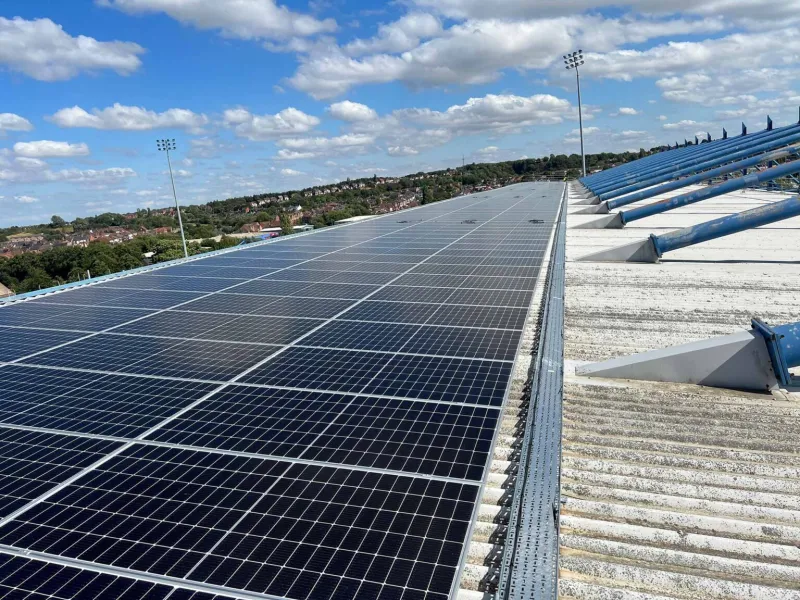
A commercial solar installation

Sized from your half-hourly load, not a per-kWh rule of thumb.

What thermal runaway is, and why chemistry comes first

Thermal runaway is a self-feeding heat reaction inside a lithium cell. Once a cell crosses its trigger temperature, it generates more heat than it can shed, vents flammable gas, and can carry the cells next to it over the same edge. The whole of battery fire safety is built around two goals: making that first cell far less likely to trigger, and making sure that if one does, it cannot cascade through the pack and the enclosure.

The single biggest lever is the chemistry, and it is decided before anything else is specified. Lithium iron phosphate (LFP) has a markedly higher thermal-runaway threshold and a more stable response than the nickel manganese cobalt (NMC) chemistry used in many high-density applications. For a stationary commercial battery, where energy density on a wall or a slab matters far less than a calm failure mode, LFP is the safer default and the one we lead with. We explain the full trade-off, including where NMC still has a place, on the dedicated chemistry page.

Chemistry comes first

The lever that is decided before anything else

Where it still has a place

NMC (nickel manganese cobalt)

The chemistry used in many high-density applications, with its place set out on the chemistry page.

  • Higher energy density, where NMC leads
  • A lower thermal-runaway threshold than LFP
  • A less stable failure response
  • Full trade-off set out on the dedicated chemistry page

The standards and the testing behind the box

A commercial battery is not trusted because a brochure says it is safe. It is trusted because the cells and the system have been tested to recognised standards by an independent body, and the certificates can be produced before contract. Two layers matter.

  • Cell and system safety: IEC 62619 is the industrial standard for the safety of secondary lithium cells and batteries in stationary and motive use. It covers the cell, the battery management system and the protective functions that are meant to stop a fault becoming a fire.
  • Large-scale fire behaviour: where a larger or containerised system is specified, UL 9540A is the test method that deliberately forces a cell into thermal runaway and measures how heat, gas and fire spread through the unit. Its results inform the separation distances and the protection the system needs, rather than being a simple pass or fail.

We specify equipment whose test evidence is real and verifiable, and we will not quote a fire-test result we have not seen documented for the actual product. The point of naming these standards is so you know what to ask the supplier for, and so the design that follows is built on tested behaviour rather than assumption.

Siting, separation and the enclosure

Where the battery goes is a fire-safety decision as much as a practical one. The aim is to keep a battery fault away from people, away from the building's escape routes, and away from anything that would turn one failed enclosure into a larger event. That is achieved through siting and separation, and the figures are set per project rather than from a generic table.

  • Separation distance from the battery to occupied buildings, boundaries, escape routes and other plant, sized to the system and informed by its fire-test behaviour.
  • The enclosure itself: a rated cabinet or a purpose-built room or container, with the fire-resistance and venting the system calls for.
  • Position relative to access, so the fire service can reach and isolate the unit, and so a failed enclosure does not block an escape route.

None of these are numbers we invent on a web page. They come out of the survey, the chosen system's tested behaviour and the consultation with the fire authority, and they are documented in the design before anything is installed.

Detection, ventilation, suppression and fire-authority sign-off

The last layer is catching a fault early and containing it. A well-designed commercial battery is watched continuously and surrounded by the right protection, so a single failing cell is detected and dealt with long before it becomes a fire.

  • Detection: the battery management system monitors cell voltage and temperature and trips on an abnormal cell, while the enclosure can carry heat, smoke and off-gas detection that warns before flame.
  • Ventilation and gas management: a venting cell releases flammable gas, so the enclosure is designed to manage and clear that gas safely rather than let it accumulate.
  • Suppression: the appropriate suppression for the enclosure and chemistry, specified for this system rather than bolted on as an afterthought.

For a system of any scale, this is not designed in isolation. A larger commercial battery attracts consultation with the local fire and rescue authority, who review siting, access and protection as part of the approval. We build that consultation into the project, alongside the planning and permitting work, so the fire strategy is agreed by the people who would respond to it, not only by us. The planning page sets out where that sits in the wider approvals.

What standards and regulations actually govern the fire case?

The standards already named cover the cells and the system. The fire strategy that wraps around them draws on a wider body of guidance, and it helps to know what the design is built against. NFPA 855 is the United States standard for the installation of stationary energy storage systems, and although it is American it is widely referenced because it codifies the separation, ventilation, detection and suppression thinking that a serious battery fire strategy uses. On the British side, the failure behaviour of the cell links back to the BS EN 62619 designation of the same industrial safety standard, and the broader workplace duty sits with the Health and Safety Executive. The HSE treats a commercial battery as plant under the general duties of the Health and Safety at Work Act and the Dangerous Substances and Explosive Atmospheres Regulations, because a venting cell produces a flammable gas.

That framing matters because it makes the fire case a legal duty on the site operator rather than an optional extra, and it is why we document the strategy rather than leave it implied. The installation itself is delivered under CDM 2015, so the fire risk is carried through design, construction and handover as a named responsibility. The procurement consequences of all this are set out on our battery costs page, and the wider engineering stack is on the how it works page.

What happens to the fire service access and the off-gas when a cell fails?

A good fire strategy assumes a fault will be caught and contained, but it also plans for the worst day. Two things decide how a battery behaves when an incident does occur: how the fire service reaches it, and what happens to the gas a failing cell releases. Access is designed in from the start, so an appliance can get to the enclosure and a crew can isolate the unit without crossing an occupied building, and the water supply the brigade would need is considered as part of the fire-authority consultation rather than discovered on the night.

Off-gas is the quieter risk. A lithium cell vents before it burns, and the gas it releases is flammable, so the enclosure is designed to detect that off-gas early and to clear or vent it safely rather than let it pool. A larger or containerised system carries this further, with the gas-management and explosion-protection thinking that UL 9540A testing is meant to inform. Detection buys time and ventilation removes the thing that would otherwise turn a vented cell into an explosion, and both are engineered for the specific enclosure. The containerised page covers how this plays out for an outdoor unit, and the planning page covers the fire-authority consultation that signs it off.

How does the fire case satisfy the insurer and the operator over the asset's life?

Even when no fire ever occurs, the fire case has to satisfy two audiences beyond the fire service: the insurer and the operator who lives with the asset. A commercial battery changes the fire-risk profile of a site, and a property or business-interruption insurer will want to see that the system is specified, sited and protected to a recognised standard before they price the cover. We design the system so that the IEC 62619 certificates, the UL 9540A fire-test evidence where a larger system is specified, the separation distances and the suppression are all documented and producible, because that documentation is what an insurer and a fire risk assessor actually ask for.

The operator's side is the long game. The battery management system that protects against thermal runaway is also the system that has to keep working for the life of the asset, so the maintenance and monitoring regime belongs inside the fire case rather than alongside it. A damaged or end-of-life pack also has to be made safe and removed by people who handle lithium correctly, which is a decommissioning question we treat as part of the design rather than a problem for later. The whole-life view of the asset is on our how it works page, and the cost side sits with the battery costs page.

FAQ

Fire safety: common questions

The risk is genuine and it is thermal runaway: a cell overheating, venting flammable gas, and potentially carrying its neighbours over the same edge. It is also a well-understood and managed risk. The chemistry, the tested enclosure, the separation distances, the detection and the suppression are all designed specifically to make that first cell unlikely to trigger and to stop it spreading if it does. We design for a calm failure rather than a catastrophic one, and we agree the strategy with the fire authority.

For stationary commercial storage, yes, in the way that matters most. LFP has a higher thermal-runaway threshold and a more stable failure response than NMC, and energy density, where NMC leads, counts for far less when the battery sits on a slab rather than in a vehicle. That is why we lead with LFP. NMC still has its place, and we set out the full trade-off on the chemistry page so the choice is made on evidence rather than habit.

Ask the supplier for two things. IEC 62619 covers the safety of the industrial lithium cells, the battery and its protective functions. For a larger or containerised system, UL 9540A is the large-scale fire test that forces a cell into runaway and measures how fire and gas spread, which then informs separation and protection. We specify equipment whose certificates are real and verifiable, and we will not quote a fire-test result we have not seen documented for the actual product.

There is no single number, and we will not pretend there is. The separation distance from the battery to occupied buildings, boundaries and escape routes is set per project, from the survey, the chosen system's tested fire behaviour and the consultation with the fire authority. It is documented in the design before anything is installed, so siting is decided on evidence for your site rather than a generic figure.

No, and we keep them separate on purpose. This page is about the battery enclosure and thermal runaway. The fire risk of the solar array itself, the DC cabling and the rooftop installation, covered by the RC62 guidance, is a different subject with its own controls. The two are designed together on a real project, but they are distinct risks and we treat each one properly rather than blurring them.

The fire strategy is part of the system rather than a separate line you can drop. The chemistry choice, the tested enclosure, the separation, the detection and the gas management are designed in, so their cost is bound up in the whole. We do not quote a price on a web page, because it is survey-led and depends on the system and the site. The make-up sits on our battery costs page, with the wider picture on the commercial solar cost guide.

It can, and we plan for it rather than let it surprise you. A larger battery attracts consultation with the local fire and rescue service on siting, access and separation, and that runs alongside the planning route rather than after it. We start the fire strategy at the survey, so the documentation an insurer and the brigade need is being prepared while other approvals progress. The timeline is set per project; the planning page covers where the consultation sits in the approvals.

Get a commercial quote

See what a battery would actually do on your site.

We model your half-hourly load and your solar against a battery sized from an on-site survey, so the figure you get is yours, not a from-price. Capex first, with the bankable brand that fits the project.

  • Sized from your half-hourly load, not a per-kWh rule of thumb
  • Brand-agnostic: the bankable battery that fits the project
  • Engineer-led, assured to the non-MCS standard (CDM 2015)