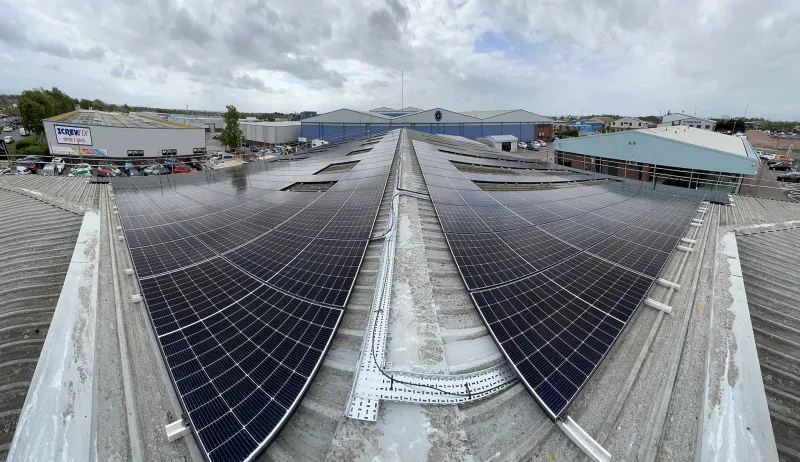
What set Alectrona apart was the documented design pack. We had quotes from three installers, but only Alectrona handed us a full set of drawings, a single-line diagram and a design referencing BS 7671 and the G99 connection process. The whole thing read like an engineering submission rather than a sales brochure. Our M&E consultant reviewed it and signed it off without a single query. That gave the board the confidence to release the capital.
Alectrona
Commercial guideString or central inverters: which architecture suits your commercial array?
There is no single right inverter architecture. A string design suits a multi-pitch or partially shaded roof; a central design suits a large, uniform single plane. The decision follows your roof geometry, shading and how the array is phased, rather than a spec-sheet headline.
- Commercial scale, over 50 kWp
- On-site 3D drone survey + PV*SOL
- Engineer-led, outside MCS
The feedback we work to earn
These are representative example reviews, not yet-collected customer feedback. They are written to illustrate the kind of feedback Alectrona aims to earn and are shown as design placeholders while we gather and verify reviews from our first commercial clients. Alectrona is the commercial solar trading brand of RVTC LTD.
Other firms priced our roof off a satellite image and a desktop guess. Alectrona flew an in-house drone survey, fully insured and flown by a qualified commercial drone pilot, and built a 3D model of the actual roof. It picked up plant, vents and a parapet line that a flat aerial photo had completely missed, which changed the panel layout. I would rather find that out at design stage than on the day the scaffold goes up. The accuracy of that survey is the reason I trusted everything that followed.
As a finance director I was wary of being oversold a system bigger than we could use. Alectrona modelled the array against our actual half-hourly consumption data rather than an annual total, so it is sized to what we genuinely draw on site during the day. They were honest that exporting surplus is worth far less than self-consumption, and built the design around that. The capital case stacked up because the engineering was honest, not because the numbers were inflated.
We were undecided between buying outright, leasing and a PPA. Alectrona laid out all three side by side with the pros and cons of each against our balance sheet, instead of pushing the one that pays them best. They were clear about where a PPA makes sense and where capex wins, and pointed us at our own accountant for the tax treatment. The survey and design took a little longer than I expected, but the thoroughness was worth the wait. Genuinely consultative.
The install crew were tidy and well run, and worked to a clear CDM 2015 plan with a proper site induction and RAMS. What impressed me most was the handover. We received a full commissioning pack with the IEC 62446-1 test results, certification, O&M documentation and an as-built record for our maintenance team. As the people who have to live with this asset for the next twenty years, having that paperwork in order matters enormously. Nothing was left loose.
I expected the usual hard sell and got the opposite. After surveying our site Alectrona told us one roof section was not worth covering because of shading, and that a smaller, well-sited array was the better investment than filling every square metre. There was no commission-driven upselling and no pressure. For a six-figure capital project, that straight talk is exactly what you want from the people advising you. We will be using them again on our second site.
- Best architecture None universally; chosen for your roof and phasing, not declared
- String Distributed units, many independent trackers; suits mixed-pitch, shaded or phased roofs
- Central One large unit, few trackers; suits large, uniform, single-plane ground-mount
- Redundancy A failed string unit drops only its share; a central failure can stop the block
- Grid Either way the inverter must hold current G99 type-test certification
String vs central inverters
An inverter turns the direct current the panels produce into the alternating current your building and the grid use. There are two broad architectures. A string inverter is a modular unit, each handling tens to a few hundred kilowatts through several independent maximum power point trackers, with multiple units distributed across a site. A central inverter is one large unit, typically rated in the megawatts, that handles a whole block of the array through a small number of trackers, sited next to the medium-voltage transformer.
Neither is universally better. String architecture suits a commercial roof with several orientations, shading or a build-out in phases, because each tracker runs its own section without dragging the others down and one failed unit removes only its share of capacity. Central architecture suits a large, uniform, single-plane ground-mount, where one big unit is cheaper per kilowatt and the array has nothing to isolate. A system above 50 kWp sits outside the MCS scheme, so the assurance here is the structural survey, the PV*SOL yield model, the G99 grid application and CDM 2015 duties, rather than a domestic badge. RVTC LTD holds the contract.
Distributed units versus one large unit
The two designs differ in how they are physically laid out and how the array connects to them.
- String inverters. A string is a series-connected run of panels. A string inverter is a modular unit that takes several of these strings, each on its own tracker, and there are several units spread across the site. Commercial units commonly carry two to four trackers, with some newer models carrying more, and unit ratings run up to a few hundred kilowatts. Because the units are distributed, the DC cabling runs are shorter and the array is broken into independent sections.
- Central inverters. A central inverter is one large unit, typically rated in the megawatts, that takes the whole array, or a large block of it, through a small number of trackers. It sits next to the medium-voltage transformer, with long DC runs feeding it from across the array. It assumes the array in front of it is uniform, because its few trackers cannot follow many different sections independently.
That single difference, many small distributed units against one large central unit, is what drives every other trade-off below: how the array copes with mixed orientations and shade, what happens when a unit fails, what it costs per kilowatt, and how it is serviced over a twenty-year life.
String or central: which suits your roof
String inverters
Modular units spread across the site, each running several independent trackers. The array breaks into independent sections, so mixed pitches, shading and phased build-outs are handled without dragging the rest down.
- Several independent MPPTs, so each roof plane or shaded section runs on its own
- A failed unit removes only its share; the great majority of production keeps running
- Small, inexpensive units swapped without specialist plant for contained downtime
- Scales incrementally as roof areas come on line or the array is built out in phases
- Suits the typical commercial building with multiple pitches and parts of the roof in shade
Central inverters
One large unit, typically rated in the megawatts, handling a whole block of the array through a small number of trackers beside the medium-voltage transformer. It assumes the array in front of it is uniform.
- Fewer units and less wiring complexity; cheaper per kilowatt at scale
- Suits a large, uniform, single-plane ground-mount where there is nothing to isolate
- A handful of trackers, best where every panel sees the same sun
- Sized once for a fixed block, commissioned in one go
- Built for a long design service life, repaired in place by specialists
Why string suits a mixed roof
A maximum power point tracker, or MPPT, continuously finds the voltage and current that extract the most power from the strings connected to it. The number of independent trackers is the single most important difference between the two architectures on a commercial roof.
Panels on one tracker should share orientation and tilt, because the tracker can only find one optimum operating point. Mix a south-facing run and an east-facing run on the same tracker and it settles on a compromise that short-changes both. A string design carries several independent trackers, so each roof plane, each orientation and each separately shaded section runs on its own tracker without dragging down the rest. A central inverter has only a handful of trackers for the whole array, so it works best where the array is one large uniform plane and there is nothing to isolate.
This is the engineering reason a string design suits the typical commercial building: multiple pitches, a north light or two, plant and parapets that throw shade across part of the roof through the day. A central design suits a flat, open, single-orientation ground-mount where every panel sees the same sun. Independent trackers reduce the mismatch loss that mixing orientations causes; the size of that gain on your roof is what the PV*SOL model returns, rather than a figure carried in from another site.
Redundancy and serviceability over a twenty-year life
The two architectures fail and are repaired in very different ways, and that difference matters more on a commercial asset than the headline kilowatt cost.
With a single central inverter, one failure can take the whole block, or the whole site, offline until it is repaired. With distributed string inverters, a failed unit removes only its share of the capacity. As an illustration, one large central unit failing can mean total shutdown, whereas on a site built from twenty smaller string units, one failure leaves the great majority of production still running while the unit is swapped. For a business that depends on the generation, that difference in single-point-of-failure exposure is often decisive.
Serviceability follows the same pattern. A string unit is a small, comparatively inexpensive item that can be swapped without specialist plant, so a fault means limited downtime and a fast, contained replacement. A central inverter is built for a long design service life and is repaired in place by specialists, but a fault carries a larger production impact while it is out. Over a twenty-year life, spare-part availability is a real consideration for both, since a discontinued platform has to be worked around; a discontinued string model is usually cheaper and simpler to design around than a discontinued central platform. We weigh this against the maintenance plan for your site rather than treat the inverter as a fit-and-forget item.
Cost, phasing and where the industry is heading
Central inverters are cheaper per kilowatt at scale. Fewer units, less wiring complexity and economies of scale all pull in their favour, and that advantage grows as the system gets larger and the array more uniform. A string design costs more per kilowatt at the equipment-and-install level, though the gap is modest, and the redundancy and serviceability it buys often justify it on a commercial roof. There is no clean megawatt figure where one becomes cheaper than the other; it depends on the array's uniformity, the roof's complexity and how the project is phased, so we frame the decision by site type and model the cost for your project rather than quote a crossover threshold.
Phasing is where string architecture earns its place on many commercial buildings. A string design scales incrementally: units are added as roof areas come on line or as the array is built out over several phases, which suits a rooftop that grows with the business. A central inverter is sized once for a fixed block and suits a single large build that is commissioned in one go.
The industry direction reflects this. String architecture is now competitive well into the megawatt range, and so-called string power stations, racks of string units in an enclosure beside the medium-voltage transformer, are increasingly used even at larger scale, combining the redundancy and serviceability of string with a single centralised maintenance location. Central inverters still dominate the very large, uniform plants, and where central architecture and deep grid-side control are in play we often reach for the SMA commercial inverter range, which pairs a central platform with the SMA Power Plant Controller for export and grid management. Whichever architecture suits your site, the inverter must hold valid, current G99 type-test certification to connect, because the choice between string and central does not change the G99 obligation. We verify that certification for the specific unit before it is specified.
How does string versus central change the DC fire and isolation risk?
The architecture choice changes the DC side of the system, and the DC side is where the recognised rooftop PV fire risk sits. A string of modules carries several hundred volts in daylight, present continuously with no zero-crossing, so a loose, corroded or badly made DC connection can strike an arc that does not self-extinguish the way an AC fault does. RC62, the joint fire-and-rescue and industry guidance, and the wider RISCAuthority fire-safety literature are written around this DC hazard, and the inverter architecture decides how much DC cabling exists and how far it runs.
A string design distributes the inverters across the roof, so the high-voltage DC runs are short and local to each unit and the array converts to AC close to the panels. The trade is a larger count of DC string connections and connectors, each a potential fault point that has to be made with one connector type, mated like-for-like, with factory-style crimps. A central design has far fewer connections, but it pulls long high-voltage DC runs across the whole array to one unit beside the transformer, so a greater length of the system stays live at high DC voltage and further from the point of isolation. Neither is safer in the abstract. They move the risk to different places, and the survey decides which profile suits the building, the roof construction and the access a fire service would need.
This is also where isolation and shutdown differ in practice. Because daylight keeps the DC side energised, a fault cannot be cleared by switching the building off, so clear, labelled DC isolation matters under either architecture. The wiring-regulation basis for those terminations and isolation points is set out in our guide to BS 7671 and solar, and the fire-safety detail of the DC side sits in our note on RC62 and rooftop fire risk. We design the DC layout, the connector regime and the isolation strategy to the same standard whichever architecture the roof calls for, because the choice changes where the DC risk lives, not whether it has to be controlled.
How do monitoring, maintenance and warranty differ between the two architectures?
A commercial array is a twenty-year asset, and how you see a fault and how you fix it differ sharply between the two architectures. A string design gives granular visibility: each unit and each tracker reports separately, so a drop in one section is localised to a unit or a string rather than hidden in a single aggregate figure. That granularity is what turns a vague "the site is down on yield" into a specific string to inspect, which is the difference between a same-day fix and weeks of lost generation. A central design reports at the level of one large unit, so a partial fault, a single failed combiner or a shaded sub-array, is harder to isolate from the monitoring alone and usually needs an on-site inspection to locate.
That visibility feeds directly into the operations and maintenance plan. PAS 2038, the British Standards Institution specification for commercial building retrofit, frames the case for designing the monitoring and the maintenance regime in from the start rather than bolting them on, and the inverter architecture sets what that regime can detect. A string fleet lends itself to remote, per-unit fault-finding and a stock of swap-out spares; a central platform leans on a planned, specialist service contract and in-place repair. Our guide on whether your solar is underperforming explains how that monitoring data is read, and our commercial maintenance guide sets out the service regime each architecture implies.
Warranty and long-term support follow the same split. String inverters typically carry a standard manufacturer warranty with an option to extend, and because the units are inexpensive and interchangeable a failed one is a contained replacement against held spares. A central platform is a larger capital item with a longer design service life, usually supported by a manufacturer service agreement rather than a shelf spare, so its warranty and support contract carry more weight in the decision. On a system outside MCS, none of this is assured by a domestic badge: the support path is whatever the manufacturer agreement and your maintenance contract actually say. We check the warranty terms, the spare-part position and the service route for the specific unit before it is specified, and we weigh that against bankable-brand support and the build cost modelled for your project.
Past the guide, this is how your figure actually gets set.
-
Survey On-site 3D drone survey
Our own insured pilot flies your roof and captures the real geometry and shading, so the design starts from your building instead of a satellite guess.
Booked to suit your operating hours
-
Model PV*SOL design and proposal
We model the array in bankable-grade software, size it around your daytime load, and set out generation, savings and payback across three funding routes.
Modelled, not promised
-
Install Engineered and installed
Designed and installed to BS 7671, commissioned to IEC 62446-1, connected under G99 and run under CDM 2015. Alectrona is typically the Principal Contractor.
Outside MCS, assured by the non-MCS stack
-
Aftercare Operations and maintenance
A 12-month defects period backed by an Insurance-Backed Guarantee, then ongoing operations and maintenance so the asset keeps earning for its full working life.
Kept performing, year on year
Last updated June 2026
String vs central inverters: common questions
A string inverter is a modular unit, each handling tens to a few hundred kilowatts through several independent trackers, with multiple units distributed across the site. A central inverter is one large unit, typically rated in the megawatts, that handles a whole block of the array through a small number of trackers and sits next to the medium-voltage transformer. The practical effect is that string breaks the array into independent sections, while central treats it as one uniform plane.
Neither is better in the abstract. A string design suits the typical commercial building with several orientations, shading from plant and parapets, or a build-out in phases, because each tracker runs its own section and a failed unit removes only its share. A central design suits a large, uniform, single-plane ground-mount where one big unit is cheaper per kilowatt and there is nothing to isolate. We choose from the survey and the PV*SOL model for your roof rather than declare one best.
A maximum power point tracker finds the operating point that extracts the most power from the strings connected to it, and panels on one tracker should share orientation and tilt. A string inverter carries several independent trackers, so each roof plane or shaded section runs on its own without dragging down the rest. A central inverter has only a few trackers for the whole array, so it assumes a uniform plane. That is why string suits a mixed-pitch or partially shaded roof and central suits a uniform array.
It depends on the architecture. With a single central inverter, one failure can take the whole block or the whole site offline until it is repaired. With distributed string inverters, a failed unit removes only its share of the capacity, so the great majority of production keeps running while a small, comparatively inexpensive unit is swapped. That difference in single-point-of-failure exposure is often the deciding factor on a commercial asset that depends on its generation.
No. Any commercial system above 50 kW needs a full G99 application to the local Distribution Network Operator regardless of whether it uses string or central inverters, and the inverter must hold valid, current G99 type-test certification either way. The architecture affects the design, the redundancy and the maintenance plan, not the obligation to connect under G99. We verify the type-test certification for the specific unit before it is specified.
At the equipment-and-install level central inverters are cheaper per kilowatt at scale, because there are fewer units and less wiring complexity, while a string design costs a little more for the redundancy and serviceability it buys. There is no fixed megawatt figure where one becomes cheaper, since it depends on how uniform the array is, how complex the roof is and how the project is phased. We do not publish a price, because a commercial cost is survey-led for your roof; our commercial solar cost guide explains what drives it and we model the figure for your specific project.
The architecture choice does not change the headline programme, because the long lead item on a commercial system above 50 kWp is the G99 connection process with Northern Powergrid, not the inverter type. A central platform is sized once and ordered as a single large item, whereas a string fleet can be procured and even commissioned in phases as roof areas come on line, which can suit a staged build. We confirm inverter lead times and the G99 timeline at survey rather than quote a fixed date; our guides on the G99 application and how long installation takes set out the real drivers.
Get the numbers for your roof.
A guide can only take you so far. The figure you get is modelled from your own half-hourly load and a system sized from the on-site drone survey. No obligation, and systems this size sit outside the domestic MCS scheme, so the assurance is the engineering stack.
- On-site 3D drone survey, fully insured in-house pilot
- Half-hourly load modelled in PV*SOL before anything is specified
- Engineer-led, assured to the non-MCS standard (CDM 2015)
- Capex, lease-purchase or PPA, whichever suits you