Skip to content

Alectrona

Commercial guide

Why we do not specify Huawei on a commercial system

Huawei is not banned from UK solar, and this is not an allegation against the company. We do not specify it because the LUNA battery line is being withdrawn from the UK, and the wider supply and support picture carries long-term risk on a 25-year asset.

  • Commercial scale, over 50 kWp
  • On-site 3D drone survey + PV*SOL
  • Engineer-led, outside MCS
Reviews

The feedback we work to earn

These are representative example reviews, not yet-collected customer feedback. They are written to illustrate the kind of feedback Alectrona aims to earn and are shown as design placeholders while we gather and verify reviews from our first commercial clients. Alectrona is the commercial solar trading brand of RVTC LTD.

What set Alectrona apart was the documented design pack. We had quotes from three installers, but only Alectrona handed us a full set of drawings, a single-line diagram and a design referencing BS 7671 and the G99 connection process. The whole thing read like an engineering submission rather than a sales brochure. Our M&E consultant reviewed it and signed it off without a single query. That gave the board the confidence to release the capital.

Estates Manager, academy trust (Yorkshire)

Other firms priced our roof off a satellite image and a desktop guess. Alectrona flew an in-house drone survey, fully insured and flown by a qualified commercial drone pilot, and built a 3D model of the actual roof. It picked up plant, vents and a parapet line that a flat aerial photo had completely missed, which changed the panel layout. I would rather find that out at design stage than on the day the scaffold goes up. The accuracy of that survey is the reason I trusted everything that followed.

Facilities Manager, distribution centre (East Midlands)

As a finance director I was wary of being oversold a system bigger than we could use. Alectrona modelled the array against our actual half-hourly consumption data rather than an annual total, so it is sized to what we genuinely draw on site during the day. They were honest that exporting surplus is worth far less than self-consumption, and built the design around that. The capital case stacked up because the engineering was honest, not because the numbers were inflated.

Finance Director, logistics group (North West)

We were undecided between buying outright, leasing and a PPA. Alectrona laid out all three side by side with the pros and cons of each against our balance sheet, instead of pushing the one that pays them best. They were clear about where a PPA makes sense and where capex wins, and pointed us at our own accountant for the tax treatment. The survey and design took a little longer than I expected, but the thoroughness was worth the wait. Genuinely consultative.

Property Director, retail park (West Midlands)

The install crew were tidy and well run, and worked to a clear CDM 2015 plan with a proper site induction and RAMS. What impressed me most was the handover. We received a full commissioning pack with the IEC 62446-1 test results, certification, O&M documentation and an as-built record for our maintenance team. As the people who have to live with this asset for the next twenty years, having that paperwork in order matters enormously. Nothing was left loose.

Operations Director, food manufacturer (Lincolnshire)

I expected the usual hard sell and got the opposite. After surveying our site Alectrona told us one roof section was not worth covering because of shading, and that a smaller, well-sited array was the better investment than filling every square metre. There was no commission-driven upselling and no pressure. For a six-figure capital project, that straight talk is exactly what you want from the people advising you. We will be using them again on our second site.

Managing Director, engineering firm (Sheffield)

  • Is Huawei banned in UK solar? No. There is no UK ban on Huawei or Chinese solar inverters
  • The hard fact The LUNA battery line is being withdrawn from the UK by end of 2025
  • Extended warranties Reported to be no longer sold on the withdrawn LUNA line
  • Wider context US export-control listing and a UK telecoms (not solar) restriction
  • Our basis A risk-management choice on a 25-year asset, not an allegation
01 The short version

Why we do not specify Huawei

OrientationThis page is orientation on a fast-moving export-control and energy-policy picture, not legal or investment advice. The export-control, telecoms and EU positions cited here are changing; confirm the current status with the relevant body or a qualified adviser before you contract.

The short version is a procurement judgement, not a verdict on the engineering. Huawei is not banned from UK solar or grid use, and we make no allegation of wrongdoing against the company. We do not specify it on a commercial system for one hard reason and one cautious one. The hard reason is that Huawei is withdrawing its LUNA battery energy storage line from the UK, so the battery half of a Huawei stack is being discontinued here regardless of any wider debate. The cautious reason is that Huawei sits under live US export-control and UK telecoms-security restrictions, with growing energy-security scrutiny in Europe, which adds support, firmware and resale uncertainty to a 25-year asset.

This page sets out the verifiable facts and is careful about what they do and do not support. It separates the commercial reality of the LUNA withdrawal from the security and policy context, which is real but largely targeted at Chinese inverters as a category rather than at Huawei by name. The conclusion is a risk-management one we make for the client. We specify equipment we can stand behind for the full operating life of the system, and on the current picture that is not Huawei.

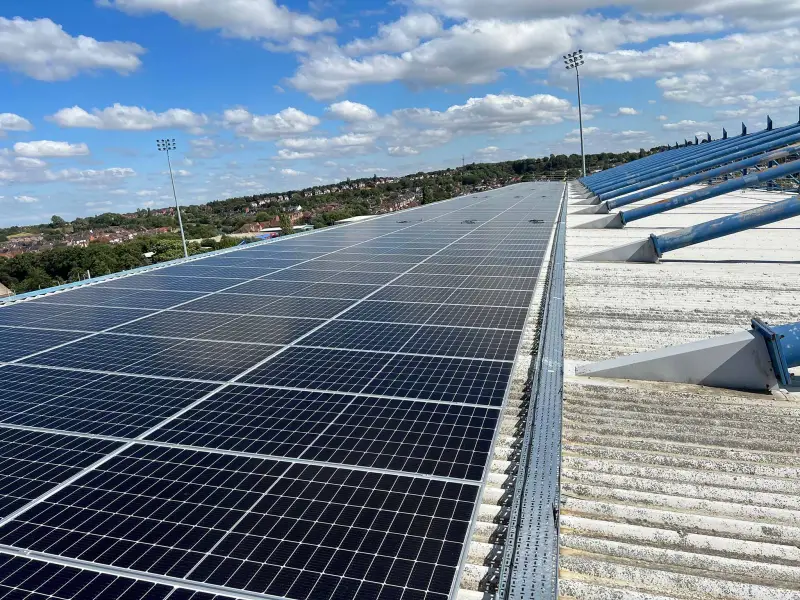
Commercial rooftop solar, the subject of this guide: Why we do not specify Huawei
An on-site drone survey and a PV*SOL model behind every quote.
02 The hard fact

The LUNA battery is being withdrawn from the UK

The clearest, most load-bearing reason is commercial rather than political. Huawei is pulling its LUNA-branded battery energy storage systems from the UK market. Reporting indicates distributors were notified on 22 August 2025, with sales to cease by the end of 2025 and the kit no longer available through UK distributors from January 2026 (The Register, September 2025). Existing inventory is being cleared and existing warranties honoured, with UK support reported to continue, but distributors are reported to be no longer permitted to sell extended warranties on the line.

For a commercial buyer that is the decisive point. A battery specified now would sit on a product line being discontinued in this market, with no route to an extended warranty. On a 25-year asset where the battery is the component most likely to need long-term support and eventual replacement, specifying a withdrawn line is poor practice irrespective of how the cells perform. The reason given for the withdrawal is reported as commercial, with battery storage said to be a single-digit percentage of Huawei's UK revenue, and Huawei has not officially confirmed the withdrawal itself. We do not recast that as a security expulsion. The practical consequence for a buyer, a discontinued line with no extended-warranty path, holds either way.

03 The wider context

A restriction without a UK solar ban

It is important to be accurate here, because the area attracts a lot of loose claims. As things stand there is no UK government ban on Chinese or Huawei solar inverters. The UK action against Huawei is in telecoms, not energy: the government ordered Huawei removed from UK 5G networks, with no new 5G kit installed from January 2021 and full removal targeted by the end of 2027 (GOV.UK, 2020). A telecoms ban is not an inverter ban, and we do not present it as one.

What does apply to the company more broadly is export control. Huawei and a long list of affiliates were placed on the US Commerce Department Entity List from May 2019, with the restrictions widened in 2020 to cover items made with US technology. That is a broad corporate and export designation rather than anything solar-specific, and it does not by itself prohibit UK use of Huawei inverters. The relevance to a 25-year asset is indirect but real: a vendor under sustained export pressure carries more uncertainty around long-term component supply, firmware updates and ongoing support than one that does not.

04

Energy-security scrutiny is a category question, handled carefully

There is a genuine policy debate about Chinese-made inverters, and it is worth a finance director understanding it accurately rather than through headlines. Chinese vendors supplied a large majority of the world's grid-connected solar inverters in recent years, with Huawei among the largest, and many of those inverters retain remote access for monitoring and control. That concentration is what has prompted scrutiny.

Two reported incidents are often cited, and both need care. In May 2025 Reuters reported that undocumented communication components had been found in some Chinese-made inverters and batteries during US equipment reviews; critically, that reporting did not name the manufacturers of the found components, and trade press noted the claims could not be independently verified. We do not attribute it to Huawei. Separately, in November 2024 some inverters were reportedly disabled remotely, an episode later attributed to a commercial dispute rather than a state action. We cite these as illustrations of the remote-access risk category for Chinese inverters generally, not as proven events involving Huawei. On policy, the EU has moved beyond consultation: the European Commission has decided to restrict EU funding for energy projects using inverters from high-risk countries, China among them, with that restriction reported to extend to battery power-conversion systems and to require exclusion of such suppliers on certain grid-linked projects by 2027. A wider high-risk-vendor list under the EU Cybersecurity Act is still being developed. That is EU policy, not UK law, and it does not bind a UK site. The honest summary is that this is a live, fast-moving policy area for Chinese inverters as a category, and a buyer should weigh it as such rather than as a settled finding against one firm.

05

Why this adds up to a procurement decision for the client

Put the three threads together and the decision is straightforward, and it is made on the client's behalf rather than against a manufacturer. First, the LUNA battery line is being withdrawn from the UK with no extended-warranty path, so the battery side of a Huawei stack is already a discontinued product here. Second, Huawei sits under live US export-control and UK telecoms-security restrictions, which adds long-term supply, firmware and resale or refinance uncertainty to an asset meant to run for decades. Third, energy-infrastructure cybersecurity and remote-access governance for Chinese inverters is an open policy question that a careful buyer would rather not be exposed to on a long-lived asset.

None of that is an allegation of wrongdoing, and we are clear that Huawei still sells inverters in some markets and that its hardware is capable. Our job is to specify equipment we can support, warrant, finance and resell across the full life of the system. We lead with bankable, market-leading panels and battery brands with a clear long-term UK support path, chosen from the survey and the PV*SOL model for your roof. On the current picture, the risk-management choice for the client is not Huawei.

06

What about firmware, remote access and cyber-security on the inverter we do specify?

The remote-access concern that drives the wider Chinese-inverter debate is not unique to one brand, so the honest answer is to set out how we govern it whatever the make. A grid-connected commercial inverter is an internet-facing device that can be reached for monitoring, firmware updates and, in some cases, remote curtailment. The risk a finance director should weigh is not whether a given vendor is malicious, it is who can reach the asset, over what channel, and whether you can see and control that. The UK does not yet have a single binding cyber standard for behind-the-meter solar inverters, which is part of why the picture feels unsettled. The relevant reference points are the Government's Code of Practice for the cyber security of consumer connected products and the Product Security and Telecommunications Infrastructure regime it sits behind (GOV.UK/DSIT), the NCSC guidance for operational technology and connected devices (NCSC), and the network operator's own connection conditions. On a Northern Powergrid site any remote export control runs through the agreed G99 protections rather than an open vendor channel, which is the same discipline our export limitation and G100 and G99 application guides describe.

What this means in practice is that we specify inverters where the monitoring and update path is documented, where the portal access can be scoped to named people, and where the vendor has a clear, contactable UK support route for security patching across the asset life. We set that out across the commercial inverter line-up, which is built only from brands we can procure and support through UK distribution. The point is not that Huawei could not be configured securely; it is that on a 25-year asset we would rather specify from a list with a settled long-term UK update and support path than from one shaped by export pressure abroad.

07

How does a withdrawn battery line affect warranty, insurance, resale and refinance?

A discontinued product line costs you more than the loss of new sales, and on a commercial asset that is the part worth understanding. Take the four practical exposures in turn. Warranty first: existing LUNA warranties are reported to be honoured, but distributors are reported no longer permitted to sell extended cover on the line, so a battery specified now would have no route to extend protection beyond the standard term on the component most likely to need it. Replacement and spares next: once a line is withdrawn from a market, like-for-like modules, spare power-conversion parts and trained field support tend to thin out over time, which lengthens any future repair and can force a part-replacement with a different chemistry or footprint. Insurance is the third: a building-and-contents or specialist solar policy is easier to place and renew on current, supported equipment, and an underwriter assessing a long-tail risk will look at supportability, which our commercial solar insurance guide covers. Resale and refinance is the fourth and often the largest: a buyer or a lender doing technical due diligence on the asset, or on the building it sits on, will mark down kit that is discontinued in the market because they inherit the support gap. The same logic is why we lead with bankable, market-leading panels and a procurable battery line-up: the equipment has to survive a buyer's or a lender's scrutiny as well as ours.

08

What do you specify instead, and how is that decided?

We do not start from a brand preference, we start from your roof and your load. The line-up is decided by the site survey and the PV*SOL yield model, which size the array, the inverter and any storage to the building's consumption and export position rather than to a catalogue. From that we specify panels from the market-leading, financeable tier and inverters and batteries we can procure and support through UK distribution, set out on the inverter and battery storage pages. The selection discipline is the same one our quality without MCS guide describes for a site above 50 kWp, where MCS does not apply and assurance comes instead from BS 7671 design and verification (IET/BS 7671), CDM 2015 duties and a documented commissioning record. The architecture question of string against central conversion is settled the same evidence-led way in our string versus central inverters guide. None of this rules a brand out on nationality; it rules in equipment with a settled UK warranty, support, spares and resale path, which is the test a long-lived commercial asset has to pass.

09

We already have a Huawei system. Should we rip it out?

No, and we would be wary of anyone who told you to. An installed, working Huawei system is not made unsafe by the LUNA withdrawal or by the policy debate, and replacing functioning kit early rarely pays back. The sensible position is to keep the system running, confirm your warranty terms and support contact in writing while they are available, and plan around the support horizon rather than react to it. The practical risks to manage are the ones this guide identifies: thinner spares and extended-warranty options on a withdrawn battery line, and an evolving cyber and export-control backdrop. A maintenance and monitoring regime, of the kind set out in our commercial solar maintenance guide, lets you catch a failing component early and budget for an eventual swap on your own timetable rather than under duress. If and when a battery or inverter does need replacing, that is the moment to move to a supported line, and we can survey the existing array and specify a compatible upgrade rather than a wholesale rebuild. The orientation note on this page applies: the export-control and policy picture is moving, so confirm the current position before you make an irreversible call.

10 How we quote

Past the guide, this is how your figure actually gets set.

  1. Survey

    On-site 3D drone survey

    Our own insured pilot flies your roof and captures the real geometry and shading, so the design starts from your building instead of a satellite guess.

    Booked to suit your operating hours

  2. Model

    PV*SOL design and proposal

    We model the array in bankable-grade software, size it around your daytime load, and set out generation, savings and payback across three funding routes.

    Modelled, not promised

  3. Install

    Engineered and installed

    Designed and installed to BS 7671, commissioned to IEC 62446-1, connected under G99 and run under CDM 2015. Alectrona is typically the Principal Contractor.

    Outside MCS, assured by the non-MCS stack

  4. Aftercare

    Operations and maintenance

    A 12-month defects period backed by an Insurance-Backed Guarantee, then ongoing operations and maintenance so the asset keeps earning for its full working life.

    Kept performing, year on year

11 FAQ

Why we do not specify Huawei: common questions

No. As things stand there is no UK government ban on Huawei or Chinese-made solar inverters. The UK action against Huawei is in telecoms, where the government ordered it removed from 5G networks, and that does not extend to solar equipment. We do not present a telecoms restriction as a solar ban. Our decision not to specify Huawei is a procurement judgement, not a regulatory prohibition.

Because the line is being withdrawn from the UK. Reporting indicates Huawei notified distributors on 22 August 2025 that LUNA battery storage sales would cease by the end of 2025, with extended warranties no longer sold on the line. On a 25-year asset, specifying a discontinued battery with no extended-warranty path is poor practice, regardless of how the cells perform. The withdrawal is reported as a commercial decision, not a security one, but the consequence for a buyer is the same.

No, and it would be wrong to say they were. The May 2025 Reuters report about undocumented communication components in some Chinese-made inverters and batteries did not name the manufacturers of the found components, and trade press noted the claims could not be independently verified. We cite it only as an illustration of the remote-access risk category for Chinese inverters generally, never as a proven event involving Huawei.

Not directly. The European Commission has moved to restrict EU funding for energy projects using inverters from high-risk countries, with a wider high-risk-vendor list still being developed under the EU Cybersecurity Act. That is EU policy, not UK law, and it does not bind your UK site. We treat it as part of a live, unresolved policy direction worth weighing on a long-lived asset, not as a binding rule that applies to your project. The precise instruments and dates are still settling, so we confirm the current position before contracting.

No. We make no allegation of wrongdoing against Huawei, and its hardware is capable and still sold in some markets. The decision is about long-term risk on the client's behalf: a withdrawn UK battery line, a vendor under export-control and telecoms-security restrictions, and an open policy debate around Chinese inverters. We specify equipment we can support, warrant, finance and resell across the full operating life of the system, which on the current picture is not Huawei.

Not as a rule. We never specify on brand nationality, so leaving Huawei off the list does not push you to a pricier option; we lead with market-leading, financeable panels and procurable inverters and batteries that compete on cost. There is no published from-price for a commercial system, because price follows the survey and the PV*SOL model for your roof, load and grid position. For how a commercial figure is built up, see our commercial solar cost guide, and any payback or return is modelled, not promised, and set out under finance.

No. The equipment we specify instead is held through UK distribution, so lead times track normal procurement rather than a discontinued line, and a withdrawn product can in fact add delay through thin stock and uncertain spares. Overall timing is driven far more by the grid connection and the survey-to-commissioning sequence than by inverter brand. Our how long installation takes guide sets out the realistic timeline, and the connection step is covered in our grid connection queue guide.

Get a commercial quote

Get the numbers for your roof.

A guide can only take you so far. The figure you get is modelled from your own half-hourly load and a system sized from the on-site drone survey. No obligation, and systems this size sit outside the domestic MCS scheme, so the assurance is the engineering stack.

  • On-site 3D drone survey, fully insured in-house pilot
  • Half-hourly load modelled in PV*SOL before anything is specified
  • Engineer-led, assured to the non-MCS standard (CDM 2015)
  • Capex, lease-purchase or PPA, whichever suits you