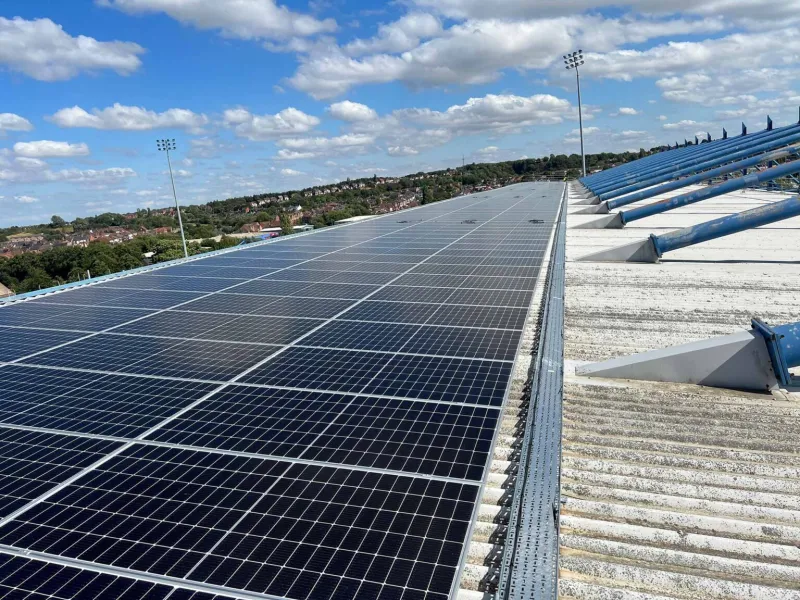
What set Alectrona apart was the documented design pack. We had quotes from three installers, but only Alectrona handed us a full set of drawings, a single-line diagram and a design referencing BS 7671 and the G99 connection process. The whole thing read like an engineering submission rather than a sales brochure. Our M&E consultant reviewed it and signed it off without a single query. That gave the board the confidence to release the capital.
Alectrona
Commercial guideHow do you choose a commercial solar installer above 50 kWp?
A commercial system sits outside MCS, so the things you check are different from a domestic job. You are buying engineering, accountability and documentation, and the right questions are about standards, structural sign-off, the grid application and who carries the warranty.
- Commercial scale, over 50 kWp
- On-site 3D drone survey + PV*SOL
- Engineer-led, outside MCS
The feedback we work to earn
These are representative example reviews, not yet-collected customer feedback. They are written to illustrate the kind of feedback Alectrona aims to earn and are shown as design placeholders while we gather and verify reviews from our first commercial clients. Alectrona is the commercial solar trading brand of RVTC LTD.
Other firms priced our roof off a satellite image and a desktop guess. Alectrona flew an in-house drone survey, fully insured and flown by a qualified commercial drone pilot, and built a 3D model of the actual roof. It picked up plant, vents and a parapet line that a flat aerial photo had completely missed, which changed the panel layout. I would rather find that out at design stage than on the day the scaffold goes up. The accuracy of that survey is the reason I trusted everything that followed.
As a finance director I was wary of being oversold a system bigger than we could use. Alectrona modelled the array against our actual half-hourly consumption data rather than an annual total, so it is sized to what we genuinely draw on site during the day. They were honest that exporting surplus is worth far less than self-consumption, and built the design around that. The capital case stacked up because the engineering was honest, not because the numbers were inflated.
We were undecided between buying outright, leasing and a PPA. Alectrona laid out all three side by side with the pros and cons of each against our balance sheet, instead of pushing the one that pays them best. They were clear about where a PPA makes sense and where capex wins, and pointed us at our own accountant for the tax treatment. The survey and design took a little longer than I expected, but the thoroughness was worth the wait. Genuinely consultative.
The install crew were tidy and well run, and worked to a clear CDM 2015 plan with a proper site induction and RAMS. What impressed me most was the handover. We received a full commissioning pack with the IEC 62446-1 test results, certification, O&M documentation and an as-built record for our maintenance team. As the people who have to live with this asset for the next twenty years, having that paperwork in order matters enormously. Nothing was left loose.
I expected the usual hard sell and got the opposite. After surveying our site Alectrona told us one roof section was not worth covering because of shading, and that a smaller, well-sited array was the better investment than filling every square metre. There was no commission-driven upselling and no pressure. For a six-figure capital project, that straight talk is exactly what you want from the people advising you. We will be using them again on our second site.
- Applies to Commercial solar over 50 kWp, outside MCS
- The trust signal Engineering standards, structural sign-off, accountability
- Core standards BS 7671, IEC 62446-1, G99, CDM 2015
- Ask to see Sample commissioning pack, structural report, insurance certificates
- Biggest red flag A from-price with no survey, or MCS used as the assurance
Choosing a commercial installer
A system over 50 kWp is a capital project on a building you depend on, well beyond a domestic upgrade. The installer you pick is responsible for the structure your array sits on, the electrical work that keeps it safe, the application that connects it to the grid, and the documents your insurer and lender will want to see. Choosing badly is expensive to unwind.
This guide is a plain-English orientation for a finance or facilities director comparing installers. It sets out the checks that actually matter above the domestic scale, the documents to ask for before you sign, and the red flags that should end the conversation. It is a guide, not formal advice; we confirm the specifics for your site.
Why the MCS question is the wrong one
MCS, the Microgeneration Certification Scheme, is a domestic-scale scheme and its PV scope stops at 50 kWp. A commercial system is larger than that, so it falls outside MCS entirely. An installer cannot honestly be MCS-certified for work the scheme does not cover, and leading with an MCS logo against a project this size is a sign a contractor may not work at this scale day to day.
So the headline question is not whether MCS signed the work off. It is which engineering standards govern the design, who is accountable for the structure and the build, who handles the grid application, and what you are handed at the end. The one exception worth knowing: a registered installer is the route to the SEG export tariff below 50 kWp, which is the consumer-protection driver at domestic scale. Above that threshold, site-specific engineering, structural sign-off and DNO approval replace MCS as the assurance mechanism.
The checks that actually matter
For a commercial buyer, competence shows in a specific stack of standards, duties and documents. Work through these before you compare prices:
- Electrical competence to BS 7671. All fixed electrical work, DC and AC, must comply with BS 7671, the 18th Edition IET Wiring Regulations (the current edition is 2018 with Amendment 4, published 2026). This applies regardless of system size and is independent of MCS. Verify the installer's electrical competence and registration with a body such as NICEIC or NAPIT, and that a named qualified supervisor reviews the work.
- A commissioning and handover pack to IEC 62446-1. IEC 62446-1:2016 defines what must be handed over and the tests a grid-connected PV system must pass. A compliant installer hands you a single-line diagram, array layout, datasheets, string and array test results, inverter and AC interface details, and earthing and protection records. Ask to see a sample commissioning pack before signing.
- Structural sign-off. Above 50 kWp this replaces the MCS structural checks. Roof loading is verified against the Eurocodes, BS EN 1991-1-4 for wind and BS EN 1991-1-3 for snow, plus the Building Regulations, with a signed report from a suitably competent person confirming the roof can carry the dead, wind and snow loads. For many roof types, and for flat-roof ballasted systems, that means a qualified chartered or structural engineer.
- Ownership of the G99 application. A commercial system connects under ENA Engineering Recommendation G99 (currently Issue 2, dated 10 March 2025), a formal application to your local DNO with inverter specs, single-line diagrams and protection settings. Approval is needed before the system is energised, and witnessed commissioning may be required for larger systems. Ask who handles the application and manages it through to an offer.
- CDM 2015 duties. A commercial PV install is construction work under the Construction (Design and Management) Regulations 2015. Where there is more than one contractor, which includes subcontractors, you as the client must appoint a Principal Designer and a Principal Contractor in writing, and a Construction Phase Plan must exist before work starts. Confirm the installer can act as Principal Contractor and produce that plan.
Larger jobs can also cross the F10 notification thresholds, where an F10 must be submitted to the HSE before work begins: a project expected to last longer than 30 working days with 20 or more workers on site at once, or one involving more than 500 person-days. Ask how the installer handles F10 and the wider CDM duties.
The paperwork that protects you after the job
Insurance and warranties are where a good installer separates from a cheap one, because these are what stand up if something goes wrong years later.
Insurance to verify. Ask for current certificates for Public Liability, which covers third-party injury or damage, and Employer's Liability, which is mandatory if they employ staff working on site. For design-and-build work, Professional Indemnity is best practice, since it covers design errors such as incorrect sizing or shading analysis that cause underperformance. On commercial-scale work, check the indemnity limits are adequate to the contract value.
Three separate warranties. A workmanship warranty is the installer's contractual promise to fix defects such as roof penetrations or faulty connections. It is worthless if that company ceases trading, which is why an Insurance-Backed Guarantee matters: it is a separate insurance policy that honours the workmanship warranty if the installing company goes out of business. Equipment manufacturer warranties on the panels and inverters are separate again. Confirm all three: the workmanship warranty term, the IBG behind it, and the manufacturer warranties.
A real quote follows a real survey. A genuine quote follows a physical roof survey and design modelling, in a tool such as PV*SOL, of your specific orientation, pitch and shading. A quote from a postcode and a satellite image is an estimate rather than a design, and it cannot survive the first site visit.
Red flags and the references to ask for
A handful of warning signs reliably mark out an installer who is not equipped for work at this scale. Treat any of these as a reason to look harder:
- Leading with 'MCS certified' as the headline assurance for a project that sits outside MCS scope.
- A 'from' or per-kWp price quoted without a site survey and design.
- No structural sign-off offered.
- No clear owner of the G99 application.
- No Construction Phase Plan, or an unclear answer on who holds the CDM Principal Contractor role.
- No Insurance-Backed Guarantee behind the workmanship warranty.
- Subcontracted labour with no single point of accountability for the warranty and snagging.
On track record, ask for case studies and references for systems of similar capacity, and for larger sites, three-phase experience. Domestic or small-commercial work does not necessarily translate to large commercial competence. A single accountable installer reduces the fragmented-delivery risk that is a common cause of UK commercial project problems. If labour is subcontracted, insist on seeing the subcontractors' own electrical and health-and-safety accreditations, and confirm one point of accountability for the warranty and snagging.
How should you compare installers on a like-for-like basis?
The honest answer is that you cannot compare prices until you have made the installers quote the same job, and on commercial solar that rarely happens by default. One contractor prices a roof-only DC array, another includes the structural report and the grid application, a third assumes you arrange access and scaffolding. Put side by side, the cheapest number is usually the one that has quietly left the most out. So the first task is to write a single scope of works, an enquiry document, that every installer prices against, rather than collecting three quotes built on three different assumptions.
A workable enquiry sets out the building and roof, your half-hourly consumption profile if you have it, the design intent and any export limit, and the deliverables you expect: a surveyed design, the structural sign-off, the G99 application to Northern Powergrid managed through to an offer, the commissioning pack to IEC 62446-1, and the warranty and handover documents. It should name who holds the Principal Contractor role under CDM 2015 and ask for a programme. When every bidder prices that same scope, the comparison becomes real, and a low number then signals either a genuine efficiency or a gap you can point to. Our guide to commercial solar cost sets out what sits inside a properly built price, and how we quote shows the survey-led route a real number follows.
One structural decision shapes everything else: whether you buy design and build from a single accountable party or split design from installation. A single design-and-build contractor carries the whole chain, from the structural and electrical design to the commissioned system, so there is one party to hold responsible if performance falls short. Splitting the roles can suit a large or complex scheme with an independent designer, but it puts the interface risk on you, because a design fault and a build fault can each be blamed on the other party. For most buildings over 50 kWp, a single point of accountability for the design and the build is the lower-risk route.
How do you verify an installer's track record and competence?
Competence is a claim until you check it, and the checks are specific. Start with the trade accreditations behind the electrical work: confirm registration with a body such as NICEIC or NAPIT and that it covers commercial-scale installation rather than domestic alone. For the construction and health-and-safety side, look for a recognised SSIP-accredited scheme such as CHAS, SafeContractor or Constructionline, which assess a contractor against the HSE's baseline health-and-safety criteria; SSIP, the Safety Schemes in Procurement forum, exists so one scheme's assessment is recognised by the others. These confirm the firm has been independently checked, which is part of demonstrating your own diligence in appointing a competent contractor under CDM 2015.
Then verify the track record directly rather than taking a logo wall at face value. Ask for two or three references on systems of similar capacity, and for a larger site, ones with three-phase and grid-application experience, because domestic or small-commercial work does not automatically scale. Call the references and, where you can, visit a completed site and ask to see its commissioning pack and monitoring. A contractor who has delivered fifty house installs and no system over 50 kWp is learning on your roof. If labour will be subcontracted, insist on seeing the subcontractors' own electrical and health-and-safety accreditations and confirm one named point of accountability for the warranty and any snagging.
Financial standing is the check buyers skip and regret. The warranties, the Insurance-Backed Guarantee and the snagging promises are only worth anything if the company is still trading when you need them, so a basic Companies House review of the accounts, age and structure of the business is proportionate on a capital project. A long workmanship warranty from a thinly capitalised firm is a weaker promise than a shorter one from a stable business standing behind an IBG.
What should the contract and commercial terms cover?
Above the domestic scale the contract is the protection, because the MCS and consumer-code framework that backstops a homeowner does not apply here, so what you secure, you secure in writing. The first decision is the contract form. Many commercial solar projects run under a recognised standard form such as a JCT or NEC contract rather than the installer's own terms, because a standard form allocates risk in a way both parties and their advisers already understand. On a smaller or more straightforward job a clear custom-drafted contract can be appropriate, but the terms below should be explicit in either case.
Payment should be staged against milestones, design approved, equipment delivered, installation complete, system commissioned and the handover pack issued, rather than a large sum up front. A retention, a percentage held back for a defined defects period after commissioning and released once any snags are closed, gives the contractor a reason to come back and put things right. The programme should be written down with the dependencies named, particularly the grid connection, which usually sets the critical path, as our guide on how long an installation takes explains; a contract may attach remedies for delay, though on a connection-led programme the realistic dates matter more than a penalty clause.
The contract should also pin down what happens after handover: the workmanship warranty term and the IBG behind it, the manufacturer warranties on the panels and inverters assigned to you, and whether an operations and maintenance arrangement is included or offered, since a commercial array is low maintenance rather than no maintenance. A change-control mechanism, for variations found once work starts such as unexpected roof condition, keeps later costs visible rather than disputed. Once the system is live, the same documentation underpins any future operations and maintenance and the asset record an inheriting owner or your insurer will ask to see.
Past the guide, this is how your figure actually gets set.
-
Survey On-site 3D drone survey
Our own insured pilot flies your roof and captures the real geometry and shading, so the design starts from your building instead of a satellite guess.
Booked to suit your operating hours
-
Model PV*SOL design and proposal
We model the array in bankable-grade software, size it around your daytime load, and set out generation, savings and payback across three funding routes.
Modelled, not promised
-
Install Engineered and installed
Designed and installed to BS 7671, commissioned to IEC 62446-1, connected under G99 and run under CDM 2015. Alectrona is typically the Principal Contractor.
Outside MCS, assured by the non-MCS stack
-
Aftercare Operations and maintenance
A 12-month defects period backed by an Insurance-Backed Guarantee, then ongoing operations and maintenance so the asset keeps earning for its full working life.
Kept performing, year on year
Last updated June 2026
Choosing a commercial installer: common questions
No. MCS is a domestic-scale scheme with a PV ceiling of 50 kWp, so it does not cover a commercial system and is not the trust signal for one. An installer leading with an MCS logo against a project this size is a warning sign rather than a reassurance. For work over 50 kWp the assurance comes from BS 7671 electrical competence, structural sign-off, the G99 grid application, CDM 2015 construction duties, and a proper handover pack.
Ask for a sample commissioning and handover pack to IEC 62446-1, which should include a single-line diagram, array layout, datasheets, string and array test results and earthing and protection records. Also ask for a structural report confirming the roof can carry the load against the wind and snow Eurocodes, current Public Liability, Employer's Liability and Professional Indemnity certificates, and confirmation of the workmanship warranty, the Insurance-Backed Guarantee behind it, and the manufacturer warranties.
A competent installer manages the G99 application to your local DNO on your behalf. G99 is the current grid-connection recommendation, Issue 2 dated 10 March 2025, and the application carries inverter specifications, single-line diagrams and protection settings. Approval is needed before the system is energised, and witnessed commissioning may be required on larger systems. If an installer cannot name who owns this application, treat it as a red flag.
A single accountable installer reduces the fragmented-delivery risk that is a common cause of UK commercial project problems. If labour is subcontracted, you need to see the subcontractors' own electrical and health-and-safety accreditations, and you need one clear point of accountability for the warranty and any snagging. Without that, responsibility can fall between parties when an issue surfaces months later.
No. A quote drawn from a postcode and a satellite image is an estimate rather than a design, because it knows nothing about what the roof can carry, your actual electricity use, or what the network operator will allow. A genuine quote follows a physical roof survey and design modelling, in a tool such as PV*SOL, of your specific orientation, pitch and shading. Comparing real designs against estimates is comparing different things.
You should not compare them until they price the same job. A genuine commercial quote follows a roof survey and design modelling, so a low headline number usually means a bidder has left something out, such as the structural sign-off, the grid application or scaffolding. Write one scope of works that every installer prices against, then compare like with like. The figure itself is modelled for your site before we quote, with the first feasibility read free.
Choosing well front-loads time but rarely delays the build. Running a structured comparison, taking up references and checking accreditations and financial standing typically adds a few weeks before you appoint, which is short against the months a commercial project runs. The longest item is almost always the grid connection, which the installer applies for once appointed. Picking a contractor who owns the G99 application and a realistic programme is what protects the timeline.
Get the numbers for your roof.
A guide can only take you so far. The figure you get is modelled from your own half-hourly load and a system sized from the on-site drone survey. No obligation, and systems this size sit outside the domestic MCS scheme, so the assurance is the engineering stack.
- On-site 3D drone survey, fully insured in-house pilot
- Half-hourly load modelled in PV*SOL before anything is specified
- Engineer-led, assured to the non-MCS standard (CDM 2015)
- Capex, lease-purchase or PPA, whichever suits you