Skip to content

Alectrona

Commercial guide

How many solar panels does a commercial system need?

The count is an arithmetic output: target kWp divided by the module's wattage. The target kWp is set by your load and the survey, rather than by the urge to fill the roof.

  • Commercial scale, over 50 kWp
  • On-site 3D drone survey + PV*SOL
  • Engineer-led, outside MCS
Reviews

The feedback we work to earn

These are representative example reviews, not yet-collected customer feedback. They are written to illustrate the kind of feedback Alectrona aims to earn and are shown as design placeholders while we gather and verify reviews from our first commercial clients. Alectrona is the commercial solar trading brand of RVTC LTD.

What set Alectrona apart was the documented design pack. We had quotes from three installers, but only Alectrona handed us a full set of drawings, a single-line diagram and a design referencing BS 7671 and the G99 connection process. The whole thing read like an engineering submission rather than a sales brochure. Our M&E consultant reviewed it and signed it off without a single query. That gave the board the confidence to release the capital.

Estates Manager, academy trust (Yorkshire)

Other firms priced our roof off a satellite image and a desktop guess. Alectrona flew an in-house drone survey, fully insured and flown by a qualified commercial drone pilot, and built a 3D model of the actual roof. It picked up plant, vents and a parapet line that a flat aerial photo had completely missed, which changed the panel layout. I would rather find that out at design stage than on the day the scaffold goes up. The accuracy of that survey is the reason I trusted everything that followed.

Facilities Manager, distribution centre (East Midlands)

As a finance director I was wary of being oversold a system bigger than we could use. Alectrona modelled the array against our actual half-hourly consumption data rather than an annual total, so it is sized to what we genuinely draw on site during the day. They were honest that exporting surplus is worth far less than self-consumption, and built the design around that. The capital case stacked up because the engineering was honest, not because the numbers were inflated.

Finance Director, logistics group (North West)

We were undecided between buying outright, leasing and a PPA. Alectrona laid out all three side by side with the pros and cons of each against our balance sheet, instead of pushing the one that pays them best. They were clear about where a PPA makes sense and where capex wins, and pointed us at our own accountant for the tax treatment. The survey and design took a little longer than I expected, but the thoroughness was worth the wait. Genuinely consultative.

Property Director, retail park (West Midlands)

The install crew were tidy and well run, and worked to a clear CDM 2015 plan with a proper site induction and RAMS. What impressed me most was the handover. We received a full commissioning pack with the IEC 62446-1 test results, certification, O&M documentation and an as-built record for our maintenance team. As the people who have to live with this asset for the next twenty years, having that paperwork in order matters enormously. Nothing was left loose.

Operations Director, food manufacturer (Lincolnshire)

I expected the usual hard sell and got the opposite. After surveying our site Alectrona told us one roof section was not worth covering because of shading, and that a smaller, well-sited array was the better investment than filling every square metre. There was no commission-driven upselling and no pressure. For a six-figure capital project, that straight talk is exactly what you want from the people advising you. We will be using them again on our second site.

Managing Director, engineering firm (Sheffield)

  • The formula Panel count = target kWp × 1,000 ÷ module wattage
  • Wattage lever A 50 kWp array is roughly 76 to 86 panels across 660 to 580 W modules
  • What sets the target Your half-hourly load and the usable roof, not filling the deck
  • Packing factor Pitched roofs pack densely; flat roofs lose area to tilt-frame row spacing
  • Firm figure from A drone survey, structural assessment and PV*SOL model, not a satellite estimate
01 The short version

How many solar panels?

The panel count is the simple part of the sum. Take the system size you are designing for in kWp, multiply by 1,000 to get watts, and divide by the wattage of the module you are fitting. A nominal 50 kWp array needs around 86 panels at 580 W, about 83 at 600 W, or roughly 76 at 660 W. Higher-wattage modules reach the same capacity with fewer panels, fewer clamps and less rail.

The hard part, and the part that actually decides the figure, is the target kWp. That is set by two things: how much usable roof the survey finds, and how much electricity your building draws through the day. The count is an output of the design rather than an input to it. Filling every square metre of roof is rarely the right answer, because output you cannot use on site is exported cheaply and can run into grid-connection limits. This guide explains how the count falls out of the design, and why the firm number waits on the survey and the model.

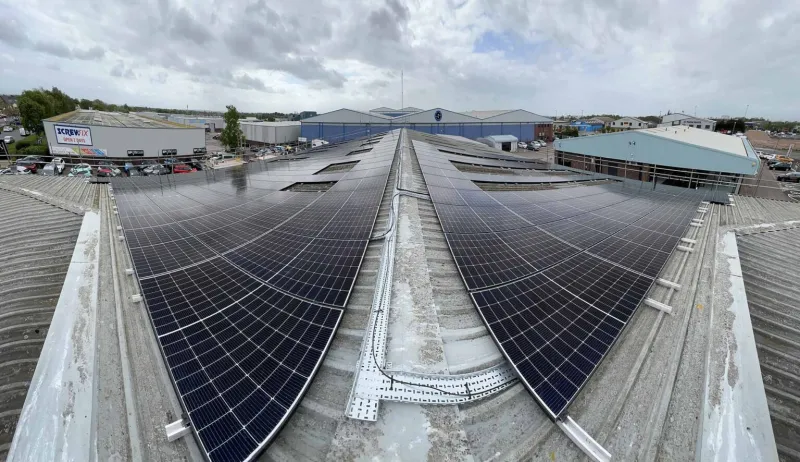
Commercial rooftop solar, the subject of this guide: How many solar panels?
Engineer-led commercial solar over 50 kWp, sized to your load.
02 The arithmetic

Target kWp divided by module wattage

The count itself is straightforward. Panel count equals the target system size in kWp, times 1,000 to convert to watts, divided by the rated wattage of the module. Current large-format commercial modules are typically rated in the region of 580 to 665 W, so the same kWp lands on a different panel count depending on which module is specified.

The worked example shows the wattage lever clearly. A nominal 50 kWp array needs roughly 86 panels at 580 W, around 83 at 600 W, or about 76 at 660 W. A higher-wattage module cuts the panel count, and with it the number of mounting clamps, the length of rail and the labour to set them, for the same installed capacity. The point of principle holds on any roof; the exact module and the exact target kWp for your building come from the survey and the model, not from a headline.

  • ~86 panels at 580 W for a nominal 50 kWp array
  • ~83 panels at 600 W same 50 kWp, higher-wattage module
  • ~76 panels at 660 W fewer clamps, less rail, same capacity
03

Why the target kWp is set by load and survey, not the roof

The wattage arithmetic only matters once you have a target kWp, and that number is where the real design work sits. It is set by two upstream questions, and neither of them is "how big is the roof".

The first is your load. A solar array earns most when its output is used on site as it is generated, because a self-consumed unit offsets an expensive import unit while an exported unit is paid far less. We model your half-hourly consumption against generation for your exact roof, which tells us how much of the array's output the building would actually use. Oversizing past that point pushes more output to export at low value and can run into the grid-connection limit the network operator sets. Undersizing leaves self-consumption on the table. The second is the usable roof the survey finds, which is always smaller than the gross roof. So the target kWp is the figure where the load match and the usable area meet, and the panel count is simply that figure divided by the module wattage.

04

Why panels per square metre is not panels per roof

It is tempting to read a panel count straight off the roof area, but the panel's own footprint and the roof it needs are two different things. A current large-format mono module is roughly 2.2 to 2.4 m by 1.1 to 1.3 m, around 2.6 to 3.1 m² of panel, at a face power density of roughly 0.20 to 0.23 kWp per square metre of panel. That is the panel sitting alone. It says nothing about the gaps a real layout needs.

How densely those panels pack onto the roof depends almost entirely on the mounting type:

  • Pitched and in-plane roofs pack densely, because the modules sit flush to the slope and self-shading is rarely the constraint.
  • Flat roofs need tilt frames and row spacing so the rows do not shade each other, so the kWp per square metre of roof is much lower than the panel's own density. The orientation choice changes this directly: a low-tilt east-west layout, where back-to-back rows need less anti-shading spacing, commonly fits more modules onto the same roof than a south-facing tilted layout.
  • Ground-mounts have more freedom on spacing than a pitched roof but still lose area to the inter-row gaps.

On top of that, the usable roof is always less than the gross roof. A common rule of thumb deducts around 20 to 30 percent for rooflights, plant, fire and maintenance walkways, perimeter set-backs and edge zones before any capacity estimate. The survey defines that deduction for your building, not a plan-area measurement.

05

How the survey and model fix the real number

Because the packing factor, the usable area and the structural capacity are all particular to your building, the firm count comes from an on-site survey, not a satellite estimate. Our process starts with an in-house drone survey that builds a measured 3D model of the roof, so the layout works from the real usable area, the rooflights, the plant, the shading and any span limits, rather than a guess from above.

Structure is a real gating constraint here, as much as roof area. The added dead load of an in-plane system is typically in the region of 15 to 25 kg/m², and a ballasted flat-roof frame can be higher, so a structural assessment can cap the achievable kWp, and therefore the panel count, below what the area alone would allow. That measured roof then feeds a generation model run against your half-hourly load in PV*SOL, which sets the target kWp to your demand. The panel count falls out of that target and the specified module. Because these systems are over 50 kWp they sit outside the domestic MCS scheme, so the assurance is the commercial engineering stack instead: a measured survey, a structural assessment, a design wired to BS 7671, IEC 62446-1, G99 and CDM 2015, and a properly contracted, commissioned install.

06

Does choosing a higher-wattage panel change how many you need?

Yes, directly, because the count is target kWp divided by the module's rated wattage, so a higher-wattage panel reaches the same capacity with fewer units. The lever is real but it has a ceiling, and it is worth understanding what actually moves with it. Stepping a 50 kWp array from a 580 W module to a 660 W module drops the count from roughly 86 panels to about 76, which is ten fewer modules, ten fewer pairs of clamps, less rail to cut and set, and fewer DC connections to make and test. On a labour-priced commercial install that reduction in parts and handling is a genuine saving, and it is one reason large-format modules dominate current commercial specification.

What the wattage does not change is the binding constraint. On most commercial roofs the limit is the usable square metres and what the structure can carry, not the number of panels as such, so a higher-wattage module rarely lets you fit materially more capacity onto a fixed roof. The reason is that the extra watts come mostly from a physically larger cell area rather than a free efficiency jump, so a 660 W panel also occupies more roof than a 580 W one. The figure that matters for capacity is the power density per square metre of panel, which sits in a narrow band of roughly 0.20 to 0.23 kWp per square metre across current mono modules, not the headline wattage. We specify the module from the bankable, warranted range rather than the highest number on the datasheet, and the choice is set by the cell technology, the warranty, the dimensions that suit your roof and span limits, and the inverter it has to pair with. The relative merits of the cell types behind those datasheets are covered in TOPCon vs HJT vs PERC, and why we lead with audited, bankable modules in bankable Tier 1 panels. On a flat roof a bifacial module can add rear-side yield without adding to the count at all, which is a separate lever explained in bifacial on flat roofs.

07

How do the inverter and string design constrain the panel count?

The panel count is not only a roof-area and load figure. Once the target kWp is set, the panels have to be wired into series strings that the inverter can accept, and that electrical design quietly shapes how the modules are grouped and, at the margin, how many go on. A string is a run of panels in series, and its open-circuit voltage at the coldest expected site temperature must stay below the inverter's maximum DC input voltage, while its operating voltage has to stay inside the MPPT tracking window for the inverter to harvest properly. BS 7671, the IET Wiring Regulations, and the manufacturer's instructions set those limits, and the IEC 62446-1 commissioning records document the strings that result.

In practice this means the panels are arranged in equal or near-equal strings per tracker, so the array tends to land on counts that divide cleanly into the chosen string length rather than any arbitrary number. The inverter capacity itself is sized against the array using a DC-to-AC ratio, the ratio of installed panel kWp to inverter kW. Commercial arrays are commonly oversized on the DC side, often somewhere around 1.1 to 1.3 to one as a typical design range, because modules rarely hit their full rated output in UK conditions, so a slightly larger array keeps the inverter working nearer its efficient band for more of the day. A consequence of that ratio is deliberate clipping at the summer peak, where the array briefly produces more than the inverter passes, which is an accepted design trade rather than a fault. Where the connection carries an export cap, an EREC G100 export-limitation scheme can throttle the inverter, which is a further reason to size to self-consumed load rather than the roof. The grid side of that is set out in export limitation and G100 and the connection process in the G99 application. So the firm count is the point where the load target, the usable roof, the structural capacity and a clean string and inverter design all agree.

08 How we quote

Past the guide, this is how your figure actually gets set.

  1. Survey

    On-site 3D drone survey

    Our own insured pilot flies your roof and captures the real geometry and shading, so the design starts from your building instead of a satellite guess.

    Booked to suit your operating hours

  2. Model

    PV*SOL design and proposal

    We model the array in bankable-grade software, size it around your daytime load, and set out generation, savings and payback across three funding routes.

    Modelled, not promised

  3. Install

    Engineered and installed

    Designed and installed to BS 7671, commissioned to IEC 62446-1, connected under G99 and run under CDM 2015. Alectrona is typically the Principal Contractor.

    Outside MCS, assured by the non-MCS stack

  4. Aftercare

    Operations and maintenance

    A 12-month defects period backed by an Insurance-Backed Guarantee, then ongoing operations and maintenance so the asset keeps earning for its full working life.

    Kept performing, year on year

09 FAQ

How many solar panels?: common questions

The arithmetic is target kWp times 1,000, divided by the module wattage. So a 50 kWp array is roughly 86 panels at 580 W, about 83 at 600 W, or around 76 at 660 W. The harder part is the target kWp, which is set by how much of the generation your building would use on site and how much usable roof the survey finds, not by the roof area alone. Treat any count you reach from a rule of thumb as orientation only; the firm number comes from the survey and the model.

Not automatically. A solar array earns most when the output is used on site, because a self-consumed unit offsets an expensive import while an exported unit is paid far less. A large roof above a modest or mostly-overnight load does not justify covering every square metre, and oversizing can also run into the export or connection limit the network operator sets. We size the array to your half-hourly demand, so the panel count matches how the building actually uses electricity rather than the bare area.

On a pitched or in-plane roof the modules sit flush to the slope and self-shading is rarely a constraint, so they pack densely. On a flat roof the panels need tilt frames and a gap between rows so the rows do not shade each other, which spreads them out, so the kWp per square metre of roof is lower than the panel's own footprint suggests. The orientation also matters: a low-tilt east-west layout commonly fits more modules onto the same flat roof than a south-facing tilted one, because back-to-back rows need less anti-shading spacing.

They mean fewer panels for the same kWp, which cuts the number of clamps, the length of rail and some of the labour, and that is a genuine benefit. But the binding constraint on a commercial roof is usually the usable square metres and the structural capacity, not the count itself, so a higher-wattage module does not automatically let you fit more capacity. We specify the module from the survey and the PV*SOL model for your roof, then the count follows from the target kWp and that module's wattage.

Only as an order-of-magnitude estimate. The firm count depends on the usable roof area, the mounting type and its packing factor, the structural capacity and the target kWp your load supports, all of which are particular to your building. Our in-house drone survey captures the roof in a measured 3D model, a structural assessment confirms what it can carry, and the PV*SOL model sets the target kWp from your half-hourly load. The panel count falls out of those, not out of a satellite image.

There is no fixed per-panel price, because the cost of a commercial array is dominated by design, structure and electrical works rather than the modules alone, and the panel count is an output of the design rather than the thing you buy. The honest figure for your roof comes from a survey-led quotation against the measured usable area, the mounting type, the structural assessment and the inverter design, not a unit rate multiplied by a count. We model and price the system to your half-hourly load rather than the roof, so a larger count is not automatically a better-value system. How commercial pricing is built up is set out in commercial solar cost.

The firm panel count is confirmed at the design stage, once the in-house drone survey, the structural assessment and the PV*SOL model against your half-hourly load are complete, which is typically a matter of weeks rather than days from first contact. Installation timescales for systems over 50 kWp are usually paced by the grid rather than the roof work, because an ENA Engineering Recommendation G99 connection has to be applied for and accepted by Northern Powergrid before the array can energise, and that network approval can run to several months. We give an indicative programme from the survey and confirm the connection lead time with the operator. The connection step is explained in the G99 application.

Get a commercial quote

Get the numbers for your roof.

A guide can only take you so far. The figure you get is modelled from your own half-hourly load and a system sized from the on-site drone survey. No obligation, and systems this size sit outside the domestic MCS scheme, so the assurance is the engineering stack.

  • On-site 3D drone survey, fully insured in-house pilot
  • Half-hourly load modelled in PV*SOL before anything is specified
  • Engineer-led, assured to the non-MCS standard (CDM 2015)
  • Capex, lease-purchase or PPA, whichever suits you