
Skip to content
07944 877 329 hello@alectrona.solar

Alectrona

Manufacturers we specify

DMEGC Solar is the solar arm of a magnetics manufacturer

DMEGC Solar makes n-type TOPCon modules for commercial rooftops and has held a place on the module bankability list for around six consecutive years. Its independent test record runs to five consecutive Kiwa PVEL Top Performer results, which is repeatability rather than one good year. Its bankability band is A, below the AA and AAA makers, and we cite it as it stands.

  • Five consecutive test passes
  • Bankability band A, stated plainly
  • Over 50 kWp, outside MCS
  • 1980 Parent founded as a magnetics manufacturer
  • SZSE 002056 Parent listing Shenzhen, since 2006
  • China Where the modules are made with further South-East Asian capacity
  • ~24.9 GW PV shipments in 2025 about 17.2 GW in 2024

The steadiest record in our value line-up, held by the solar division of a magnetics manufacturer rather than by a solar company.

DMEGC Solar is a division, not a company. Its parent, Hengdian Group DMEGC Magnetics, has been making soft ferrite and permanent magnets since 1980 and is listed in Shenzhen under 002056. Solar is one business unit inside it.

That is worth saying plainly, because the covenant behind a thirty-year performance warranty is the group’s. How long a group keeps funding a solar division is a capital allocation decision rather than a product one, and it is a fair thing for a finance committee to ask about.

01 Repeatability

Five test results in a row beat one good grade What a repeated independent pass tells you that a quarterly badge does not.

Most of the credentials attached to module makers are point-in-time. A bankability listing describes one quarter. A letter grade describes one assessment. Neither says much about whether the line that made your pallet behaves like the line that made last year’s, which is the only question that matters across a twenty-five-year asset.

Repeated independent testing gets closer to it. Kiwa PVEL takes samples from a production run and puts them through thermal cycling, damp heat, mechanical stress and potential-induced degradation sequences, then publishes where they landed. DMEGC has come out as a Top Performer five years running, and it has held its place on the module bankability list for around six consecutive years. Two different schemes, measuring different things, both saying the same thing about consistency.

The honest limit is worth stating. PVEL tests samples, not your pallet, and a good result is evidence about a production line rather than a guarantee about a specific module. We read it that way, alongside the incoming inspection we do on site, and we set out the assurance stack that replaces an MCS badge above 50 kWp in our guide to quality without MCS.

03 Roof loading

The module footprint decides where the walkways go

A module is a dimension before it is a wattage. The footprint sets how many panels a given deck carries, where the maintenance walkways and edge setbacks fall, and how the dead load is spread across the purlins. Change the module and all three move, which is why we fix the series after the structural survey rather than before it.

On a flat roof, the double-glass bifacial variants also pick up rear-side gain from light reflected off a pale membrane. That is a real effect and a modest one, and it depends on the mounting height, the row spacing and the reflectance of the roof surface, so we model it in PV*SOL for your building rather than adding a percentage from a brochure.

What a structural roof survey covers
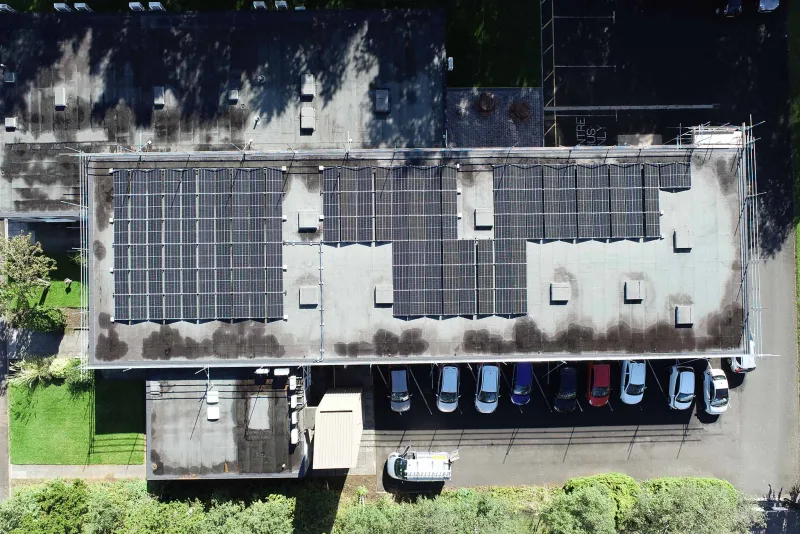
A flat commercial roof with modules set out in spaced rows

Panel count, walkways and load distribution all follow from the module footprint.

04 Volume

A division that grew while the sector was cutting back

Shipment figures and market recognition, each labelled with what it actually measures.

  • ~17.2 GW PV shipments in 2024 up around 73% on the year before
  • ~24.9 GW PV shipments in 2025 growth through a sector-wide price war
  • Top Brand EUPD market recognition a buyer-survey award, not a laboratory test
05 The range

A single module line, offered in more than one roof format

Solar modules

n-type TOPCon modules in commercial and small formats

The value module we specify where the roof has both the area and the structural headroom to carry a conventional panel count, and the case is settled on installed cost per kWp.

  • Infinity N series n-type TOPCon
  • Infinity N large-format bifacial double-glass

The module footprint sets the panel count, the walkway positions and how the dead load is distributed, so the series is fixed after the structural survey rather than before it.

Datasheet figures only. We publish no price, and the exact model is confirmed against the design and the current datasheet before order.

06 Bankability

A division of a magnetics group, standing behind a thirty-year promise

Two things carry DMEGC’s case, and neither of them is a single good result. It has held a place on the module bankability list for around six consecutive years, and it has taken a Kiwa PVEL Top Performer result five years running. Both are repeat measurements. A maker that passes an independent stress-test programme five times in a row is telling you something a one-year grade cannot, which is that the production line is consistent from year to year.

The counterweight is where it lands when the same analysts rank it. Its PV ModuleTech band is A, below the AA and AAA makers, and we cite that as it stands rather than rounding it up. It also carries an S&P Global Tier 1 rating, which is a separate scheme run by a different organisation against different criteria, and we keep the two apart wherever both appear in a tender answer.

BloombergNEF Tier 1 lists DMEGC Solar for Q1 2026. We re-verify the listing for the exact module before contract.

  • 6 years Consecutive years on the BloombergNEF module list a repeated listing, not a single quarter
  • 5 years Consecutive Kiwa PVEL Top Performer results independent stress testing on production modules
  • A PV ModuleTech bankability band below the AA and AAA makers
  • SZSE 002056 Parent listed in Shenzhen Hengdian Group DMEGC Magnetics, since 2006

DMEGC is a value specification in our line-up, chosen where the roof is generous enough that efficiency per square metre is not the binding constraint and the decision comes down to installed cost per kWp against a maker with a settled record.

07 Honest placement

Where a value module with a steady record is the right answer

Specify

Where it fits

  • Large simple roofs where the structure carries a conventional panel count without strengthening
  • Buyers who weigh a repeated independent test record above a single headline grade
  • Programmes needing settled UK stock so the modules do not pace the job
  • Phased estate rollouts where the same series has to stay available across several years
Specify something else

Where it does not

  • Tenders scored only on the AA or AAA bankability bands
  • Constrained roofs where the output target needs a premium high-efficiency module to fit
  • Specifications requiring the module maker itself to be a standalone listed company
  • Briefs that treat the two Tier 1 schemes as interchangeable, which we will not do in a tender answer
08 FAQ

DMEGC Solar on a commercial roof: common questions

Hengdian Group DMEGC Magnetics, the Shenzhen-listed parent under 002056, of which DMEGC Solar is the solar division. We name the division precisely rather than leaning on the wider magnetics business, because the two are not the same thing when a claim is made. The issuing entity for your specific module is read from the warranty document and written into your specification.

Both exist and they are different schemes. The BloombergNEF Tier 1 PV module maker list is a quarterly financing signal, and DMEGC is on the Q1 2026 list having held a place for around six consecutive years. The S&P Global Tier 1 rating is a separate scheme run by a different organisation against different criteria. We name the scheme and the quarter in every written answer rather than letting the phrase stand alone.

Not on its own, and we will not round the grade up to make the page read better. The A band puts DMEGC below the AA and AAA makers on that particular assessment, which matters if your funder scores suppliers by band. Against that sit five consecutive independent test passes and around six consecutive years on the module list. Where a tender genuinely requires a top-band maker, we say so and put one forward.

Our registry records no warranty term for DMEGC, so we will not quote a figure we cannot evidence. The product warranty and the linear performance warranty are read from the current manufacturer datasheet for the exact module at design stage and written into your specification, so the cover behind the system is documented before you sign rather than assumed from a brand headline.

By area. We take the usable roof area from the drone survey, model the output in PV*SOL against your half-hourly consumption, and see whether a conventional panel count reaches the target. If it does, a value module with a steady record is the better commercial answer. If the roof runs short, a higher-efficiency module earns the difference. The reasoning goes into the specification either way.

Get a commercial quote

The equipment is chosen to fit the design, not the other way round.

Tell us about the roof and the load. We survey the site, model the array in PV*SOL against your half-hourly data, and specify what actually fits, with the manufacturer, the series and the warranty named. DMEGC Solar goes on the roof where it is the right answer and not because it is on a list.

  • On-site 3D drone survey and half-hourly PV*SOL model
  • We confirm your DNO and handle the G99 connection
  • Over 50 kWp, outside MCS