

Skip to content
07944 877 329 hello@alectrona.solar

Alectrona

Manufacturers we specify

Canadian Solar is a Canadian company and a Chinese manufacturer

Canadian Solar supplies large-format crystalline modules built for utility and commercial duty, and has done so since 2001. The parent is NASDAQ-listed in Ontario; the modules come from its Shanghai-listed manufacturing arm in China. Shipments fell from around 31.1 GW in 2024 to 24.3 GW in 2025, which a finance committee should hear before it hears about the badge.

  • Modules made by CSI Solar
  • Utility-scale supply since 2001
  • Over 50 kWp, outside MCS
  • 2001 Founded in Guelph, Ontario
  • NASDAQ CSIQ Parent listing the manufacturing arm is listed separately in Shanghai
  • China Where the modules are made through CSI Solar, not in Canada
  • 24.3 GW Modules shipped in 2025 down from about 31.1 GW in 2024

A NASDAQ-listed parent with a separately listed Chinese manufacturing arm, so the country on the badge is not the country of origin.

Canadian Solar Inc. is a Canadian company. It was founded in Guelph in 2001, it trades on NASDAQ as CSIQ, and since January 2025 its global head office has been in Kitchener, Ontario. The modules are not made there.

Production runs through CSI Solar, the manufacturing arm, which is China-based and separately listed in Shanghai under 688472. Both of those things are true at once, and it is the second one a supply-chain questionnaire will ask about.

01 Bankability

Two listed companies, one brand name on the module

The corporate structure is the bankability question here. Canadian Solar Inc. trades on NASDAQ under CSIQ and holds the brand; CSI Solar, the arm that actually makes the modules, is China-based and listed on the Shanghai STAR Market under 688472. A module warranty is written by whichever entity is named on the sheet, so we read which one that is instead of assuming the NASDAQ parent stands behind it.

The trading record is the strong part of the case. Twenty-five years of continuous supply into utility-scale projects is a longer run than most of this market can show, and the group shipped 24.3 GW of modules in 2025. That figure was around 31.1 GW the year before. A fall of that size does not make a supplier unsafe, and a committee reading a thirty-year performance warranty should be told about it rather than shown only the record year.

BloombergNEF Tier 1 lists Canadian Solar for Q1 2026. We re-verify the listing for the exact module before contract.

  • 2001 Continuous trading since twenty-five years of utility-scale supply
  • 24.3 GW Modules shipped in 2025 about 31.1 GW the year before
  • AA PV ModuleTech bankability band a strong band, below the top AAA
  • 2026 Kiwa PVEL Top Performer measured on production modules
02 The range

A range built for utility-scale duty, applied to a commercial roof

Solar modules

Large-format modules for utility and commercial duty

The module for a big, regular deck where the case turns on cost per watt across a large array rather than on the last percentage point of efficiency per square metre.

  • TOPHiKu6 n-type TOPCon
  • TOPBiHiKu7 bifacial n-type TOPCon
  • HiKu7 monofacial

The exact power bin and both warranty terms come from the current datasheet for the model proposed; we hold no Canadian Solar sheet in our registry and will not print a figure from memory.
Datasheet figures only. We publish no price, and the exact model is confirmed against the design and the current datasheet before order.

03 Corporate structure

The company on the badge and the company at the factory

One brand, two listed entities, in two countries. Which one matters depends on what you are asking.

The brand

Canadian Solar Inc.

The parent that owns the brand and reports the group results. This is the entity people mean when they call the modules Canadian.

  • Listed on NASDAQ as CSIQ
  • Founded in Guelph, Ontario in 2001
  • Global head office in Kitchener, Ontario since January 2025
  • Reports the group shipment figures
The maker

CSI Solar Co., Ltd

The manufacturing arm that produces the modules and holds the factories. This is the entity behind what arrives on your roof.

  • China-based manufacturing
  • Listed separately on the Shanghai STAR Market under 688472
  • Produces the modules delivered into the UK
  • Named on the datasheet a warranty is written against

We read which entity writes the warranty on the datasheet for the model proposed, and state it in your specification rather than leaving the group name to imply it.

04 Procurement

What this structure means on a supply-chain questionnaire

Buyers with a public-sector, listed-company or lender-driven procurement process are increasingly asked to state country of manufacture, not brand nationality, and to evidence it. A brand called Canadian Solar will not satisfy that question on its own. The answer for these modules is China, through CSI Solar, and we would rather you had it from us at design stage than from a due-diligence pack three weeks before financial close.

The group is visibly managing the same pressure. In late 2025 it restructured its United States venture into CS PowerTech, holding 75.1%, in response to American scrutiny of Chinese supply links. That is a live corporate matter with an unfinished shape, and it does not change what a UK commercial roof receives today, which still comes from the Chinese manufacturing arm.

Our practice is simple. We take country of manufacture from the delivery documentation for your actual order rather than from the brand, we record it in the handover pack alongside the module serials, and where a scheme genuinely requires manufacture outside China we say plainly that this is not the brand for it and put forward one that is.

05 Roof duty

Built for a deck, not for the gaps between plant

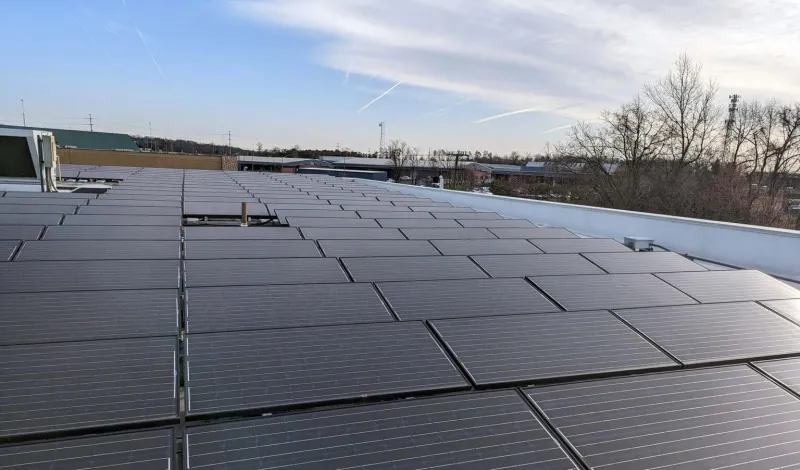
This range comes out of utility-scale supply, and it shows in the format. Large modules over long, uninterrupted runs give the lowest installed cost per watt available, because the same output arrives on fewer components, fewer connections and fewer hours of labour. On a distribution shed or a factory with regular bays, that is exactly the right economics.

The same format is a liability on a broken roof. Where plant, rooflights and access routes cut the deck into small usable patches, a large module simply cannot reach into them, and the array loses area it could have used. We measure that from the drone survey before choosing the format, and on a fragmented roof we usually specify a higher-efficiency or smaller-format module instead.

Best commercial solar panels
Long uninterrupted rows of modules across a large commercial roof

Long regular runs are where a utility-format module earns its cost per watt.

06 Due diligence

Three things we check before specifying from a structure like this

A group with a brand entity in one country and a manufacturing entity in another needs three separate answers, not one.

Which entity writes the warranty

We read the warranty document that comes with the proposed model and name the issuing entity in your specification. A warranty from a manufacturing subsidiary and one from a listed parent are different instruments, whatever the brand on the frame says.

What the delivery note says

Country of manufacture is taken from the documentation for your order and recorded in the handover pack. That is the answer a procurement or ESG questionnaire needs, and it is not the same as the country in the brand name.

Which listing actually applies

The NASDAQ line and the Shanghai line are two different sets of accounts. Where a lender wants the manufacturer’s financials rather than the group’s, we point them at the right one instead of letting the better-known ticker answer for both.

07 Honest placement

The roofs this range suits, and the questionnaires it does not

Specify

Where it fits

  • Long, regular warehouse and factory decks with the area to spread the watts
  • Funders who want a supplier with a twenty-year project record behind the warranty
  • Designs where cost per watt across the whole array is the deciding number
  • Multi-building estates where one large-format module has to cover several roof types
Specify something else

Where it does not

  • Buyers who need modules made outside China, which the Canadian name does not deliver
  • Roofs where the output target only fits at back-contact efficiency
  • Tenders scored on the top AAA bankability band, which Canadian Solar does not hold
  • Fragmented roofs cut up by plant, where a large-format module wastes the area it cannot reach
08 FAQ

Canadian Solar on a commercial roof: common questions

No. Canadian Solar Inc. is the parent, NASDAQ-listed as CSIQ, founded in Guelph in 2001 and headquartered in Kitchener, Ontario. Manufacturing runs through CSI Solar, which is China-based and listed separately on the Shanghai STAR Market under 688472. We take country of manufacture for your order from the delivery documentation and record it in the handover pack.

It should be known rather than ignored. The group shipped 24.3 GW of modules in 2025 against around 31.1 GW in 2024, a fall that reflects a brutal pricing environment across the whole module sector rather than a company-specific failure. Twenty-five years of continuous utility-scale supply is the counterweight. We confirm the maker’s current standing as part of due diligence before specifying.

It is heritage, not a current credential. Canadian Solar was a founding member in September 2015 of an analyst grouping that ran to 2019 and no longer exists, so we always state it in the past tense. For present-day assurance we use the Q1 2026 BloombergNEF Tier 1 listing, the PV ModuleTech AA band and the 2026 Kiwa PVEL Top Performer result, each named as what it actually is.

We hold no Canadian Solar datasheet in our registry, so we will not quote a year or a degradation figure. The product warranty, the linear performance warranty and the issuing entity are read from the current datasheet for the exact model proposed, confirmed before contract, and written into your specification so the cover matches the panels actually delivered.

We publish no per-panel or per-watt price. This is a competitively priced large-format brand rather than a premium one, so it usually lands in the value part of our line-up, but the number that matters is the installed system cost built from the roof survey, the PV*SOL yield model and the balance-of-system design. Our commercial solar cost guide sets out how it is put together.

Get a commercial quote

The equipment is chosen to fit the design, not the other way round.

Tell us about the roof and the load. We survey the site, model the array in PV*SOL against your half-hourly data, and specify what actually fits, with the manufacturer, the series and the warranty named. Canadian Solar goes on the roof where it is the right answer and not because it is on a list.

  • On-site 3D drone survey and half-hourly PV*SOL model
  • We confirm your DNO and handle the G99 connection
  • Over 50 kWp, outside MCS