Skip to content
07944 877 329 hello@alectrona.solar

Alectrona

Manufacturers we specify

JA Solar sells modules at one maturity and batteries at another

JA Solar is one of the largest module makers in the world and a much newer name in battery cabinets. We specify the 610 W bifacial module on large, regular roofs where the win is cost per watt across a wide plane, and we assess the BluePlanet storage cabinet on its own certificates rather than on the panel record. The two halves of this company are not the same age, and this page treats them that way.

  • N-type TOPCon bifacial modules
  • BluePlanet liquid-cooled cabinet
  • 12-year product, 30-year performance
  • 2005 Founded Beijing, China
  • SZSE: 002459 Listing Shenzhen A-share since the 2018 privatisation
  • Modules and storage What it supplies to us
  • 610 W Flagship commercial module 23.1% module efficiency

The value module for a big, regular roof, from a maker whose storage line is far younger than its panels.

Most directors know JA Solar as a panel maker, and that is the right instinct. It is one of the largest module manufacturers in the world, vertically integrated, publicly listed and shipping at a volume that makes module supply almost never the item pacing a commercial programme. On a big warehouse or distribution roof its 610 W bifacial module spreads a strong commercial yield over fewer fixings and less mounting per watt.

The same company also sells a commercial battery cabinet, and that is a much newer business. This page covers both, but it does not blend them. Everything the module side has earned stays on the module side, and the cabinet is put through its own checks.

01 One company, two ages

The two halves of JA Solar are not the same age

Reading this maker correctly means holding two quite different assessments at once. Both are true, and they support different amounts of weight.

A module business with two decades behind it

Founded in 2005, vertically integrated, Shenzhen-listed and shipping tens of gigawatts a year into more than 165 countries, with independent reliability testing and a quarterly financeability listing to cite. This is the part of the company a lender already recognises.

A storage business measured in a few years

The BluePlanet cabinet is a newer product family from the same firm. It has the parent balance sheet behind it, which is real, and it does not yet have the deployed record or the independent scorecards the modules carry.

Two products bought in two different ways

Modules arrive at volume through distribution, so the questions are format, structure and the datasheet for the exact SKU. The cabinet arrives as one finished item to underwrite, so the questions are the safety certificates, the warranty document, the coolant loop it brings into the maintenance scope, and how many hours it actually holds at its rated power.

02 Cell technology

Why the TOPCon cell suits a flat commercial roof Two datasheet properties do most of the work, and one of them only pays on the right surface.

The module we specify uses N-type TOPCon cells in a double-glass bifacial laminate. TOPCon matters here for two reasons the datasheet bears out. Light-induced degradation is lower, so less of the first-year output is lost before the asset settles into its linear curve. And the temperature coefficient is stronger than the older PERC cell, which tells on a flat commercial array in July, when a roof with little airflow under the modules runs a long way above the test condition the nameplate was measured at.

The bifacial build is the conditional part. A double-glass module returns rear-side yield off whatever is beneath it, so a light-coloured single-ply membrane or pale concrete gives back something useful, and a dark bitumen roof gives back very little. That is a survey observation rather than a specification default, and it is why we look at the roof surface before deciding whether the bifacial premium earns its place.

The flagship 72-cell module is rated at 610 W and 23.1% module efficiency, wired with multi-busbar cells to a 1,500 V maximum system voltage. The format is deliberate: on a wide simple roof each panel covers more area per connection, which holds down the mounting, the cabling and the labour per installed watt.

03 Structure

A 2.3 metre module is a structural decision The format that makes this module efficient to install is also the format the roof has to accept.

At 1,134 by 2,333 mm the panel is large by any standard, and that has consequences before it has benefits. It concentrates load into fewer fixing points, it presents more area to wind uplift at the edge and corner zones, and it needs two people and clear access to place safely on a working roof. On older stock with limited spare capacity, a structural report can rule the format out entirely regardless of how good the cell is.

Where the structure does take it, the same size is what makes the module economical. Fewer panels for the same array means fewer clamps, fewer rails, fewer connections and fewer hours at height, and the balance-of-system saving on a large roof is usually larger than the difference in module cost.

So the sequence is fixed. The structural survey and the drone survey come first, the mounting arrangement follows the structure, and the module is chosen to suit both. We do not select a panel and then ask the roof to accommodate it.

What a structural roof survey covers
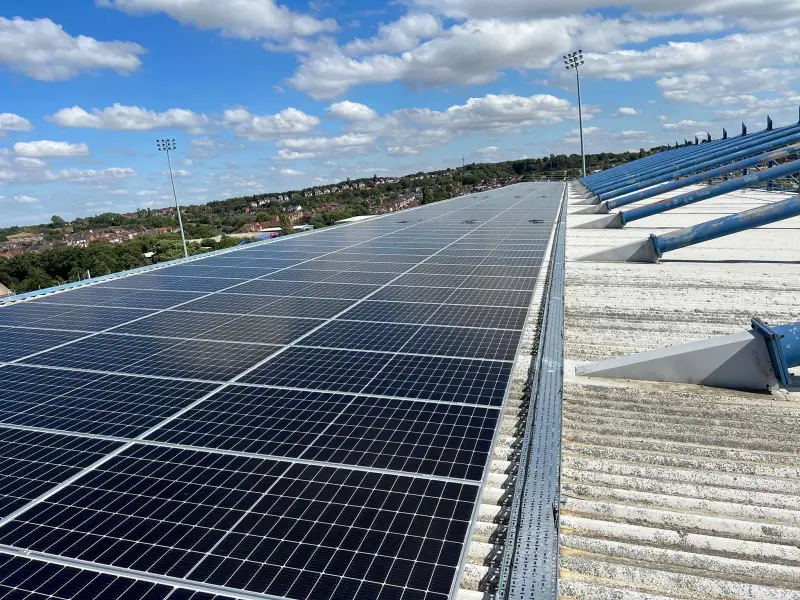
Large-format modules laid in long uninterrupted runs across a commercial roof

A wide, regular plane like this is where the large format pays for itself.

04 Module warranty

The cover written into the module datasheet

Terms move by series, by production year and by the distributor supplying the UK stock, so these are confirmed for the exact module before contract and read back to you in the proposal.

  • 12 years Product warranty workmanship and materials
  • 30 years Linear performance warranty output against the declared curve
  • 23.1% Module efficiency at 610 W from the flagship datasheet
06 Before contract

How a JA Solar specification is checked

  1. Verify

    Re-verify the live listing quarter

    The financeability list is quarterly and latest-only, so the quarter stated in a proposal is checked against the current publication for the exact module rather than carried forward from an earlier one.

    At specification

  2. Read

    Read the datasheet for the exact SKU

    Power, efficiency, dimensions, temperature coefficient and both warranty terms are taken from the issued datasheet for the module the distributor will actually supply, then written into the specification.

    Before order

  3. Separate

    Assess the storage on its own papers

    The cabinet is checked against its own safety certification, its cycle and retained-capacity basis and its warranty document. Nothing from the module assessment is allowed to stand in for any of it.

    Before shortlisting

  4. Confirm

    Confirm the structure takes the format

    The structural survey settles whether the roof accepts the fixing pattern, point loads and wind zones of a 1,134 by 2,333 mm module. Where it does not, we change the module rather than the report.

    Before design freeze

07 The full range

A mature module range and a young storage cabinet

Solar modules

N-type TOPCon bifacial double-glass modules

The module for a large, regular roof where the win is cost per watt across an uninterrupted plane. The double-glass bifacial build takes rear-side gain off a light membrane or pale concrete instead of wasting it.

  • DeepBlue 4.0 Pro
  • Cell: N-type TOPCon, multi-busbar
  • Flagship rating: 610 W at 23.1% module efficiency
  • Format: 1,134 by 2,333 mm, 72-cell
  • Maximum system voltage: 1,500 V
  • Warranty: 12-year product, 30-year linear performance

The large format is the point and the problem: on a fragmented or heavily obstructed plane a smaller high-efficiency panel uses the space better.

Battery storage

Liquid-cooled commercial and industrial battery cabinet

A factory-built, pre-commissioned cabinet at 125 kW and 261 kWh, paralleled where the load justifies more. It arrives as one defined product to underwrite rather than a set of parts assembled on the ground. The pairing is a little over two hours at full output, which is a peak-shaving shape: it covers the height of a demand peak comfortably and will not carry a long evening block on its own.

  • BluePlanet C&I ESS
  • Rating: 125 kW / 261 kWh per unit
  • Duration at rated power: About 2.1 hours
  • Cell: 314 Ah LFP
  • Cooling: Liquid-cooled, with a coolant loop to maintain
  • Depth of discharge: 95%
  • Cycle life: 8,000 cycles and above
  • Scaling: Up to 20 units in parallel, around 5.2 MWh

This line is far younger than the module business, so it is judged on its own certificates and its own warranty document rather than on the panel record. The liquid cooling is a maintenance item as well as a performance one: a coolant loop belongs in the operations and maintenance scope from the start, which an air-cooled cabinet of similar rating does not ask for.

Datasheet figures only. We publish no price, and the exact model is confirmed against the design and the current datasheet before order.

08 Bankability

A large balance sheet, and the limit of what it covers

JA Solar is a maker of genuine financial scale: founded in 2005, listed on the Shenzhen exchange as 002459 after being privatised from NASDAQ in 2018, shipping roughly 60 to 70 GW of modules in 2025 and around 79.4 GW in 2024, and selling into more than 165 countries. For a twenty-five-year asset that is the question a lender asks first, and the answer here is a firm large enough and diversified enough across markets to still be answering a warranty claim well into the 2040s.

The limit of that conclusion matters as much as the conclusion. Scale is company-level evidence, and it does not certify a product. The module side additionally carries independent evidence: a PV ModuleTech AAA bankability grade, in the top band, and a 2026 Kiwa PVEL Top Performer result on measured reliability. The BluePlanet cabinet has no equivalent independent record yet, so its case is built from the issued safety certificates and the warranty document for the exact unit, and we read both before it goes on a shortlist. A balance sheet is not a test report.

BloombergNEF Tier 1 lists JA Solar for Q1 2026. We re-verify the listing for the exact module before contract.

The BloombergNEF list rates PV modules for financeability and does not rate batteries at all, so this listing belongs to the JA Solar modules and says nothing whatever about the BluePlanet storage cabinet further down the page.

  • SZSE: 002459 Shenzhen-listed since 2018 privatised from NASDAQ; there is no live US ticker
  • 165+ Countries supplied the reach behind a twenty-five-year warranty commitment
  • IEC 62619 Cell and battery safety standard read off the certificate for the cabinet, never inferred from the module business
  • 8,000 cycles Datasheet cycle life for the cabinet warranty term and retained capacity confirmed from the issued document before contract

JA Solar is specified for two quite separate reasons on the same site, so the honest placement has to be written twice: once about area and structure, once about load and growth.

09 Honest placement

The roof decides the module, and the load decides the cabinet

Specify

Where it fits

  • Large, regular roofs with the structure to carry a 2.3 metre module and the area to spread it.
  • Light membranes and pale concrete, where the double-glass rear side returns useful yield.
  • Schemes whose funder wants a module maker with a current financeability listing and independent reliability testing.
  • Storage that has to grow in matched units towards the megawatt-hour range under one architecture.
Specify something else

Where it does not

  • Constrained or fragmented planes, where a smaller back-contact panel wins on watts per square metre.
  • Roofs whose structural report will not take the fixing pattern and point loads of a 1,134 by 2,333 mm module.
  • A first, modest behind-the-meter battery, where a smaller cabinet is better matched than a 261 kWh block.
  • Any storage decision made on the strength of the module reputation, which is a different product from a much younger business.
10 FAQ

JA Solar on a commercial roof: common questions

Both, but not to the same extent. It is one of the largest solar module manufacturers in the world, founded in 2005 and shipping tens of gigawatts a year, and the BluePlanet commercial and industrial cabinet is the same company's battery product. The module business is two decades old with independent reliability testing behind it; the storage line is a newer family. We specify from both and we assess them separately.

The cabinet is liquid-cooled at 125 kW and 261 kWh, about two hours at full output. Liquid cooling holds the cells in a tighter temperature window than the air-cooled cabinets several other makers supply at a similar rating, which tells where the duty is hard daily cycling or the cabinet stands in a warm, enclosed plant area. It is not a free upgrade: the coolant loop is a serviceable item and it goes into the maintenance schedule and the operating budget at design, not at handover.

No, and this is the single most important thing to get right about this maker. BloombergNEF Tier 1 is a PV-module scheme that rates module makers for lenders. It has no battery equivalent and it says nothing about a storage cabinet. JA Solar is listed for Q1 2026 on the module side, which we re-verify for the exact module before contract. The BluePlanet cabinet is assessed instead on the manufacturer's scale, its IEC 62619 certification, its cycle and retained-capacity basis and its issued warranty document.

The 610 W TOPCon module we specify carries a 12-year product warranty on workmanship and materials and a 30-year linear performance warranty on output, both taken from the JA Solar datasheet. Terms move by series, by production year and by the distributor supplying the UK stock, so we confirm the figures for the exact module before contract and read them back to you in the proposal rather than quoting a range figure.

When the roof is short of area or short of capacity. At 1,134 by 2,333 mm the panel concentrates load into fewer fixings and presents more area to wind uplift, so a structural report on older stock can rule it out. On a fragmented plane broken up by plant, rooflights and walkways, a smaller high-efficiency back-contact panel fits more usable watts into the space that is left. On a dark roof surface the bifacial rear-side gain is small enough that the double-glass build has less to offer.

No module or cabinet price is published here. A scheme above 50 kWp is survey-led, and the figure comes from the modelled design for your roof, your half-hourly load and your connection. On the storage side the cost follows the number of cabinets your load justifies along with the electrical and civil works, none of which a per-unit figure would describe. The proposal quotes one scope, with the module, the rating and the warranty terms named openly.

Get a commercial quote

The equipment is chosen to fit the design, not the other way round.

Tell us about the roof and the load. We survey the site, model the array in PV*SOL against your half-hourly data, and specify what actually fits, with the manufacturer, the series and the warranty named. JA Solar goes on the roof where it is the right answer and not because it is on a list.

  • On-site 3D drone survey and half-hourly PV*SOL model
  • We confirm your DNO and handle the G99 connection
  • Over 50 kWp, outside MCS