

Skip to content
07944 877 329 hello@alectrona.solar

Alectrona

Manufacturers we specify

Sunsynk hybrid inverters and the high-voltage stacks behind them

Sunsynk supplies a three-phase hybrid inverter and the modular lithium iron phosphate stack that runs with it, sold and supported in this country from Widnes in Cheshire. The reason installers rate it is support: parts move, the platform is familiar and the helpline is in the same time zone as the site. The reason we are careful with it is that Sunsynk designs and brands the hardware rather than manufacturing it, so it holds no utility-grade standing and we do not claim any.

  • Three-phase hybrid, 30 to 50 kW
  • LFP cells, IEC 62619 confirmed per model
  • UK support and spares from Widnes
  • Widnes UK sales, support and warranty base Cheshire
  • China Where the hardware is manufactured
  • Hybrid Solar, storage and grid in one unit
  • LFP Cell chemistry in the high-voltage stacks

Sunsynk is the support-led choice for a mid-sized commercial store, specified where a familiar hybrid platform and quick UK spares matter more than the balance sheet of the maker.

Sunsynk supplies two things that are bought together: a three-phase hybrid inverter and the modular high-voltage battery stack designed to run behind it. The hybrid combines the solar inverter, the battery charger and the grid interface in one unit, so generation, storage and import are coordinated by one device on one firmware roadmap rather than negotiated between separate boxes from separate makers.

The brand is unusual on this list in that it is not a manufacturer in the ordinary sense. The equipment is built in China; the UK operation in Widnes does distribution, technical support and warranty. That is worth knowing before you read anything else about it, because it explains both the thing Sunsynk is genuinely good at and the thing it cannot offer.

01 How the company is put together

A brand and a support operation, rather than a factory

Most of the makers on this site own their production. SMA runs Niestetal, Fronius runs its Austrian plants, the large Chinese manufacturers own their own lines. Sunsynk is built differently. It specifies and brands its hardware and has it manufactured in China, and the UK entity in Widnes handles the parts of the business a British buyer actually touches: supply, technical support, warranty administration and the relationship with the wholesalers.

Say that plainly and both consequences follow honestly. The upside is service. A support operation whose whole job is this market answers faster than a manufacturer's regional office, holds stock that suits UK installation patterns, and has an installer base that has already seen the fault you are looking at. On a building where the store is meant to save money every day, the time between a fault and a fix is worth more than a datasheet decimal place.

The limitation is the one a finance committee will find. Ownership of the factory, control of the cell supply and the balance sheet behind the warranty are questions that reach past the party you contracted with. That is not a reason to avoid the brand. It is a reason to specify it where capital is your own and the site is your own, and to look elsewhere when a third party is setting conditions on who made the equipment.

02 The hybrid architecture

One box doing three jobs, with what that buys and what it risks Solar conversion, battery charging and the grid interface in a single unit

A hybrid inverter is not a convenience feature. Putting the solar conversion, the battery charging and the grid interface in one machine means the decisions between them are made inside one device rather than inferred across a data link between two manufacturers. Generation, charging, discharge and import are scheduled together, there is one firmware roadmap to keep current, and when something behaves oddly there is one party accountable for it rather than two pointing at each other.

The cost of that is concentration. A fault in the hybrid takes the solar, the store and the scheduled discharge offline at the same time, where a site built from a separate PV inverter and a separate battery inverter would lose only one of them. On a mid-sized commercial building that is usually an acceptable trade for the simplicity, and where it is not, we design the site the other way and say why. That decision comes out of the survey and the load profile rather than a preference for one architecture.

How we size a commercial store
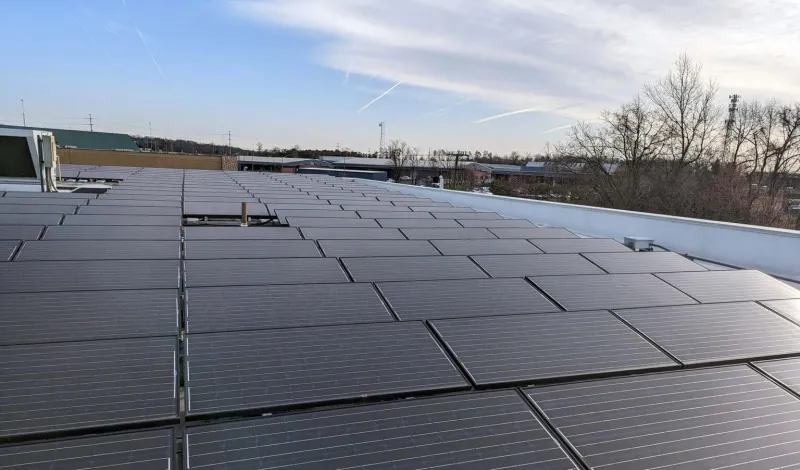
Commercial rooftop array of the kind a three-phase hybrid inverter and battery stack serves

The store is sized from the half-hourly load beneath the roof, not from the array above it.

03 On the datasheet

The figures we hold the specification to

Every one of these is confirmed from the current datasheet for the exact model before contract, because the ratings move between product generations.

  • 30 to 50 kW Three-phase hybrid rating band paralleled where a single unit will not carry the load
  • 97.6% Peak inverter efficiency 97.0% European weighted
  • 5.12 kWh High-voltage rack module 51.2 V nominal, stacked to the capacity required
04 New array or existing one

The coupling decision is made by what is already on the roof

Sunsynk is bought as a hybrid, but that does not settle how it joins your site. There are two arrangements and the survey decides between them.

New build

DC-coupled behind the hybrid

Where the array and the store go in together, the panels land on the hybrid directly and the battery charges on the DC side without a second conversion.

  • One conversion stage between the modules and the battery
  • Generation, charging and import scheduled by one device
  • One firmware roadmap and one party accountable for behaviour
  • Export position agreed with the network operator under G99 before commissioning

The natural arrangement when there is no existing inverter to work around.

Retrofit

AC-coupled beside what is there

Where the roof already has a working string inverter, the store charges from the building supply downstream of the existing PV and the original inverter carries on as it is.

  • No change to the existing array or its inverter
  • The store is sized against the half-hourly load, not the array rating
  • Adding storage changes the export profile, so it is a fresh G99 conversation
  • A conversion penalty applies, which we model rather than ignore

The usual answer on a building that already generates and now wants to keep more of it.

Which arrangement suits the site is a design decision taken from the survey and the half-hourly data, not a rule of the brand.

06 The full range

The hybrid and the stack are bought as one system

Inverters

Three-phase high-voltage hybrid inverters

Sites where the solar, the battery and the grid interface are wanted behind one machine and one firmware roadmap, with units paralleled where a single inverter will not carry the load.

  • SUNSYNK-50K-SG01HP3 (50 kW three-phase hybrid)
  • SG01HP3 three-phase hybrid series, 30 to 50 kW
  • Rating band: Three-phase high-voltage hybrid, 30 to 50 kW per unit, paralleled above that
  • Efficiency: Up to 97.6% peak, 97.0% European weighted
  • Grid compliance: G99 certified, to EN 50549 and IEC 61727 / 62116

A hybrid puts generation, storage and the grid interface in one enclosure, so a single fault takes all three offline until it is attended to.

Battery storage

Modular high-voltage LFP battery stacks

Stacked usable energy sized to the half-hourly load rather than fixed at one capacity, for self-consumption and clipping the expensive end of a peak.

  • Sunsynk 5.12 kWh HV rack module
  • Sunsynk high-voltage battery series
  • Module: 5.12 kWh rack module at 51.2 V nominal, stacked to the required capacity
  • System voltage: About 512 V nominal, with an operating window of roughly 416 to 584 V
  • Cell chemistry: Lithium iron phosphate (LFP)
  • Safety standard: IEC 62619 for industrial secondary lithium cells and batteries, confirmed per model

Capacities and module generations change quickly here, so a figure from last season's stack is not a promise about the one delivered.

Datasheet figures only. We publish no price, and the exact model is confirmed against the design and the current datasheet before order.

07 Bankability

What you are actually buying when the maker does not own the factory

Sunsynk is a brand and support operation rather than a factory owner. The hardware is manufactured in China, and Sunsynk UK Ltd, working from Widnes in Cheshire, handles distribution, technical support and warranty for this market. That structure has a genuine upside, and it is the reason the brand has the UK following it does: the installer base already knows the product, spares move quickly, and there is somewhere to ring that answers in the same working day as the site. On a mid-sized commercial store those are the things that decide whether a fault costs an afternoon or a fortnight.

It also means the questions a lender asks about a manufacturer, who owns the factory, who supplies the cells and what the balance sheet looks like, land on parties a purchaser never contracts with directly. So the honest position is that Sunsynk is specified on support and product fit rather than on financeability. Its stacks use lithium iron phosphate cells and carry a named product warranty, and we confirm the IEC 62619 certification for the exact model from the current datasheet before contract. We claim no bankability tier for it, and where the standing of the maker is a condition of the funding we put a larger listed manufacturer forward instead.

  • IEC 62619 Cell and battery safety standard confirmed per model before contract
  • LFP Cell chemistry in the high-voltage stacks a more benign failure mode than NMC
  • Widnes UK support, spares and warranty base Cheshire
  • Named term Product warranty on inverter and stack verified from the issued document, not the brochure

Sunsynk sits in a specific part of the commercial band. Above it the argument shifts to makers with their own manufacturing and a standing a funder recognises; below it, this is a domestic product in a larger box.

08 Honest placement

Where a Sunsynk system is the right call

Specify

Where it fits

  • Warehouses, depots, workshops and small production sites in the middle of the commercial band
  • Sites where quick UK spares and a familiar service platform matter more than the maker's balance sheet
  • Retrofits onto an array that already works, where the store is AC-coupled beside the existing inverter
  • Projects funded from capital, where no third party is setting conditions on who made the equipment
Specify something else

Where it does not

  • Financed or leased schemes where the funder sets conditions on the standing of the manufacturer
  • Grid-scale or heavy industrial duty, which is a different class of equipment entirely
  • Sites where the store must keep running through an inverter fault, since a hybrid is one point of failure
  • Specifications requiring the cell maker and the pack maker to be the same company
09 FAQ

Sunsynk on a commercial roof: common questions

No, and it is better to be straight about it than to let a brand name imply otherwise. Sunsynk specifies and brands its hardware and has it manufactured in China; the UK entity, based in Widnes in Cheshire, handles supply, technical support and warranty for this market. That is a common structure in this industry and it is not a criticism, because the support operation is the part a British buyer actually deals with and it is the part Sunsynk does well.

What it changes is where the assurance comes from. We confirm the certification, the ratings and the warranty terms from the issued documents for the exact model rather than from a corporate story about a factory, and where a funder needs the manufacturer itself to carry the standing, we say that Sunsynk is not that maker.

It depends entirely on who is paying. Bought from your own capital, on your own building, the questions that matter are whether the product suits the load, whether the safety certification is in order and whether a fault gets fixed quickly, and Sunsynk answers all three well. Batteries have no recognised financeability tier in any case, so the honest test is manufacturer scale, track record, warranty terms and certification to IEC 62619 rather than a badge.

On a financed or leased scheme where a third party sets conditions on the manufacturer, Sunsynk does not hold the standing of the large listed makers and we will not pretend it does. In that situation we put a different maker forward and explain the trade you are making by doing so.

Usually, and the decision turns on how the existing solar is wired rather than on the brand. A hybrid is most natural on a new array, where the modules and the battery sit behind one device on the DC side. On a building that already has a working string inverter, the store is normally AC-coupled: it charges from the building supply downstream of the existing PV, so the original inverter keeps running and the battery is added alongside it, at the cost of an extra conversion which we account for in the model.

Either way it is treated as a fresh connection question. Adding storage changes the site export profile, so the work is agreed with your network operator under G99 before commissioning, and the store is sized against your half-hourly consumption rather than the rating of the existing array.

That comes out of the survey, and a figure printed here would not be yours. The three-phase hybrid range runs from around 30 kW to 50 kW per unit with machines paralleled above that, and the high-voltage stack is built up from 5.12 kWh rack modules to whatever capacity the load justifies. We model your half-hourly consumption in PV*SOL against the array, size the store to the load rather than to the panels, and confirm the exact model and its warranted ratings from the current datasheet before contract.

We do not publish a figure, because the honest one is survey-led and the components that move it are all site-specific. The inverter rating, how many modules go into the stack, whether it is a new install or an AC-coupled retrofit, and the connection and switchgear work your building needs are what set the number, and none of them can be guessed from a floor area. We confirm the exact model and its warranted ratings, then price the installed system from the design. Our battery storage costs page explains what drives the figure.

Get a commercial quote

The equipment is chosen to fit the design, not the other way round.

Tell us about the roof and the load. We survey the site, model the array in PV*SOL against your half-hourly data, and specify what actually fits, with the manufacturer, the series and the warranty named. Sunsynk goes on the roof where it is the right answer and not because it is on a list.

  • On-site 3D drone survey and half-hourly PV*SOL model
  • We confirm your DNO and handle the G99 connection
  • Over 50 kWp, outside MCS