

Skip to content
07944 877 329 hello@alectrona.solar

Alectrona

Manufacturers we specify

SolaX for multi-inverter roofs and packaged storage

SolaX supplies us three-phase string inverters that stop at 30 kW and a storage range that runs from a hybrid-and-stack build up to a finished 215 kWh cabinet. On a commercial roof that makes it a multi-unit specification rather than one large machine. We reach for it on segmented, phased and retrofit sites, and we say plainly where one bigger inverter would serve the roof better.

  • X3-PRO G2 and X3 hybrids
  • Triple Power T58 and the Trene cabinet
  • Named 10-year warranties
  • Hangzhou Head office Zhejiang, China
  • Inverters and storage What it supplies to us
  • 30 kW Top of the three-phase string range X3-PRO 30K-G2
  • 215 kWh Air-cooled Trene cabinet 100 kW, AC-coupled

A mid-market maker whose commercial value is unit count and retrofit flexibility rather than one large machine.

SolaX Power is an established Chinese maker of three-phase string and hybrid inverters and of the storage that sits behind them, supplied to us through UK distribution with named warranty terms. On a domestic system it is a familiar name. On a commercial roof it behaves differently, because its three-phase string range stops at 30 kW while the roofs on this site start at 50 kWp.

That single fact is the whole specification argument. A SolaX roof is built from several machines, and a SolaX battery is either stacked up in 5.8 kWh modules or dropped in as one finished cabinet. Both of those are advantages on the right building and an avoidable expense on the wrong one, so the page sets out which is which.

01 The full range

SolaX arrives as several small machines or as one finished block

Inverters

Three-phase string inverters sized for sub-arrays

The building block for a roof assembled from several machines rather than one. Each unit brings its own three trackers and its own AC connection, so a phased or multi-building site can be energised section by section instead of waiting for the whole array.

  • X3-PRO 25K-G2
  • X3-PRO 30K-G2
  • MPP trackers: Three, two strings on each
  • Maximum DC input: 1,100 V
  • DC oversizing headroom: Up to 150%
  • Peak efficiency: Up to 98.5%
  • Standard UK warranty: 10 years, extendable on eligible models

The series stops at 30 kW, so a large unbroken plane needs a unit count that a single 100 kW class machine would avoid.
Battery storage

A modular high-voltage stack and a packaged C&I cabinet

Two different answers to the same question. The hybrid inverter with a Triple Power stack builds capacity in 5.8 kWh modules alongside the solar; the Trene cabinet arrives as a finished AC-coupled block that ties into the building network without touching the existing inverters. Both are specified on a power rating and a duration, not on capacity alone, because a store that covers the peak but empties before the shift ends has only solved half the problem.

  • X3 and X3 Ultra three-phase hybrids
  • Triple Power T58
  • ESS-TRENE
  • Trene, air-cooled: 100 kW / 215 kWh, 280 Ah LFP
  • Trene, liquid-cooled: 125 kW / 261 kWh, 314 Ah LFP
  • Duration at rated power: About 2.2 hours air-cooled, about 2.1 liquid-cooled
  • Enclosure: IP55, AC-coupled
  • Triple Power T58 warranty: 10 years, over 6,000 cycles

The Triple Power stack grew out of smaller systems, so at the top of a commercial load it is the Trene cabinet, not the stack, that carries the duty. A longer-duration Trene cabinet is also catalogued, and we do not state a rating for it here because none has been read off a datasheet yet.

Datasheet figures only. We publish no price, and the exact model is confirmed against the design and the current datasheet before order.

02 Bankability

What SolaX can and cannot evidence to a funder

SolaX holds no independent inverter-bankability placing, and we do not manufacture one for it. What it can evidence instead is unusual in the mid-market and worth weighing on its own: a 10-year standard manufacturer warranty on the UK three-phase inverters, where several larger and better-known makers issue five years as standard and sell the rest as an extension. A finance committee reading warranty exposure rather than league tables should notice that the baseline term is already long and does not depend on a purchase decision made later.

The battery side is evidenced the same way, from documents rather than reputation. The Triple Power T58 carries a published 10-year term rated over 6,000 cycles, and we read the retained-capacity basis, the throughput limit and the operating-temperature conditions off the issued datasheet for the exact product before contract. The Trene cabinet carries its own terms. Where a lender wants a maker with a longer commercial storage record or a survey placing behind it, that is a fair requirement and we will put a different maker forward rather than argue the point.

  • 10 years Standard UK inverter warranty the baseline term, not an extension bought later
  • 6,000+ cycles Triple Power T58 warranty basis 10-year term; retained capacity read from the issued datasheet
  • IEC 62619 Cell and battery safety standard confirmed on the certificate for the specified cabinet
  • IEC 62933-5-2 Storage system safety standard covers the cabinet as a whole, not the cells alone
03 Two routes

Two ways a SolaX system lands on a commercial site

The maker supplies two storage architectures that behave very differently on site. We choose between them from the half-hourly load and the state of the existing electrical installation, not from a preference.

Assembled on site

X3 hybrids with a Triple Power stack

The hybrid inverter handles solar and battery in one unit, and capacity is built up from 5.8 kWh modules with several stacks managed together through a BMS parallel box.

  • Capacity set in module steps rather than in whole cabinets
  • Solar and storage share one platform and one controller
  • Inverters paralleled to lift total power as the load grows
  • Suits a new build where the array and the store are designed together

More parts to align on site, and more commissioning time than a factory-built block.

Both routes are sized against your half-hourly consumption in the model before either is named, and the exact ratings and warranty come from the issued datasheet.

04 Array geometry

One roof, several machines What a multi-inverter layout actually buys you.

Spread four 25 kW units across a segmented roof and each one sits near the strings it serves. Cable runs shorten, DC voltage drop falls, and the combiner and fuse count drops with them. A fault then takes out a quarter of the array rather than all of it, and a replacement unit is a manageable item to hold or to obtain rather than a programme event.

The commercial argument is usually staging. A building being fitted out in phases, or a landlord energising one unit at a time, can bring each section into service as it completes, with its own metering and its own monitoring record. A single central machine cannot do that without either waiting or running well below its rating for months.

The cost of the approach is real and we quote it rather than hide it: more AC connections, more isolation, more commissioning and more witness points at the connection. Where the roof is one wide clean plane, that overhead buys nothing and we specify a larger machine from another maker instead.

How a 50 to 150 kWp scheme is put together
A commercial roof array laid out in separate banks across several sections of the building

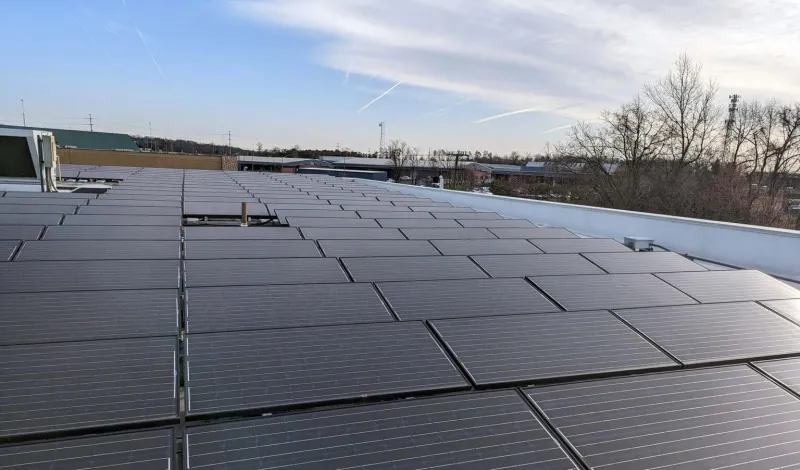
A segmented roof of this shape is where several smaller inverters earn their keep.

05 Datasheet

What one X3-PRO G2 unit brings to the design

The figures below are taken from the X3-PRO G2 datasheet and are confirmable. They are the numbers that decide how many units a roof needs.

  • Three MPP trackers per unit two strings on each tracker
  • 1,100 V Maximum DC input longer strings, fewer parallel runs
  • 150% DC oversizing headroom the array can be loaded hard against the unit
07 Storage detail

Air cooling, liquid cooling and what the choice changes The Trene cabinet comes in two thermal designs, and they are not interchangeable.

The air-cooled Trene runs 280 Ah cells at 100 kW and 215 kWh, which is a little over two hours at full output. The liquid-cooled version runs larger 314 Ah cells at 125 kW and 261 kWh, and lands at much the same duration despite the bigger numbers on both sides. That is worth noticing before a capacity figure is chosen, because moving up the range here buys more peak coverage rather than more run time. The headline difference is capacity, but the working difference is how tightly the cells are held. A liquid-cooled pack keeps a narrower temperature spread across the block, which matters when the duty is hard daily cycling or the cabinet sits in a warm, enclosed plant area. An air-cooled cabinet has fewer parts in the cooling path and one less fluid circuit to maintain over the asset life.

Both use lithium iron phosphate cells, which is the chemistry the behind-the-meter market has settled on for its higher thermal-runaway onset and slower failure progression than nickel-based cells. The IP55 rating lets the cabinet sit outside, which on a full plant room is often the deciding factor rather than any electrical characteristic.

Duration is the third thing this choice settles. Both cabinets above sit near two hours, and a load that needs four is a different order rather than a bigger one. A longer-duration Trene cabinet does exist in the same series, and this page deliberately publishes no power or energy figure for it: the only figures available for it are read off its part-number designation, they do not reconcile with the duration that same designation claims, and an inferred rating is not a specification. We will state it once a datasheet has been read. Sizing a store against a half-hourly load is set out on our battery sizing page.

Coupling is the last design call. AC coupling keeps the battery independent of the solar inverters, so a retrofit does not touch a working array and the storage can be sized to the load rather than to the generation. We set the arrangement at survey and record it in the design, because it changes the metering, the protection and the way the export limit is held.

SolaX is specified on array geometry, not on scale. The question that settles it is whether your building wants one machine or several, and that is a question the roof answers rather than the brochure.

08 Honest placement

Where the unit count pays, and where it costs

Specify

Where it fits

  • Roofs split across separate buildings, pitches or phases, where each section can carry its own inverter.
  • A retrofit where storage has to tie into the AC network without disturbing the existing solar inverters.
  • Sites built in stages, where part of the array has to generate before the rest is finished.
  • A behind-the-meter load in the band one or two Trene cabinets cover, where a finished block beats an assembled one.
Specify something else

Where it does not

  • A single large unbroken plane, where one 100 kW class machine replaces four SolaX units and a good deal of AC cabling.
  • A financed scheme whose funder asks for an inverter maker with a current independent bankability placing.
  • Storage well past the band a small number of Trene cabinets cover, where a maker with a deeper multi-cabinet record fits better.
  • Heavily shaded roofs, where module-level electronics recover more than any three-tracker string design will.
09 FAQ

SolaX on a commercial roof: common questions

Because the X3-PRO G2 range stops at 30 kW, a SolaX design above 50 kWp is always a multi-unit design. That suits a building split across pitches, units or phases: each section carries its own inverter, cable runs stay short, a fault is contained to one part of the array and sections can be energised as they complete. On a wide unbroken plane the same approach adds switchgear and commissioning for no gain, and we specify a larger machine from another maker instead.

Trene is a finished cabinet: cells, conversion and controls integrated in one AC-coupled enclosure at 100 kW and 215 kWh air-cooled, or 125 kW and 261 kWh liquid-cooled. Triple Power T58 is a modular high-voltage stack built up from 5.8 kWh modules and paired with an X3 or X3 Ultra hybrid inverter, managed through a BMS parallel box. The stack lets capacity be set in small steps alongside a new array; the cabinet is the better answer for a retrofit or a larger load, because it ties into the building AC network without touching the existing solar.

The three-phase inverters supplied to the UK carry a 10-year standard manufacturer warranty, extendable on eligible models. That is longer as a baseline than several larger makers offer before an extension is bought. The Triple Power T58 carries a 10-year term rated over 6,000 cycles on the published datasheet, and the Trene cabinet carries its own terms. We read the registration requirement, the retained-capacity basis and the operating conditions off the issued document for the exact product before contract, then register the cover at commissioning so it runs from handover.

SolaX holds no current independent bankability placing on either its inverters or its storage, and we make no such claim for it. It is a mid-market maker with live UK distribution and long written warranty terms, which is a real but different kind of evidence. Where your funder requires a maker with a survey placing or a longer commercial storage record, that is a reasonable condition and we will put an alternative forward rather than argue for the brand.

We publish no equipment prices. A commercial scheme above 50 kWp is survey-led, and with SolaX the unit count is itself part of the design, so a per-inverter figure would tell you very little about the project. The figure in your proposal comes from the modelled design for your roof, your half-hourly load and your connection, quoted as one scope rather than assembled from list prices.

Get a commercial quote

The equipment is chosen to fit the design, not the other way round.

Tell us about the roof and the load. We survey the site, model the array in PV*SOL against your half-hourly data, and specify what actually fits, with the manufacturer, the series and the warranty named. SolaX goes on the roof where it is the right answer and not because it is on a list.

  • On-site 3D drone survey and half-hourly PV*SOL model
  • We confirm your DNO and handle the G99 connection
  • Over 50 kWp, outside MCS