

Skip to content
07944 877 329 hello@alectrona.solar

Alectrona

Manufacturers we specify

Fox ESS inverters and storage, specified on stock and support

Fox ESS supplies both halves of a commercial system: three-phase string inverters up to 110 kW, and storage in three different architectures. It is a young maker with no independent standing to point at, so the case for it is availability, UK spares and a service base you can actually reach. We specify it where that is what the project needs, and we say so when it is not.

  • UK service and logistics base
  • LFP cells, certification read per model
  • Over 50 kWp, outside MCS
  • Wuxi, China Where the equipment is made
  • Coventry UK service and spares base
  • Inverters and storage What it supplies to us
  • LFP Cell chemistry across the storage range

The maker we reach for when a replacement unit has to be on site this week rather than this quarter.

Fox ESS makes three-phase string inverters and commercial storage, and it is one of the few makers on our list that supplies both halves of a system at a rating that suits a British industrial roof. The range is competent rather than distinctive. Nothing in it does something no rival can do, and that is not the reason it is on the list.

The reason is supply. A commercial array that stops earning because a 100 kW inverter is sitting in a container off Rotterdam is a real cost, and the case for Fox ESS is that this happens less often with it than with most of the alternatives. We are equally plain about the other side: the company is young, privately held and rated by nobody, so where a lender is underwriting the maker rather than the asset, we put a different name forward.

01 The full range

Two ladders: string inverters, and storage in three shapes

Inverters

Three-phase grid-tied string inverters, 15 to 110 kW

The R Series carries a large commercial roof on a single machine, with nine maximum-power-point trackers on the R75 and R100 and ten on the R110, so each pitch and each shaded bay tracks on its own input. The T Series covers sub-arrays, outbuildings and phased sections inside the same scheme.

  • R75
  • R100
  • R110
  • FE-T-15.0
  • FE-T-25.0
  • Peak efficiency: Up to 98.6% across the range
  • Maximum DC input: 1100 V on the R Series
  • MPP trackers: 9 on the R75 and R100, 10 on the R110
  • V Series: 30 to 75 kW, 3 to 6 trackers, string monitoring
  • Warranty: Named and registerable; term confirmed per model

The R Series ratings that make the commercial case are typically built to order, so the units a large roof actually needs are the ones least likely to be sitting on a shelf.
Battery storage

Hybrids, modular high-voltage batteries and factory-built cabinets

Fox covers every storage architecture a commercial site is likely to need. A hybrid where the array and the store are designed together, an AC-coupled route that leaves a working inverter estate untouched, and a cabinet that arrives as one commissioned product with its own power conversion and switchgear inside. The cabinet range is also where power and energy come apart, because the Plus is supplied at two power ratings against the same energy figure, and the two orders behave quite differently on site.

  • H3 Smart
  • H3 Pro
  • H3 Plus
  • CQ16
  • G-Max
  • G-Max Plus
  • Hybrid ladder: H3 Smart 5 to 15 kW, H3 Pro 15 to 30 kW, H3 Plus 50 to 125 kW
  • Modular battery: CQ16 high-voltage LFP stacks, configured per design
  • G-Max cabinet: 100 kW / 215 kWh, about 2.2 hours
  • G-Max Plus: 100 kW / 241 kWh, or 125 kW at the same 241 kWh
  • Duration, G-Max Plus: About 2.4 hours at 100 kW, about 1.9 at 125 kW
  • Warranted cycle life: G-Max at least 8,000 cycles to 70% end of life

A cabinet is quick to install and slow to change. It is commissioned as one sealed product, so a shift in duty two years later means a different cabinet rather than a different module count, and the 125 kW Plus in particular buys peak coverage by giving up run time.

Datasheet figures only. We publish no price, and the exact model is confirmed against the design and the current datasheet before order.

02 Bankability

What a finance committee can and cannot verify about Fox ESS

Fox ESS is privately held and Chinese-domiciled, so there are no filed accounts to read and no independent survey that rates it. Every figure the company publishes about its own size is self-reported and unaudited, and we present it on that basis rather than repeating it as fact. That is the honest starting point, and it is why we never put Fox ESS forward as the answer to a lender's question about who stands behind the equipment.

What can be verified is the part that decides whether a warranty is worth anything in practice. There is a UK subsidiary, a service and logistics base in Coventry handling technical support, spares and aftersales, and distributor stock held in the country rather than promised from a factory. The cells are LFP and the certification is on the datasheet: we confirm IEC 62619 on the cells, the IEC 62933 series on the storage system, and the UL 9540A propagation test result on the cabinet, for the exact model, before anything is drawn. The warranty term and its retained-capacity figure come off the issued document, never off a brochure headline.

  • Coventry UK service and logistics base Technical support, spares and aftersales inside the country
  • IEC 62619 Cell safety standard, confirmed per model With IEC 62933 on the system and UL 9540A on the cabinet
  • 8,000 cycles G-Max warranted cycle life To 70% end of life; the term is read off the current datasheet
  • Privately held No filed accounts, no independent rating Nothing to underwrite the maker on beyond the product and the UK route
03 Storage architecture

Three ways Fox ESS storage lands on a commercial site

Most makers give you one shape of battery and expect the site to accommodate it. Fox covers all three of the routes a commercial building normally takes, which is why the brand survives so many different surveys.

Left alone

AC-coupled retrofit onto existing solar

The H3 Pro and H3 Plus platforms are also supplied as AC-coupled battery chargers. The existing array and its inverters stay exactly where they are, and the battery is coupled in at the AC busbar instead.

  • No change to a working inverter estate
  • Suits an export-limited site where the case is load management
  • Metering and current-transformer positions set at survey

The usual answer where solar was installed years ago and still performs.

Arrives finished

G-Max and G-Max Plus cabinets

Cells, power conversion, battery management and switchgear are built into one outdoor-rated enclosure at the factory and commissioned as a single product. There is no inverter to match and no stack to build on site.

  • G-Max at 100 kW and 215 kWh, about 2.2 hours
  • G-Max Plus at 241 kWh, supplied at 100 kW or at 125 kW
  • The 125 kW Plus therefore runs under two hours, not two and a half
  • Cabinets parallel for larger battery-led schemes

Fastest to commission, and the hardest of the three to change afterwards.

Which of the three suits your building comes out of the half-hourly load and the existing electrical estate, not from a preference. We size the store before we name the shape.

04 Scale, attributed

The numbers Fox ESS publishes about itself

These are the figures the company states, and they are worth knowing. They are also the company's own, they are not audited by anyone, and no independent body has checked them. We repeat them with the attribution attached rather than as established fact.

  • 1.5 million Batteries the company says it has installed Fox's own figure for the past three years
  • Over 5,000 Employees the company reports Across six stated research and development centres
  • Self-published The source of every figure here None of it independently audited, and we do not present it as such
05 The UK layer

A warranty is only worth the route to invoking it Ten years of cover from a factory you cannot telephone is not ten years of cover.

The part of Fox ESS that does real work on a commercial project is not in Wuxi. It is the UK subsidiary: a service and logistics base in Coventry covering technical support, spares and aftersales, field engineers who attend a first commissioning, and hands-on training run through a facility partner in York. That domestic layer is the difference between a warranty document and a working warranty.

It matters most at the least glamorous moment. When a three-phase unit trips out on a distribution site in February, the question is not which maker has the better efficiency curve. It is whether a replacement can be released, shipped and fitted before the next billing period. Fox ESS answers that question well at the smaller ratings, and we hold it on the list largely for that reason.

We hold the monitoring access, the as-built records and the warranty registrations ourselves, so a fault routes through us rather than through a manufacturer call centre. That is true whichever brand we fit; with Fox ESS the manufacturer side of it is simply closer to hand.

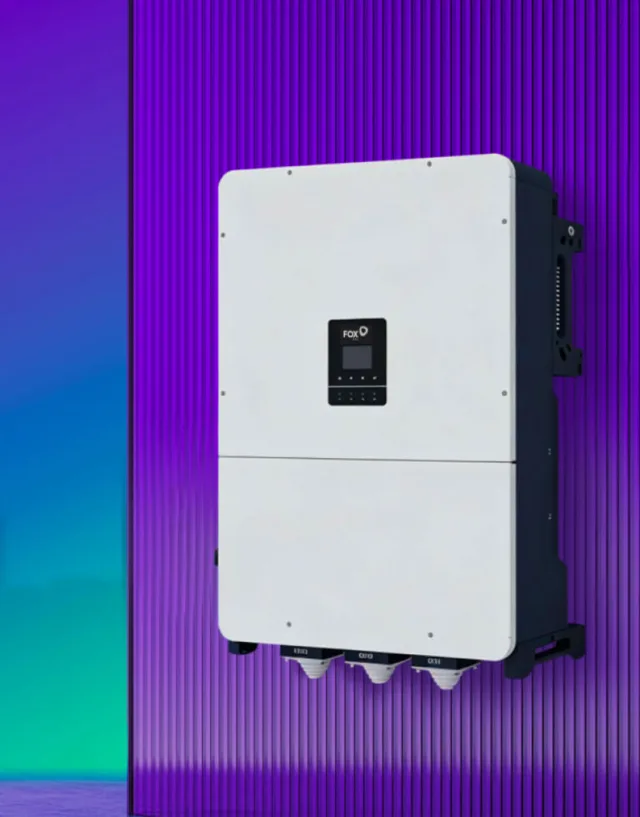
Fox ESS H3 Plus three-phase commercial hybrid inverter

The H3 Plus hybrid, the top of the three-phase ladder at 50 to 125 kW.

07 Cells and certificates

What we read before a Fox ESS battery goes into a design A battery cannot hold a module financeability badge, so certification and warranty carry the whole weight.

Fox builds its commercial storage on lithium iron phosphate cells. That is the chemistry the behind-the-meter market has settled on, because it holds capacity across many cycles, runs at a stable thermal profile and tolerates the daily charge and discharge pattern that peak shaving and self-consumption ask for. The trade-offs against nickel-based cells are set out on our LFP versus NMC page.

Because no financeability scheme covers batteries, the substance behind a storage warranty is the certification. We confirm three things against the issued datasheet for the specific model rather than the family: IEC 62619, which governs cell and battery safety under industrial duty; the IEC 62933 series, which covers the storage installation and how it behaves on the network; and UL 9540A, the cell-to-system thermal-runaway propagation test that insurers and fire officers ask to see on a cabinet. A missing propagation result changes where a cabinet can stand on a site, so it is a design input rather than paperwork.

Those product certificates then sit inside a site fire-engineering envelope: siting, separation, ventilation, detection and access for the fire service, decided at survey and written into the design. The wider site safety case is covered on our battery fire safety page, and the connection that gates any commercial battery is set out in the grid connection queue guide.

The decision is almost always about logistics rather than engineering. Fox ESS does the ordinary things competently; what it does better than most of the line-up is get a unit to a Yorkshire industrial estate quickly and support it from inside the UK afterwards.

08 Honest placement

Where Fox ESS earns the specification, and where it loses it

Specify

Where it fits

  • Sites where a failed unit has to be replaced in days, because the smaller Fox ratings are held deep in UK distribution.
  • A storage retrofit onto working solar, where the AC-coupled H3 route adds a battery without disturbing the existing inverter estate.
  • A cabinet-scale battery behind the meter, where a factory-integrated G-Max commissions faster than a system built up on site.
  • Phased schemes where the array and the store are designed together on one hybrid platform and grown later.
Specify something else

Where it does not

  • A financed scheme where the lender is underwriting the manufacturer rather than the equipment. There is no independent placing here and we will not invent one.
  • A shaded or cluttered roof that genuinely needs module-level electronics, because a string platform cannot recover what a per-module architecture recovers.
  • A programme with no float on inverter delivery, because the R Series at the ratings a large roof needs is normally built to order.
  • Ground-mount much past a couple of hundred kilowatts, because the R Series stops at 110 kW and the machine count starts climbing faster than the cable saving falls.
09 FAQ

Fox ESS on a commercial roof: common questions

Often not, and we would rather say that here than in a meeting. Fox ESS is privately held with no filed accounts, and no independent survey rates it, so a lender underwriting the manufacturer has nothing to read. Where the credit case turns on who stands behind the equipment, we put a more established maker forward and explain why. Where it turns on the asset and the cash flow, Fox ESS is a reasonable specification and we back it with certification and warranty confirmed for the exact model before contract.

Same format, more energy, and a choice of power rating on the newer one. The G-Max sits at 100 kW and 215 kWh in an outdoor cabinet with the cells, power conversion, battery management and switchgear factory-integrated, which is a shade over two hours at full output. The G-Max Plus lifts the same enclosure to 241 kWh and is supplied at either 100 kW or 125 kW. That second option is the one worth pausing on: the extra power does not come with extra energy, so the 125 kW cabinet covers a bigger peak but empties in under two hours where the 100 kW version runs nearer two and a half. Which of them suits a site is decided by the shape of the load rather than by the larger number, and we confirm the product the distributor is actually supplying against the current datasheet at specification, because cabinet products revise faster than their marketing pages do.

Yes, and it is one of the better reasons to choose it. The H3 Pro and H3 Plus platforms are supplied as AC-coupled battery chargers as well as hybrids, so the store couples in at the AC busbar and the existing array and its inverters are left in place. That matters on a site where the solar still performs and there is no case for replacing working equipment. The design work moves to metering, current-transformer positions and the export position on the connection agreement, all of which we read at survey.

Because they are built to order rather than stocked. The T Series and the smaller three-phase units are held in depth by UK distributors, which is where the brand gets its reputation for availability. The R75, R100 and R110, which are the units a roof above 50 kWp actually needs, are normally made against an order. We confirm live stock and the current build lead time for the exact model before a programme date is committed, and if the connection date will not wait, we change the design rather than the promise.

We do not publish a figure, and a figure taken from a brochure would not survive contact with your building. The honest number comes from the half-hourly load, the capacity and power rating the design lands on, the architecture your existing electrical estate allows, and the grid-connection works the site needs. We model the array and the store in PV*SOL after an insured drone survey, then confirm the current model and warranty before contract. What drives the capital cost is set out on our battery costs page.

No. MCS is a domestic scheme and does not apply above 50 kWp, so it is never the trust signal on this kind of project. Assurance comes from the engineering stack instead: design and test to BS 7671, commissioning and verification to IEC 62446-1, the G99 connection agreed with your network operator, and delivery under CDM 2015 on a JCT or NEC contract. That is the same stack whichever maker sits inside the enclosure.

Get a commercial quote

The equipment is chosen to fit the design, not the other way round.

Tell us about the roof and the load. We survey the site, model the array in PV*SOL against your half-hourly data, and specify what actually fits, with the manufacturer, the series and the warranty named. Fox ESS goes on the roof where it is the right answer and not because it is on a list.

  • On-site 3D drone survey and half-hourly PV*SOL model
  • We confirm your DNO and handle the G99 connection
  • Over 50 kWp, outside MCS