
Supply that does not queue
The manufacturer is upstream of the shortage rather than downstream of it, so module lead time is seldom the item that moves a commissioning date.

Alectrona
Manufacturers we specifyLONGi supplies us monocrystalline modules from a business that owns the step before the cell. It is the largest mono-wafer manufacturer in the world and sells wafers into the same industry it competes in, which is why its supply is steady and why its accounts move with silicon pricing rather than with rooftop demand. On a commercial roof it is a mainstream specification with the deepest bankability record in our line-up.
The industry’s upstream supplier as well as one of its largest module makers, which is what makes availability dependable and its results sensitive to silicon prices.
Most module brands are assemblers who buy the two components that decide how a panel performs. LONGi makes both, and then sells one of them to the competition.
That is the reason to put it on a commercial roof, and it is also the reason its recent financial results read the way they do. This page takes the wafer first and the catalogue second.
A monocrystalline wafer is a slice of a grown silicon ingot, and the equipment, the yield learning and the energy contracts behind one at scale are a much larger undertaking than a module assembly line. LONGi built that base first and the module business on top of it, which is the reverse of how most familiar brand names grew.
For a commercial buyer the effect is prosaic and useful. Module availability is rarely the item that paces a programme when the manufacturer is also the industry’s wafer supplier, so the critical path on a scheme above 50 kWp stays where it belongs: the structural survey, the design sign-off and the network connection.
It also means one company can be held to account for the cell and the laminate together. On a twenty-five-year asset that is worth more than a percentage point of nameplate efficiency.
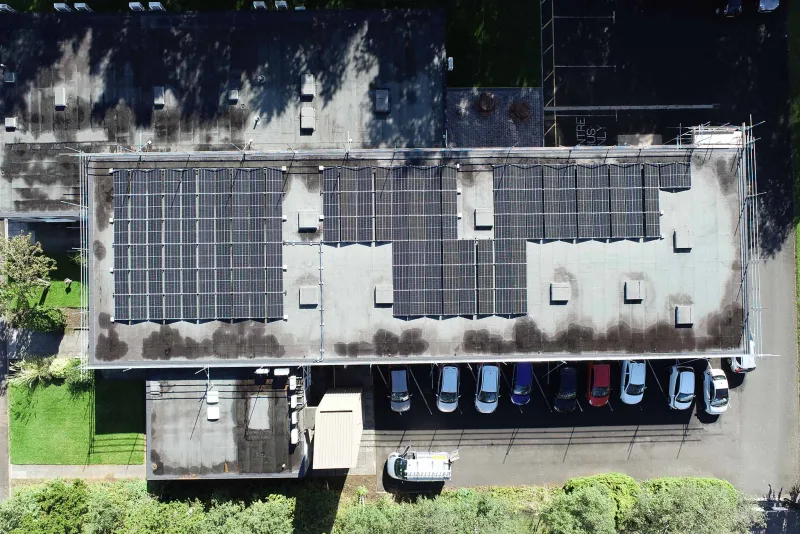
Long runs like these are where a dependable supply position is worth more than a headline efficiency figure.
LONGi runs two cell architectures in parallel. The TOPCon line is the volume answer for ordinary commercial roof runs, with a flatter temperature coefficient than the p-type cells it replaced and lower first-year degradation. The back-contact line moves both contacts to the rear of the cell, removing the front-side shading that busbars cost, and it is where the brand puts its highest efficiency.
The practical value of having both under one manufacturer shows up on a mixed site. A distribution shed with one clear plane and one plane broken by plant, rooflights and a parapet does not want two manufacturers, two warranty administrations and two sets of spares. It wants one maker with an answer for each.
Which series lands on your roof follows the survey rather than the catalogue, and the cell type, the bin and the temperature behaviour are read from the datasheet for the exact module. Our comparison of the cell technologies sets out what each one changes.
Vertical integration is often claimed and rarely explained. Here is what it does on a commercial project, and nothing beyond that.
The manufacturer is upstream of the shortage rather than downstream of it, so module lead time is seldom the item that moves a commissioning date.
A cell fault and a lamination fault are administered by the same company. There is no gap between a cell supplier and a laminator for a claim to fall into.
Moving a cell architecture into volume requires the wafer to change with it. Owning both is why this maker reached back-contact production ahead of most of the field.
A finance committee will find the loss before it finds anything else, so these are the three figures that put it in proportion.
The mainstream specification for a large array where the buyer wants a heavily stocked module behind a twenty-five-year asset. The TOPCon line covers ordinary roof runs; the back-contact line is where LONGi answers a constrained roof without leaving the brand.
Our registry holds no LONGi datasheet, so no wattage, efficiency or warranty term is published here; each is confirmed from the current sheet for the series and bin specified.
Datasheet figures only. We publish no price, and the exact model is confirmed against the design and the current datasheet before order.
LONGi is unusual among module makers because a large part of its revenue never becomes a module at all. It is the largest monocrystalline wafer manufacturer in the world, and it sells wafers to cell and module makers who then compete with it. A lender reading the accounts should understand that consequence directly: the business is exposed to silicon and wafer pricing across the whole industry, not only to demand for its own panels. That is why 2025 was a loss-making year on revenue above CNY 70bn, with the loss sharply narrowed against the year before, at the same time as its module shipments were joint first in the world.
The corresponding strength is the one that matters on a long asset. A company that owns the step before the cell is not waiting in the same queue as everyone else when supply tightens, and it is a single counterparty for a defect that could otherwise be argued between a cell supplier and a laminator. That is the shape of the financeability argument here, and it is a different shape from a maker that buys its wafers.
BloombergNEF Tier 1 lists LONGi for Q1 2026. We re-verify the listing for the exact module before contract.
LONGi is the module we specify when nothing about the roof argues for a specialist, and the buyer wants the least interesting supply story on the project.
It is the largest monocrystalline wafer manufacturer in the world, and it supplies wafers to cell and module makers across the industry, including competitors. For your project the useful consequences are supply continuity and a single manufacturer accountable for the cell and the laminate together. The corresponding exposure is that the group’s results move with silicon and wafer pricing rather than only with demand for its own panels.
It should be in the pack rather than decide the pack. The loss came on revenue above CNY 70bn and narrowed sharply against the previous year, and it reflects module prices falling across the sector. A Tier 1 listing measures financeability and industry acceptance rather than financial strength, which is exactly why we state the result alongside it. We confirm the manufacturer’s current standing before specifying.
We do not publish a figure, because the term is not held in our product registry and product and performance periods vary by series and production year. We confirm both in writing against the datasheet for the exact module specified, so the cover you rely on matches the panel actually installed rather than a brand-level headline.
It is widely stocked through UK distributors and specified on commercial and utility schemes here, so module availability is rarely what paces a programme. The items that usually set the critical path above 50 kWp are the survey, the design sign-off and the G99 connection with the network operator, and we start the connection application early rather than let it follow procurement.
A commercial array above 50 kWp sits outside MCS, which is a domestic scheme, so the assurance is engineered. We design and install to BS 7671, commission and verify to IEC 62446-1, agree the G99 connection with the network operator, carry the CDM 2015 duties through the works, and base the layout on a structural survey of the actual roof. Our quality without MCS guide documents how that stack is evidenced.
Last updated August 2026
Tell us about the roof and the load. We survey the site, model the array in PV*SOL against your half-hourly data, and specify what actually fits, with the manufacturer, the series and the warranty named. LONGi goes on the roof where it is the right answer and not because it is on a list.