
Skip to content
07944 877 329 hello@alectrona.solar

Alectrona

Manufacturers we specify

Fronius and the warranty term that shrinks as the inverter grows

Fronius has been family-owned in Austria since 1945 and builds its commercial inverters in the EU, which is the reason most specifiers reach for it. The detail that matters more above 50 kWp is the warranty. The free extension is ten years on units under 50 kW and five years on units of 50 kW and over, so the machines we would fit sit on the shorter term. We price the paid extension in at specification rather than leaving it.

  • Austrian-built, family-owned since 1945
  • Tauro ECO rated to +65C outdoors
  • Warranty term budgeted, not assumed
  • 1945 Founded in Pettenbach fourth-generation family ownership
  • Austria Where the commercial range is built
  • Three divisions Welding, battery charging, solar energy
  • Tauro ECO The commercial workhorse 50 kW and 100 kW, active-cooled

Fronius is the EU-provenance choice on our list, bought for outdoor-rated build quality and an owner that does not depend on solar revenue, with a warranty scheme that works against the sizes we install.

Fronius International GmbH was founded in Pettenbach, Upper Austria, in 1945 by Günter Fronius. It is now run by his granddaughter, the fourth generation of the family to hold it, and it still makes its inverters in Austria, which is why the brand keeps appearing in specifications that carry an EU-provenance clause. Above 50 kWp the range we draw on is led by the Tauro ECO at 50 kW and 100 kW.

The reason to read this page rather than the datasheet is the warranty scheme. It is generous and unusually well documented, and it runs in the opposite direction to what most buyers assume: the larger the inverter, the shorter the free extension. On a commercial job that puts every machine we would fit on the shorter term, and the answer is to price the extension in at specification rather than discover it in year six.

01 The range

What Fronius supplies for an array over 50 kWp

Inverters

Active-cooled outdoor three-phase inverters, with transformerless string platforms below them

Exposed rooftop and ground-mount duty where a passively cooled inverter would derate through a hot week, and roofs where a DC arc-fault interrupter is wanted inside the unit rather than added beside it.

  • Tauro ECO 50-3-D
  • Tauro ECO 100-3-D
  • Fronius Eco 27.0-3-S
  • Symo Advanced 20.0-3-M
  • Symo Advanced 12.5-3-M
  • Tauro ECO 50-3-D and 100-3-D: 50 kW and 100 kW three-phase, active-cooled, IP65, rated from -40 to +65C, 580 to 1000 V DC input
  • Tauro ECO efficiency: Up to 98.5% maximum and 98.2% European weighted, on a single MPP tracker
  • Symo Advanced 12.5 and 20 kW: Two MPP trackers, IP66, with an integrated Fronius Arc Guard arc-fault interrupter
  • Free warranty extension: To a total of 10 years under 50 kW and 5 years at 50 kW and over, on Solar.web registration within 30 months of delivery

The Tauro ECO 50 and 100 run a single MPP tracker, so a roof with several orientations needs the three-tracker standard Tauro or a different platform entirely.
Datasheet figures only. We publish no price, and the exact model is confirmed against the design and the current datasheet before order.

02 Bankability

A family firm that sells welders, and why that matters to your warranty

Fronius is a fourth-generation family firm, founded in 1945 and still privately held, and it is the one maker on our inverter list that does not depend on solar revenue to stay solvent. The group runs three divisions: welding technology, battery charging systems and solar energy. When European PV demand fell away in 2024, that spread is what kept the company independent while pure-play inverter makers were raising capital or being absorbed. For a committee asking who will still be there to honour a warranty in fifteen years, that is a more useful fact than a ranking.

It did not come through untouched. Fronius cut around 1,000 jobs across two rounds in 2024, roughly 350 announced in June and a further 650 in July, as installation volumes dropped and margins were squeezed; trade press reported the business stabilising through 2025. The honest read is a diversified private manufacturer that took a demand-driven restructuring and stayed independent, rather than either a maker in distress or one insulated from the cycle.

  • 1945 Founded in Austria four generations of the same family
  • Three divisions Welding, battery charging and solar revenue that does not all move together
  • 15 years Longest available warranty term paid extension, bought in the first six months
  • About 1,000 Jobs cut in the 2024 downturn across two rounds, June and July 2024
03 The warranty scheme

Four numbers that decide what the cover is actually worth

Fronius publishes its warranty scheme in full, which is to its credit. These are the four figures that matter on a commercial job, and not one of them happens automatically.

  • 10 years Free extension, units under 50 kW the Symo Advanced and the Eco
  • 5 years Free extension, units of 50 kW and over the Tauro ECO 50 and 100
  • 15 years Total cover with the paid extension bought within the first six months
  • 30 months Registration window from delivery on Fronius Solar.web
04 What that means here

The term shortens exactly where the machine gets expensive

Read the scheme once and the shape of it is obvious. A domestic or light-commercial Symo Advanced gets a free extension to a total of ten years. A Tauro ECO at 50 or 100 kW, the unit that actually goes on a building over 50 kWp, gets five. The larger the inverter, the more it costs to replace and the shorter the free cover, which is the reverse of what a buyer expects and the reason it is worth saying out loud on a page like this.

Three practical consequences follow, and we build all three into the specification rather than the small print. The registration is not automatic: the inverter has to go on Fronius Solar.web within thirty months of delivery, and units commissioned on or after 1 June 2026 must be registered to qualify at all, so we register at commissioning as part of handover. The paid extension to a total of fifteen years has to be bought within the first six months of the free period, so it is a decision at contract, not one you can revisit at year four. And on a twenty-five year appraisal there is still a replacement to think about, which we put in the model as a line rather than an assumption.

None of this is a reason to avoid Fronius. It is a reason to buy it with the numbers in front of you. We confirm the exact term and category for the specific model with the distributor before contract, then register and document it, so the cover runs from handover and someone can find the paperwork in eight years when it is needed.

05 Outdoor duty

Active cooling is the reason the Tauro sits outside IP65, rated from -40 to +65C

A passively cooled inverter sheds heat through its casing. On a dark membrane roof in a July heatwave, with the machine in full sun and no air movement, that gets difficult, and the unit protects itself by derating. It derates at precisely the hour the array is producing most, which is the worst possible time to lose output. The Tauro ECO is actively cooled and rated from -40 to +65C in an IP65 enclosure, so it is built to hold its rating in that condition rather than back off from it.

The second benefit is placement. A machine designed to live outdoors can go next to the array instead of consuming plant-room space at the other end of the building, which shortens the DC runs and reduces the cable and the voltage drop that goes with them. The cost is fans, which are a wear item and a serviceable part, so a Fronius scheme carries a genuine inspection line rather than a sealed box that is either working or not.

How we plan inspection and maintenance
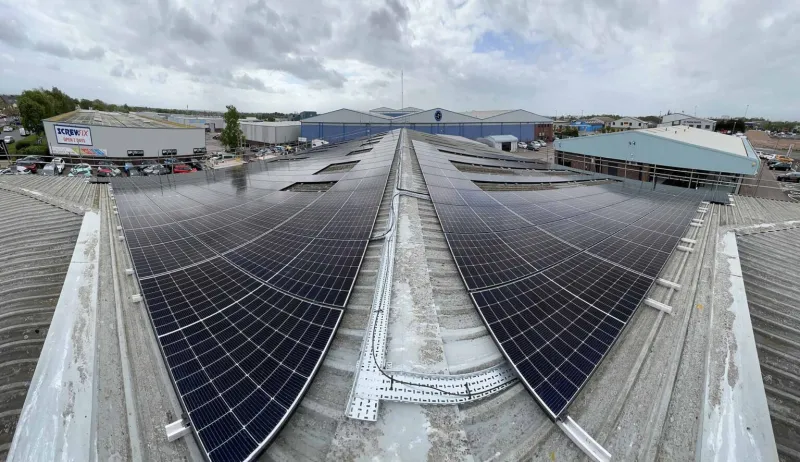
Commercial rooftop array in full sun, the duty an active-cooled outdoor inverter is built for

The hour a passively cooled inverter derates is the hour the array produces most.

Foundedin1945.Heldbythesamefamilyintothefourthgeneration.

Welding,batterycharging,solar.Threedivisions,soonebadPVyearisnotthewholecompany.

Awarrantyisonlyasgoodasthefirmstillstandingbehinditinyearfifteen.

Fronius is specified on provenance and on outdoor duty. It is not the cheapest inverter on a commercial roof and it does not carry the strongest bankability standing, so the case has to be made on the array in front of us.

07 Honest placement

Where a Fronius machine is the right answer

Specify

Where it fits

  • Exposed or hot plant positions, where the active-cooled Tauro ECO holds its rating instead of derating
  • Schemes carrying an EU-provenance requirement in the specification or the procurement policy
  • Long uniform string runs on rooftop or ground-mount, which suit the single-tracker Tauro ECO
  • Roofs where an integrated arc-fault interrupter is wanted, which the Symo Advanced carries as standard
Specify something else

Where it does not

  • Roofs broken across several orientations, where a single-tracker Tauro would average the yield away
  • Schemes where the funder wants the maker leading the inverter bankability survey
  • Budgets that will not carry the paid warranty extension, because the free term at this size is five years
  • Sites wanting storage behind the same unit, which the commercial Fronius range does not offer
08 FAQ

Fronius on a commercial roof: common questions

That is how the scheme is written, and it is the single most important thing to know about Fronius on a commercial job. Registering on Fronius Solar.web within thirty months of delivery gives a free extension whose length depends on the size of the unit: to a total of ten years for inverters under 50 kW, such as the Symo Advanced and the Eco, and five years for inverters of 50 kW and over, such as the Tauro ECO 50 and 100. A paid extension takes the cover to a total of fifteen years if it is bought within the first six months of the free period.

Since this site only builds above 50 kWp, the machines we would fit are the ones on the shorter free term. We treat the paid extension as part of the capital decision rather than an afterthought, confirm the exact term and category with the distributor before contract, and register at commissioning so the cover runs from handover.

We will not gloss over it. During the 2024 European PV downturn, as installations fell and margins were squeezed, Fronius cut around 1,000 jobs across two rounds, about 350 announced in June 2024 and a further 650 in July. We flag it plainly because it shows the firm is not immune to the market cycle.

The wider picture is that Fronius stayed financially independent through it, with welding technology and battery charging providing revenue that pure-play inverter makers do not have, and trade press reported the business stabilising through 2025. We treat it as a diversified family firm that weathered a demand-driven restructuring, not a maker in distress. Where the standing of the manufacturer is a condition of your funding, we confirm the position for the specific model before contract.

The commercial lead is the Tauro ECO outdoor range at 50 kW and 100 kW: three-phase, active-cooled, IP65 and rated from -40 to +65C, built for exposed rooftop and ground-mount duty. Below it the Eco three-phase units at 25 and 27 kW give a transformerless platform for building a larger array from several machines, and the Symo Advanced at 12.5 and 20 kW add a second MPP tracker and the integrated Arc Guard arc-fault interrupter. The model, the count and the DC-to-AC ratio come from the PV*SOL design for your roof, and we confirm the SKU the UK distributor supplies, including which Tauro connection variant, before we quote.

We do not publish inverter prices, and the honest answer is that provenance is one input among several. What actually moves the figure on a Fronius scheme is how many machines the roof needs once the tracker limitation is respected, whether the design lands on the Tauro ECO or a smaller platform used in multiples, which warranty extension is bought, and the switchgear and connection work the site requires. Where a specification carries an EU-provenance requirement, that constraint is set before the pricing rather than after it. We model the array first and price the installed system from the design.

We position Fronius on provenance and independence rather than a bankability badge. It does not lead the BloombergNEF Inverter Bankability Survey; Sungrow holds that position, so we make no bankability-leader claim for Fronius. What we can state is that it is a financially independent, family-owned Austrian manufacturer founded in 1945, diversified across welding, battery charging and solar, with EU manufacturing and a UK operation. That independence is a real contrast to loss-making single-product inverter makers, and it is the basis on which we specify it, confirmed for the exact model before contract.

Get a commercial quote

The equipment is chosen to fit the design, not the other way round.

Tell us about the roof and the load. We survey the site, model the array in PV*SOL against your half-hourly data, and specify what actually fits, with the manufacturer, the series and the warranty named. Fronius goes on the roof where it is the right answer and not because it is on a list.

  • On-site 3D drone survey and half-hourly PV*SOL model
  • We confirm your DNO and handle the G99 connection
  • Over 50 kWp, outside MCS