
Skip to content
07944 877 329 hello@alectrona.solar

Alectrona

Manufacturers we specify

SMA and the plant control a constrained connection needs

SMA has built inverters at Niestetal since 1981, and its Sunny Tripower line put the first free-standing string inverter on a commercial roof. We reach for it when a large connection carries firm grid conditions, because its export-limitation and plant-control stack is the deepest of the makers we supply. It is also the maker on this list carrying a live restructuring, and that is on the page rather than in a footnote.

  • German-built, continuously since 1981
  • ArcFix and ShadeFix inside the inverter
  • Restructuring stated, not skirted
  • 1981 Making inverters at Niestetal since Germany
  • Germany Where the commercial range is built
  • 12 MPP trackers On the Sunny Tripower 125 across 24 string inputs
  • Inverters What SMA supplies to us no modules, no storage on this range

SMA is the plant-control specialist on our inverter list, chosen for grid-side depth on a constrained connection rather than for the strength of its balance sheet.

SMA Solar Technology AG has made inverters in Niestetal, near Kassel, since 1981. Its Sunny Tripower line introduced the free-standing string inverter, a machine built to stand on its own feet on a deck or a plant-room floor rather than hang off a wall, and the commercial range runs from 50 kW up to 125 kW string inverters, then on into 1500 V ground-mount platforms and central stations.

We specify it for one reason above the others. On a large UK connection the grid-side conditions decide what the site is permitted to do, and SMA gives the deepest active and reactive power control, export limitation and grid-code compliance of the makers we supply. That is an engineering case. We hold it separate from the company finances, which are set out on this page rather than left off it.

01 The free-standing design

An inverter that stands on the deck rather than hangs on a wall The CORE line, and what it changes about the install

Most commercial string inverters are wall-mounted. That is fine until the only suitable wall is at the far end of the building from the array, or the plant room is already full, or the wall build-up will not take the point load of a bracket and a machine. SMA's CORE design was the first free-standing string inverter: it stands on its own feet on a flat surface, so it can be placed where the DC runs are shortest instead of where a wall happens to be.

On a refurbishment that is a practical saving. Shorter DC runs mean less cable, fewer roof penetrations and less voltage drop across the array, and a machine that stands on the deck arrives in the same crane movement as the ballast. The current free-standing flagship is the Sunny Tripower 125 at 125 kW, with 12 MPP trackers across 24 string inputs, which lets a roof broken across four or five orientations be grouped honestly rather than averaged into one operating point.

String or central, and how we choose
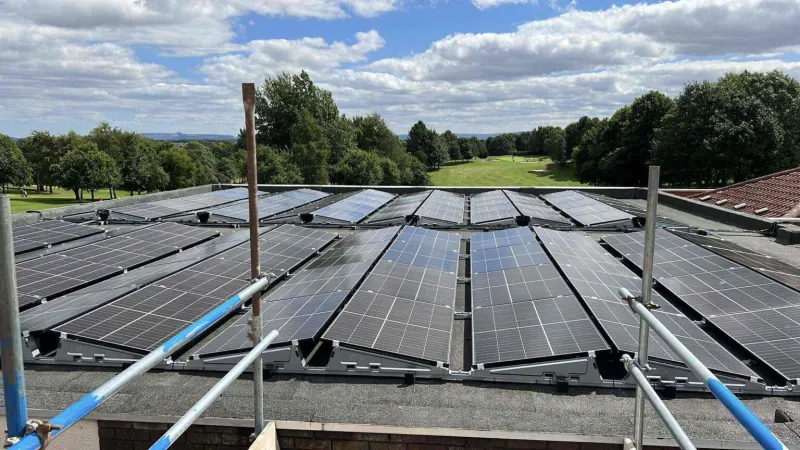
Commercial rooftop array of the kind an SMA free-standing inverter is placed on

Placement follows the DC runs when the inverter does not need a wall.

02 Twelve trackers or one

The MPPT count is a roof decision, not a power decision

SMA sells two different answers at overlapping power ratings. The choice between them is made by how uniform the strings are, not by how large the array is.

Broken roofs

Sunny Tripower, many trackers

The free-standing CORE1 and the 125 carry six and twelve MPP trackers. Each tracker finds its own operating point, so a pitch in shade for two hours a day does not drag the rest of the array down with it.

  • CORE1 at 50 kW: 6 trackers across 12 string inputs
  • Sunny Tripower 125 at 125 kW: 12 trackers across 24 string inputs
  • ShadeFix recovers yield at string level, with no device on each module
  • Integrated arc-fault protection in both

The right answer where the roof has north lights, plant decks, several pitches or a shaded corner.

Uniform arrays

Sunny Highpower PEAK3, one tracker

A single-MPPT machine on a 1500 V DC architecture. With uniform strings there is nothing for extra trackers to do, and the simpler conversion path is where the 99.1% peak efficiency comes from.

  • SHP 150-20 at 150 kW on 1500 V DC, up to 99.1% peak efficiency
  • SHP 100-20 at 100 kW on 1000 V DC, the same design at lower system voltage
  • Chosen by site DC voltage rather than by array size
  • Fits Integrated Plant Control and the SMA Data Manager

Wrong for a complex roof: one tracker means the weakest string sets the operating point for all of them.

Both are confirmed against the datasheet issued for the exact model before contract. SMA revises the commercial range, and the CORE2 is already end of sale.

03 Grid-side control

Export limitation is where the plant controller earns its keep

On a site over 50 kWp the connection offer usually carries conditions, and increasingly those conditions include a firm export limit. Holding that limit is easy to promise and harder to evidence. SMA's answer runs through three layers: ennexOS as the underlying energy-management platform, the SMA Data Manager M as the gateway that commissions and monitors an inverter fleet centrally, and the SMA Power Plant Controller for active and reactive power control, export limitation and grid-code compliance across Sunny Highpower and Sunny Central plants.

What that buys is not more features. It is that the constraint is enforced and recorded at plant level rather than inferred from inverter behaviour, so when the DNO or a technical adviser asks how the limit is held, there is a configuration to show them and a log to back it. Where a connection carries a firm limit we configure dynamic export control to G100 so the site keeps its own generation for its own load instead of curtailing, and we document the settings as part of the handover pack.

The inverters expose SMA Modbus, SunSpec Modbus, Speedwire and Webconnect, so the plant sits inside a wider monitoring platform or a building management system without a translation layer. SMA Smart Connected, a proactive fault-detection service, comes with the commercial inverters. Every unit is commissioned to BS 7671, verified to IEC 62446-1 and registered under G99 with the network operator before energisation.

04 On the datasheet

Four figures we hold SMA to

These come from the issued SMA datasheets and are confirmable. We check them again for the exact model before contract, because the commercial range turns over.

  • 24 String inputs on the Sunny Tripower 125 across 12 MPP trackers
  • 99.1% Peak efficiency, Sunny Highpower SHP 150-20 98.8% European weighted
  • 1500 V DC architecture on the Sunny Highpower range the SHP 100-20 is the 1000 V sibling
  • IP65 Enclosure rating across the commercial string range
06 The range

The SMA range we would actually put on a commercial roof

Inverters

Free-standing three-phase string inverters, and 1500 V platforms for ground-mount

Large multi-pitch commercial roofs where strings have to be grouped across several orientations and shading zones, and uniform ground-mount where a single-tracker 1500 V machine is the cleaner build.

  • Sunny Tripower CORE1 (STP 50-41)
  • Sunny Tripower 125 (STP 125-70)
  • Sunny Highpower PEAK3 (SHP 100-20)
  • Sunny Highpower PEAK3 (SHP 150-20)
  • Sunny Central UP
  • Sunny Tripower 125: 125 kW, 12 MPP trackers across 24 string inputs, up to 98.4% peak and 98.1% European efficiency, 1100 V DC, IP65
  • Sunny Tripower CORE1: 50 kW free-standing, 6 MPP trackers across 12 string inputs, 1000 V DC, IP65, with integrated arc-fault protection and ShadeFix
  • Sunny Highpower PEAK3 SHP 150-20: 150 kW, single MPP tracker, 1500 V DC, up to 99.1% peak and 98.8% European efficiency, IP65
  • Standard warranty: 5 years on the string range, extendable to a total of 10, 15 or 20 years through SMA extension plans

The Sunny Highpower units run a single MPP tracker, so they suit long uniform strings and are the wrong machine for a roof broken across orientations.

Datasheet figures only. We publish no price, and the exact model is confirmed against the design and the current datasheet before order.

07 Bankability

What the restructuring means for a warranty you need in year fifteen

SMA has made inverters at Niestetal since 1981 and is one of very few non-Chinese manufacturers still carrying a full commercial and utility range. That longevity is real. So is the fact that the company is midway through a multi-year restructuring. For FY2025 it reported revenue roughly flat at about EUR 1.52bn and a net loss of about EUR 181m, against about EUR 118m the year before. EBITDA before one-time items stayed positive at about EUR 107m; once inventory write-downs, purchase-obligation provisions and restructuring charges are counted it fell to about minus EUR 65m.

The distinction that decides whether this matters to your scheme is which part of SMA the equipment comes from. The pressure sits in the residential and smaller commercial division, under price competition from Asian makers. Large Scale and Project Solutions, which is exactly the Sunny Tripower and Sunny Highpower range on this page, grew its revenue in 2025. Before we put SMA into a specification we confirm in writing how the warranty is backed and how UK spares and support are arranged, and where a more settled maker suits the roof equally well we say so.

  • 1981 Continuous inverter manufacture Niestetal, near Kassel
  • 5 years Standard string-inverter warranty extendable to a total of 10, 15 or 20 years
  • EUR 1.52bn FY2025 revenue roughly flat year on year
  • Grew in 2025 Large Scale and Project Solutions revenue the division this range sits in

SMA is a considered choice rather than a default. The case for it is grid-side depth and German engineering. The case against it is capital cost and a balance sheet under repair.

08 Honest placement

Where SMA earns the extra, and where it does not

Specify

Where it fits

  • Large connections where the DNO sets a firm export limit and the settings have to be auditable afterwards
  • Multi-pitch or partly shaded roofs, where ShadeFix recovers yield at string level without electronics on every module
  • Uniform ground-mount on a 1500 V DC architecture, where the Sunny Highpower single-tracker design is the simpler build
  • Sites that want DC arc-fault protection inside the inverter rather than added as a separate device
Specify something else

Where it does not

  • A single-orientation roof that a simpler three-phase string inverter serves just as well for less capital
  • Schemes where the funder requires the maker that leads the inverter bankability survey, which SMA does not
  • Sites that want storage behind the same box, which this commercial range does not provide
  • Budgets that cannot carry the warranty extension, because the standard term here is five years
09 FAQ

SMA on a commercial roof: common questions

We will not gloss over it. SMA reported FY2025 revenue roughly flat at about EUR 1.52bn with a widened net loss of about EUR 181m, against about EUR 118m in 2024. EBITDA before one-time items stayed positive at about EUR 107m, but including one-time items it fell to about minus EUR 65m on inventory write-downs, provisions and restructuring charges, and the company is running a multi-year transformation programme with one-time charges of roughly EUR 170m to 220m and announced job cuts.

The mitigant we state alongside it: the division this page concerns, Large Scale and Project Solutions, grew its revenue in 2025 and is the healthier part of the business, and SMA remains a long-established German manufacturer. Before we specify it we confirm in writing how the warranty is backed and how UK support and spares are arranged. If a more settled maker suits your roof just as well, we will say so.

It addresses the same problem from a different place. ShadeFix runs in the inverter and repeatedly sweeps for the true global maximum power point on each string, so a shaded run is worked around rather than allowed to sit at a false local peak. There is no electronics on the module and nothing extra on the roof to fail or to be replaced at height.

The trade-off is granularity. Module-level electronics can recover more where shading is severe and highly localised, such as a dense forest of vent stacks, and they give per-module monitoring that string-level optimisation cannot. Where the shading is that bad we would look at an architecture built around it instead. On the more common commercial case, a few hours of edge shading on part of a large roof, ShadeFix does the job without adding several hundred devices to the maintenance schedule.

The free-standing Sunny Tripower range leads: the 50 kW CORE1 with six MPP trackers across twelve string inputs, and the 125 kW Sunny Tripower 125 with twelve trackers across twenty-four string inputs for large multi-pitch roofs. For uniform ground-mount we step to the Sunny Highpower PEAK3, the 150 kW SHP 150-20 on a 1500 V architecture or the 100 kW SHP 100-20 at 1000 V, both single-tracker designs picked by site DC voltage. Utility plants use Sunny Central stations with the SMA Power Plant Controller. The exact model and count come out of the PV*SOL design for your site rather than a catalogue line.

It handles the grid-side conditions the network operator imposes. The Data Manager gives centralised commissioning and monitoring across the inverter fleet; the Power Plant Controller adds active and reactive power control, export limitation and grid-code compliance across Sunny Highpower and Sunny Central plants. Where the connection carries a firm export limit, dynamic export control holds the agreed limit without curtailing what the building itself is using, and the settings are documented so the constraint can be audited later. That depth is the main reason we reach for SMA on a large connection rather than a simpler string platform.

We do not publish an inverter price, and a per-unit figure would mislead you anyway. What moves the number on an SMA scheme is the tracker count you actually need, whether the design lands on a free-standing Sunny Tripower or a single-tracker Sunny Highpower, whether the plant-control layer is required by the connection conditions, and which warranty extension is bought. Those are design outputs. We model the array in PV*SOL from the survey, specify the inverter that fits, and price the installed system with the model and the warranty term named.

Get a commercial quote

The equipment is chosen to fit the design, not the other way round.

Tell us about the roof and the load. We survey the site, model the array in PV*SOL against your half-hourly data, and specify what actually fits, with the manufacturer, the series and the warranty named. SMA goes on the roof where it is the right answer and not because it is on a list.

  • On-site 3D drone survey and half-hourly PV*SOL model
  • We confirm your DNO and handle the G99 connection
  • Over 50 kWp, outside MCS