

Skip to content
07944 877 329 hello@alectrona.solar

Alectrona

Manufacturers we specify

Solplanet on a commercial roof: string inverters to 110 kW, storage from elsewhere

We specify Solplanet's ASW LT string inverters, 50 to 110 kW, for PV-only commercial roofs, with up to ten trackers on the larger machines, and put the battery with a maker whose commercial storage we support. Solplanet is the overseas brand of AISWEI Technology of Shanghai, the former Zeversolar business and a residential-led inverter maker.

  • ASW LT, 50 to 110 kW
  • Up to ten MPP trackers
  • Warranty registered and claimed by us
  • AISWEI Maker formerly Zeversolar, SMA-owned from 2013 to 2019
  • 50 to 110 kW The commercial units we specify
  • Ten MPP trackers on the 100 and 110 kW units
  • Inverters only What we specify from it at this scale storage comes from another maker

A residential-led string maker whose 50 to 110 kW machines suit PV-only commercial roofs with several faces, paired with storage from another maker.

Most of Solplanet's range is for houses: string and hybrid inverters, single- and three-phase, and the batteries that go with them. Its commercial line is mainly three-phase string inverters, with an all-in-one storage cabinet added in 2025, and the part of it we specify is four machines, the ASW50K-LT-G3 and the ASW80K, 100K and 110K-LT. We fit Solplanet at home too, and our residential Solplanet page covers that side.

On a commercial roof the case for these inverters is tracker count and a straightforward PV-only design.

01 The range

Four machines, one voltage class, no battery input

Inverters

Three-phase string inverters for PV-only commercial roofs

Grid-tie string inverters sized for a commercial array broken into blocks of 50 to 110 kW, each block on its own machine. They take no battery, so a Solplanet commercial roof is a PV roof, and any storage on the site is coupled on the AC side from a different maker.

  • ASW50K-LT-G3
  • ASW80K-LT
  • ASW100K-LT
  • ASW110K-LT
  • MPP trackers: Five on the 50 kW, eight on the 80 kW, ten on the 100 and 110 kW
  • Maximum DC voltage: 1,100 V
  • Apparent power, 80 to 110 kW: 110% of rating: 88, 110 and 121 kVA
  • Maximum PV array: 150% of the AC rating
  • Peak efficiency: 98.6%

The current edition of G99 defines full type testing only for units of 50 kW or less, so the 80 to 110 kW units connect on a partial type test plus site evidence; the 50 kW LT-G3 sits at that ceiling and is fully type tested.
Datasheet figures only. We publish no price, and the exact model is confirmed against the design and the current datasheet before order.

02 Bankability

A warranty written in Shanghai, claimed through us in the UK

A finance committee weighing Solplanet should start with the warranty route. Solplanet has no UK-registered company. The factory warranty is written by AISWEI Technology in Shanghai, the standard term depends on the purchase contract, and the terms cover equipment bought from AISWEI or one of its authorised distributors. The current inverter terms pay on-site travel, duties and taxes in Australia, the EU and India, and do not name the UK. So we buy it through Solplanet's authorised UK distribution, get the term for the exact model in writing before order, and run any claim ourselves for as long as that warranty runs.

AISWEI's legal entity was incorporated in 2009, traded as Zeversolar from 2011, and was bought by SMA in stages from 2013 until it was wholly owned in 2016. Its management bought it out of SMA in 2019 and launched Solplanet as the overseas brand the following year. Everything is built at one plant in Yangzhong, in Jiangsu province, and the company reports more than 70 GW of inverters shipped by the end of 2025. Wood Mackenzie placed it sixth in its 2024 global PV inverter shipment ranking and ninth, with a grade A, in its scored manufacturer ranking for the first half of 2025.

  • 2009 Legal entity incorporated traded as Zeversolar, SMA-owned from 2013 to 2019
  • 70 GW Cumulative inverter shipments the company's own figure to the end of 2025
  • Ninth Wood Mackenzie scored ranking, first half of 2025 grade A; we do not treat it as a bankability placing
  • One plant Manufacturing base Yangzhong, Jiangsu province
03 Datasheet

What the 100 kW LT machine carries

These are the figures that decide how many machines a roof needs and how the strings are drawn. They are taken from the ASW LT 75 to 110 kW datasheet and manual.

  • Ten MPP trackers 32 A each, 48 A short-circuit
  • 1,100 V Maximum DC voltage standby between 950 and 1,100 V
  • 110 kVA Maximum apparent power 110% of the 100 kW rating
  • 150 kWp Largest array on one unit 150% of the AC rating
04 String design

Drawing strings to the window the LT runs in The DC limit is 1,100 V, but the useful ceiling sits lower, and in two cases lower again.

The 80, 100 and 110 kW LT machines accept up to 1,100 V on their DC input, but they stand by rather than generate between 950 and 1,100 V. A string designed close to the limit therefore stays in standby on a cold, bright morning until the modules warm and its voltage falls, so we size strings to stay below 950 V at the coldest module temperature the site will see. The 50 kW LT-G3 tracks between 200 and 1,000 V, so its strings are sized to that window instead.

Two site conditions pull the ceiling down further on the 80 to 110 kW units. Where there is a capacitor bank on the site, or where the connection is zero export, their datasheet requires the DC input to stay at or below 850 V. Both are common on commercial sites, and both change the string length, so they are settled at survey before a module count is fixed.

With ten trackers on the 100 and 110 kW units, each face of a split roof gets its own maximum power point. Each tracker takes two strings in parallel at up to 32 A, so the two strings on one tracker need to share a face and a module count. A roof shaded in patches needs module-level electronics, which is a different specification.

G100 export limitation explained
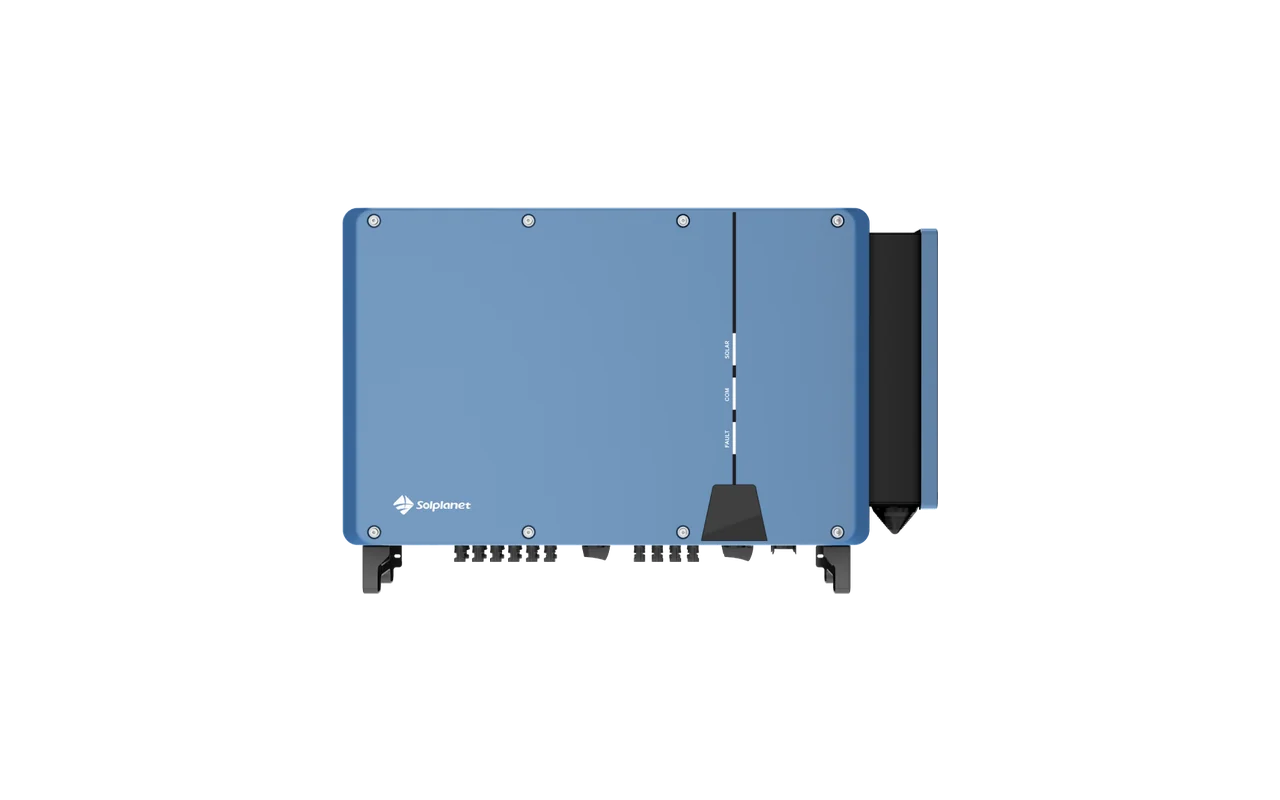
Solplanet ASW LT three-phase string inverter, the 80 to 110 kW chassis

The ASW LT 80 to 110 kW chassis. The 100 and 110 kW models carry ten trackers.

06 How we specify it

Four checks before a Solplanet inverter goes on the drawing

  1. Supply

    Authorised distribution, term in writing

    The factory terms cover equipment bought from AISWEI or an authorised distributor, so we buy Solplanet through its authorised UK distribution. The term varies with the purchase contract, so we confirm it in writing before order.

  2. G99

    Build the connection case

    ENA references for every unit, the site evidence the partial type test on the 80 to 110 kW models calls for, and the connection sized on apparent power.

  3. Export

    Settle export control across the plant

    Plant-level export control on the LT range runs through Solplanet's Ai-Logger 1000, which manages up to 80 devices with zero export built in, set against the limit in the connection offer.

  4. Protection

    Check earthing and residual current

    Where an external RCD is required it is Type A, 300 mA or more, and on a TT supply the manual for the 80 to 110 kW units requires the neutral-to-earth voltage to be under 20 V.

TheinverterisaPVdecision.Thebatteryisaseparateone,madewithadifferentmaker.

Tentrackersononemachine,andeachfaceoftheroofonitsown.

Wherethewarrantyiswrittendecideswherewebuy.

07 Storage

Where the battery comes from on a Solplanet roof

The LT inverters take no battery, so storage on a Solplanet site is AC-coupled from another maker.

Not specified

Solplanet's own all-in-one cabinet

Solplanet builds an all-in-one commercial cabinet, the ASW 125K/261-PT, but we have found no UK route for it and cannot support it here today.

We will look again if a UK route, a register entry and UK warranty terms appear.

Storage is sized against half-hourly consumption before a maker is named, and the export limit is set once for the inverters and the battery together.

08 Honest placement

Where a Solplanet string inverter earns the roof

Specify

Where it fits

  • PV-only commercial roofs that divide into blocks of 50 to 110 kW, each on its own machine.
  • Roofs split across several orientations, where ten trackers on one 100 or 110 kW unit keep each face on its own maximum power point.
  • Sites whose battery is AC-coupled from a maker we already specify, so the inverter and the storage are separate decisions.
Specify something else

Where it does not

  • A single-vendor PV and storage package. We have found no UK route for Solplanet commercial storage.
  • Plants that want one machine above 110 kW. The 125 kW LT is not on the ENA register, and the 250 to 360 kW HT needs its own 800 V transformer.
  • Financed schemes whose funder wants a present-day bankability placing on the inverter. We hold none for Solplanet, and its case rests on warranty terms that do not name the UK for on-site costs.
  • Estates whose procurement rules require the inverter maker to have a UK-registered company behind the warranty.
09 FAQ

Solplanet on a commercial roof: common questions

There is no published price. The number of machines, the string design and the storage all come out of the survey and a half-hourly PV*SOL model of your site, so a box price would not describe your scheme. The proposal names every model and quotes one figure for one scope.

Plan on a few months, because the G99 connection usually sets the pace: on a sub-1 MW commercial site the connection offer commonly arrives eight to sixteen weeks after a complete application, later where the network is constrained, and any network works follow it. We lodge it early, with the extra evidence the larger units need. Inverter lead time is confirmed when the design is fixed, and a dated programme follows the survey.

Not through any UK route we have found. Solplanet makes an all-in-one commercial cabinet, but it is not on the company's GB product range, it has no entry on the ENA Type Test Register, and its warranty pays on-site costs in Australia, the EU and India only. On a Solplanet roof we therefore specify the inverters for the PV and AC-couple a commercial battery from one of the storage makers we already support, sized to your half-hourly load.

It means the ENA register holds part of the G99 Type A compliance case for the ASW80K, 100K and 110K-LT, and the rest goes in with the connection application and is demonstrated at commissioning. Under the current edition of G99, full type testing stops at 50 kW, and the ASW50K-LT-G3, at exactly 50 kW, holds it. We size the site on the 110% apparent-power figures.

The factory warranty is given by AISWEI Technology Co., Ltd. in Shanghai, as Solplanet has no UK-registered company. It covers kit bought from AISWEI or a distributor it authorises, which is why we buy through Solplanet's authorised UK distribution, and its current inverter terms name Australia, the EU and India for on-site travel and duties but not the UK. We confirm the term for the exact model in writing before order, register it at commissioning, and run any claim ourselves.

Yes, with the right controller. Solplanet's plant-level export control for the LT range is the Ai-Logger 1000, which manages up to 80 devices and has zero-export control built in, set against the limit in the G99 connection offer. We set it up and prove it at commissioning.

Get a commercial quote

The equipment is chosen to fit the design, not the other way round.

Tell us about the roof and the load. We survey the site, model the array in PV*SOL against your half-hourly data, and specify what actually fits, with the manufacturer, the series and the warranty named. Solplanet goes on the roof where it is the right answer and not because it is on a list.

  • On-site 3D drone survey and half-hourly PV*SOL model
  • We confirm your DNO and handle the G99 connection
  • Over 50 kWp, outside MCS