
Skip to content
07944 877 329 hello@alectrona.solar

Alectrona

Manufacturers we specify

Aiko Solar and the case for back-contact cells on a tight roof

Aiko supplies N-type ABC modules, the back-contact cell it mass-produces itself, at 24.6% module efficiency on the panel we specify. It writes a 15-year product warranty where most of the market writes 12. It is a young module brand built on long cell-making heritage, and its standing on the bankability lists is recent, so we re-verify it for the exact module before contract.

  • N-type ABC back-contact
  • 15-year product warranty
  • Over 50 kWp, outside MCS
  • 2009 Founded as a merchant solar-cell supplier
  • SSE 600732 Public listing Shanghai Stock Exchange
  • China Where the modules are made
  • 14.7 GW ABC modules shipped in 2025 about 0.7 GW two years earlier

The most output per square metre we can buy from a listed maker, on a cell architecture only Aiko mass-produces.

Aiko spent its first decade as a merchant cell maker, selling cells into other people’s module brands, and only became a module brand itself in the last few years. That order of events explains the company. The cell is the product; the laminate is the wrapper it travels in.

What it now sells is an All Back Contact cell, with both electrical contacts moved to the rear of the wafer. We specify it on commercial roofs that run out of area before they run out of budget, and we say so when a roof is not one of those.

01 Cell architecture

Both contacts moved to the back of the cell What that buys, and what it costs to make.

A conventional solar cell carries its front-side current on metal fingers and busbars printed across the face of the wafer. That metal is opaque. It shades the cell it is collecting from, and across a large-format module the loss is measurable. Back contact moves both polarities to the rear, so the front face is uninterrupted silicon and all of it is working.

The gain is not free. Interdigitating both contacts on the back of a wafer is a harder process than printing fingers on the front, it has fewer equipment suppliers behind it, and the finished cell is not electrically interchangeable with a TOPCon one. Aiko carries that cost because the cell has always been its product rather than a component it buys in.

Two consequences show up on a working roof rather than on a datasheet. Shade behaves differently: a back-contact cell handles partial shading at cell level, so a shadow thrown by a vent stack costs less generation than the same shadow across a conventional string. And the module gives back less in heat, with a temperature coefficient of -0.26%/°C, a shallower curve than most TOPCon modules hold, on the July afternoons when a commercial load is usually at its highest. Our guide to TOPCon, HJT and PERC sets the cell types side by side.

02 The datasheet

What the architecture is worth on the 665 W module

Figures read from the Stellar 3N+ datasheet and re-confirmed for the exact SKU before order.

  • 24.6% Module efficiency the wider series is rated to 25.5%
  • -0.26%/°C Temperature coefficient a shallower curve than most TOPCon modules
  • 1134 x 2382 Module size in millimetres 665 W across roughly 2.7 square metres
04 What it changes on site

Fewer modules, less mounting, less dead load per kilowatt

A 665 W module covers roughly 2.7 square metres. Reaching a given output with fewer, higher-output modules means fewer clamps, fewer rail metres, fewer cable runs and, where the mounting is fixed rather than ballasted, fewer places where the roof covering is interrupted. That last point is usually the one the building owner cares about, because every penetration is a detail somebody has to stand behind.

It also changes the structural conversation. Dead load per kilowatt falls when the same generation arrives on fewer modules and less steel, which can be the difference between a roof that takes the array as drawn and one that needs the layout thinned. We put that to the structural engineer rather than assuming it, and the array is sized to the answer.

How much roof space an array needs
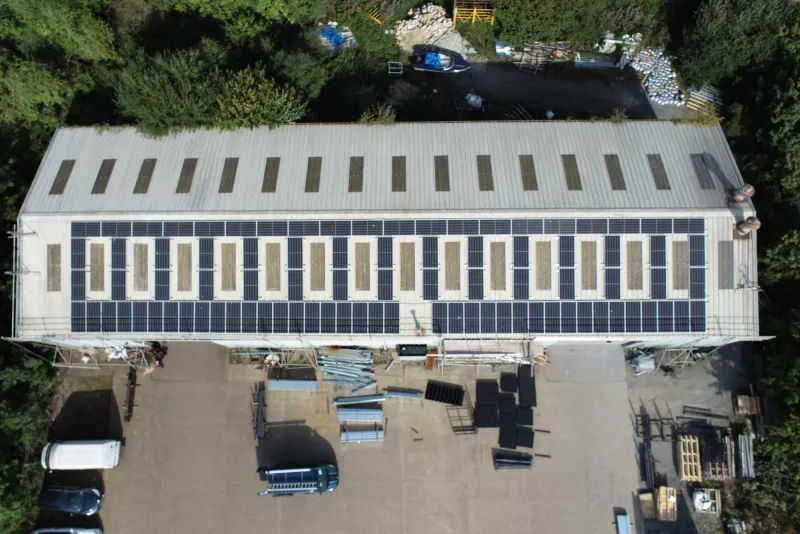
A commercial rooftop solar array over long roof runs

Module count, rail metres and dead load all follow from the watts per module.

Efficiencyisonlyworthpayingforwhentheroofistheconstraint.

Onabigemptydeckitbuysnothingyoucannotbuycheaper.

Sowemeasuretherooffirst,thenchoosethecell.

05 The range

One product line, and the cell inside it is the whole argument

Solar modules

N-type ABC back-contact dual-glass modules

The module we reach for when the roof, rather than the budget, sets the size of the array. It puts more kilowatts on a fixed area than anything else we can buy from a listed maker.

  • Stellar 3N+ AIK-A-MDE72-665-SF-DG-01C
  • Stellar 3N+ 72-cell ABC dual-glass series
  • Module efficiency: 24.6% on the 665 W panel, series rated to 25.5%
  • Temperature coefficient: -0.26%/°C
  • Format: 1134 x 2382 mm, 72-cell, 1500 V
  • Warranty: 15-year product, 30-year performance

ABC is Aiko’s own cell architecture, so a like-for-like replacement module in year twelve can only come from Aiko.

Datasheet figures only. We publish no price, and the exact model is confirmed against the design and the current datasheet before order.

06 Bankability

A long cell record and a short module record, in one company

Aiko is a listed company on the Shanghai Stock Exchange under 600732, with fifteen years of cell manufacturing behind it. That is the part of the record a lender can actually test, and it predates the module brand by a decade. The module business is much younger: ABC shipments went from roughly 0.7 GW in 2023 to 6.3 GW in 2024 and 14.7 GW in 2025, which is a steep ramp rather than a long trading history.

So the question for a finance committee is not whether the company still exists in ten years. It is whether the ABC line is still in production when a module fails, because no other manufacturer makes an equivalent one. Our reading is that a maker who has staked its entire module strategy on a single architecture has little reason to walk away from it, and we present that as a judgement rather than as a credential.

BloombergNEF Tier 1 lists Aiko Solar for added Q3 2024, present Q1 2026. We re-verify the listing for the exact module before contract.

  • 15 years Product warranty on the module we specify against a market norm of 12
  • 14.7 GW ABC modules shipped in 2025 from about 0.7 GW in 2023
  • SSE 600732 Listed on the Shanghai Stock Exchange accounts are published
  • 2026 Kiwa PVEL Top Performer independent stress testing, not a paper rating

This decision is arithmetic before it is preference. We take the usable area from the drone survey, subtract the plant, the walkways and the setbacks, then work out how many kilowatts the remainder carries at each candidate module’s efficiency. Aiko earns its place when that number comes up short of the target.

07 Honest placement

When the extra efficiency is worth paying for, and when it is not

Specify

Where it fits

  • Roofs where plant, rooflights and setbacks cap the panel count below the output the building needs
  • Buildings with a summer-peaked load, where a -0.26%/°C coefficient holds output through the hottest hours
  • Arrays broken up by vents and parapets, where cell-level shade tolerance limits what one shadow costs
  • Fixed rather than ballasted mounting, where fewer modules means fewer interruptions to the roof covering
Specify something else

Where it does not

  • Large unobstructed decks that already have more area than the load needs
  • Funders who require a supplier with a long module trading history rather than a long cell one
  • Specifications that name two interchangeable module sources for the same array
  • Schemes decided purely on cost per watt across a big plane of roof
08 FAQ

Aiko Solar on a commercial roof: common questions

ABC stands for All Back Contact. Both electrical contacts sit on the rear of the wafer, so no metal crosses the front face and none of the cell is shaded by its own wiring. That recovered front-side area is the main reason the module we specify is rated at 24.6%, with the wider series rated to 25.5%. The trade is a harder manufacturing process with fewer suppliers behind it.

Not within a string. An ABC module has different voltage and current behaviour from a TOPCon or PERC one, so a string designed around one cell type will not accept the other without the string calculation being redone. Separate strings on separate MPPT inputs can carry different modules, and we would design it that way deliberately rather than as a repair. For a replacement in later life, plan on a like-for-like module from Aiko.

It is the honest risk on this page. The company has fifteen years of cell manufacturing behind it and is listed in Shanghai under 600732, but ABC module shipments only went from roughly 0.7 GW in 2023 to 14.7 GW in 2025. Its place on the BloombergNEF Tier 1 list dates from Q3 2024. We manage the exposure by recommending spare modules at order rather than by pretending the trading record is longer than it is.

The Stellar 3N+ datasheet carries a 15-year product warranty against manufacturing defects and a 30-year performance warranty on linear output. Fifteen years is two to three years past what most of the market writes, and a longer product term is worth reading as what a maker is prepared to underwrite on its own process. We confirm both terms from the datasheet for the exact module and set them out in your specification before order.

We publish no per-panel, per-watt or per-kWp figure, because the module is one line in a survey-led cost and Aiko is specified precisely where a cheaper panel would not fit the output onto the roof. The comparison that matters is the whole installed system against the alternative design, which is what your proposal sets out. See our commercial solar cost guide for how the figure is built.

Get a commercial quote

The equipment is chosen to fit the design, not the other way round.

Tell us about the roof and the load. We survey the site, model the array in PV*SOL against your half-hourly data, and specify what actually fits, with the manufacturer, the series and the warranty named. Aiko Solar goes on the roof where it is the right answer and not because it is on a list.

  • On-site 3D drone survey and half-hourly PV*SOL model
  • We confirm your DNO and handle the G99 connection
  • Over 50 kWp, outside MCS