

Skip to content
07944 877 329 hello@alectrona.solar

Alectrona

Manufacturers we specify

Qcells and a supply chain that does not run through China

Qcells supplies us crystalline-silicon modules built in the United States, South Korea and Malaysia, under a Korean listed parent and a technology base that still sits in Germany. It is the answer when a procurement policy, a public-sector tender or a funder’s conditions ask where the modules are actually made. It is also not on the BloombergNEF Tier 1 list, and we say so before anyone asks.

  • Modules built outside China
  • Nine consecutive independent test cycles
  • Over 50 kWp, outside MCS
  • 1999 Founded In Germany; acquired by Hanwha in 2012
  • KRX: 009830 Listed parent Hanwha Solutions
  • US, Korea, Malaysia Where the modules are made No Chinese module capacity in the footprint
  • Nine years Consecutive independent test result Kiwa PVEL Top Performer, including 2026

A premium module maker specified where the origin of the supply chain is part of the brief, held to its own credential rather than borrowed from the BloombergNEF list.

Ask most module suppliers where their panels are made and the honest answer is China, sometimes by way of a South-East Asian assembly line. Qcells is the maker in our line-up that answers differently, and it answers with fully integrated American capacity rather than a final-assembly address.

The cost of that position is a credential a funder may not recognise, and this page deals with that first.

01 The range

Qcells supplies solar modules

Solar modules

Crystalline-silicon modules from American, Korean and Malaysian lines

The specification for a commercial roof where the origin of the module is part of the decision rather than an afterthought: a procurement policy with supply-chain conditions, a public-sector framework, or a funder whose diligence asks where the cells were made and not only who badged them.

  • Q.TRON
  • Q.PEAK DUO XL-G11S
  • Q.PEAK DUO
  • Cell architecture: Q.ANTUM, with n-type cells on the Q.TRON line
  • Origin: Modules built in the United States, South Korea and Malaysia
  • Technology base: Thalheim, Germany

We hold no Qcells datasheet in our registry, so the efficiency, nameplate power and warranty years for your module are read off the current sheet at survey rather than printed here.
Datasheet figures only. We publish no price, and the exact model is confirmed against the design and the current datasheet before order.

02 Bankability

A Korean parent, a German technology base and American factories

Qcells is financeable on evidence that is genuinely its own, and the evidence is not the list most funders reach for first. Its verifiable Tier 1 standing comes from the S&P Global Tier 1 Cleantech assessment for 2025, which is a separate scheme with a separate methodology from the BloombergNEF Tier 1 PV module maker list. We name it as itself. We never let the shared word do work it has not earned.

Behind the module sits Hanwha Solutions, listed in Seoul under 009830, and behind the technology sits a German business founded in 1999 and acquired by Hanwha in 2012. The manufacturing footprint is the part a commercial buyer is most likely to be asked about: fully integrated capacity in Georgia in the United States, alongside South Korean and Malaysian lines. Very few module makers of this scale can answer a supply-chain question that way, and on some tenders that answer is worth more than a place on any list.

S&P Global Tier 1 Cleantech lists Qcells for 2025. We re-verify the listing for the exact module before contract.

  • 1999 Founded in Germany Technology base still at Thalheim
  • KRX: 009830 Listed parent company Hanwha Solutions, South Korea
  • Nine years Consecutive Kiwa PVEL Top Performer Independent measured reliability, including the 2026 cycle
  • US, Korea, Malaysia Module manufacturing Georgia capacity is fully integrated
03 Two schemes, one word

What Qcells holds, and what it does not

These are different assessments run by different organisations on different cycles. A document that treats them as interchangeable is wrong, and the mistake is easy to make because both use the words Tier 1.

What Qcells does not hold

BloombergNEF Tier 1 PV module maker list

A quarterly financeability list of module manufacturers, revised and latest-only. Qcells does not appear on it, so we do not claim it, imply it, or write a sentence that lets a reader assume it.

  • Different publisher, different methodology, quarterly cycle
  • Measures financing track record, not module quality
  • Where a funder requires it, we put a listed maker forward to compare

Neither scheme measures how a panel behaves on a roof. That is what the independent test record is for, and it is a separate question again.

04 Where it is made

Georgia, Korea and Malaysia rather than Jiangsu The reason a procurement team ends up on this page rather than on a cheaper one.

Qcells operates module capacity in the United States, South Korea and Malaysia. The American footprint is the notable part, because it is fully integrated rather than final assembly: the Georgia operation runs the upstream steps on the same site as the module lines, which is what allows the origin question to be answered at cell level and not only at laminate level.

That matters to a specific kind of UK buyer. A public-sector framework, a listed company publishing supply-chain due diligence, or a funder with conditions attached to procurement will all ask a question that most module brands answer with a single country. Being able to name three, none of them the default, is a commercial asset, and it is the reason we keep this maker in the line-up even though it will not win a tender decided on price per watt.

The technology behind the cells is older than the ownership. The business was founded in Germany in 1999, its technology headquarters remains at Thalheim, and Hanwha acquired it in 2012. The Q.ANTUM cell architecture came out of that German research base and still carries the range.

05 Measured, not asserted

Nine consecutive years on an independent test scorecard The evidence we lean on hardest for this maker, because it is the evidence that is strongest.

The Kiwa PVEL Top Performer scorecard is an independent laboratory exercise: modules are pulled through thermal cycling, damp heat, mechanical load and other accelerated stress sequences, and the results are published. It says nothing about a balance sheet, which is precisely why it is useful next to one.

Qcells holds that result across nine consecutive years, including the 2026 cycle. A single year is a good batch. Nine consecutive years is a manufacturing process that keeps producing the same module, which is the thing a thirty-year asset actually depends on.

It is also ranked the leading residential and commercial brand in the United States by Wood Mackenzie. That is a market-share observation in another country rather than a quality finding, and we cite it as such.

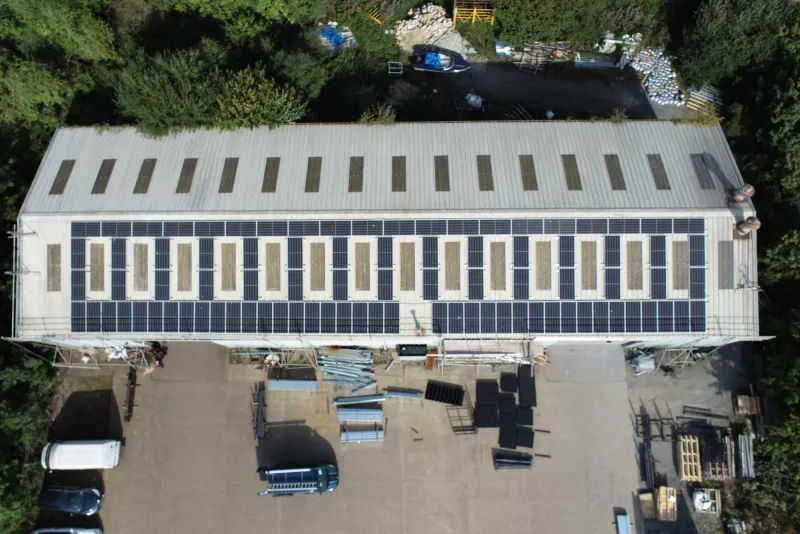
Overhead view of a commercial solar array across a large industrial roof

Accelerated stress testing predicts what a roof like this will look like in year twenty.

Origin is the whole reason this brand is on the list, so the honest placement follows from where the modules are made rather than from how they perform.

07 Honest placement

Where we specify Qcells, and where we do not

Specify

Where it fits

  • Tenders and frameworks with supply-chain conditions on where cells and modules are manufactured.
  • Organisations reporting on procurement due diligence, where a documented non-Chinese footprint answers the question directly.
  • Buyers who weigh a long independent test record above a place on a quarterly financeability list.
Specify something else

Where it does not

  • A funding pack that names the BloombergNEF Tier 1 list as a condition. Qcells is not on it, and no wording will change that.
  • Schemes decided purely on cost per watt across a large open roof, where a volume maker will price below it.
  • Programmes with no tolerance for an origin-related supply interruption, given the customs-related furlough at the Georgia plants in early 2026.
08 FAQ

Qcells on a commercial roof: common questions

No, and we will not present it as one. Its verifiable Tier 1 standing comes from the separate S&P Global Tier 1 Cleantech assessment for 2025, which is a different scheme run by a different organisation on a different cycle. We keep the two apart in every document. Where a lender or funder specifically requires the BloombergNEF listing, we say so plainly and put a genuinely listed module forward to compare against.

In the United States, South Korea and Malaysia. The American capacity in Georgia is fully integrated rather than final assembly, which is what lets the origin question be answered upstream of the laminate. The company was founded in Germany in 1999 and its technology headquarters remains at Thalheim; Hanwha acquired the business in 2012 and the listed parent is Hanwha Solutions in Seoul.

It is a procurement and reporting benefit rather than a performance one. A public-sector framework, a supply-chain due diligence statement or a funder’s conditions may ask where cells and modules are manufactured, and a documented answer that does not depend on a single country is easier to evidence. It does not make the panel generate more electricity, and we do not present it as though it did.

The product and performance terms depend on the exact series and production year, and we hold no Qcells datasheet in our own registry, so we confirm both figures from the current sheet for the module we propose and set them out in writing. On a commercial roof we read the warranty back to you alongside the bankability and the test evidence rather than after the order.

We publish no per-panel or per-watt figure. Qcells is a premium name, so it will not undercut a volume maker on the module line, but the module is a modest share of an installed cost driven by the roof, the fixing method, the inverter selection and the connection works. The bands are set out in our commercial solar cost guide, and your figure is built from the survey and the yield model.

Get a commercial quote

The equipment is chosen to fit the design, not the other way round.

Tell us about the roof and the load. We survey the site, model the array in PV*SOL against your half-hourly data, and specify what actually fits, with the manufacturer, the series and the warranty named. Qcells goes on the roof where it is the right answer and not because it is on a list.

  • On-site 3D drone survey and half-hourly PV*SOL model
  • We confirm your DNO and handle the G99 connection
  • Over 50 kWp, outside MCS