What set Alectrona apart was the documented design pack. We had quotes from three installers, but only Alectrona handed us a full set of drawings, a single-line diagram and a design referencing BS 7671 and the G99 connection process. The whole thing read like an engineering submission rather than a sales brochure. Our M&E consultant reviewed it and signed it off without a single query. That gave the board the confidence to release the capital.
Alectrona
Commercial solar by areaCommercial solar in Dewsbury.
Alectrona is Yorkshire-based and quick to your site across Dewsbury and the wider Heavy Woollen District, designing commercial solar over 50 kWp for the mill, manufacturing and warehouse roofs around WF12 and WF13. We have not installed in Dewsbury yet, so we lead with an on-site drone survey and a system modelled against your own half-hourly load, not a local job count we do not have.
- Northern Powergrid network
- The survey comes to your site
- Over 50 kWp, outside MCS
The feedback we work to earn
These are representative example reviews, not yet-collected customer feedback. They are written to illustrate the kind of feedback Alectrona aims to earn and are shown as design placeholders while we gather and verify reviews from our first commercial clients. Alectrona is the commercial solar trading brand of RVTC LTD.
Other firms priced our roof off a satellite image and a desktop guess. Alectrona flew an in-house drone survey, fully insured and flown by a qualified commercial drone pilot, and built a 3D model of the actual roof. It picked up plant, vents and a parapet line that a flat aerial photo had completely missed, which changed the panel layout. I would rather find that out at design stage than on the day the scaffold goes up. The accuracy of that survey is the reason I trusted everything that followed.
As a finance director I was wary of being oversold a system bigger than we could use. Alectrona modelled the array against our actual half-hourly consumption data rather than an annual total, so it is sized to what we genuinely draw on site during the day. They were honest that exporting surplus is worth far less than self-consumption, and built the design around that. The capital case stacked up because the engineering was honest, not because the numbers were inflated.
We were undecided between buying outright, leasing and a PPA. Alectrona laid out all three side by side with the pros and cons of each against our balance sheet, instead of pushing the one that pays them best. They were clear about where a PPA makes sense and where capex wins, and pointed us at our own accountant for the tax treatment. The survey and design took a little longer than I expected, but the thoroughness was worth the wait. Genuinely consultative.
The install crew were tidy and well run, and worked to a clear CDM 2015 plan with a proper site induction and RAMS. What impressed me most was the handover. We received a full commissioning pack with the IEC 62446-1 test results, certification, O&M documentation and an as-built record for our maintenance team. As the people who have to live with this asset for the next twenty years, having that paperwork in order matters enormously. Nothing was left loose.
I expected the usual hard sell and got the opposite. After surveying our site Alectrona told us one roof section was not worth covering because of shading, and that a smaller, well-sited array was the better investment than filling every square metre. There was no commission-driven upselling and no pressure. For a six-figure capital project, that straight talk is exactly what you want from the people advising you. We will be using them again on our second site.
- WF12 · WF13 Postcode coverage
- Northern Powergrid Local network
- West Yorkshire Sub-region
Commercial solar in Dewsbury
Alectrona is the commercial arm of RVTC LTD, working on solar over 50 kWp for businesses across Dewsbury and the WF postcodes: WF12 out towards Thornhill and Dewsbury Moor, and WF13 through Ravensthorpe and the town centre. We are quick to your site from base, and we cover the surrounding Heavy Woollen towns of Batley, Mirfield, Ossett, Heckmondwike and Cleckheaton from the same patch, with Wakefield, Huddersfield and Leeds all a short drive away.
We will be straight with you: we have not yet completed an installation in Dewsbury, so there is no local job list to point at and we will not pretend otherwise. Above 50 kWp a rooftop array sits outside MCS, the structural and electrical stakes rise, and the design has to be built around how the building actually draws power rather than a roof-area estimate. That work starts with an in-house drone survey and a half-hourly model, and it runs the same on a Dewsbury mill roof as anywhere else we cover.
The commercial roofs around Dewsbury
Dewsbury's commercial roofs carry the mark of the woollen trade. It is the largest town in West Yorkshire's Heavy Woollen District, the cluster of mill towns that, with Batley, Heckmondwike and Ossett, grew on heavyweight cloth and the recycled-wool trades of shoddy and mungo. What that history leaves on the ground is a building stock dominated by large 19th-century stone mills, with extensive flat and shallow-pitch mill roofs now in mixed manufacturing, warehouse and light-industrial use. On that kind of structure the roof area is usually there, but whether the deck and the older covering can carry a ballasted array is a question for a structural survey first, not an assumption, and we treat that loading and heritage-roofing check as the starting point on a converted mill rather than an afterthought.
The manufacturing base is genuinely its own. Mill Street West Industrial Estate, off Anchor Bridge Way at WF12 9QS, is a secure steel-portal multi-let estate a short way from the town centre, sitting alongside the wider Dewsbury Mills and Anchor House complex where carpet and bedding occupiers run, and Calder Bank Mills on Calder Bank Road in WF12 9QW is home to Westex carpets. The Dewsbury to Batley corridor is a notable centre for bed, mattress and divan manufacturing, run by long-standing local names, which points to a stock of mid-size manufacturing and warehouse sheds with broad roof areas and steady weekday process loads. Those are the load shapes solar serves best, because the array generates in the same daytime hours that compressors, extraction, machinery and lighting are already pulling power.
The third strand is storage and distribution. Wrigglesworth Storage runs two warehousing and distribution sites of more than 50,000 square feet in the town, holding bales for the local textiles and carpet trade with road haulage off the M62 and A638, and the Shawcross area held a large third-party logistics warehouse, now reported closing, that once served national retail clients. Around all of this the town centre has seen major regeneration, with roughly £24.8m of Towns Fund money behind nine projects, the Townscape Heritage restoration of landmark buildings and the Pioneer House Higher Skills Centre, served by the station on the Leeds to Huddersfield and Manchester main line. The firms occupying these estates describe the local economy and the building stock; they are not our customers, and we make no claim that they are. They matter here only because they tell you the type of site we design for in this town. Across all of it the value comes from using generation on site rather than exporting it, so we model the real half-hourly load for each building before sizing anything.
We model your roof in 3D, before we quote.
Every Dewsbury design starts with an on-site survey rather than a satellite guess. Our in-house drone pilot, insured and qualified to A2 CofC and GVC standard, flies a 3D survey of the roof, capturing pitch, orientation, shading, parapets and the true usable area. On the town's converted-mill stock that matters, because the drone reads the condition of older coverings without anyone walking a fragile heritage roof to find out. That model then feeds a PV*SOL design built against your half-hourly consumption, so the array is sized to the load you actually carry and the layout is only fixed once the roof, its loading and any structural limits are accounted for.
The survey travels to Dewsbury exactly as it does anywhere in Yorkshire. Whether the roof is a stone mill off Mill Street West or a steel-portal warehouse out towards the M62, the pilot comes to you and the design is built from what the drone records on the day.
Connecting to the grid in Dewsbury
The distribution network operator for Dewsbury is Northern Powergrid, whose Yorkshire licence covers Kirklees and the wider West Yorkshire area, and any commercial system over 50 kWp connects under a G99 application to them. G99 is the engineering approval that lets a generator of this size run in parallel with the grid, and it governs how much you are permitted to export. We prepare and manage that application and the technical correspondence as part of the project rather than leaving it with you.
We do not assert a named constrained primary for Dewsbury, because there is none on record here and we will not invent one. The honest position is that available export headroom is assessed site by site against Northern Powergrid's local network. On a manufacturing or warehouse site with a heavy, self-consumed daytime load, the connection is often more straightforward than the headline kWp suggests, because much of the generation never leaves the building, and where the network needs it we design in an export limitation scheme so the array runs at full output for self-consumption while capping what reaches the grid. We confirm the right approach for your site at survey, before any commitment.
Maintenance and older systems
Dewsbury and the surrounding Heavy Woollen towns hold a real number of commercial roofs that already carry solar, including FiT-era arrays now well into their working life, often left without proper support after the firm that fitted them moved on. Through our sister operation Solar Tech Support we take on independent, brand-agnostic operation and maintenance and the takeover of those older systems, whoever installed them and whatever the panels and inverters are, with monitoring, fault-finding, cleaning and repair to keep an ageing asset earning.
This is honest, ongoing O&M, not a fixed response-time promise we cannot yet back with a local track record. What we will do is set out plainly what an arrangement covers before you commit, and give you a clear read on whether an older array on a Dewsbury mill or estate roof is worth maintaining and what it is realistically still producing.
Engineering, on real roofs.
- Sports venues
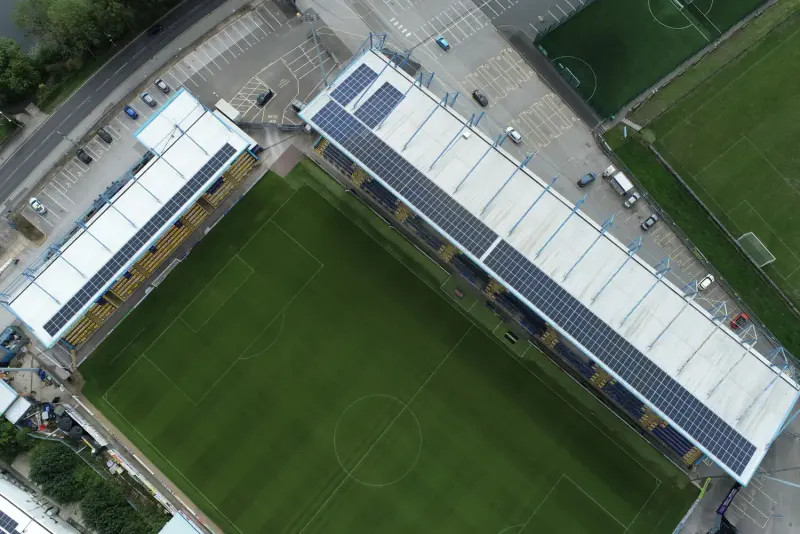
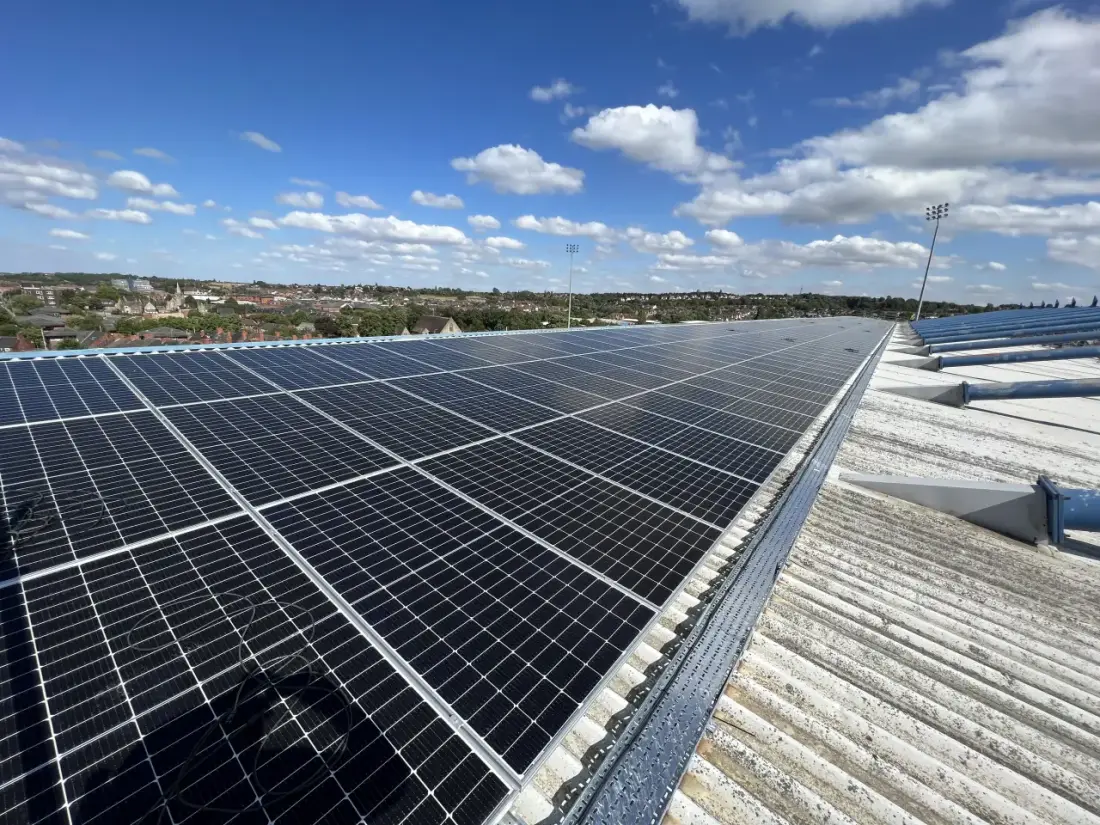
Nottinghamshire football stadium
How the team engineers rooftop solar for a football stadium, matching a large venue roof to an event-driven match-day load. A representative example of the team’s stadium work.
Read the case study - Warehousing & logistics
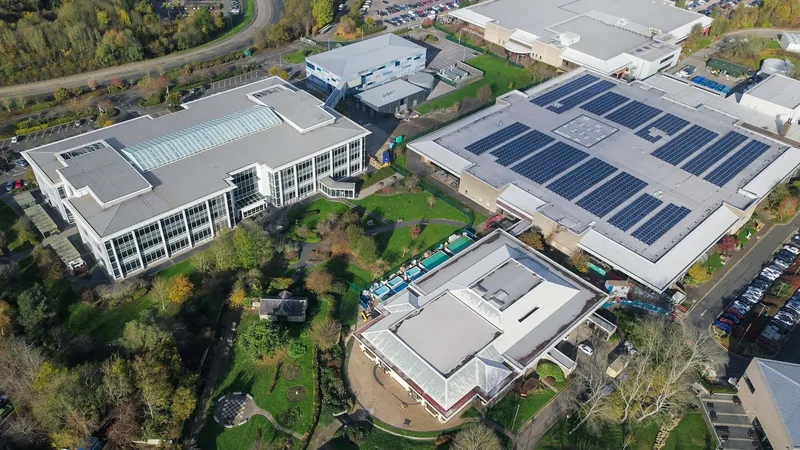
Yorkshire distribution centre
A representative large flat-roof distribution-centre array designed to a daytime logistics load, using half-hourly modelling, an in-house drone survey and an export-limited G99 design to maximise self-consumption.
Read the case study
Last updated June 2026
Commercial solar in Dewsbury: common questions
Not yet, and we say so openly. We are a Yorkshire-based commercial installer covering Dewsbury and the wider WF12 and WF13 area, but we will not claim a local track record we do not have. What we offer is the engineering a system over 50 kWp needs: an in-house drone survey of your roof, a PV*SOL model built against your half-hourly load, a design to BS 7671 and a G99 connection to Northern Powergrid.
Often it can, but the roof decides, and on a converted mill that is the first thing we check. Dewsbury sits at the heart of the Heavy Woollen District, so much of its commercial stock is 19th-century stone mill buildings whose decks and coverings were never designed with a ballasted array in mind. Our drone survey reads the roof in 3D without anyone walking it, and a structural assessment confirms what it can safely carry before any array is sized or specified.
The distribution network operator for Dewsbury is Northern Powergrid, whose Yorkshire licence covers Kirklees and West Yorkshire, and a system over 50 kWp connects under a G99 application to them. We prepare and manage that application as part of the project. There is no town-wide constraint we would claim here; available export headroom is assessed for each specific site, and where it is limited we design in an export limitation scheme.
Yes. Through our sister operation Solar Tech Support we provide independent, brand-agnostic operation and maintenance and take over older systems across Dewsbury and the surrounding Heavy Woollen towns, including FiT-era arrays whose original installer has moved on. We assess the site first and agree the service scope against what we find, rather than quoting a fixed promise sight unseen.
There is no Dewsbury price and no per-mile rate, because the figure comes from the survey and the PV*SOL model rather than a published from-price. For a system over 50 kWp the cost is driven by the things we measure on the day: the usable roof area and pitch, whether a converted mill deck needs structural reinforcement before it can carry a ballasted array, the inverter and cabling strategy, and the G99 connection terms Northern Powergrid sets for your point of connection. A steel-portal warehouse off the M62 and a 19th-century stone mill roof in the town centre can hold a similar panel count and still price differently once loading and access are accounted for. We fly the in-house drone survey, model the array against your own half-hourly consumption, and the number you receive is built from that specific site rather than estimated from a postcode.
We can usually get a surveyor to a Dewsbury site quickly, because Alectrona is Yorkshire-based and the town sits on our regular patch alongside Batley, Mirfield and the wider Heavy Woollen District. The drone survey itself is a single visit and the pilot comes to you, so reaching the site is rarely the constraint. The programme length is set mostly by the G99 connection rather than by travel: once we have surveyed and modelled the array, the application to Northern Powergrid and the time they take to return connection terms is the main variable, and that runs in parallel with design and procurement. We give you a realistic timeline for your specific site after the survey, rather than a fixed number up front, because the connection position and any structural work on a mill roof are what move the dates.
Tell us where the site is.
Wherever you are in the region, the on-site drone survey comes to you and the PV*SOL model sets the figure. Send us the site and the half-hourly load, and we will come back with a designed system.
- On-site 3D drone survey, fully insured in-house pilot
- We confirm your DNO and handle the G99 connection
- Over 50 kWp, outside MCS
- PV*SOL bankable-grade modelling