What set Alectrona apart was the documented design pack. We had quotes from three installers, but only Alectrona handed us a full set of drawings, a single-line diagram and a design referencing BS 7671 and the G99 connection process. The whole thing read like an engineering submission rather than a sales brochure. Our M&E consultant reviewed it and signed it off without a single query. That gave the board the confidence to release the capital.
Alectrona
Commercial solar by areaCommercial solar in Goole.
Yorkshire-based and quick to your site in Goole, designing commercial solar over 50 kWp for the dockside sheds, the M62 distribution estates and the new manufacturing roofs around Junction 36. We have not installed in Goole yet, so we lead with an on-site drone survey and a load-matched design rather than a local job count we cannot show.
- Northern Powergrid network
- The survey comes to your site
- Over 50 kWp, outside MCS
The feedback we work to earn
These are representative example reviews, not yet-collected customer feedback. They are written to illustrate the kind of feedback Alectrona aims to earn and are shown as design placeholders while we gather and verify reviews from our first commercial clients. Alectrona is the commercial solar trading brand of RVTC LTD.
Other firms priced our roof off a satellite image and a desktop guess. Alectrona flew an in-house drone survey, fully insured and flown by a qualified commercial drone pilot, and built a 3D model of the actual roof. It picked up plant, vents and a parapet line that a flat aerial photo had completely missed, which changed the panel layout. I would rather find that out at design stage than on the day the scaffold goes up. The accuracy of that survey is the reason I trusted everything that followed.
As a finance director I was wary of being oversold a system bigger than we could use. Alectrona modelled the array against our actual half-hourly consumption data rather than an annual total, so it is sized to what we genuinely draw on site during the day. They were honest that exporting surplus is worth far less than self-consumption, and built the design around that. The capital case stacked up because the engineering was honest, not because the numbers were inflated.
We were undecided between buying outright, leasing and a PPA. Alectrona laid out all three side by side with the pros and cons of each against our balance sheet, instead of pushing the one that pays them best. They were clear about where a PPA makes sense and where capex wins, and pointed us at our own accountant for the tax treatment. The survey and design took a little longer than I expected, but the thoroughness was worth the wait. Genuinely consultative.
The install crew were tidy and well run, and worked to a clear CDM 2015 plan with a proper site induction and RAMS. What impressed me most was the handover. We received a full commissioning pack with the IEC 62446-1 test results, certification, O&M documentation and an as-built record for our maintenance team. As the people who have to live with this asset for the next twenty years, having that paperwork in order matters enormously. Nothing was left loose.
I expected the usual hard sell and got the opposite. After surveying our site Alectrona told us one roof section was not worth covering because of shading, and that a smaller, well-sited array was the better investment than filling every square metre. There was no commission-driven upselling and no pressure. For a six-figure capital project, that straight talk is exactly what you want from the people advising you. We will be using them again on our second site.
- DN14 · DN8 · YO8 Postcode coverage
- Northern Powergrid Local network
- East Yorkshire & Humber Sub-region
Commercial solar in Goole
Alectrona is the commercial arm of RVTC LTD, working on rooftop and ground-mount solar above 50 kWp. We are based in Yorkshire and reach Goole and the surrounding East Riding quickly, covering the DN14 district and the nearby towns of Howden, Snaith, Rawcliffe, Hook, Thorne and Selby. We are honest from the start: we hold no completed installs in Goole, so this page is about coverage, the engineering a system this size needs, and the on-site survey we run before any design is drawn.
A system over 50 kWp sits outside the domestic MCS route and carries real structural, electrical and grid-connection weight. That is why every Goole enquiry starts with an insured drone pilot flying a 3D survey of the roof, a PV*SOL model built against your half-hourly consumption, and a design to BS 7671. On a large dockside warehouse or a new logistics shed off the M62, the array can run to several hundred kilowatts, so the sizing is matched to how the building actually draws power through the day rather than to a roof area.
The commercial roofs around Goole
Goole's commercial roof stock is built around a port and a fast-growing manufacturing cluster, and the load shapes underneath those roofs are what drive the design. The Port of Goole, operated by Associated British Ports, is the UK's furthest-inland port, sited where the Aire and Calder Navigation meets the River Ouse, handling around one and a half million tonnes of cargo a year across terminals including Caldaire, South Dock, Ouse Dock, West Dock and Stanhope Dock, with around twenty thousand square metres of covered storage. Those large dockside sheds and transit warehouses make up a substantial share of the town's commercial roof, broad flat or low-pitch structures over handling, storage and lighting loads that run through the working day.
The bigger change is to the east of the town, at Junction 36 of the M62, where the Capitol Park and Goole 36 employment site forms the anchor of the local logistics and advanced-manufacturing cluster, with large-footprint distribution sheds and the kind of broad steel-portal roofs that take a clean panel layout. Siemens Mobility opened its rail manufacturing factory here, the Goole Rail Village, in October 2024, building Piccadilly Line trains for the London Underground on a site of around sixty-seven acres. Reported employment runs as a range, from the figures announced at planning to up to roughly a thousand direct roles cited at opening alongside a larger supply-chain total, so we quote it as a range rather than a single precise headcount. A manufacturing plant of this kind carries a heavy, steady weekday electrical demand, which is close to the ideal case for self-consumption.
Goole's wider inward-investment offer adds warehousing and grocery distribution off the motorway and a base in glass and chemicals manufacturing, and the RaisE Business Centre on Tom Pudding Way near Junction 36 provides flexible workspace as part of the town's regeneration. We name these as context for the local economy and the building stock, not as customers of ours and not as live employers whose current status we are asserting. The common thread is the load profile: port handling, distribution and process manufacturing all pull their demand through daylight, when a south-facing array generates, so a well-sized system is consumed behind the meter rather than exported. We model each building's real half-hourly demand before sizing anything.
We model your roof in 3D, before we quote.
Every Goole design starts with an on-site survey rather than a satellite guess. Our in-house drone pilot, insured and qualified to A2 CofC and GVC standard, flies a 3D survey of the roof, capturing pitch, orientation, shading, parapets, plant and the true usable area. That model feeds a PV*SOL simulation run against your half-hourly load, so the system is sized to what the building actually uses rather than to a number pulled from a roof area.
The survey travels to Goole exactly as it does anywhere in Yorkshire, whether the roof is a transit shed on the ABP dock estate, a distribution unit on Capitol Park or a manufacturing building out at Junction 36. The pilot comes to you, and the design is built from what the drone records on the day.
Connecting to the grid in Goole
The distribution network operator for Goole is Northern Powergrid, whose Yorkshire licence covers the East Riding and the Humber, and any system over 50 kWp connects under a G99 application to them. G99 is the engineering approval that lets a generator of this size run in parallel with the grid, and it governs how much you are permitted to export. We prepare and manage that application as part of the project, including the protection settings and, where the connection or your own commercial case calls for it, an export limitation scheme so the array runs at full output for self-consumption while capping what reaches the network.
We do not assert a named constrained primary for Goole, because there is none on record and we will not invent one. The honest position is that headroom is assessed site by site against Northern Powergrid's local network, and the M62 Junction 36 estates and the dockside corridor each connect on their own terms. On a high, steady manufacturing or port-handling load, much of the generation never leaves the building, which often eases the export side of the G99 position. We confirm the available capacity for the actual site and design the connection around what the network offers.
Maintenance and older systems
Goole and the surrounding East Riding hold a real stock of commercial roofs that already carry solar, including FiT-era arrays now well over a decade old and systems left behind by installers who have since moved on or stopped trading. Through our sister operation Solar Tech Support we take on independent operation and maintenance brand-agnostically, whatever panel or inverter is on the roof, with monitoring, fault-finding, inverter and string repair and performance checks to keep an ageing asset earning.
This is honest, ongoing O&M rather than a fixed promise we cannot yet back with a local track record. The salt-laden air off a working estuary also matters here, as it does down the Humber towards Hull: dockside and waterside roofs soil faster than an inland site, so a scheduled clean and inspection is a genuine performance measure on a Goole port building rather than a token visit. We assess an inherited system on site first, report honestly on what it is producing against what it should, and agree a maintenance scope against what we find rather than quote a service level sight unseen.
Engineering, on real roofs.
- Sports venues
Nottinghamshire football stadium
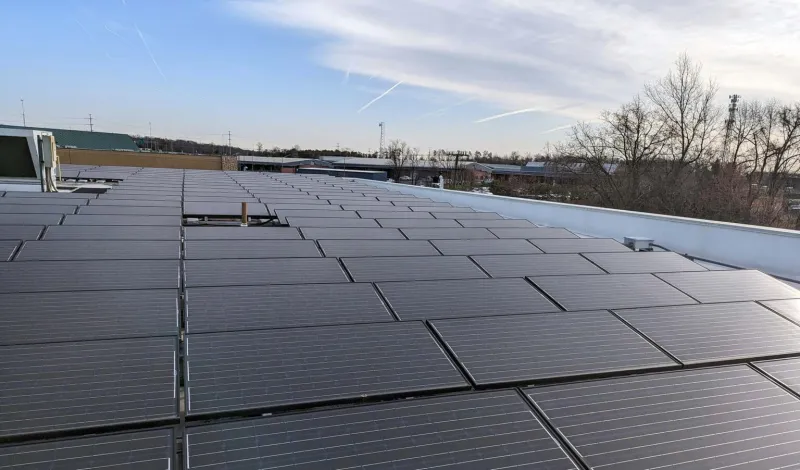
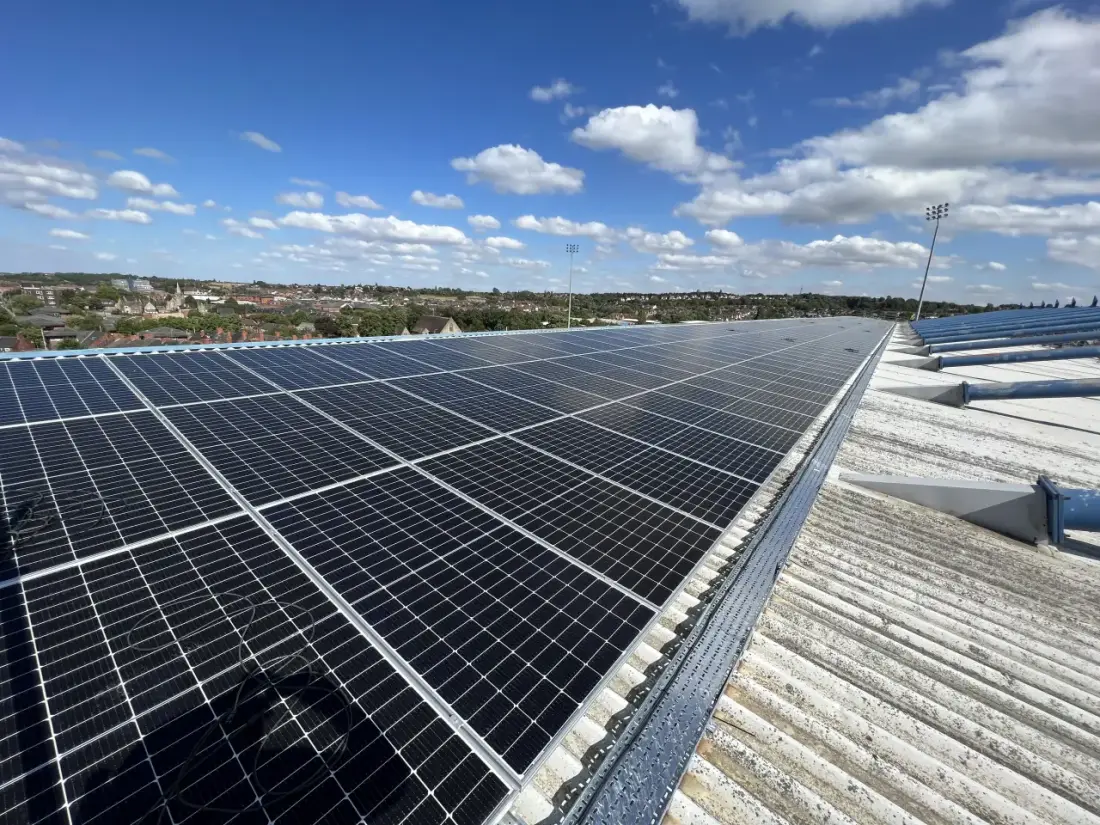
How the team engineers rooftop solar for a football stadium, matching a large venue roof to an event-driven match-day load. A representative example of the team’s stadium work.
Read the case study - Warehousing & logistics
Yorkshire distribution centre
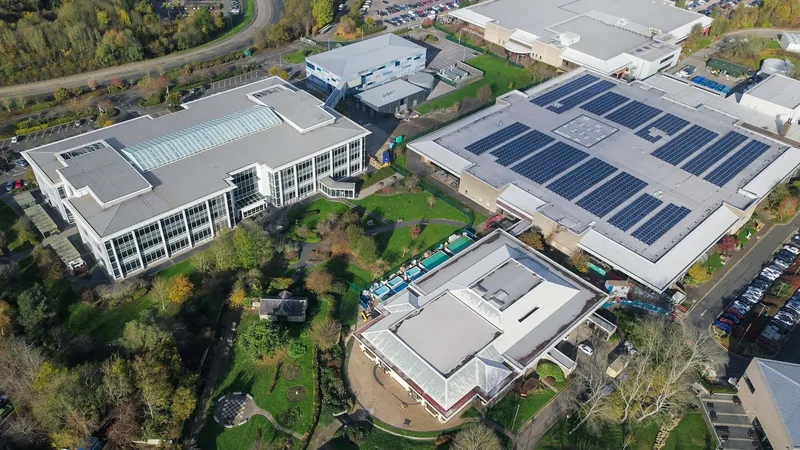
A representative large flat-roof distribution-centre array designed to a daytime logistics load, using half-hourly modelling, an in-house drone survey and an export-limited G99 design to maximise self-consumption.
Read the case study
Last updated June 2026
Commercial solar in Goole: common questions
Not yet, and we say so openly. We are Yorkshire-based and cover Goole and the wider East Riding for systems over 50 kWp, but we will not claim a local track record we do not have. What we bring is the engineering capability for a large commercial array, an in-house drone survey of your roof, and a PV*SOL design built against your own half-hourly load and to BS 7671.
The dockside sheds of the Port of Goole, the distribution units on Capitol Park and the Goole 36 site, and the new manufacturing roofs at Junction 36 of the M62 all carry a heavy, steady weekday demand from handling, storage, lighting and process plant. That daytime load matches solar generation closely, so a high share of what the array produces is used on site behind the meter rather than exported, which is where the return on a system this size comes from.
The distribution network operator for Goole is Northern Powergrid, whose Yorkshire licence covers the East Riding and the Humber. A system over 50 kWp connects under a G99 application that we prepare and manage as part of the project. Where the connection or your commercial case calls for it, an export limitation scheme lets the array run at full output for self-consumption while capping export to the network. We confirm the available capacity for your specific site rather than assume it.
Yes. Through our sister operation Solar Tech Support we provide independent, brand-agnostic operation and maintenance and take over older systems, including FiT-era arrays whose original installer has moved on. We assess the system on site first and report honestly on what it is producing. On waterside roofs near the dock we plan a scheduled clean and inspection, because salt-driven soiling builds faster near the estuary than inland.
We do not publish a per-kWp or from-price figure for Goole, because an honest number for a system over 50 kWp only comes out of the survey. The cost is driven by the roof itself, by how your building draws power and by the grid connection, and your location in Yorkshire adds nothing to that figure. A broad steel-portal shed at Junction 36 takes a different mounting and cabling design from an older transit shed on the ABP dock estate, and the array is sized to your half-hourly load rather than to roof area. Our drone survey and the PV*SOL model produce the design, and the price follows from that design and your own consumption data. You pay the same survey-led approach here as anywhere we cover, with no travel loading for reaching Goole.
We can usually reach a Goole site for the drone survey within days of an enquiry, because we are Yorkshire-based and the survey comes to you wherever the roof is, from the dockside on the River Ouse to the Capitol Park and Goole 36 estates at Junction 36. Travel is not the constraint on the programme. What sets the timeline is the G99 connection: a system over 50 kWp needs an application to Northern Powergrid, and their assessment and any connection terms govern when the array can energise. We move quickly on the survey, the PV*SOL design and the application paperwork, then the build is scheduled around the connection offer rather than around how far we have to drive.
Tell us where the site is.
Wherever you are in the region, the on-site drone survey comes to you and the PV*SOL model sets the figure. Send us the site and the half-hourly load, and we will come back with a designed system.
- On-site 3D drone survey, fully insured in-house pilot
- We confirm your DNO and handle the G99 connection
- Over 50 kWp, outside MCS
- PV*SOL bankable-grade modelling