What set Alectrona apart was the documented design pack. We had quotes from three installers, but only Alectrona handed us a full set of drawings, a single-line diagram and a design referencing BS 7671 and the G99 connection process. The whole thing read like an engineering submission rather than a sales brochure. Our M&E consultant reviewed it and signed it off without a single query. That gave the board the confidence to release the capital.
Alectrona
Commercial solar by areaCommercial solar in Keighley.
Yorkshire-based commercial solar for Keighley's engineering, manufacturing and works roofs over 50 kWp, from the Parkwood Street and Dalton Lane industrial sites to the Steeton fringe. We have not yet installed in Keighley, so we lead with coverage, an on-site drone survey and a load-matched design rather than a local job count.
- Northern Powergrid network
- The survey comes to your site
- Over 50 kWp, outside MCS
The feedback we work to earn
These are representative example reviews, not yet-collected customer feedback. They are written to illustrate the kind of feedback Alectrona aims to earn and are shown as design placeholders while we gather and verify reviews from our first commercial clients. Alectrona is the commercial solar trading brand of RVTC LTD.
Other firms priced our roof off a satellite image and a desktop guess. Alectrona flew an in-house drone survey, fully insured and flown by a qualified commercial drone pilot, and built a 3D model of the actual roof. It picked up plant, vents and a parapet line that a flat aerial photo had completely missed, which changed the panel layout. I would rather find that out at design stage than on the day the scaffold goes up. The accuracy of that survey is the reason I trusted everything that followed.
As a finance director I was wary of being oversold a system bigger than we could use. Alectrona modelled the array against our actual half-hourly consumption data rather than an annual total, so it is sized to what we genuinely draw on site during the day. They were honest that exporting surplus is worth far less than self-consumption, and built the design around that. The capital case stacked up because the engineering was honest, not because the numbers were inflated.
We were undecided between buying outright, leasing and a PPA. Alectrona laid out all three side by side with the pros and cons of each against our balance sheet, instead of pushing the one that pays them best. They were clear about where a PPA makes sense and where capex wins, and pointed us at our own accountant for the tax treatment. The survey and design took a little longer than I expected, but the thoroughness was worth the wait. Genuinely consultative.
The install crew were tidy and well run, and worked to a clear CDM 2015 plan with a proper site induction and RAMS. What impressed me most was the handover. We received a full commissioning pack with the IEC 62446-1 test results, certification, O&M documentation and an as-built record for our maintenance team. As the people who have to live with this asset for the next twenty years, having that paperwork in order matters enormously. Nothing was left loose.
I expected the usual hard sell and got the opposite. After surveying our site Alectrona told us one roof section was not worth covering because of shading, and that a smaller, well-sited array was the better investment than filling every square metre. There was no commission-driven upselling and no pressure. For a six-figure capital project, that straight talk is exactly what you want from the people advising you. We will be using them again on our second site.
- BD21 · BD20 · BD22 Postcode coverage
- Northern Powergrid Local network
- West Yorkshire Sub-region
Commercial solar in Keighley
Keighley keeps a working manufacturing base that most market towns its size lost a generation ago, and a good share of that floorspace sits under roof area that rooftop solar is well suited to. Alectrona is the commercial arm of RVTC LTD, Yorkshire-based and working across the BD postcodes that make up the town: BD21 in central Keighley and Riddlesden, BD20 out towards Steeton and Silsden, and BD22 up the Worth Valley through Oakworth, Haworth and Oxenhope. We cover the wider Airedale belt, including Bingley, Shipley and Skipton, from the same base.
We have not yet installed in Keighley, so there is no local job list to point at and we will not invent one. A system over 50 kWp sits outside MCS, carries real structural and electrical weight, and has to be built around how the building actually draws power rather than a roof-area estimate. That work starts with an on-site drone survey and a PV*SOL model run against your half-hourly load, and it is the same on a Parkwood Street works roof as on a logistics unit anywhere else we cover.
The commercial roofs around Keighley
Keighley's commercial roof stock follows the town's industrial story, and that story is still being written. The engineering and equipment-manufacture base is the strongest local feature: Byworth Boilers builds industrial steam and hot water boilers from Parkwood Boiler Works on Parkwood Street in BD21 4, and Acorn Stairlifts runs a substantial manufacturing, engineering and international-logistics base at Steeton on the BD20 side, just north-west of the town. These are the kind of process and assembly buildings that draw a steady weekday electrical load through shifts, with machinery, fabrication plant, compressed air and extraction running in the same daylight hours an array generates, which is the demand shape that lets generation be consumed on site rather than exported cheaply.
The town is also actively rebuilding its industrial floorspace, and that matters for new roof stock. Providence Park, on the former Universal Mills plot at the corner of Dalton Lane and Bradford Road, is a new industrial site part-funded through the Government's Keighley Towns Fund, bringing modern steel-portal units of the sort that take a clean panel layout and predictable roof loading, alongside the Keighley College engineering hub on the same site. Further along the valley floor, the Aire Valley Business Centre on Lawkholme Lane in BD21 3 is the subject of a proposed redevelopment that would add new warehouse and office units while retaining the existing Airedale Mill building. Alongside the new build sits Keighley's older inheritance: the wool, cotton and textile-machinery heritage that gave the town its name left a stock of mill and works buildings with broad flat or shallow-pitch roofs, lower structural loading than a modern shed and, often, fragile or heritage coverings, so on that stock a structural and loading check comes before any array is sized.
The firms and sites named here describe the local economy and the building stock; they are not our customers, and we make no claim that they are. They matter on this page only because they tell a Keighley facilities manager the type of site we design for: high, steady daytime process loads on the engineering side, and large but structurally cautious roofs on the mill side. We model each building's real half-hourly consumption before sizing anything, whether it is a fabrication unit on the valley floor or a converted works up the Worth Valley.
We model your roof in 3D, before we quote.
Every Keighley design starts with an on-site survey, and our drone pilot travels up Airedale to the town the same as anywhere in Yorkshire. The pilot is in-house and fully insured, holding the A2 CofC and GVC, and flies a 3D survey of the roof to capture pitch, orientation, shading, plant and the true usable area. On Keighley's older mill and works stock that detail earns its place, because the drone reads the condition of an ageing covering without anyone walking a fragile heritage roof to find out.
That model then feeds a PV*SOL simulation run against your half-hourly consumption, so the array is sized to the load the building actually carries and the layout is only fixed once the roof, its loading and any structural limits are accounted for. Whether the site is a fabrication unit on Parkwood Street, a new shed at Providence Park or a converted works towards Steeton, the pilot comes to you and the design is built from what the drone records on the day.
Connecting to the grid in Keighley
The distribution network operator for Keighley is Northern Powergrid, whose Yorkshire licence covers the town, and any system over 50 kWp connects under a G99 application to them. Keighley sits in the Aire and Worth valleys, where parts of the network are fed along valley-floor and semi-rural feeders rather than the heavier urban grid found nearer Bradford, so the export position is worth settling early rather than assumed. We confirm the available capacity with Northern Powergrid for the actual point of connection and design the array and any export limitation around what they offer.
We do not assert a specific named constraint for your postcode, because there is none on record for Keighley and we will not invent a constraint to dramatise the page. The honest position is that headroom is assessed site by site, and where it is tight on a valley feeder a G99 export-limitation scheme, and battery storage where it strengthens the case, keeps a large array serving your own demand without pushing more than agreed to the network. We prepare and manage that application as part of the project.
Maintenance and older systems
Keighley's engineering and mill estates hold a real number of commercial arrays from the Feed-in Tariff years, now a decade or more into their working life and often left without proper support once the firm that fitted them moved on. Through our sister operation Solar Tech Support we take on independent, brand-agnostic operation and maintenance and the takeover of those older systems, whoever installed them and whatever panels and inverters are on the roof, across Keighley and the wider Airedale sub-region towards Bingley and Skipton.
That covers performance monitoring, inverter and string fault-finding, isolator and connection checks, cleaning and bringing a neglected array back to where it should be. We will not publish a fixed response-time promise we cannot stand behind for Keighley specifically. What we will do is assess the existing system on site, give you an honest read on what it is producing against what it should, and agree a maintenance scope to suit the building and your tolerance for downtime.
Engineering, on real roofs.
- Sports venues
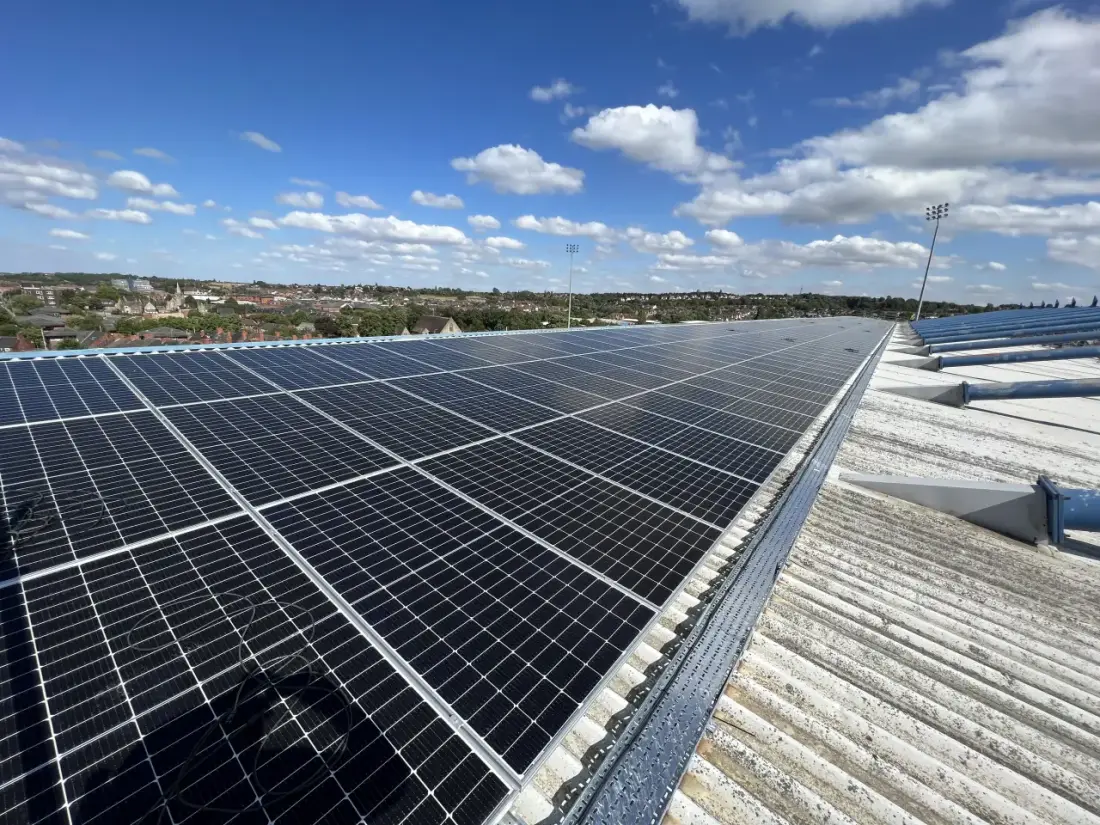
Nottinghamshire football stadium
How the team engineers rooftop solar for a football stadium, matching a large venue roof to an event-driven match-day load. A representative example of the team’s stadium work.
Read the case study - Warehousing & logistics
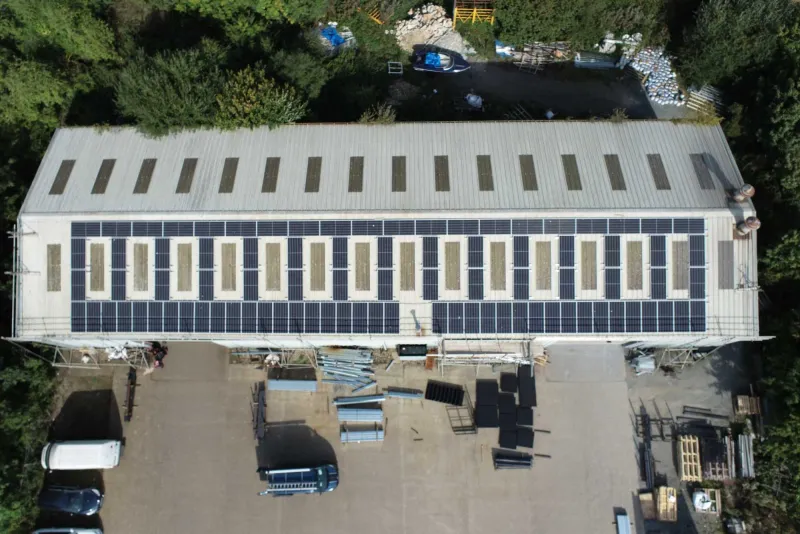
Yorkshire distribution centre
A representative large flat-roof distribution-centre array designed to a daytime logistics load, using half-hourly modelling, an in-house drone survey and an export-limited G99 design to maximise self-consumption.
Read the case study
Last updated June 2026
Commercial solar in Keighley: common questions
Not yet, and we say so openly. We are a Yorkshire-based commercial installer covering Keighley and the BD20 to BD22 districts, out to Bingley, Silsden, Steeton, Haworth, Shipley and Skipton, but we will not claim a local track record we do not have. What we offer is the engineering a system over 50 kWp needs: an in-house drone survey of your roof, a PV*SOL model built against your half-hourly load, a design to BS 7671 and a G99 connection to Northern Powergrid.
Keighley keeps a strong engineering and equipment-manufacture base, from industrial boiler and stairlift production to metal fabrication and precision work. Those plants draw a steady weekday load through shift hours, which is the ideal shape for on-site solar, because the generation lands in the same daytime hours the site is already paying for power. The return comes from self-consumption against that load, not from exporting to the grid.
Often it can, but the roof decides, and on Keighley's textile-mill and works stock that is the first thing we check. Brick-and-timber and older works structures can carry lower structural loading than a modern shed, and the covering may be fragile or of heritage value. Our drone survey reads the roof in 3D without anyone walking it, and a structural assessment confirms what the roof can safely carry before any array is sized.
The distribution network operator for Keighley is Northern Powergrid, and a system over 50 kWp connects under a G99 application we prepare and manage. We would not claim a town-wide constraint here, but Keighley sits in the Aire and Worth valleys where some feeders are semi-rural, so we confirm export headroom with Northern Powergrid for the actual connection point and design in an export limitation, with battery storage where it helps, when capacity is tight.
We do not quote a per-kWp or a from-price for Keighley, because a figure given before the survey would be a guess. The cost of a system over 50 kWp turns on the roof itself: its pitch, covering and structural loading, the panel layout the usable area allows, the inverter and electrical design, any export limitation, and whether battery storage earns its place against your load. Our pricing comes from the on-site drone survey and the PV*SOL model run against your half-hourly consumption rather than from a rate card, so the number reflects your building rather than an average. That approach is the same on a Parkwood Street works roof, a new unit at Providence Park or a converted mill up the Worth Valley, and it is the same wherever in Yorkshire the site sits. What we can do early is walk the likely shape of the project and what drives the figure, then return a costed design once the survey and model are done.
The survey comes to you quickly. We are Yorkshire-based, so reaching Keighley and the wider Airedale belt up towards Bingley, Silsden and Skipton is part of our normal coverage rather than a special trip, and the drone survey is straightforward to book in. The overall programme, though, is set by the grid rather than by travel. A system over 50 kWp connects under a G99 application to Northern Powergrid, and their assessment and any connection or export-limitation terms usually sit on the critical path ahead of the physical install. We prepare and manage that application from the start so it runs in parallel with the design and structural checks rather than holding things up at the end. Once the connection position is settled and the design signed off, the on-roof work itself is a matter of days to a few weeks depending on the size and complexity of the array. We give you a realistic programme after the survey, when we know the roof and the connection position, instead of a fixed promise up front.
Tell us where the site is.
Wherever you are in the region, the on-site drone survey comes to you and the PV*SOL model sets the figure. Send us the site and the half-hourly load, and we will come back with a designed system.
- On-site 3D drone survey, fully insured in-house pilot
- We confirm your DNO and handle the G99 connection
- Over 50 kWp, outside MCS
- PV*SOL bankable-grade modelling