Skip to content

Alectrona

Commercial solar funding

Industrial Energy Transformation Fund (IETF)

A straight account of the Industrial Energy Transformation Fund: it is closed, it was built for energy-intensive industry, and even when open it never funded solar panels.

  • Honest eligibility check, no grant promises
  • Indicative, not financial or tax advice
  • Over 50 kWp, outside MCS
Reviews

The feedback we work to earn

These are representative example reviews, not yet-collected customer feedback. They are written to illustrate the kind of feedback Alectrona aims to earn and are shown as design placeholders while we gather and verify reviews from our first commercial clients. Alectrona is the commercial solar trading brand of RVTC LTD.

What set Alectrona apart was the documented design pack. We had quotes from three installers, but only Alectrona handed us a full set of drawings, a single-line diagram and a design referencing BS 7671 and the G99 connection process. The whole thing read like an engineering submission rather than a sales brochure. Our M&E consultant reviewed it and signed it off without a single query. That gave the board the confidence to release the capital.

Estates Manager, academy trust (Yorkshire)

Other firms priced our roof off a satellite image and a desktop guess. Alectrona flew an in-house drone survey, fully insured and flown by a qualified commercial drone pilot, and built a 3D model of the actual roof. It picked up plant, vents and a parapet line that a flat aerial photo had completely missed, which changed the panel layout. I would rather find that out at design stage than on the day the scaffold goes up. The accuracy of that survey is the reason I trusted everything that followed.

Facilities Manager, distribution centre (East Midlands)

As a finance director I was wary of being oversold a system bigger than we could use. Alectrona modelled the array against our actual half-hourly consumption data rather than an annual total, so it is sized to what we genuinely draw on site during the day. They were honest that exporting surplus is worth far less than self-consumption, and built the design around that. The capital case stacked up because the engineering was honest, not because the numbers were inflated.

Finance Director, logistics group (North West)

We were undecided between buying outright, leasing and a PPA. Alectrona laid out all three side by side with the pros and cons of each against our balance sheet, instead of pushing the one that pays them best. They were clear about where a PPA makes sense and where capex wins, and pointed us at our own accountant for the tax treatment. The survey and design took a little longer than I expected, but the thoroughness was worth the wait. Genuinely consultative.

Property Director, retail park (West Midlands)

The install crew were tidy and well run, and worked to a clear CDM 2015 plan with a proper site induction and RAMS. What impressed me most was the handover. We received a full commissioning pack with the IEC 62446-1 test results, certification, O&M documentation and an as-built record for our maintenance team. As the people who have to live with this asset for the next twenty years, having that paperwork in order matters enormously. Nothing was left loose.

Operations Director, food manufacturer (Lincolnshire)

I expected the usual hard sell and got the opposite. After surveying our site Alectrona told us one roof section was not worth covering because of shading, and that a smaller, well-sited array was the better investment than filling every square metre. There was no commission-driven upselling and no pressure. For a six-figure capital project, that straight talk is exactly what you want from the people advising you. We will be using them again on our second site.

Managing Director, engineering firm (Sheffield)

No. The Industrial Energy Transformation Fund is closed: in July 2025 the government confirmed it will not continue, the planned second Phase 3 window will not run, and no successor is planned. Even when open it excluded solar PV and was built for energy-intensive industry, not commercial roofs.

The Industrial Energy Transformation Fund, or IETF, comes up a lot when a business searches for help with the cost of solar, so it is worth being plain about what it was and where it now stands. It was a government grant fund run by the Department for Energy Security and Net Zero, delivered in England, Wales and Northern Ireland, with Scotland running its own parallel scheme. It funded energy-intensive industry to cut energy use and emissions. It was never a rooftop-solar grant, and as of 2026 it is not open to anyone.

The current status, plainly

The IETF is closed. On 3 July 2025, following the 2025 Spending Review, the government confirmed the fund will not continue. There will be no further extension, the planned second competition window of Phase 3 will not go ahead, and no successor fund has been set out. As of mid-2026 there is no open window and nothing accepting new applications. The gov.uk collection page still shows the fund closed to new applications, and only projects already selected in earlier rounds are being delivered to completion.

The government flagged that future support for industrial decarbonisation would be set out in a separate Carbon Budget and Growth Delivery Plan. If anything comes of that, treat it as a distinct, as-yet-undefined route, not the IETF. We will not point you at a fund that has been wound down, and we will not imply a replacement exists before one is confirmed.

Who it was for, when it was open

Even at its peak the IETF was narrow. The lead applicant had to be a business carrying out an eligible industrial activity, meaning an energy-intensive site with operational processes such as manufacturing or processing. Phase 3 widened the scope to include data centres and controlled-environment horticulture and agriculture. Public-sector bodies, universities, councils and schools could not lead an application; they could only join as project partners. Energy and emissions savings had to be measurable at site level. A typical commercial business with a roof to fill never sat in that category.

How it worked, and the point that mattered for solar

The IETF was a competitive grant fund run in time-limited windows. It funded three strands: feasibility studies, engineering studies, and the deployment of energy-efficiency and deep-decarbonisation measures. Grants covered a percentage of eligible costs, with the subsidy intensity varying by company size and location and deep-decarbonisation deployment typically capped around 85%.

Here is the part that settles it for solar. The IETF explicitly excluded solar PV. The guidance stated that the costs of purchasing, installing and maintaining renewable electricity generation equipment such as solar panels were not supported. Only solar thermal, generating direct process heat to replace a fossil fuel, was eligible. The fund targeted process heat, heat recovery, fuel switching and efficiency at heavy-industry sites. It was never going to fund a photovoltaic array on a warehouse, a factory office or a logistics shed.

The figures, for the record

Phase 3 was a £185m programme running across 2024 to 2028. Its only competition window opened on 29 January 2024 and closed on 19 April 2024. No window has opened since and none is planned. When open, the minimum grant thresholds were £100,000 for large companies and £75,000 for SMEs. The Autumn 2024 Budget committed £163m to complete existing Phase 1, Phase 2 and first Phase 3 window projects. There are no live deadlines in 2026 because the scheme is closed. We quote these so you can see the scale and judge the fit, not to suggest any of it is available now.

The honest verdict for a private commercial roof

An Alectrona commercial solar customer cannot realistically use the IETF, for two compounding reasons. First, it is closed, with no successor announced, so there is no live route at all in 2026. Second, even when it was open it was the wrong scheme for solar PV: it was aimed at energy-intensive heavy industry, it required leadership by an industrial business, and it explicitly excluded the cost of solar panels and other renewable electricity generation. Only a genuine heavy-industry client doing process decarbonisation, such as solar thermal for process heat, fuel switching or heat recovery, ever fitted, and that door is now shut. We would rather say that plainly than build a case around money that is not there.

What is actually available instead

For the great majority of private commercial buyers, the honest route is still capex: buying the system outright. It is the route we recommend wherever the capital is available, because you own a roughly 25-year asset from day one and keep every pound of the saving and the relief. The supporting routes that genuinely apply to a private site are these:

  • Capital allowances on a bought system. Solar PV is a special-rate asset, and the Annual Investment Allowance gives a 100% first-year deduction within the £1m annual limit. Full expensing does not apply to solar, so the AIA is the route to that first-year relief. This is indicative, not tax advice; confirm your own position with a qualified accountant. See our capital allowances page.
  • SEG and export income. The Smart Export Guarantee pays for the surplus you send to the grid. It pays far less per unit than the power you avoid buying, so the value is in self-consumption first, with export as a way to monetise what is left over. See our SEG and export page.
  • PPA or leasing, if cash flow matters more than total return. A power purchase agreement puts solar on the roof with no capital outlay, and leasing or hire purchase spreads the cost over time. Both trade some of the return for easier cash flow, and a PPA largely benefits the funder who owns the asset. See our PPA and leasing pages.

If you are an eligible industrial or public-sector body, it is worth checking the grants hub for the schemes that are genuinely aimed at those organisations, with the standing caveat that windows open and close and the rules change. For everyone else, the better call is capex, claimed through capital allowances, with your own figures modelled from an on-site survey rather than a rule of thumb. None of this is financial or tax advice, and we do not act as your tax adviser; confirm the position with a qualified accountant before you commit.

Indicative, not financial or tax advice. Confirm the position with a qualified accountant or tax adviser. Your figure comes from a survey-led PV*SOL model.

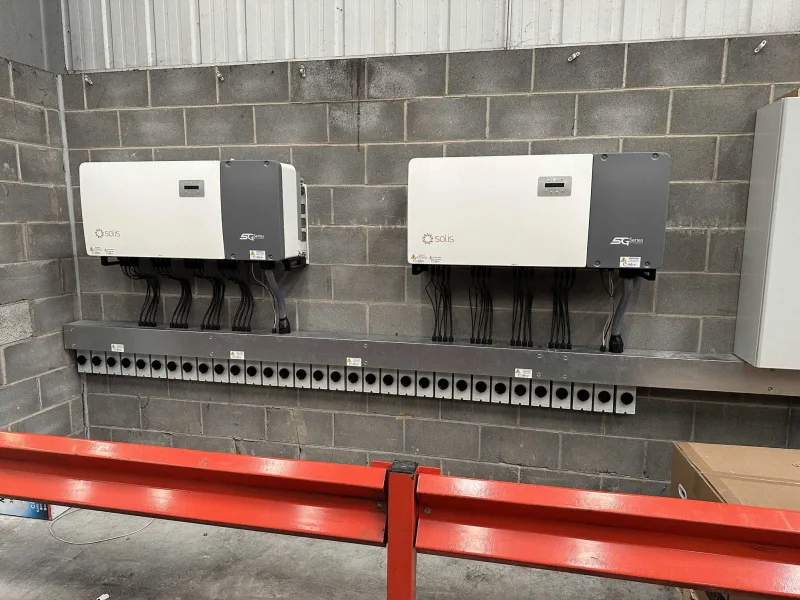
A commercial solar installation
FAQ

IETF and commercial solar: common questions

No, on two counts. The Industrial Energy Transformation Fund is closed: in July 2025 the government confirmed it will not continue, the planned second Phase 3 window will not run, and no successor is planned, so there is no open route in 2026. And even when it was open it explicitly excluded solar PV; the guidance stated that the cost of purchasing, installing and maintaining renewable electricity generation such as solar panels was not supported. Only solar thermal for process heat was eligible.
No. On 3 July 2025, following the Spending Review, the government confirmed the fund will not continue, with no further extension and the planned second Phase 3 competition window cancelled. As of mid-2026 there is no open window and nothing accepting new applications; only projects selected in earlier rounds are being delivered to completion. The gov.uk collection page still shows the fund closed to new applications.
The lead applicant had to be a business carrying out an eligible industrial activity, meaning an energy-intensive site with operational processes such as manufacturing or processing. Phase 3 widened the scope to include data centres and controlled-environment horticulture and agriculture. Public-sector bodies, universities, councils and schools could not lead an application and could only join as project partners. A typical commercial business with a roof to fill never sat in that category.
Only solar thermal, where the panels generate direct process heat to replace a fossil fuel at an industrial site. Solar PV, the electricity-generating panels on a commercial roof, was explicitly excluded: the guidance stated the costs of renewable electricity generation equipment such as solar panels were not supported. The fund targeted process heat, heat recovery, fuel switching and efficiency at heavy industry, not rooftop electricity generation.
For most private commercial sites the route is capex, buying the system outright, with the tax relief claimed through capital allowances. Solar PV is a special-rate asset, and the Annual Investment Allowance gives a 100% first-year deduction within the £1m annual limit. SEG export earns from the surplus you send to the grid, and a PPA or lease spreads or removes the capital outlay if cash flow matters more than total return. This is indicative, not tax advice; confirm the position with a qualified accountant.
Get a straight read on funding

Tell us about your site and we will tell you what actually applies.

No grant promises here. We will give you a straight read on whether any funding route genuinely applies to your site, then model your own roof from an on-site survey so you compare capex, capital allowances, SEG and a PPA on real figures. Request a free commercial feasibility and eligibility check.

  • A free eligibility and feasibility check
  • Figures from an on-site survey and a PV*SOL model
  • No grant promises, no from-price