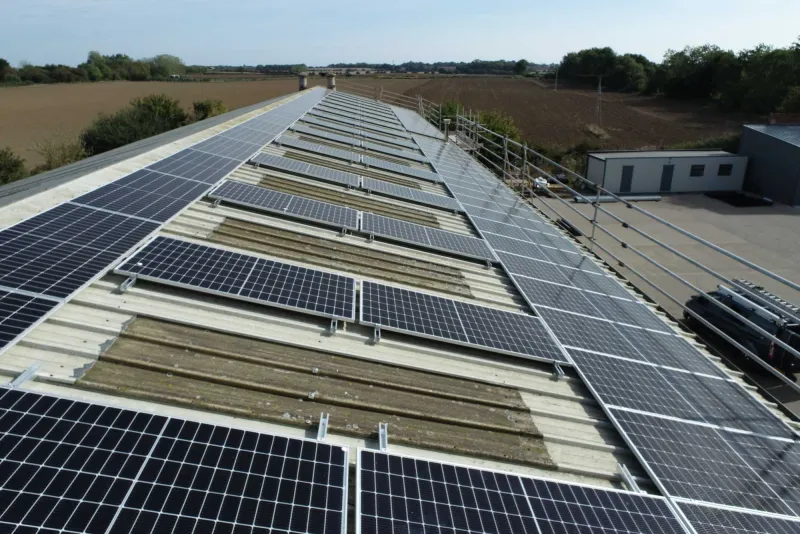
What set Alectrona apart was the documented design pack. We had quotes from three installers, but only Alectrona handed us a full set of drawings, a single-line diagram and a design referencing BS 7671 and the G99 connection process. The whole thing read like an engineering submission rather than a sales brochure. Our M&E consultant reviewed it and signed it off without a single query. That gave the board the confidence to release the capital.
Alectrona
Commercial inverters · over 50 kWpFronius commercial inverters.
Fronius is the EU-made, family-owned choice for commercial inverters, founded in Austria in 1945 and financially independent: Tauro ECO at 50 and 100 kW for large arrays, with the warranty scheme stated honestly rather than as a bankability badge.
- Austria manufacturer
- Specified to fit your design
- Over 50 kWp, outside MCS
The feedback we work to earn
These are representative example reviews, not yet-collected customer feedback. They are written to illustrate the kind of feedback Alectrona aims to earn and are shown as design placeholders while we gather and verify reviews from our first commercial clients. Alectrona is the commercial solar trading brand of RVTC LTD.
Other firms priced our roof off a satellite image and a desktop guess. Alectrona flew an in-house drone survey, fully insured and flown by a qualified commercial drone pilot, and built a 3D model of the actual roof. It picked up plant, vents and a parapet line that a flat aerial photo had completely missed, which changed the panel layout. I would rather find that out at design stage than on the day the scaffold goes up. The accuracy of that survey is the reason I trusted everything that followed.
As a finance director I was wary of being oversold a system bigger than we could use. Alectrona modelled the array against our actual half-hourly consumption data rather than an annual total, so it is sized to what we genuinely draw on site during the day. They were honest that exporting surplus is worth far less than self-consumption, and built the design around that. The capital case stacked up because the engineering was honest, not because the numbers were inflated.
We were undecided between buying outright, leasing and a PPA. Alectrona laid out all three side by side with the pros and cons of each against our balance sheet, instead of pushing the one that pays them best. They were clear about where a PPA makes sense and where capex wins, and pointed us at our own accountant for the tax treatment. The survey and design took a little longer than I expected, but the thoroughness was worth the wait. Genuinely consultative.
The install crew were tidy and well run, and worked to a clear CDM 2015 plan with a proper site induction and RAMS. What impressed me most was the handover. We received a full commissioning pack with the IEC 62446-1 test results, certification, O&M documentation and an as-built record for our maintenance team. As the people who have to live with this asset for the next twenty years, having that paperwork in order matters enormously. Nothing was left loose.
I expected the usual hard sell and got the opposite. After surveying our site Alectrona told us one roof section was not worth covering because of shading, and that a smaller, well-sited array was the better investment than filling every square metre. There was no commission-driven upselling and no pressure. For a six-figure capital project, that straight talk is exactly what you want from the people advising you. We will be using them again on our second site.
Fronius is an Austrian manufacturer founded in 1945 by Günter Fronius and still family-owned, now run by the founder's granddaughter and in its fourth generation. It is built on three divisions, welding, solar energy and battery charging, which spread its revenue across markets that do not all move together. For a finance director weighing who will be there to honour a warranty in ten or fifteen years, that diversification and the firm's stated financial independence are the points that matter, and they set Fronius apart from inverter makers that sell nothing else.
For commercial solar above 50 kWp we specify Fronius on EU provenance, build quality and a service scheme that is genuinely strong across the commercial range. This site sits outside MCS, which is a domestic scheme, so we do not use it as a trust signal here; quality is assured through the non-MCS engineering stack instead. We are precise instead about where Fronius leads and where it does not: it does not top the inverter bankability survey, and it went through a demand-driven restructuring during the 2024 downturn. We set both out plainly below.
Why we specify Fronius
We reach for Fronius where EU manufacturing, build quality and a strong service relationship carry weight, and where a roof benefits from the specific engineering in the range. The Tauro ECO units are active-cooled outdoor inverters rated from -40 to +65C with an IP65 enclosure, built for exposed rooftop and ground-mount duty where a passively cooled unit would derate. The Symo Advanced models carry an integrated Fronius Arc Guard arc-fault interrupter that shuts the inverter down on a DC arc, which is a real safety feature on a large commercial array and one we weigh on roofs where DC-side protection is a priority, mapping onto the DC de-energisation that RC62 fire-safety guidance looks for.
We do not specify it on the badge. Fronius is a premium, established maker, but it is not the bankability-survey leader and it went through a demand-driven restructuring during the 2024 European PV downturn, so the choice is made on engineering fit for the array, the connection requirements, and a per-project check of the exact warranty term and UK support for the specific model. Where a site needs the maker that leads the inverter bankability survey, we say so and put Sungrow forward instead.
The commercial range
The commercial range we draw on is led by the Tauro ECO outdoor inverters at 50 kW and 100 kW (Tauro ECO 50-3-D and 100-3-D), three-phase, active-cooled, up to 98.5% maximum efficiency (98.2% European) with a 580 to 1000 V DC input and an IP65 enclosure rated from -40 to +65C, for large C&I rooftops and ground-mount arrays. The ECO units run a single MPP tracker; the standard Tauro 50 kW instead carries three trackers where a roof needs several orientations. The Direct and precombined connection variants differ in how the strings land, so we confirm the exact SKU the distributor supplies for each scheme. Below the Tauro, the Eco three-phase units at 25 and 27 kW give a transformerless, regulated-air-cooled platform with an IP66 enclosure, and the Symo Advanced at 12.5 and 20 kW add two MPP trackers and the integrated arc-fault protection.
The model, count and DC-to-AC ratio come from the PV*SOL model for your roof, not from a catalogue line. Every figure on this page is taken from the manufacturer datasheets and is confirmable; we publish model, power, phase and MPPT count, and we do not publish a price. A few efficiency figures and the exact warranty category for a given unit are confirmed against the current datasheet before contract.
Monitoring, connection and support
Fronius inverters report through Fronius Solar.web, which is both the monitoring platform and the registration route for the warranty extension, giving string-level yield and fault data for commissioning sign-off and ongoing performance reporting under an O&M agreement. For export limitation and dynamic power control we pair the inverters with a three-phase Fronius Smart Meter on the data interface, and the Fronius datamanager provides Modbus TCP and SunSpec for SCADA or zero-export schemes where the DNO sets an export limit as a condition of connection. Every commercial inverter we fit is commissioned to G99 and configured to the connection agreement.
The warranty scheme is a real strength and we are precise about how it works. Registering the inverter on Fronius Solar.web within 30 months of delivery gives a free extension whose length depends on inverter size: to a total of 10 years for units under 50 kW (the Symo Advanced and Eco) and 5 years for units of 50 kW and over (the Tauro ECO 50 and 100 kW). A paid extension takes cover to a total of 15 years, bought within the first six months of the free period, and inverters commissioned on or after 1 June 2026 must be registered to qualify. We confirm the exact term for the specific model with the distributor before contract. As the specifying and installing contractor we own the support relationship, hold the monitoring access, register the warranty as part of commissioning and keep the as-built records the asset needs over its life.
The Fronius commercial range we specify
- Tauro ECO 100-3-D Tauro ECO (project-grade, active-cooled outdoor)
100 kW three-phase active-cooled outdoor inverter, single MPP tracker, up to 98.5% max / 98.2% European efficiency, 580 to 1000 V DC, IP65, rated -40 to +65C; for large commercial and ground-mount arrays.
- Tauro ECO 50-3-D Tauro ECO (project-grade, active-cooled outdoor)
50 kW three-phase active-cooled outdoor inverter, single MPP tracker, up to 98.5% max / 98.2% European efficiency, 580 to 1000 V DC, IP65, rated -40 to +65C; same platform as the 100 kW unit for large C&I rooftops.
- Eco 27.0-3-S Fronius Eco (large-scale three-phase, SnapINverter)
27 kW three-phase transformerless string inverter, single MPP tracker, up to around 98.3% max efficiency, 1000 V max DC, IP66 with regulated air cooling; indoor or outdoor mounting.
- Symo Advanced 20.0-3-M Symo Advanced (SnapINverter, integrated arc-fault)
20 kW three-phase string inverter, 2 MPP trackers, up to around 98.0% max efficiency, 1000 V max DC, IP66, with integrated Fronius Arc Guard AFCI; for commercial roofs needing DC arc-fault protection.
- Symo Advanced 12.5-3-M Symo Advanced (SnapINverter, integrated arc-fault)
12.5 kW three-phase string inverter, 2 MPP trackers, up to around 97.8% max efficiency, 1000 V max DC, IP66, with integrated Fronius Arc Guard AFCI; for commercial roofs needing DC arc-fault protection.
Models shown are confirmed against the current datasheet and your design at survey. The figure for your system comes from the PV*SOL model, not a price list.
Fronius commercial inverters: common questions
We position Fronius on provenance and stability rather than a bankability badge. It does not lead the BloombergNEF Inverter Bankability Survey; Sungrow holds the global number-one ranking, most recently in the 2024 and 2025 surveys, so we make no Tier 1 or bankability-leader claim for Fronius. What we can state honestly is that Fronius is a financially independent, family-owned Austrian manufacturer founded in 1945, diversified across welding, solar and battery charging, with EU manufacturing and a dedicated UK operation. That financial independence is a genuine contrast to loss-making single-product inverter makers, and it is the basis on which we specify Fronius, confirmed per project.
Fronius gives a free warranty extension on Solar.web registration within 30 months of delivery, and the length depends on inverter size: a total of 10 years for units under 50 kW, such as the Symo Advanced and Eco, and 5 years for units of 50 kW and over, such as the Tauro ECO 50 and 100 kW. A paid extension takes it to a total of 15 years if bought within the first six months. Inverters commissioned on or after 1 June 2026 must be registered to qualify. We confirm the exact term for your specific model with the distributor before contract, then register and document it at commissioning.
We will not gloss over it. During the 2024 European PV downturn, as installations fell sharply and margins were squeezed, Fronius cut around 1,000 jobs across two rounds (about 350 announced in June 2024 and a further 650 in July 2024). We flag that plainly because it shows the firm is not immune to the market cycle. The wider picture is that Fronius remained financially independent through it, with its welding and battery-charging divisions providing stability that pure-play inverter makers lack, and trade press reported the business stabilising through 2025. We treat it as a financially diversified family firm that weathered a demand-driven restructuring, not a maker in distress.
The commercial lead is the Tauro ECO outdoor range at 50 kW and 100 kW, active-cooled, three-phase and built for exposed rooftop and ground-mount duty. The Eco three-phase units at 25 and 27 kW give a transformerless platform for large arrays, and the Symo Advanced at 12.5 and 20 kW add a second MPP tracker and integrated arc-fault protection. The exact model, count and DC-to-AC ratio come from the PV*SOL design for your roof, and we confirm the SKU the UK distributor supplies, including the precombined versus direct Tauro variant, for each scheme.
The inverter is chosen to fit the design, not a badge.
Tell us about the roof and the load. We size the array in PV*SOL, set the export position with your DNO, and specify the inverter that fits, with the model and warranty named and no from-price.
- On-site 3D drone survey and half-hourly PV*SOL model
- We confirm your DNO and handle the G99 connection
- Over 50 kWp, outside MCS