What set Alectrona apart was the documented design pack. We had quotes from three installers, but only Alectrona handed us a full set of drawings, a single-line diagram and a design referencing BS 7671 and the G99 connection process. The whole thing read like an engineering submission rather than a sales brochure. Our M&E consultant reviewed it and signed it off without a single query. That gave the board the confidence to release the capital.
Alectrona
Commercial solar by sectorCommercial solar for universities & colleges.
A campus is an estate of buildings rather than a single one, and the research and teaching load underneath runs heavier and longer than a school day, so a well-planned array across the estate self-consumes the bulk of what it makes rather than exporting it cheaply.
- Estate-wide multi-building campuses with daytime load and sustainability targets. Salix and public-sector funding can apply, and a PPA suits a capital-constrained estate.
- Sized from your half-hourly load
- Over 50 kWp, outside MCS
The feedback we work to earn
These are representative example reviews, not yet-collected customer feedback. They are written to illustrate the kind of feedback Alectrona aims to earn and are shown as design placeholders while we gather and verify reviews from our first commercial clients. Alectrona is the commercial solar trading brand of RVTC LTD.
Other firms priced our roof off a satellite image and a desktop guess. Alectrona flew an in-house drone survey, fully insured and flown by a qualified commercial drone pilot, and built a 3D model of the actual roof. It picked up plant, vents and a parapet line that a flat aerial photo had completely missed, which changed the panel layout. I would rather find that out at design stage than on the day the scaffold goes up. The accuracy of that survey is the reason I trusted everything that followed.
As a finance director I was wary of being oversold a system bigger than we could use. Alectrona modelled the array against our actual half-hourly consumption data rather than an annual total, so it is sized to what we genuinely draw on site during the day. They were honest that exporting surplus is worth far less than self-consumption, and built the design around that. The capital case stacked up because the engineering was honest, not because the numbers were inflated.
We were undecided between buying outright, leasing and a PPA. Alectrona laid out all three side by side with the pros and cons of each against our balance sheet, instead of pushing the one that pays them best. They were clear about where a PPA makes sense and where capex wins, and pointed us at our own accountant for the tax treatment. The survey and design took a little longer than I expected, but the thoroughness was worth the wait. Genuinely consultative.
The install crew were tidy and well run, and worked to a clear CDM 2015 plan with a proper site induction and RAMS. What impressed me most was the handover. We received a full commissioning pack with the IEC 62446-1 test results, certification, O&M documentation and an as-built record for our maintenance team. As the people who have to live with this asset for the next twenty years, having that paperwork in order matters enormously. Nothing was left loose.
I expected the usual hard sell and got the opposite. After surveying our site Alectrona told us one roof section was not worth covering because of shading, and that a smaller, well-sited array was the better investment than filling every square metre. There was no commission-driven upselling and no pressure. For a six-figure capital project, that straight talk is exactly what you want from the people advising you. We will be using them again on our second site.
- Indicative size indicative 250 kWp – 1 MWp+ across a campus estate
Universities and FE colleges run an estate rather than a single building. Lecture theatres, libraries, IT and data rooms, labs, workshops, halls of residence, sports centres and catering all sit under different roofs, on different meters, drawing power at different times. The demand is deeper and longer than a school day, because research equipment, server rooms and lab plant keep pulling through evenings, weekends and much of the holiday calendar when teaching has stopped. That continuous estate load is what makes a campus worth modelling building by building rather than estimating from a single roof.
It is a different problem from a school. Where a school or academy is largely one term-time weekday load on a handful of roofs, a campus is a portfolio of mixed-use buildings under a single estates team and a published sustainability strategy. The sustainability and net-zero KPIs are usually formal and reported, the budget is capital-constrained, and the funding routes are particular to the public sector. We treat the estate as a portfolio of arrays planned together rather than a string of one-off jobs. The same estate-as-portfolio approach runs through how we handle a council estate and an NHS trust, where mixed buildings and public-sector funding shape the work in much the same way.
Engineer-led commercial solar, over 50 kWp and outside MCS.
What makes solar work for universities & colleges.
Solar earns most when the generation is used on site. A unit consumed offsets an expensive import unit, while a unit exported is paid far less, so the return tracks how well the array output lines up with demand across the estate through the day. A campus reads well on that test, and for a reason that sets it apart from a school: the load does not switch off when teaching does. Research labs, fume cupboards, environmental chambers, fridges and freezers, data centres and server rooms draw a heavy, near-continuous base load that runs through evenings, weekends and holiday weeks. On top of that base sits the daytime teaching load, lighting, lecture-theatre AV, IT suites, catering and ventilation, which peaks in the same window the roof is generating.
The honest qualifier is that a campus is mixed, so the match varies by building. A library or a lab block self-consumes a high share because it runs long and deep. A teaching block that empties over the summer behaves more like a school and exports more in the holidays. Halls of residence flip the pattern again, with load concentrated in the evening and overnight. Because the estate holds all of these at once, the only honest way to size it is to read the half-hourly profile of each building, then look at whether battery storage shifts surplus into evening or overnight load, and whether planning across the portfolio evens out the seasonal swing. Where a building exports cheaply for weeks at a time, we say so rather than fill its roof.
What a typical system looks like.
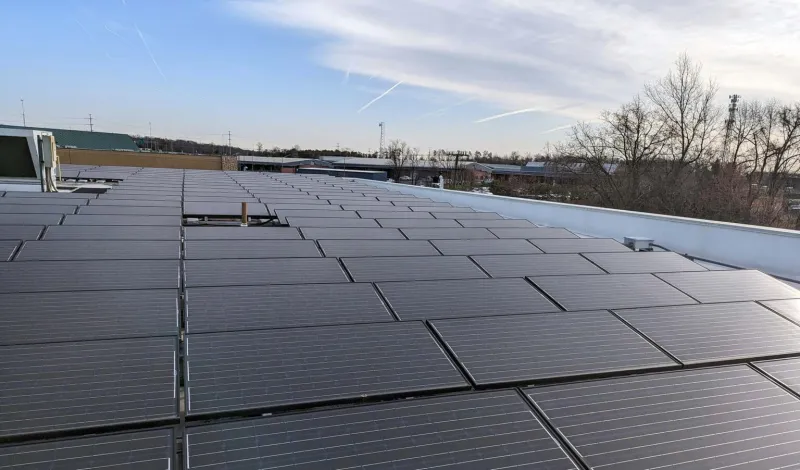
A campus presents a run of large, varied roofs across many buildings, from flat-decked lecture and library blocks to pitched older stock and plant-heavy science and engineering buildings, usually under several supply points rather than one. Because the array is planned across that whole estate rather than a single roof, the indicative scale here is large and estate-wide, typically a multi-building portfolio whose total runs well into the megawatt class once the campus is taken as a whole. Treat that as orientation only. It is not a quote and carries no price. The real figure comes from the on-site survey and the PV*SOL model of each roof against each building's load, and a campus needs that care more than most: heritage and listed buildings, dense rooftop plant on science blocks, and mixed roof ages all shape what each roof can carry before any layout is fixed.
The non-MCS engineering wrapper on a live, occupied campus
Because every array across a campus is over 50 kWp, the work sits outside MCS, which is a domestic certification scheme and not the right assurance for an estate of this scale. On an occupied university or college that engineering wrapper does real work rather than ticking a box. The whole programme runs under the Construction (Design and Management) Regulations 2015, with an appointed Principal Designer who carries the design-risk duties while students, staff and researchers keep using the buildings beneath the scaffold, and a Principal Contractor who controls the site so a live lecture block, library or hall of residence stays safe and in use through the install. That matters more here than on an empty industrial shed, because the work happens around people who never leave.
The grid side is the pacing item, and it is the part most specific to a campus. A university typically draws power through several supply points rather than one, so a G99 connection has to be agreed with Northern Powergrid, the distribution network operator across Yorkshire and the wider region, at each point that will export, and those applications run in parallel rather than as a single submission. We build the connection evidence from the same PV*SOL model that sizes the array, so the network sees a real per-building case rather than a round number. Each completed building is handed over with an IEC 62446-1 commissioning pack and an as-built record, which gives the estates and maintenance team a documented asset they can inspect, maintain and audit for its full operating life rather than a system nobody on site can account for.
Heritage and listed fabric is the other campus-specific constraint, and it is common on older institutions. Where a building is listed or sits in a conservation area, the survey and the layout work around the fabric and any planning or listed-building consents rather than assuming a clear roof, and we say early where a roof is better left alone. The in-house 3D drone survey lets us assess pitch, plant and condition on heritage stock without anyone walking an uncertain roof first, which keeps both the building and the survey team safe while the evidence is gathered.
Funding routes, procurement and the campus business case
A campus business case is rarely settled on generation alone. It has to satisfy an estates strategy, a published carbon-reduction target and a finance team working to a capital programme, and the building-level evidence from the survey and model is what carries it through all three. We model the self-consumed share roof by roof rather than quoting an estate average, because a funding bid, a board paper and a procurement evaluation all rest on numbers that hold up to scrutiny rather than a headline figure. We do not put a saving, a payback or a per-kWp price on a sector page; the way the capital case is built is set out in our is commercial solar worth it guide, and any return is modelled on your own data, not promised here.
The funding routes are particular to the sector. Universities and colleges draw on Salix-administered public-sector decarbonisation funding, and a capital-constrained estate that does not want to own the array can use a power purchase agreement, where a third party funds and owns the system and the institution buys the generation. Where part of the estate is held by a trading subsidiary or a commercial arm that pays corporation tax, the capital-allowances position is worth flagging alongside the grant route, because the tax treatment differs from the charitable or public side of the institution. We are not a funder and we do not advise on the finance, but the survey and the PV*SOL model give you the building-level evidence that a grant application or a PPA both have to be built on. Because the funding window and the grid-connection timeline rarely move at the same speed, we sequence the survey and modelling early so the evidence pack is ready when a bid window opens rather than racing it, and we phase the rollout so the strongest buildings can proceed while later supply points are still in connection.
Procurement is the other reality a campus brings that a private buyer does not. A publicly funded institution usually has to buy through a compliant route, whether that is a Crown Commercial Service or sector framework, a dynamic purchasing system or a tendered process, and social value increasingly carries weight in the award alongside price. We deliver to those rules and document the work so it stands up to an audit, and we scope the local employment, skills and supply-chain commitments early rather than bolting them on once the design is fixed.
Commercial solar for universities & colleges: common questions
A school is largely one term-time weekday load across a few roofs. A campus is an estate of mixed-use buildings, labs, libraries, data rooms, teaching blocks and halls of residence, on several meters, with a load that runs far longer and deeper. Research equipment, server rooms and lab plant keep drawing through evenings, weekends and much of the holiday calendar, so the estate self-consumes more across the year than a school does. We model each building's half-hourly load and plan the arrays as a portfolio, which is a different exercise from a single school site. Our schools and academies page covers the term-time case in its own right.
The indicative scale here is large and estate-wide, a multi-building portfolio whose total runs well into the megawatt class once the whole campus is counted. That is for orientation only rather than a quote, and carries no price. Your real figure comes from the on-site drone survey and the PV*SOL model of each roof against each building's half-hourly load, summed across the estate rather than estimated from any one roof.
On-site generation reduces the estate's grid import and the carbon behind it, which feeds directly into a reported sustainability strategy and net-zero plan. What matters for a formal KPI is honest, building-level evidence, so we model the self-consumed share for each roof rather than quote an estate average. We do not put a saving or a payback figure on a sector page. Those belong in a substantiated business case built on your own data and modelling.
We do not put a price or a per-kWp figure on a sector page, because the cost of a campus scheme is driven by roof count, roof age and condition, plant density, the number of supply points and the G99 position at each one, and those only become real after the survey. A single megawatt-class estate rollout and a phased programme that leads with two or three buildings sit at very different points. We give you a costed, designed proposal once the on-site drone survey and the PV*SOL model are done, and our is commercial solar worth it guide sets out how the capital case is built. The funding routes below sit alongside that.
There are public-sector routes a campus can use, including Salix and the wider public-sector decarbonisation funding that universities and colleges draw on, and for an estate that does not want to fund the capital itself a power purchase agreement (PPA) is an option, where a third party owns the array and the institution buys the generation. We are not a funder and we do not advise on the finance, but the survey and PV*SOL modelling give you the building-level evidence those applications and a PPA both have to be built on.
The pacing item on a campus is rarely the install, it is the grid connection. Any array over a network's threshold needs a G99 connection at each supply point, and on a multi-building estate that runs in parallel across several points, so the realistic path from survey to an energised first phase is months rather than weeks. The drone survey and PV*SOL modelling come first and feed the connection applications and any funding bid; design, procurement and a CDM-managed install across a live, occupied campus follow once the connections are agreed. We phase the rollout building by building so the strongest roofs can be energised while later points are still in connection.
See what your roof and your load would actually do.
We model your half-hourly consumption against a system sized from an on-site drone survey, so the figure you get is yours, not a from-price. No obligation, no MCS gatekeeping on systems this size.
- On-site 3D drone survey, fully insured in-house pilot
- Half-hourly load modelled in PV*SOL before anything is specified
- Engineer-led, assured to the non-MCS standard (CDM 2015)